Building Dreams in Ilan--Huang Sheng-yuan
Yang Ling-yuan / photos Chuang Kung-ju / tr. by Christopher J. Findler
December 2005


Strolling along a winding road in Ilan's Yuanshan Township, the scenery unfolds before you, no towering buildings to obstruct your view. If you drive, the lack of the level, hurried pavement found in the city will oblige you to let up on the pedal. Amid the fields stands an unassuming structure, once a garment factory, that for the past ten years has been leased by an architect. The number of people working in the building has increased to more than 25; except for two construction managers, all are young people in their 20s and 30s from 18 different localities in Taiwan. They congregate in the partition-free space within to make models, to discuss, and to hold meetings. Sometimes they open the back door and hold lectures in the freshly cut field. Over the course of time, the employees have come to refer to the office as "Center Field."
To office head Huang and the group of young people with whom he shares common ideals, Ilan is the perfect place for realizing their dreams. They have won a variety of awards for their structures, including the Green Architectural Design Award, the Far Eastern Outstanding Architectural Design Award, the Taiwan Architecture Award and the Taiwan Association of Architects Award. But winning prizes is not Huang's goal. Awards merely reflect the values and persistence that an architect should have in facing the issue of man and his environment.
At the end of 2005, the Ilan Train Station will have a new face. The first thing you see upon leaving the station will be a long tree-lined, red-tiled corridor with a high glass ceiling as opposed to the major road filled with streams of vehicles of the past. Walking down the passageway, you'll come across a large pond christened the Fish Jumping Pool. Seated next to the tables near the pond will be people sipping coffee and idly chatting away. Bordering one side of the walkway will be a bicycle path, so whether on foot or on bike, the corridor can lead you home.
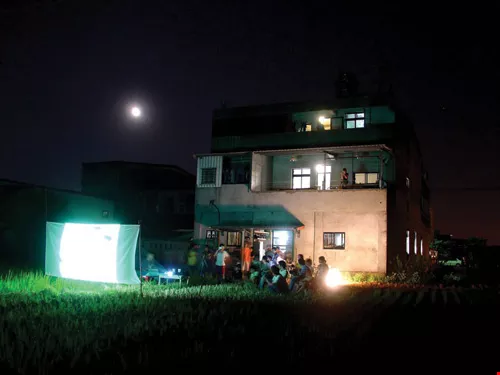
The office just about breaks out in joyous celebration whenever somebody comes to visit. Here, everybody gathers at "Center Field" at night to share their experiences and personal stories. (courtesy of Huang Sheng-yuan)
On the right side of the train station, old warehouses have been cleared out and converted into a pedestrian shopping piazza in which the vestiges of old age as well as modern wooden floors, glass enclosures, and the occasional bamboo thicket growing out of the roof have been ingeniously blended. At dusk, light from cleverly designed lamps inside the shops shines through the glass to splash against the building, blending the old and the new to create a new romantic ambience.
Standing in the warehouse and sporting a tank top, shorts, and a traditional conical bamboo hat, Huang explains how it will look after construction is finished--"This is the future site of the Tiutiu Tung Plaza. It will preserve that which makes old Ilan special, while offering something new." What looks to be a huge remodeling project is really a combination of several smaller public infrastructure projects. Huang, who makes it a point to concern himself with the latest developments in construction in Ilan, hops from his vehicle whenever he passes by a public construction site to familiarize himself with the latest progress. If he can think of any ways to further improve the project, he will put his head together with his partners and offer suggestions and put out bids to win opportunities to put their ideas into practice. The Tiutiu Tung Plaza only took shape after a few other smaller projects were integrated.
No changes are currently evident in the train station, except for a temporary park next to the parking lot across the way. It boasts some newly erected, strangely shaped towering green steel trees that could easily be taken for installation art.
"Lanyang is a rainy place. I would like to make the Ilan Train Station into the train station best suited for walks in the rain." It was this simple idea that prompted Huang to employ a virtual forest of 15-meter-high green steel myrtle trees which will eventually be capped with a glass canopy. The area around them is to be filled with real trees and the ground underneath paved with red tiles. The corridor will take travelers leaving the train station directly to the hustle and bustle of downtown just across the way.
Many years ago, Huang was already asking himself why there wasn't a walkway exclusively for the use of individuals entering and exiting the train station instead of forcing them to thread their way through bumper-to-bumper traffic. People are more important than vehicles, he felt, so he proposed adding a pedestrian corridor extending from the station. It would be inconvenient for vehicles picking up and dropping off passengers, however, and could be expected to be opposed by vehicle owners. But with the increasing number of people retiring to Ilan from other areas, attitudes have been changing, and in the end the project, as one that would benefit a wider range of people, was accepted with surprisingly little resistance.
"This is the advantage of being a local. We can afford to wait," asserts Huang. Although originally from Taipei City, he considers himself more like a local of Ilan. Infrastructure projects cannot be hurried, because any changes require constant negotiations and dialogue with all organizations involved as well as approval from the citizenry. Some projects require communication on a door-to-door basis before they can even be set into motion. Work on some projects needs to be done by installment, on-again off-again over a period of years, due to government budget restrictions. But the media, which is in the dark about such considerations and doesn't bother dropping by to investigate, criticizes them, saying that a site is "sitting idle and has become a mosquito breeding ground." Needless to say, Huang and his team feel unjustly treated.
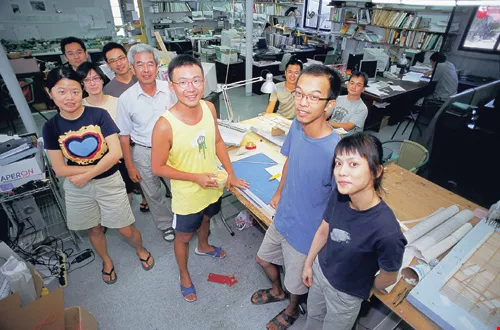
Huang's colleagues have put down everything to come and work in rustic Ilan. In return, Huang Sheng-yuan feels that the best thing that he can do is step aside and allow them to receive the applause and glory.
The list of difficulties involved with undertaking a public infrastructure project is long. Take Taiwan Railway's old warehouse for example. The Ministry of the Interior's Construction and Planning Agency originally charged the Ilan County Government with tearing it down and widening the road to 30 meters. The plan's announcement made Huang uneasy, because the old warehouse was a rare survivor. It was a historically significant link to the past. Once razed, it could not be raised again. He went into an emergency huddle with his coworkers and came up with the pedestrian pathway/business street idea.
Huang sprayed several coats of chemicals on the scarred exterior of the antique warehouse to prevent further damage from the elements. County councillors objected, saying it was "ugly." After construction was finished, it was to be handed over to the county government's Bureau of Business and Travel, which would be responsible for planning and attracting businesses. The events concourse to one side would have to sit idly until the Bureau of Cultural Affairs made plans for its use. Will Tiutiu Tung Plaza become what Huang hopes--a culture-steeped area? That is still an unknown. Despite the steady stream of frustrations, however, Huang has remained positive and hopeful. He lives here after all. He can afford to wait for the final results.
The plaza is not the biggest infrastructure project currently on Huang's plate. The swath of land stretching from the train station to the banks of the Ilan River, the earliest section of the old city, is the former site of such important buildings as the county government, the county parliament, the county magistrate's residence, and the former prison. The beauty that once characterized the old city has faded with time. The county government has been tossing around the idea of urban renewal for a few years, but involved nothing more innovative than removing important structures elsewhere and starting all over. A resident for over a decade, Huang takes part in discussions of renovation plans from the perspective of a local. With the completion of the Taipei-Ilan Expressway, the city of Ilan might find itself faced with an influx of vehicles and the train station will gradually lose its importance. He could not help but wonder what new face this old town should present to the world at that time.
His and other local teams eventually jointly came up with a proposal for an "Ilan River Bank--Old Town Living Corridor" to revive the city. The corridor employs green engineering, open-air cafes, and footpaths threading between buildings to breathe life back into Ilan's old town. Originally slated for the garbage bin of history, the town is now to be transformed into a leisure area rich in history and culture, a place where locals and visitors alike can reminisce over old memories while creating new ones.
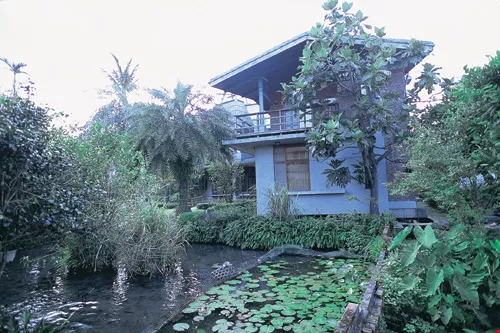
The richness of Ilan's water resources is reflected in the design of the Lin residence near Chiaohsi. Unusually for Taiwan, this home has been awarded an important architectural award. To Huang Sheng-yuan, there is no better gift for local inhabitants than architecture that blends in with the natural surroundings.
Ilan's beautiful mountains and waters have attracted many new residents. Huang is no exception. Huang did a lot of soul-searching, however, before deciding to pursue a career in architecture here.
After graduating from Tunghai University's Department of Architecture, Huang Sheng-yuan, born in the early 1960s, received a master's degree from Yale. He would later obtain a position at Eric O. Moss, a renowned architectural firm in Los Angeles, where he worked on a number of well-known projects, but he could never get used to the idea of "architecture for architecture's sake." An idea began forming in his mind, murky at first: architecture should exist as part of the landscape, not in spite of the landscape. It should not negatively impact either local residents or its surroundings. He began longing to do something for himself and for others.
He would later give up his achievements in America and return to Taiwan, opting to teach until the path before him became clearer. He taught for many years at Tamkang, Huafang, Chiao Tung, and Chung Yuan Universities, while serving on review committees evaluating public art proposals for the Ministry of Education and urban design for the Taipei City Government. He also came in contact with and studied public infrastructure projects and urban planning for the first time. His many ideas on ecology during a conference in Ilan drew the attention of then county county chief executive Yu Shyi-kun, who asked him to come and help out in Ilan. It wasn't until this time that Huang had the opportunity to take a professional interest in Ilan, which lies beyond the Central Mountain Range on Taiwan's less populated east coast.
"The Tungshan River Park was being built at the time. It wasn't big, but it had character and the people of Ilan were encouraged to take part in the project." He began to realize that the government here was different... none of the stubborn conservatism that you find in most bureaucracies. It seemed to him that he might be able to do something interesting here.
This is why he chose to stay on in Ilan, even though his parents had moved to Canada shortly after he returned to Taiwan, leaving him with no immediate family in Taiwan. It was here too that he met and married his wife Li Ching-hui, who had quit a newspaper job in Taipei to seek her cultural ideals in Ilan. The couple now have two lovely daughters.
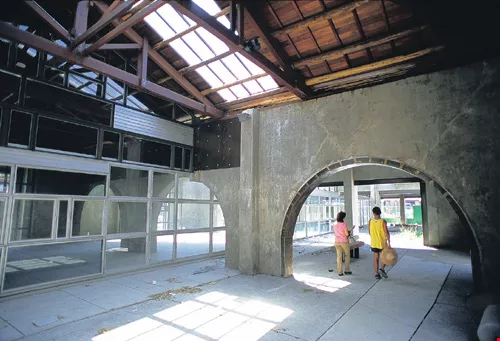
Taiwan Railway's high and spacious old warehouse in Ilan embraces a pedestrian walkway and shops, while preserving a piece of architectural history.
In 1994, Huang set up an architectural office in Ilan focusing on environmental reengineering and pushing public infrastructure projects. He felt that the banks of the Ilan River would play a vital role in changing Ilan City's destiny, because once the Taipei-Ilan Expressway opened, the uninspiring old part of the city might just be relegated to catching dust. He put all his energy into studying the riverside corridor in preparation. Over several years, the county government set about sorting out this area, and three years ago Huang was awarded some supporting projects.
It's hard to make a living when you're this idealistic and meticulous, so Huang had to depend on smaller projects to make ends meet. He discovered how difficult it is to squeeze money out of the government to reengineer the environment, but using the term "urban renewal" did the trick. Thus he began working on smaller projects, like fixing roads and laying down gutters. He loved taking these fix-'em-up jobs that nobody else wanted, because he wasn't just looking at the project before him. For the sake of future living space, he would have to do better quality work and make plans for further into the future.
The firm took on a number of these jobs which though small individually, interlocked in complex networks stretching across different neighborhoods. Although the firm was busy and now had two dozen employees, it still wasn't making any money. In the early days of the firm, Huang even had to borrow over NT$2 million to pay rent and salaries.
"During the first three years, my salary was only NT$18,000 per month. The same was true of everyone in the firm. When the loan was finally paid off, the salaries of senior employees climbed from NT$20-30,000 to NT$50-60,000 today. I could only look my employees in the eye when we received awards." Personally, Huang couldn't care less about awards. But his heart went out to his colleagues, who came from all over to work long hours with little to show for it. To them, receiving awards showed the importance of their work and helped them win understanding from their families.
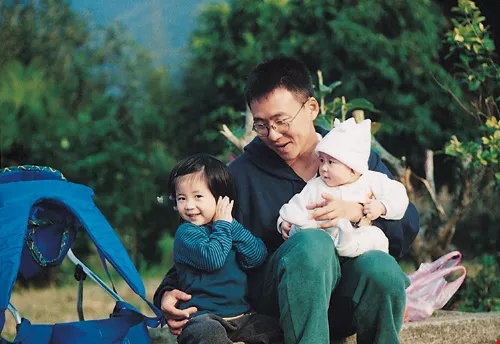
After Huang Sheng-yuan and his wife came to Ilan in pursuit of their own ideals, they both saw things happen. They now have two lovely daughters. (courtesy of Huang Sheng-yuan)
When tackling public infrastructure projects, Huang often finds himself deep in thought, thinking not about what should be done, but about what the final purpose of the project should be. For instance, when the county government wanted to convert an abandoned pig farm into Hsiti's community center, Huang felt that a community center cannot exist independently of the local culture, so he divided it up into units in imitation of a traditional residential complex. In tribute to its surroundings, he used repetition and antithesis in the exterior design. The first floor of the structure was made into a courtyard open to all and is used by local residents for leisure activities. Walking toward the back of the building from the courtyard leads you directly into the local community. You even walk along the same kind of paving bricks as you meander out to the Yang Shih-fang Memorial Garden in the back.
"We spent a lot of time convincing community residents that the government's intentions were good. In the end, we even cleaned up the buildings' exterior and put in raised flower beds free of charge," reminisces Huang. They gradually accepted the idea. In the end, even individuals that lived much further in the back asked if they, too, could get the paving stones. In addition to helping to bring the community closer together culturally, Huang built a bridge from the second floor of the community center directly to the riverside park, to link the center with the surrounding scenery. Four years ago this project won kudos in the form of the Outstanding Architectural Design Award.
"I consider architecture a window of dialogue between man, society, the environment, and the world, and I hope to achieve through it a more beautiful life for all." Caring for the environment can be a tough and lonely road and Huang doesn't want the glory all to himself. He calls on other architects to join in and to do their part in imparting Taiwan's environment with diverse creations.
"Ten years ago, some projects might not have met the demands of the times, but even if not ideal, these structures can be remodeled, perhaps even creating a unique style in the process." Huang believes that architecture extends a lifelong invitation. As long as your intentions are good and you stay the course, you'll bear good fruit regardless of when you join the race.
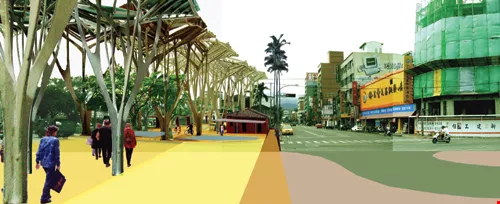
This is a representation of Ilan's future Tiutiu Tung train station plaza. This pedestrian-only corridor will link the station to the bustling streets outside, thereby ousting the stereotype that outside train stations in Taiwan there is inevitably bumper-to-bumper traffic. (courtesy of Huang Sheng-yuan)
The Lin family residence in Chiaohsi was Huang Sheng-yuan's first architectural project in Ilan. From a distance, this low-key structure hidden in the woods appears simple and unadorned, but entering the backyard, you suddenly realize that the mansion is mounted on stilts extending into a carp-filled pond below.
Inside there is a half open-air hot spring bathing room and huge windows that allow the beautiful scenery of Ilan right into the living and dining rooms--indoor decoration doesn't come any better. Climbing onto the roof lets you enjoy the splendor of the Lanyang Plain from a unique angle. Despite the modern twists, the house also has a corner dedicated to traditional methods of washing clothes and vegetables beneath the house and next to the pond. Seven years ago, this project won an award from the Taiwan Association of Architects--a rare honor for a small residential building.
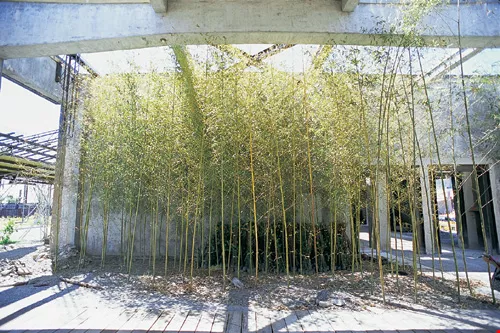
Verdant bamboo thickets adorn the converted warehouse's pedestrian shopping area--old and new overlap and blend.
Not far from the Lin residence is another unusual looking structure--encased in glass, floors jutting this way and that, a mosaic ceiling, a pond below, and a kindergarten next door. Closer inspection reveals that this complex houses Chiaohsi's household registration office, health bureau, and community study center.
Flanked by the old and new provincial highways, a one-story high drop in the middle of this once overgrown barren piece of land was once a major nuisance for both teachers and students at the adjacent township office kindergarten. After three years of construction, the first floor office area was converted into an open area for public use, redefining the relationship between public servants and the township's citizens.
"Anytime you see a bizarre looking structure like this, it's bound to be one of Huang's. The people of Ilan are used to it," explains a chuckling Wu Lung-chieh, who has worked with Huang for three years. Wu feels Huang is more a teacher than a boss. Working here, you find that there are no computerized controls on the doors, no central air conditioning, not even a time clock. All employees can contract to do construction jobs, large or small, whether or not they have experience. You just have to knuckle down and jump into the fray. But if you run into any problems, Huang is always there to help.
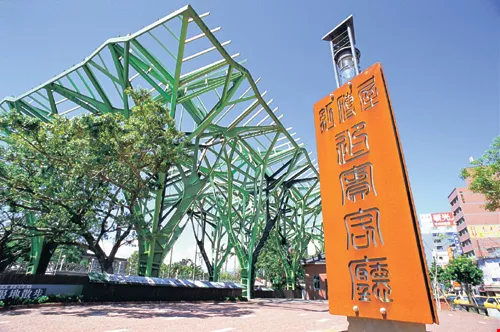
Steel girders resembling myrtle trees hide behind real trees. They will spread their branches in warm welcome to travelers.
"Huang is teacher, architect, and artist," observes Huang Chih-ju, another assistant in Huang's office. Flipping through some of the many proposals submitted by Huang for various types of construction jobs, you see none of the traditional architectural drawings showing coldly dissected buildings or logical, systematic engineering analyses. What you do see are reports written in prose--scenes, replete with people and stories, describing the site after construction is complete, dreams interweaving fact and fantasy. Furthermore, Huang insists on not using computerized 3D animation to show his ideas, preferring rather traditional handmade models in which the smallest details are brought to life. His studio is filled with many such models, each a work of art.
"His artistic idealism and perfectionism keep us on our toes." Many have been the time when workers were standing by to commence work, but at the last minute, Huang has had a sudden inspiration and changed the plans, sending everyone into a flurry of activity.
"But working here, you really do feel free. Your schedule is your own," points out Huang Chih-ju. A graduate of Chung Yuan Christian University, he originally came to work here for the summer.... That was five years ago. Just as for the other employees, the studio is his home. He works until he decides to stop. If he's tired, he gives his ragged out brain a rest by crashing on one of the futons on the second and third floors, working out in the nearby swimming pool, or biking around in the countryside.
"Huang Sheng-yuan offers more than just practical engineering experience. He imparts a broader perspective of how humans will live in the future"--Huang Chih-ju's conclusion is also the highest of praise for Huang Sheng-yuan.
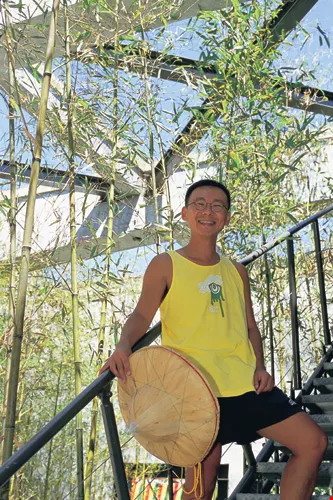
Undaunted by the odds, Huang Sheng-yuan invites architects from around Taiwan to join in and re-create their local surroundings and to apply their hearts and minds to producing diversified creations.


