U-Theatre: Purifying Minds Through Drumming
Yang Ling-yuan / photos Jimmy Lin / tr. by Tsai Nanting
June 2008


At 7:30 a.m. on the morning of March 23, deep in the mountains of Laochuan Borough in the Taipei City suburb of Mucha, the rumbling of drums pierces the forest stillness. At U-Theatre's facility, 15 performers and 30 staff members working under the leadership of artistic director Liu Ruoyu enact an offering to Heaven to initiate the first performance of the 50-day event known as "Walk Taiwan."
This is U-Theatre's third pilgrimage around the island, serving to commemorate the troupe's 20th year. "By starting out at the beginning, we will experience a rebirth," says Liu. When the troupe discussed how it should engage in its "coming of age" rite, Liu thought, "Let's just walk!" She says, "Each circuit brings about change. I'm sure we will once more experience new life."
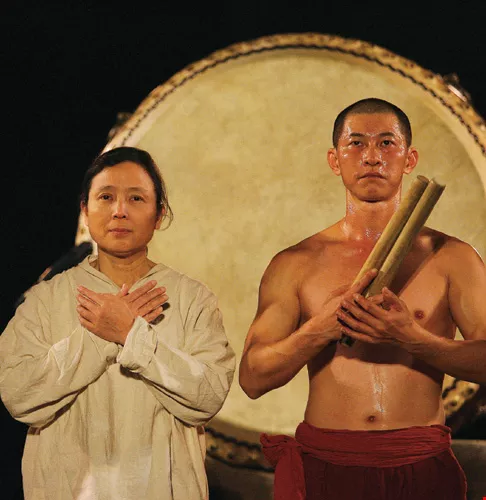
The gregarious, energetic Liu Ruoyu and the contemplative Huang Chih-chun, nine years her junior, form a partnership in which one manages the theater and the other creates. This husband and wife team form the combined forces behind U-Theatre.
Walking deeper and broader
"Walking" and "performing" have become a part of U-Theatre members' daily lives. By "wearing our hearts on the soles of our feet," members engaging in this long-term peregrination stamp their greed, anger, and obsession out into the ground. Through daily bodily pain, they seek to set their minds free and seek to return to a primal simplicity and quietude. U-Theatre finds time each year to do its walking, whether through Taroko Gorge in Hualien, through Tibet in China, or along the Seine in France. From the cities to the wilds, U-Theatre's footsteps have traversed the deepest recesses of human nature.
Walking by day throughout the 50-day journey, U-Theatre members logged 1,200 kilometers and passed through 100 townships. They visited with silently toiling individuals and community groups, including a driftwood sculptor, the Love River Association of Culture and Ecology, and the Renai Senior Citizens' Home, bringing media attention and care to cultural groups and populations in need. At night, U-Theatre put on a total of 30 performances in front of temples and in cultural centers, schools, and parks. Sometimes they were even joined by local cultural groups. In this way, U-Theatre's world has been greatly expanded.
At the beginning of Walk Taiwan, U-Theatre members carried flags and formed a long line. Accompanied by the strains of gongs, they began to step down the mountain. Even in the rain, many U-Theatre fans came to walk with them, expressing their support as the troupe marked its 20th year. The procession started out from the theater on Mt. Laochuan, passing by the Linguang MRT station, the Tunhua Eslite bookstore, and arriving that evening at the open-air theater at Da-an Forest Park. To kick off first performance of Walk Taiwan, U-Theatre put on Walking Towards Love to raise funds for the Renai Senior Citizens' Home in Nantou.
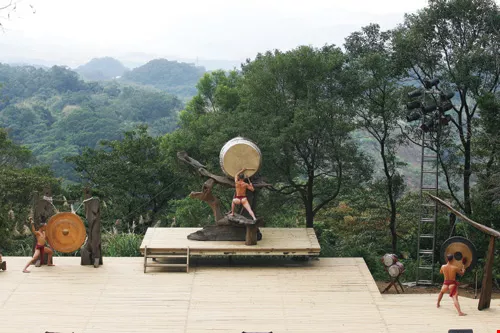
The open-air stage on Mt. Laochuan in the Mucha area of Taipei is a precious place where U-Theatre members can shout to heaven and find a source of inspiration. Thrice renovated, it was recently named a significant cultural site of Taipei.
The Sound of Ocean
On the 28th night, at the Weiwuying Metropolitan Park in Fengshan, Kaohsiung, U-Theatre set up a temporary stage by a century-old banyan tree in a clearing next to former military buildings. One hour before the performance, the crowd continued to grow, spilling out from the stage area. As the shadows of the audience members flickered in the light of dusk, the atmosphere became charged with anticipation.
Ear-splitting drums suddenly quelled the crowd's agitation. The majestic sounds emanated from the combined forces of small and medium sized drums and paigu (tuned sets of drums), clappers, and gongs. The opening piece, "Mountain Rumbling," depicted rocks rent by the power of nature, causing deep waters to spout upwards to form fresh springs.
Lingering tones of the guqin (Chinese seven-stringed zither) then arose, accompanied by the sounds of streams, bringing the audience into the world of "Flowing Water." Small and medium drums conveyed order amidst chaos, then transformed into the sounds of falling rain, dripping water, and splashes. Slowly, the hearts of audience members were being softened.
Thereafter, "The Sound of Ocean" and "Crashing Cliffs" featured large drums, "wind" gongs (suspended gongs) and "cloud" gongs (a set of tuned gongs suspended in vertical frame) supplying the main melody to the accompaniment of medium and paigu drums, "wooden fish" (a percussion instrument made from a hollow wooden block), and Sanskrit-like chanting, all working to express the sound of crashing waves. Not only did the sounds of drums and gongs rouse the audience, U-Theatre also utilized its distinctive leaping and dancing techniques to express the power and beauty of water upon the cliffs. The audience was deeply struck.
The performance ended with the stirring sounds of the large drums and giant gongs imitating the roar of the sea in "Sound of the Waves," accompanied by the brilliant sounds of chimes and Sanskrit chanting. The audience was able to experience warmth and stability amidst the rushing rhythms, finding an experience of peace of body and mind.
This performance, the most important of the entire Walk Taiwan event, harked back a decade to U-Theatre's first major international performance at the Avignon Festival, where The Sound of Ocean was performed in its entirety.
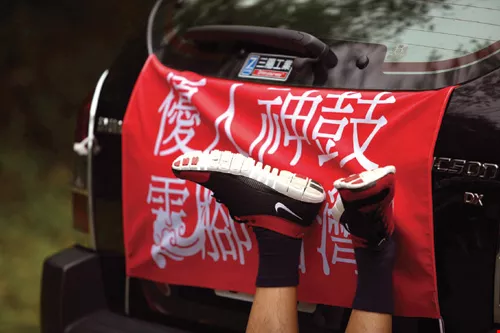
Treading through Taiwan by day and performing in little parks, by ponds, and by ancient city gates by night, one finds that despite the rustic simplicity of the stages in these places, the audience's responses are all the more heartfelt and enthusiastic.(photo above courtesy of U-Theatre)
A decade come and gone
At that time, the festival organizers thoughtfully arranged for U-Theatre to perform in a stone quarry, with a stage set up in front of a sheer rock face. Under the cool moonglow, the stones seemed to emit a divine aura and a Zen-like feel. U-Theatre's drums and gongs were amplified by the resonant rocks, deeply stirring the audience. At the end of the performance, the festival's artistic director Bernard Faivre d'Arcier even climbed on to the stage to convey his congratulations to the troupe.
U-Theatre's program was named "Most Outstanding" at the festival by the French media. The troupe began to attract international attention, appearing at the Millenium Festival in Santiago de Compostela, Spain; at the Oriente Occidente festival in Rovereto, Italy, at the Biennale de la Danse in Lyon, France, at the Theatre Vidy in Lausanne, Switzerland; at the Hippodrome in Douai, France; at the Hong Kong Cultural Centre; and at the Octobre en Normandie festival in Rouen, France. These experiences allowed U-Theatre to gain a solid footing in developing its performance style.
Ten years later, The Sound of Ocean again made its appearance in slightly revised form at the Weiwuying Park. Even though the backdrop lacked the Zen-like aura of the original stone quarry, the lush canopy of banyans here provided a different spirit of liveliness and harmony. Through this expansive, unadorned performance stage, the audience was able to experience an awe-inspiring resonance with the universe.
Walking among the people
Walk Taiwan began 12 years ago. U-Theatre wanted to get out into the countryside and bring the numinous sounds of their drums from the urban to the rural areas. By day, they would train their minds and bodies through walking, learning how to let go of their preconceived notions. By night, the troupe would offer themselves up in their performances. Members who were familiar with temple culture contacted a string of temples along the west coast. With NT$15 million grant money from the Council for Cultural Affairs, U-Theatre not only had places to perform in and rest in at night, but also the chance to rouse artistic appreciation wherever they traveled.
Once, in Chiaotou Township in Kaohsiung County, a local math teacher who was a U-Theatre fan heard that they were coming to town. He raised funds locally and offered up a rousing welcome. When the troupe arrived in town, the proprietor of a local soybean milk eatery offered them all a complimentary breakfast. When news of their arrival spread through the township, residents brought their best home-cooked dishes. It was as if they were celebrating a wedding banquet. At the evening performance the audience was filled with many folks seeing U-Theatre for the first time. Says Liu, "In those days we were still unknown, so we were deeply moved by the wholehearted welcome we received from the villagers."
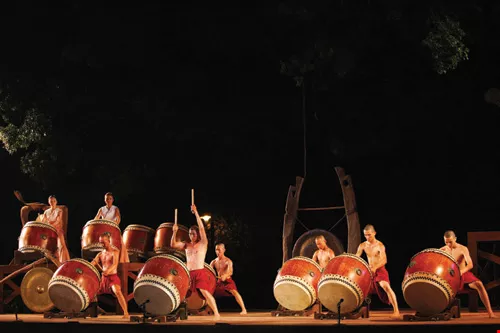
U-Theatre performing at The Sound of Ocean at Weiwuying Park in Kaohsiung, the climax of this year's Walk Taiwan activities. The unworked racks housing gongs and drums are from driftwood gathered at the Hualien coast by the Aboriginal artist Gi Lahatze. The driftwood blends together with its environment, highlighting the primal naturalness of the performers.
From theater to life
Twenty years ago, during the formative years of Taiwanese independent theater, U-Theatre was born. While at the Lanling Theatre Workshop, founder Liu Ruoyu (previously Liu Ching-min) had been a well-established actress, with her role as Ho Chu in Ho Chu's New Match having won her widespread recognition. She caught the attention of the great Polish theater director Jerzy Grotowski, who transformed her outlook on performance during a year of training in California. After returning to Taiwan, Liu resolved to follow her mentor in moving "from the theater to life," forming a troupe dedicated to opening up body and mind through performance-U-Theatre.
Grotowski had been the founder of Poor Theatre. To him, theater should provide a naked encounter between performers and audience members. All other elements, even lighting, costume, and props, could essentially be done without. To magnify the performers' energy, Grotowski developed a training regimen of expressions, gestures, vocalizations, and postures. Performance became an endless artistic challenge.
"While I was training in the States, my teacher kept reminding us, 'Be awake,' and 'Find yourself,'" says Liu. "At that time, I was not acquainted with Zen meditation; I just thought that his methods were very unique." After Liu began meditating, she discovered that her teacher had used performance training to outwardly express that which was contained deep within the recesses of her mind. Through such wendings, a performer could arrive at a thorough self-understanding. This was similar to the effect of Zen meditation. Meditation thus became an essential element in the U-Theatre training regimen.
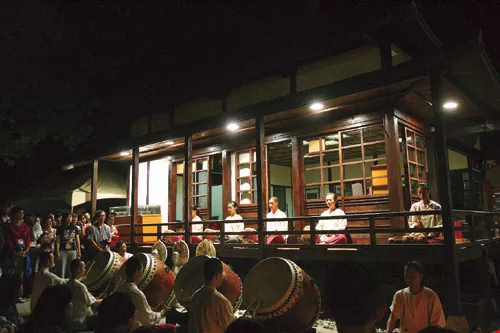
Treading through Taiwan by day and performing in little parks, by ponds, and by ancient city gates by night, one finds that despite the rustic simplicity of the stages in these places, the audience's responses are all the more heartfelt and enthusiastic.(photo above courtesy of U-Theatre)
From the West back to the native land
Still in an exploratory mode, U-Theatre's second play, Retrial of Wei Jingsheng, came after its first, Faust: A Subterranean Journal. The second half of Retrial featured an open dialogue on cross-strait relations. Unexpectedly, it sparked an adverse reaction from the audience. Reviewers either loved it or hated it.
From this experience, Liu learned that Taiwan's independent theater groups, which mostly perform stage plays, have largely remained the products of the West's alternative cultures. They have not moved into Taiwanese culture itself. She thus decided to get back to the roots, studying popular rites and folk arts, including chegu performances (dancing and singing with a small drum at the waist), stilt walking, beiguan music, and the "Eight Generals" processions. Subsequent U-Theatre performances would take their inspiration from classical Chinese tales, adding in contemporary Taiwanese perspectives. Touring the cities and towns of Taiwan, U-Theatre sought to open up a dialogue with local audiences.
Five years after U-Theatre was founded, the troupe began to emphasize the elevation of its members' "quality of life." Liu invited Huang Chih-chun to join the group; he had just returned from studying meditation in India, and became U-Theatre's drumming master.
Huang was born in Malaysia. He began studying drumming at age six and martial arts at age ten. Huang required troupe members to first learn how to meditate and contemplate the self, and only then move on to the study of drumming and martial arts. "After training in this way, whenever the performers were on stage, the audience could feel an explosive power emerging from beneath a surface stillness," he says. Liu saw how Huang's regimen was effecting a qualitative change on the troupe. The Chinese name of the theatre was thus changed to youren juchang ("the theatre of excellent performers").
In order that troupe members truly focus on opening up and developing themselves, U-Theatre moved away from the noisy urban corner they had occupied in Taipei City, to a remote hideaway on Mt. Laochuan in Mucha. U-Theatre's members came from all over, joining with an attitude of entering into the mountains to engage in cultivation. The training schedule includes tai chi at 6 a.m., meditation at 8 a.m., hiking and drumming in the afternoon, and rehearsing at dusk. In addition, members also engage in gardening. Whether eating, drinking, or training, troupe members constantly adhere to a given set of precepts and program of spiritual cultivation.
"Our main purpose in studying drumming is to cultivate ourselves. Its effect on our performative self-expression is secondary," says company manager Ken Kuo. U-Theatre seeks innovation and self-expression in its performances. The troupe's chosen instruments comprise a wide-ranging combination, including drums, gongs, huqin (Chinese two-stringed fiddle), and flute, as well as Western instruments such as the piano and cello. However, in the end nothing can replicate the stirring sounds of drums. Paired with dance and music in one performance after another, the drums have gradually come to occupy a unique place of their own, and have earned the members of U-Theatre the nickname of "drummers out of the stillness."
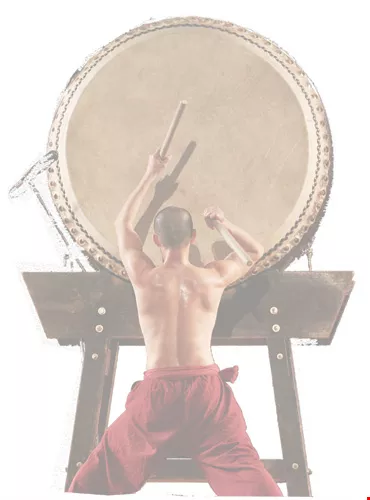
Performing Vajrasattva
Rumbling drumbeats open up Meeting with Vajrasattva. In the darkness, three-headed dancers suddenly appear in the light, startling the audience. The dancers move wildly to the rhythm of the drums, which comes crashing in giant waves. They wield long staves to express the courage and martial prowess of Vajrasattva.
In the next section of the performance, "Searching for Snakes in the Grass," 14 drummers and six singers use magnificent chanting fused with the strains of drums and strings to express how Vajrasattva, originally bursting with spirit, loses his way in the face of his inner demons. In "Roar of the Crouching Lion," solemn chanting signifies sagely guidance as Vajrasattva returns to the right path of self-cultivation. Warriors display amazing skills in drumming and dancing, each wielding two staves to pound on large upright drums situated behind them, as well as on a row of medium and paigu drums in front. The magnificent drumming is as weighty as the cliffs and peaks, and now expresses not an iota of weakness or doubt.
The final two sections of the performances, "Sword-Mind" and "Vajra Mind" feature five warriors holding staves representing wisdom. They beat on side drums, enacting the process of "shouting the mind awake." At the conclusion, the performers enact a sacred dance of Gurjieff, the Russian spiritual leader and originator of the "Fourth Way." The performers circulate precisely within complex geometrical patterns, allowing their inner stillness to flow outwards to the audience, thus bringing to fulfillment the warrior's lifelong quest for vajrasatta, or the "adamantine mind."
Meeting with Vajrasatta made its debut six years ago, and takes its inspiration from the "bodhisattva of the adamantine mind" in Tibetan Buddhism, whose story may be summarized in the following verses: "One staff is like the sword of the Vajra king, another is like the search for a snake in the grass, another is like the roar of a crouching lion, and another is a staff that is not used as a staff." These verses depict the warrior's dramatic journey of self-cultivation.
This performance, richly utilizing theater, drumming, martial arts, dance, and music is the result of three years of hard work. The piece is filled with Buddhist concepts, whose form of expression is akin to that of a popular sacrificial rite. The work has been hailed by audiences as an epitome of U-Theatre drumming. In 2002, it won first prize in the first Taihsin Art Awards competition.
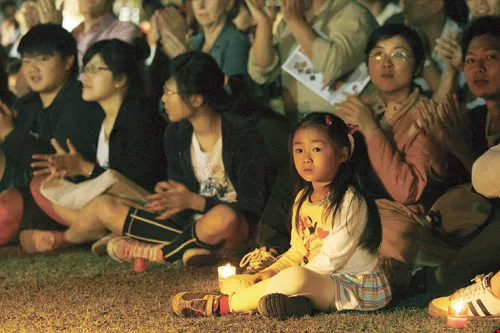
Treading through Taiwan by day and performing in little parks, by ponds, and by ancient city gates by night, one finds that despite the rustic simplicity of the stages in these places, the audience's responses are all the more heartfelt and enthusiastic.(photo above courtesy of U-Theatre)
Fusing Dao and art, movement and stillness
Every time U-Theatre goes on a "Walk Taiwan" pilgrimage, it always seeks to recruit new members from its audiences.
Says Ken Kuo, "Even though some troupe members have over a decade's worth of experience with us, it is indeed difficult to train a new performer." U-Theatre performers must master not only dance and martial arts, but must also have strong physical expressiveness, responsiveness, and a sense of rhythm. More importantly, those who are willing to submit to U-Theatre's strict regimen of physical and mental training must live up to the ideal of "fusing Dao and art."
In light of the difficulty of training a new generation of troupe members, Liu and Huang have not only established a system for cultivating "young U-Theatre performers," but have also begun to work with Taipei's Jingwen High School on a course in performance arts.
In order to propagate U-Theatre's artistic ideals as well as give back to society, the troupe has emulated the practices of the Shaolin Monastery. There, the monk Sande established the "36th Chamber of Shaolin" to pass on the martial arts of the monastery to local villagers. In the same way, U-Theatre has founded "Performing Arts School 36" to train the public in bodily and performance techniques. U-Theatre has also designed classes so that community residents can experience its training regimen.
To U-Theatre, "performance" is but one of life's dimensions. What is most important in life is to cultivate oneself. In order to hold on to both their cultivation and their performance art, U-Theatre members have left behind their former occupations and courses of study, dwelling in the mountains to focus on their training. This is a rare phenomenon in Taiwan's artistic world. To meet their monthly expenses, which total NT$1.5 million in salaries and management expenses, U-Theatre is constantly booked for performances and projects. However, work and cultivation, the noise of performance and the stillness of the mountains are always alternating with each other. This is the spirit of U-Theatre: "Movement in stillness; stillness in movement."
U-Theatre founder Liu says, "We have embarked on a long, long journey. But it is the value of life itself that keeps us going on this arduous process of training." Step by step, she leads U-Theatre towards a purer path of cultivation, and towards a more moving art.
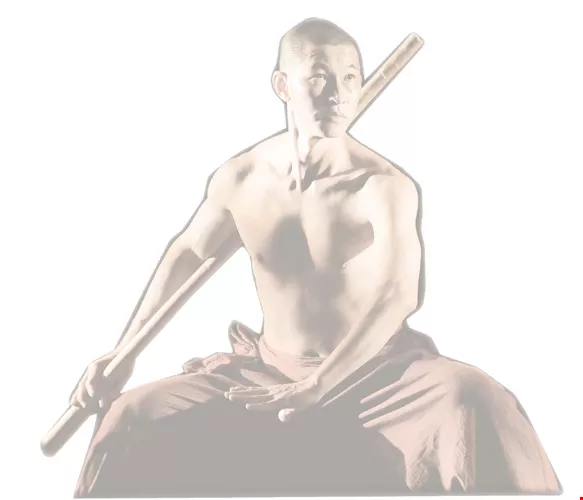
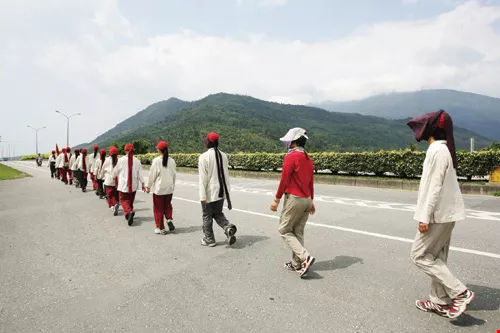
Treading through Taiwan by day and performing in little parks, by ponds, and by ancient city gates by night, one finds that despite the rustic simplicity of the stages in these places, the audience's responses are all the more heartfelt and enthusiastic.(photo above courtesy of U-Theatre)
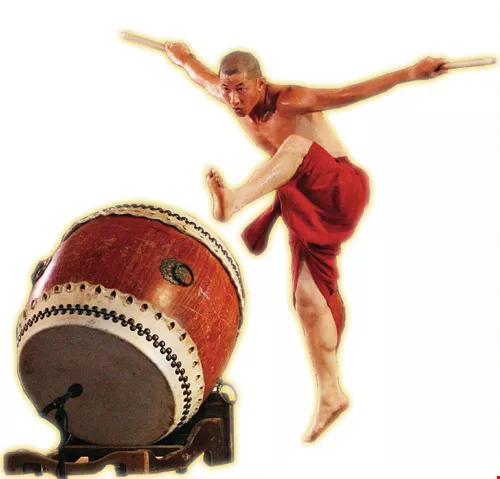
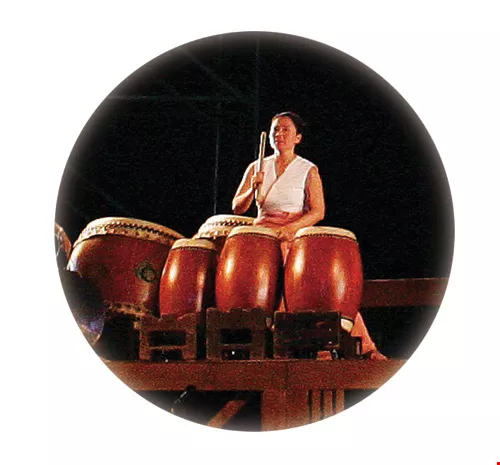
"Drumming out of one's silence" is the ideal to which U-Theatre performers aspire. Through training their bodies and minds, they seek their hidden potential. Through drumming, the audience also partakes of the power of their purification. Pictured is master drummer Huang Chih-chun.

@List.jpg?w=522&h=410&mode=crop&format=webp&quality=80)

@List.jpg?w=522&h=410&mode=crop&format=webp&quality=80)


