Collecting Bygone Sounds:Lin Pen-po's Gramophones
Kuo Li-chuan / photos Chi Kuo-chang / tr. by Julius Tsai
November 2004


The phonographic stylus touches down lightly on the surface of the shellac record and begins to travel its grooves. Through the crackling and hissing comes, distant-seeming yet clearly discernable, the strains of the song "The Peach Blossom's Tears of Blood." This song was recorded in 1932 by Chun-chun, an artist from the first generation of Taiwanese pop stars, and relates that generation's stories of joy and sorrow. Lin Pen-po closes his eyes, intently listening to the melodies emanating from the gramophone. At this moment, he has left behind all of the ups and downs of his job managing academic affairs at a Taipei school. All of his anxieties melt away as he listens to the voices singing songs from a bygone era.
Kai-Nan Commercial and Technical High School can be found amidst the heat and bustle of urban Taipei. From the outside, there is nothing to set it apart from any number of other schools. However, when one walks up into the "Gramophone Cultural Exhibition Center" on the second floor, one encounters there the many-faceted loveliness of gramophones from different eras and countries, their horns set off at different angles to display them at their most beautiful. Lin, who is director of academic affairs at the school, loves nothing better than to linger amidst this display of gramophones that he has donated. Whenever he is tired, he comes up here and plays an old melody. When inspiration strikes, he polishes the gramophones. Each has its own story about how it was acquired by Lin. In turn, the story of Lin's passion for collecting begins in a Puyuma village....
Lin Pen-po was born in Taipei in 1950. When he was two, his family moved to Taitung, a fairly remote area at the time. Lin's parents rented a thatched hut in a Puyuma village on a plot behind National Taitung Girls' Senior High School. He grew up among Puyuma playmates, following the village chief up into the mountains on hunting expeditions, all the while developing wilderness survival skills. The village elders even made him a gift of a hunting rifle.
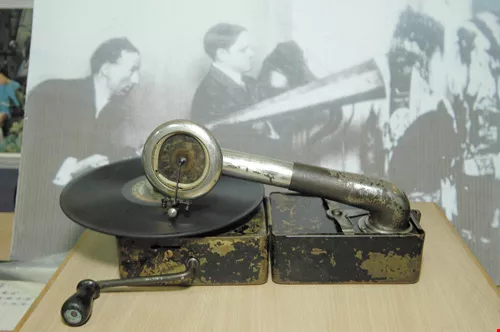
This early 1930's miniature gramophone from Britain fits in one's palm, and was the "Walkman" of its day.
Although making a living in Taitung was not easy and the family lived in straitened circumstances, Lin's parents insisted that their children receive an education. When the school year started and the family was unable to pay the tuition fees, Lin's mother went directly to the county magistrate for assistance so that her children's schooling would not be disrupted. Lin still remembers that when he was in the seventh grade, tuition fees were NT$200. Because his mother was unable to come up with the very substantial amount needed to pay tuition for him and his four elder brothers, she sent the children to school with NT$50 each, instructing them to discuss with their teachers the possibility of making an initial, partial tuition payment. The young Lin Pen-po felt so ashamed at not having the full amount that he lingered outside the school, not daring to enter. Finally, he became so anxious that he began to cry.
His homeroom teacher at the time, Ting She-wu, saw him there. When Ting learned of the child's plight, he took out his own wallet and paid the difference so that Lin was able to successfully register for school. "Even though my teacher has passed away, I still travel to Taitung each year to sweep his grave to show my grateful remembrance for all that he did for me," says Lin. Lin was inspired by his teacher's magnanimity, and as a teacher himself, is especially sensitive to the needs of students from poorer backgrounds. He has even petitioned his school to institute an installment payment plan for students.
At that time, a military reserve camp stood across the street from National Taitung Senior High School. Lin, who had no shoes of his own to wear, asked the soldiers stationed there if they would throw out any worn out or unwanted shoes onto a grassy area outside of the compound's walls. When Lin got off from school, he would scrutinize that grassy patch. When he spied thrown-out shoes from a distance, he would rush over and pick them up. "Sometimes I would collect shoes that had only the left foot still in wearable condition, while other times the sizes of the two feet of the shoes would be widely divergent. But I always had shoes to wear," says Lin. Lin produces a class picture from his middle school days. In the picture, he is wearing two left shoes.
The first time Lin heard a gramophone was in 1967. In those days, more affluent families would dig a well in front of the entrances to their homes. This made fetching water more convenient for them, and it was a convenience that they would also share with their neighbors. Lin, who was a freshman in high school at the time, would often go to the Old Well in the Puyuma village (now Chiangkuo Street) to fetch water. Once he saw the owner of the well, a Puyuma elder, in the act of winding up his gramophone. When he laid the stylus onto the black disc, the scratchy sounds of an old Japanese melody emerged. Lin was amazed and intrigued. Since Lin had grown up in a Puyuma village, he quickly became acquainted with the children of the gramophone's owner and succeeded in "borrowing" the gramophone. 37 years later, it still sits in Lin's home.
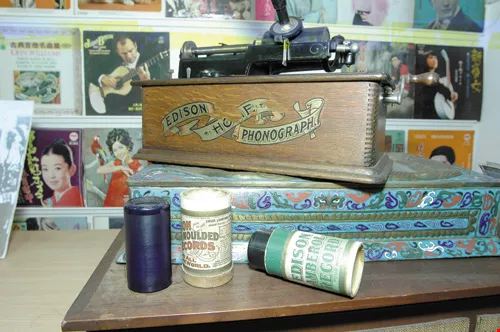
The Edison phonograph of the late 19th century, which used wax cylinders (shown in foreground), can be considered the ancestor of the modern gramophone.
Following his graduation from high school, Lin moved with his family back to Sanhsia Township in Taipei County, bringing the gramophone along with his old and no longer functional hunting rifle. He took the university entrance exams and enrolled in the history department at National Cheng Kung University.
After finishing university and his military service, Lin worked in sales at a steel company. After work, he would ride his motorcycle around to antique shops and secondhand stores. The old-style Japanese dormitories that used to occupy Chienkuo North and South Roads were in the process of being torn down in those years, between 1976 and 1978. Once, when Lin was passing through the area, he saw someone in one of the secondhand stores bringing down a sledgehammer on an old gramophone in order to salvage scrap metal from it. Lin hurriedly went over to put a halt to this and, paying NT$50, purchased his first cabinet model gramophone.
Perhaps due to his historical studies, Lin has always held deep feelings for antique objects. Since childhood, he has loved seeking for treasures amidst the junk heap. Lin feels that every antique is like a sojourner in time, a track in the sands of time. Even though time cannot be turned back, one can in effect relive the past through preserving antiques and appreciating the ingenious creations of one's forbears, experiencing the feelings that come with a remembrance of the past and the cherishing of such objects. "Among all antiques, the gramophone is the only object that can play back sounds. Through playing records, a person can truly experience the social ambient, ways of thinking and popular customs of each period," says Lin.
Because of that chance occurrence, Lin began to take special notice of shops selling gramophones. Antique shops in Taipei those days were concentrated along Pate Road, Antung Street, Chunghsiao East Road, and a section of Aikuo East Road. Lin could be found in all of these places, and on and off from 1977 to 1981, he collected almost 40 gramophones.
At that time, a well-preserved portable gramophone cost NT$500 to NT$1,000, no small amount for Lin. To pay the family's bills, Lin took on a number of other secondary jobs. He served as a tutor and traded antiques streetside. When he had accumulated some savings, he bought a secondhand taxicab to serve as his own transportation and also moonlighted as a cabbie. Even though he was busy all day making a living, Lin never lost his love for gramophones. "At the end of a hard day's work, I would come home and sit there listening to the stirring music coming from my gramophones. All of my cares would simply fall away," he remembers.
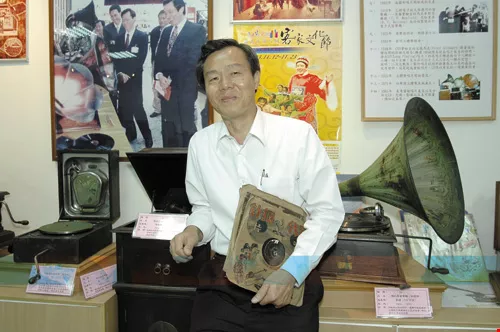
Since sharing music is better than listening alone, Lin Pen-po has established a Gramophone Cultural Exhibition Center at his school to give students that chance to hear beautiful melodies from the past.
Lin entered the educational field in 1981 and later began teaching at Kai-Nan Commercial and Technical High School. In February 1994, students from the school entered the Asian Youth Judo Championship, held in New Delhi. Lin traveled with the team as its manager and translator. Lin reveals that his special affinity with India stems from his first year in university, when an Indian businessman aiming to set up an office in Taiwan came to stay at the Eastern Hotel, where Lin's eldest brother worked. With a recommendation from his brother, Lin entered that newly formed company. Later, when his gramophone collecting would take him to India, he would find that his training at that job had prepared him to communicate there without any obstacles.
Quite by coincidence, Lin was feeling unwell when he arrived with the team in New Delhi, and rushed out to look for medicine. The pharmacy that he visited happened to be situated on a bustling street. In the shop next door was displayed a horned gramophone. Lin decided to purchase it on the spot; it was the first gramophone of the kind that he owned. He then made the most of this opportunity by going around to the different shops on the street, chatting and exchanging business cards with their proprietors.
After returning to Taiwan and enjoying this lily-horned gramophone that he had brought back from far-off India, Lin could not resist calling up shops in India to ask for their assistance in locating more gramophones. In this manner, Lin traveled to India a total of six times, purchasing over 40 gramophones. In the course of his collecting, one of these machines, a miniature gramophone from the 30s, prompted him to make three trips there.
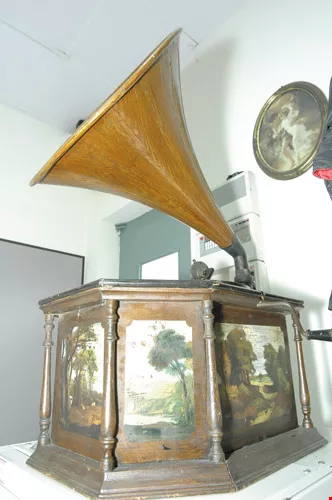
This Swiss-made gramophone from between 1925 and 1935 is like a work of art, allowing one to not only enjoy the experience of listening to music but also the pleasure of viewing an oil painting.
Gramophones first gained popularity around 1893, when records began to be mass-produced. Gramophones then were simple devices, consisting of a turntable, phonographic stylus, resonator and horn. They were quite ungainly in their appearance. In 1904, the Asahi Record Company created a lily-shaped horn in an effort to enhance the gramophone's visual appeal and the overall listening experience. This design proved immensely popular, and gramophones began to increase in elaborateness and in size. Not only were they made with the finest woods, they were also adorned with all manner of painted designs.
Another type of gramophone, a British-made portable model, was taken to the battlefield in World War I. Soldiers were now able to enjoy music in their spare moments. These miniature gramophones, which one might call "wartime Walkmans," boasted stacked internal components that represented the state of the art in space-saving design.
Lin caught sight of the battered case and metal casing of just such a portable gramophone while in India in 1994. He wanted to purchase it, but its owner would not part with the machine. In 1995, Lin loaned 50 gramophones to the Historical Research Commission of Taiwan's "Music and Cultural Exhibit Commemorating the Fiftieth Anniversary of the Restoration of Taiwan." In 1996, he went back to the owner of the miniature gramophone in India, demonstrating with a newspaper clipping of the 1995 exhibit that he was a real collector and not simply out to make a quick profit. With this, the owner finally relented and parted with his beloved gramophone.
In 1998, while in India, Lin discovered a 1921 British-made large-horned two-track stereophonic gramophone. This machine utilized one phonographic needle to feed two separate acoustic pickups featuring diaphragms of different thickness to produce high and low notes. This was one of the earliest two-track stereo systems. When Lin saw his, he told the Indian merchant who was helping him search for gramophones, "I must bring this back to Taiwan with me!" Though the price was over his budget, he was extremely excited. The shopkeeper, mystified, asked him why he had come from so far to collect gramophones? Lin answered, "Gramophones have become an indispensable part of my life."
Most of the gramophones he collected in India had flower-shaped horns and were made of aluminum, steel, tin or wood. Because the gramophones took up lots of space and were easily crushed, Lin was forced to check them in at the airport but take their horns with him as carry-on luggage. He could often be seen in those years holding several horns as he passed though the checkpoints at the international airport in India.
"Due to their weight, the cost for shipping these horns could reach NT$100,000 or NT$200,000. When I first started to return to Taiwan with gramophones purchased abroad, customs officials would even classify them as 'stereos' and levy customs duties on them," says Lin. Aside from traveling in India, Lin also brought back additions to his collection from England, America, and Japan.
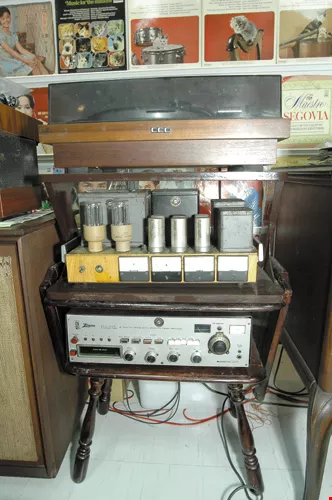
This vacuum-tube amplifier and turntable from the 1960s can only play 33 and 45 rpm records.
Besides gramophones, Lin also collects phonograph cylinders, gramophone records, styluses, and tools needed for restoration work. Among the thousands of items in his collection is a cylinder used by Edison when he invented the phonograph, as well as a seven-millimeter-thick turntable the inventor designed to compete in the marketplace. Lin also has records of Taiwanese folk ballads from the era of Japanese occupation, Taiwanese Opera, old Japanese songs, 1930s pop songs from Shanghai and America, Indian songs, and all manner of post-war Taiwanese songs. Some of these were included with gramophones he purchased, and others were given by fellow aficionados during charity exhibitions they put on together, but most were bought at antique shops or flea markets.
Records play at 16, 45, 78, or the more stable and euphonious 33 revolutions per minute; they might measure three, five, seven, 10 or 12 inches in diameter. Early phonograph cylinders were even more interesting, since only one cylinder could be produced per recording session. Thus, if one wanted to make ten cylinders of a voice recording, the artist would have to sing the desired piece ten times over. Since each cylinder could contain only two minutes of music, longer pieces would have to be recorded on multiple cylinders. Furthermore, each recorded cylinder could only be listened to five or six times before wearing out. For all these reasons, phonograph cylinders were not cheap.
Lin holds up a 1938 recording of the Taiwanese folk song "Loving the Year Round," issued by Nitto Records, and explains, "Records during the Japanese occupation were 78-rpm records made of shellac. Shellac is collected from the excretions of a Southeast Asian insect, the lac beetle. Shellac records wear out with repeated play, so they need to be frequently cleaned."
Styluses also form a treasured part of Lin's collection. He explains that they can be made from diamond, ceramic, metal or bamboo. Bamboo styluses were used towards the end of World War II when other materials were scarce. Though less durable, they tend to scratch the records less. Lin's styluses are encased in exquisite metal boxes, demonstrating once more that buying gramophones and listening to records were activities restricted to those with money and leisure.
Perusing a 1935 Japanese price list for gramophones and records, it is not difficult to discover that these were considered luxury goods during the era of Japanese occupation. At that time, a teacher made ¥20-30 (Japanese yen) a month, while a high-level civil servant such as a prefectural magistrate made ¥60-80 a month. A single record sold for ¥1.65, and a top-of-the-line electric gramophone could command a price of up to ¥600. Even the cheapest portable gramophone put out by Columbia cost ¥28, almost an entire month's salary for a teacher. Very few people could afford this hobby, so it was not unusual to see a group of three or five friends collectively purchasing a gramophone and then taking turns using it.
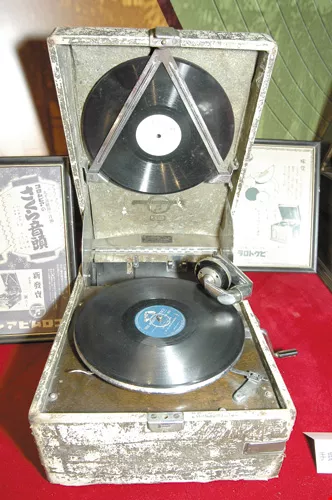
This Japanese-made Columbia gramophone from 1936, the first in Lin Pen-po's collection, is a portable model that can also hold five records. Its stylus produces a graceful sound.
Out of a desire to share his passion with the public, Lin has actively lent out gramophones from his collection to cultural exhibitions put on by a variety of organizations and schools. In October 2002, with the support of Hsu Shu-ching, the principal of Kai-Nan Commercial and Technical High School, Lin established the Gramophone Cultural Exhibition Center at the school. Not only did he donate over 50 of his gramophones to serve as the basis of the center's permanent collection, he has also used his free time outside of class to offer courses such as "Nostalgia for Songs from the Past" and "The Golden Age of Taiwanese Records." Such courses have been enthusiastically received by students at both Kai-Nan and at Chungcheng Community College.
"By listening to music from different eras on the gramophone, people's memories can be stirred up, and they can recall all kinds of good things about those former times. This in turn rekindles a passion for life. To me, this is what 'nostalgia' is really all about," says Lin.
With his former experiences in buying and selling antiques streetside, Lin has become adept at taking gramophones apart and coming to understand their inner workings. He can transform a discarded object into a thing of wonder. One such object is a gramophone made in the shape of a grand piano. Lin transformed it into a unique work of art by utilizing components for a horn brought back from an American ghost town, restoring its woodwork, painting it, and refurbishing the case. On another occasion, Lin picked up a tin horn off the rack at a Tahan River junkyard, and deftly crafted it into a gramophone like none other.
Over a dozen gramophones can be found in Lin's bedroom, with all of their horns pointing at him. Even without the gramophones emitting a sound, the whole room seems to be filled with wondrous music. Once, while cleaning a shellac record, he accidentally dropped it and it shattered. Lin felt so sad about this that he shed tears.
In 30-some years of collecting, with over 200 gramophones in his collection, Lin's mottos are "passion" and "sparing no effort or expense." His greatest aspiration is that one day the collection of gramophones that he has so painstakingly assembled will have a permanent home in a museum. If the national government were willing to establish a gramophone museum, Lin has indicated his willingness to donate the entirety of his treasured collection. This would allow his gramophones, the only antiques that can play back sounds, to become part of the people's heritage as well.
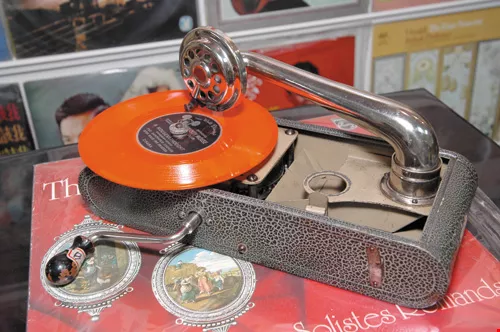
This Swiss-made miniature gramophone made between 1920 and 1930 is exquisitely designed.
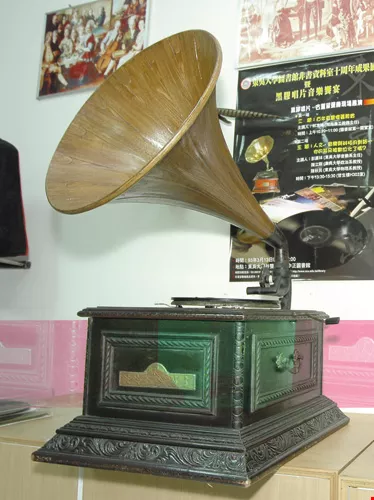
A record and a gramophone can capture stories from the past, allowing the listener to linger there. Pictured is a British gramophone from the beginning of the 1930's, distinguished by its wooden horn and its carved exterior.
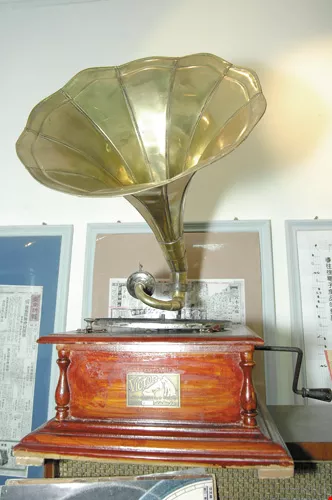
A "retro" gramophone from India, made in the 1990s. It has an air of bygone days, and is used mainly for decoration.
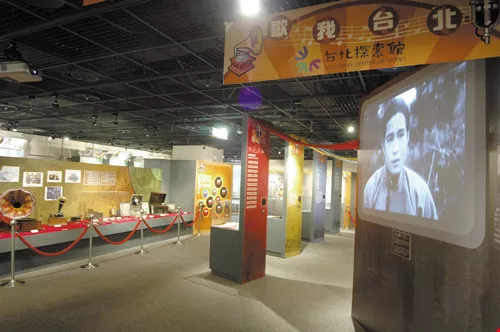
The Discovery Center of Taipei is putting on a special exhibit entitled "Sing Taipei" this year, at which several antique gramophones are featured on site.
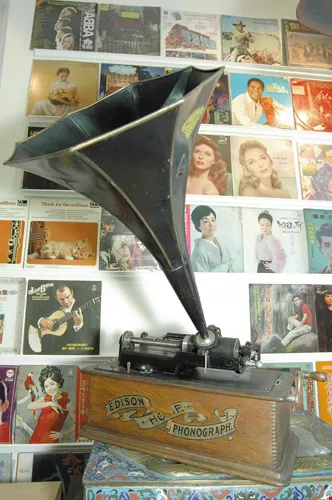
This phonograph of Thomas Edison's, from the late 19th century, is over a hundred years old.
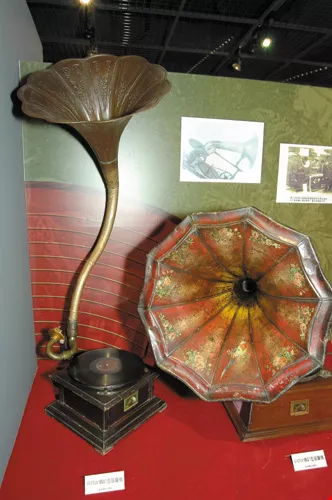
Acquiring a piece such as this, a stylish Swiss gramophone from the 1930s, is one of the great pleasures of the gramophone collector.


@List.jpg?w=522&h=410&mode=crop&format=webp&quality=80)


