Down Home Religion--The Truth Family Odyssey
Andre Huang / photos Jimmy Lin / tr. by Jonathan Barnard
November 2007


If you go in for the splendor of Taiwan's major temples, this place might seem messy and unattractive. If the stately magnificence of major religious ceremonies appeals to you, things here may seem too casual and disorganized. And if you favor the sophisticated organic cuisine of big cities, the vegetarian fare here might seem neither tasty nor healthy enough.
But if the cutthroat nature of utilitarian and materialistic society gives you the blues, you may find it refreshing that people here treat each other like siblings. If you've ever passed your days struggling to make ends meet, you will discover that the cooperation and communalism here have much to recommend them. And if the hurry and emptiness of urban life bother you, the peace and joy of these people will have an appeal....
Located in the countryside of Tainan County, the members of the Truth Family are devotees of I-Kuan Tao. From the town of Yuching it is a drive of ten minutes to reach the Truth Family Shrine. Although in name a Buddhist shrine, it is in fact just a plain three-story building. The large hall on the first floor contains several statues of Maitreya Buddha, as well as an assortment of different-sized chairs and tables and two television sets. It looks much like any living room in small-town Taiwan. The second floor is devoted to worship of Maitreya Buddha, and the third floor to the worship of the Ancient Mother of Limitless Heaven. All in all, the style is simple and down-home. On the first floor, there is a kitchen behind the Buddhist shrine. A courtyard, vegetable garden and various residences (studio apartments of 300-350 square feet) surround the building. Together these structures comprise a compound known as the Maitreya Community.
This is the home base of the Truth Family. In 1993 I-Kuan Tao adherent Chang Ho-ping, who had retired from his job with the Pingtung County Government for health reasons, came here and established a shrine with two other I-Kuan Tao believers. In this communal living arrangement, he embarked on the second half of his life. Many other I-Kuan Tao adherents who lived nearby and came to worship found that there were benefits to this way of life, and the community grew. Among the current members are even families of three generations that include in-laws. It has been 14 years since the community began, and now nearly 100 people live here.
In step with the rising membership, the physical facilities have also grown. The Truth Shrine has been expanded into a three-story building, and the surrounding residences have gradually grown in number. The complex has also purchased nearby real estate to use as orchards, vegetable gardens, and residences. The money for this real estate has come from the community as a whole, but the deeds are held under individual members' names. The members of the community provide the labor for the construction and farm work. The community's members have thrown themselves into building their home.
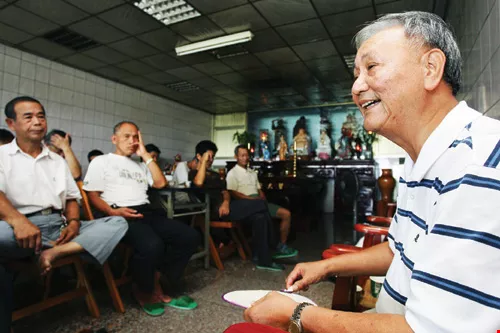
After lunch, Truth Family elder Chang Ho-ping delivers a lecture on the "principles of truth" on the second floor of the shrine.
Joy from letting go
There has been a history of government suppression of I-Kuan Tao, but it is now recognized as one of Taiwan's representative religions. The foundation of its teachings is a mix of Confucianism, Buddhism and Taoism. Also incorporating ideas from Christianity and Islam, the faith holds that "the five religions come from one source." Confucian ethics and the Buddhist practice of vegetarianism and edicts against the taking of life are integrated into daily life. I-Kuan Tao adherents believe that the end of the world is coming, and that we are in the closing stages of the "White Yang" age. Soon the Ancient Mother of Limitless Heaven will send the Maitreya Buddha to save the world.
The Truth Family's founder Chang Ho-ping has long been an I-Kuan Tao believer. Although he used to lecture about the faith's doctrines, the Truth Family has no direct connection to any branch of the religion and operates completely independently. Deep reflections on the state of society and religion prompted Chang to establish the Truth Family, which operates as a commune, unaffiliated and removed from any official religious site.
He uses the Buddhist concept of the "end of the world" to explain why people are so selfish, why the world is so chaotic, and why suicide rates are so high. Just as "it has been said that every citizen, no matter how lowly, contributes to a nation's rise or fall," so too, he says, must the nation bear responsibility for every person's welfare, and so too must those with religious abilities shoulder their duty to ask Heaven to provide people with direction.
When traditional Zen Buddhism talks about its adherents achieving a state of emptiness, it emphasizes struggling hard at self-cultivation while retreating from the world. It doesn't provide a path for people to take within the world. Typical religious sites, including those of I-Kuan Tao, stress magnificent architecture or awe-inspiring ceremonies or sutras that can draw people in. There is little emphasis on changing the attitudes or perspectives on life that people have out in the world. At seven-day Zen Buddhist retreats there is a sense that many participants are joining the crowd to do the popular thing. Some people stress doing good works, but this "visible giving" aimed at building karma is not what Buddha described when he spoke of giving without expectation of reward.
"We focus on the Zen of life. We don't talk about grand theories, or put much stock in ceremonies or delving deeply into difficult scriptures. Rather we seek a path through life and deal with problems as they come up. Enlightenment can happen at any time. We let everyone learn how to let go and release 'the true self' within."
"After learning how to let go, I can do for others and others can do for me, so that the Commonwealth of the Great Unity can be realized in this world," Chang Ho-ping says. "Only when there is equal progress in the spiritual realm and in daily life, can we achieve paradise and save people."
The concept of establishing a paradise on earth may seem a simple one, but it is far from easy to get people who are used to modern utilitarian and materialistic society to cast aside selfish desires, turn over their income to the group, and live a simple communal life. Wu Cheng-han has lived in the community for 12 years. He used to be a real-estate broker in the Tienmu neighborhood of Taipei. Although appearing very successful on the surface, "My life was in crisis," he says. "My mother had had a stroke and was bedridden, and my wife wanted a divorce. Amid these difficulties, it was the words 'let go' that allowed me to understand that the life of luxury in Taipei was not for me."
"At first, I had a tough time of it, because when a big group of people live together, a lot of one's faults naturally come to the surface," explains Wu. "For instance, I used to be quite egotistic and male chauvinist. When something didn't go the way I wanted, I'd lose my temper, and I didn't get along well with my wife. After coming here, because you have to learn to accommodate people in every aspect of life, and because there is an ongoing conversation about the principle of truth, I gradually learned how to accept things and let go, trying to avoid being narrow minded. Over the course of a few years I was slowly able to change. I hardly have a temper at all now, and I've improved relations with my wife. Living this kind of collective life has been of tremendous help."
Wu insightfully says that like most of the members of the Truth Family, he had read some of the Confucian, Buddhist and Taoist scriptures before coming here. "But truly reading the scriptures isn't the same thing as living them. Sitting and speaking isn't as good as rising and doing. Gaining understanding through group living is the best way to really put these into practice."
Apart from elderly retirees and middle-aged dropouts from the rat race, young people also number among the members of the Truth Family. Cheng Jui-chang is 30. After finishing his military service, he came here with his mother, and now he works as a carpenter at the compound. In his estimation, his arrival both marked a new chapter in his life and was also an expression of filial piety. Gregarious by nature, he has come into contact with all kinds of people in society. "Outside life isn't better," he says. "There is the constant struggle for and hankering after money, and fewer people help each other."
When you ask him about relationships between the sexes, a source of difficulty for many young people, he says that Taiwanese men have had their minds polluted by watching Japanese pornography. He explains that the approach of the Truth Family is to direct youth to develop proper conceptions about these relations. "Romantic love can certainly make people happy, but what's even more important is that when you lose the love, you've got to let it go, or else it can become a bad thing."
Apart from trying to lead people to gain proper conceptions about these matters, the Truth Family has no prohibitions with regard to young people's marriages and relations. "In this day and age who can control that?" he says laughing. Currently the Truth Family has more middle-aged and elderly members, and fewer young people. Consequently, there are few love affairs or marriages within the community. Partners tend to meet on the outside and then come here to live together. And no one has ever left because of getting married.
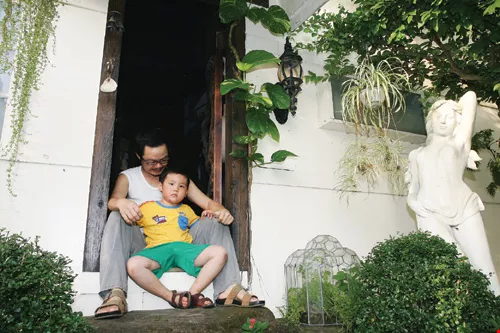
with local children in front of his small wooden residence.
A little laid back, a little romantic
When you take a closer look, you discover that members of the Truth Family are less self-righteous hermits than lively, easygoing country folk.
Arriving at lunchtime, this reporter was invited into the kitchen. With people going in and out laughing, it was a festive atmosphere. There was no set manner to how or when people ate. Some filled their bowls and walked into the living room to eat while they watched television. There was nothing uptight at all about the meal. The food was vegetarian, but it wasn't a sophisticated organic vegetarianism, but rather Grandma's down-to-earth vegetarianism. There were vegetables, fragrant manjack (Cordia dichotoma), and deep-fried soy faux chicken. It may have been a little salty and oily, and it might not have appealed to city folk's palates. But as far as members of the community were concerned, if it filled them up, it was good enough.
After lunch and a short rest, we went up to the second floor to listen to a talk on the "principles of truth." Family members first bowed to a statue of the Maitreya Buddha. Then the men and women split into two groups, and Chang Ho-ping picked up a fan and began to talk in a manner neither slow nor rushed about a variety of issues, ranging from current events to family principles, from religious doctrine to interpersonal relations. But he always steered things back to the idea that "letting go of one's attachments is the only way to cast off one's anxieties and achieve happiness in the present." Afterwards, there was a question-and-answer session.
During the lecture two members of the group poured tea. As the assembled listened while sipping the tea, they looked as if they were listening to a village elder telling stories. Unlike school, however, attending was entirely one's own choice. One could have done something else, rested, or chatted. To each their own. There were no restrictions or requirements. After an hour or so, the assembled once again bowed to the Maitreya Buddha and then they parted ways.
After dinner, there was another gathering, but it was more focused on discussion and voicing individual opinions. More raucous, it was a space where people could discuss current events and mediate differing viewpoints.
In their search for truth, members of the Family don't read the scriptures or dabble in mystery. And there is none of the "guru worship" that you often see in religious communities. In their eyes Chang Ho-ping is just a friendly elder. They call him Uncle Chang, as if he were an elder in an extended family from a bygone era.
When encountering different opinions, the approach is: let them be. Chang Ho-ping explains, "With so many people living together, there will inevitably be differences of opinions. But we 'accommodate the anxious, the stupid and the wise.' When I encounter those who are restless, I am tolerant of them, patiently waiting for them to change, for time to bring progress. As for the wise, we'll defer to them."
This sense of equality and amiability allows the Truth Family to tolerate and embrace all kinds of people. The suave Chen Te-ping, who is in his 40s, used to work as an artist. As a student of art and philosophy, he once traveled around the world looking for the path to enlightenment. Not an adherent of any specific religion, he says that he has experienced a peace and joy here that he never felt anywhere else, and so has stayed put for 12 years. Apart from working in the mango orchard, he has also helped design the decor of the new buildings. Other people's residences are attached concrete structures, whereas his is a standalone wooden structure. Its roof is made of beams taken from an old farmers' association warehouse. Inside are various decorative elements made of slate and wood. The whole effect is very elegant.
Even the folk singer Chen Ming-chang has found himself attracted to these special qualities. He and his wife have often come on a whim to stay for several days, half relaxing and half creating. Chen Ming-chang and his wife are very warm and friendly, Truth Family members say. The couple has given them T-shirts of their own design, and in the evenings they even call them all together to strum the guitar and sing.
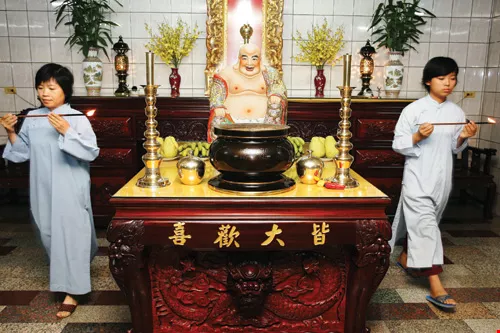
On the third floor of the Truth Shrine incense is lit before every meal to worship the Maitreya Buddha, and (behind) the Ancient Mother of Limitless Heaven, who has no avatar.
A cooperative extended family
Although the Truth Family is a religious community, there are no deacons or bureaucracy. Instead, all the members, according to their abilities and interests, join the work squads responsible for housework, farm work, carpentry, metalworking, or gardening. Although the work is entirely voluntary, it all seems to be done in a very organized manner, which makes it appear as if there were some sort of unspoken understanding among the members.
A Mr. Chen originally worked in a mechanical department of CPC Corporation. When he discovered how equal weight was placed on the spiritual and the material worlds here, he deemed it a true utopia. When he retired, he moved here and began learning how to grow mangos. "Having never done it before, I hadn't realized how much hard work farming is!" says Chen with a smile, before revealing his satisfaction: "Nevertheless, growing crops is a lot like raising children. You get a lot of satisfaction from seeing them grow up. But unlike people, plants won't rebel. There's a direct correlation between how much work you put in and how well they do."
The Truth Family has bought two pieces of land nearby to grow mangos, which is one of their main cash crops. "Back when there were fewer hands to help out, we used to sell them to someone who brought them to market," Chen explains. "But now we market them directly and avoid being exploited by middlemen. We've also given many of them to friends. Because we don't apply pesticides and we weed by hand, our mangos are very popular."
Truth Family's metalwork and carpentry squads mainly work on creating residences for members, and occasionally they also do work for close friends so as to earn some cash. The farthest they've gone is to Mexico for three months to help a fellow I-kuan Tao adherent build a factory. Currently they are hard at work on some new construction projects, including "Seniors Hall" (a guests' dormitory near the vegetable gardens), as well as a roadside store that will sell their own handicrafts as well as tea that they purchase from wholesalers.
Although Truth Family members keep private bank accounts, the income from Family endeavors goes back to the collective. This money is passed to Chang Ho-ping to manage. If members have any need, they can go to Chang for money. Most of the collective's funds come from the sale of crops, as well as metalworking and carpentry, and member contributions. But no record is made of the money coming in and out; it's all done on trust.
This reporter skeptically asked: "What if someone were to take advantage, by reaping benefits but making no contributions?" Everyone laughed at the question, disallowing its conceivability: "When everyone else is working hard, how could you laze off?" "Everyone who comes here has similar values. If you want to live the easy life, you wouldn't come here!" Others say that the way they used to sit around in their old homes was claustrophobic and debilitating. They are much happier now working up a sweat every day!
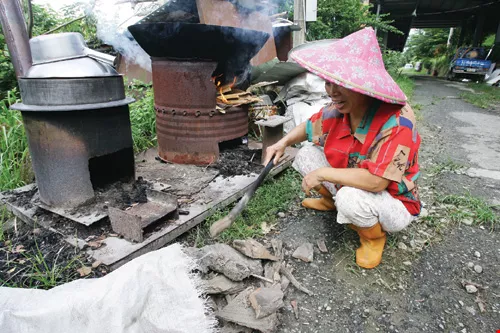
They may have electricity and gas, but they still gather wood to boil water. Nothing goes to waste.
Reflections
Although the Truth Family is a religious society, it has a real-life orientation that aims to raise the spirit through practice.
Yet a present that is joyful and free from anxiety does not guarantee a smooth future. Religious scholars opine that this emphasis on real practice over scripture-based education is in reality just a shallow sharing of life experiences, and not enough to reach enlightenment. Meanwhile, as the numbers of members and visitors grow, how long will the Truth Family be able to maintain its loose structure, and its lack of commandments and ceremonies? As its business grows and it faces market competition, will the model of everyone giving according to their abilities and taking according to their needs, survive? Will the take-it-as-it-comes, happy-go-lucky approach continue to work?
As previously discussed, "reading the scriptures is no match for acting upon them." Speculating about these matters won't provide answers to these questions. Answers will only come to those who pursue the creation of a paradise on Earth.

@List.jpg?w=522&h=410&mode=crop&format=webp&quality=80)


