A Century-Spanning Dialogue: The Documentary Daughter of Nectar
A Cinematic Love Letter to Huang Tu-shui from Directors Lin Chun-ni and Huang Pang-chuan
Chen Chun-fang / photos Kent Chuang
May 2026

“Our teachers repeatedly taught us: ‘Art is not merely a straightforward, realistic representation. Only by expressing one’s individuality without reservation can its true value be recognized. The life of art ultimately comes down to this single point.’”— Huang Tu-shui
At the premiere of the documentary Daughter of Nectar, directors Lin Chun-ni and Huang Pang-chuan opened their remarks with this very quote. In 1921, Taiwanese sculptor Huang Tu-shui astounded the world when his marble sculpture, Water of Immortality, was selected for the prestigious Imperial Art Exhibition (Teiten) in Japan. Although Huang died young, he left behind far more than brilliant artworks; he bequeathed a relentless pursuit of art's immortal spirit.
Now, more than a century later, the two directors have utilized celluloid film—combined with first-hand interviews and meticulous historical research—to retrace Huang’s artistic journey. They trace the trajectory of Water of Immortality from its creation and subsequent decades of obscurity to its eventual rediscovery. This film is undoubtedly a cinematic love letter to Huang Tu-shui.
黃邦銓導演、林君昵導演.jpg?w=1080&mode=crop&format=webp&quality=80)
Directors Huang Pang-chuan (left) and Lin Chun-ni (right) utilized celluloid film, first-hand interviews, and historical research to create the documentary Daughter of Nectar—their cinematic love letter to Huang Tu-shui. (courtesy of MoNTUE)
A Celluloid Dialogue: Carving a Century-Long Epic
“This is a ‘documentary that does not feel like a documentary.’ We hope the audience, through the vision of these two directors, can follow in Huang Tu-shui’s footsteps and embark on their own artistic path,” remarked Lin Mun-lee, the film’s chief planner and founder of the Museum of National Taipei University of Education (MoNTUE).
This century-long epic began with Huang’s creation in 1921. Amidst subsequent political and social turmoil, the sculpture vanished for half a century. Fortunately, it was carefully hidden and protected by the family of Dr. Chang Hong-biao, ultimately allowing for its miraculous reappearance. Lin Chun-ni recalls the shock of hearing that Water of Immortality was finally being unboxed while she was working with the MoNTUE research team. “When I first saw her, she was covered in a thick layer of dark brown dust,” Lin notes. “In that moment, she didn’t look like a statue; she looked like a human being sealed away by time.”
002.jpg?w=1080&mode=crop&format=webp&quality=80)
When Water of Immortality was first unboxed, she was covered in thick brown dust, appearing as though she were a person sealed away by time. (courtesy of MoNTUE)
This profound shock cemented the directors’ resolve to expand their short film into a feature-length documentary, realizing that such a sprawling, century-spanning history could not be adequately told in a brief timeframe. Huang Pang-chuan explains that their insistence on shooting with traditional celluloid film stems from the fact that both film and sculpture share the creative logic of “subtractive art.”
Sculpture involves chiseling away excess stone to reveal the form within. Similarly, film development involves stripping away silver halide crystals to allow light to shine through. For the directors, this choice of medium was an artistic statement. By colliding the highly physical materials of celluloid and stone, they sparked a dialogue across time and space between contemporary creators and Huang Tu-shui.
011.jpg?w=1080&mode=crop&format=webp&quality=80)
Both celluloid film and sculpture are forms of “subtractive art.” The collision of these mediums sparks a dialogue across time and space between contemporary artists and Huang Tu-shui. (courtesy of MoNTUE)

Huang Tu-shui’s sculpting prowess was astonishing. From the fingernails to the texture of the skin, every detail of Water of Immortality is incredibly lifelike, as he transformed solid marble into a woman as soft as cotton.
A Flesh-and-Blood Pioneer
As the first Taiwanese sculptor to study Western art in Japan and be repeatedly selected for the Imperial Art Exhibition, Huang paved the way for a Taiwanese society that had not yet developed modern concepts of fine art. His influence on Taiwan’s artistic evolution was profound. Yet, in Huang Pang-chuan’s eyes, he is not some deity placed on a pedestal to be worshipped. Rather, he was a flesh-and-blood pioneer—a revered elder in the field with a noticeably untamed, rebellious streak.

Huang Pang-chuan and Lin Chun-ni spent five years conducting fieldwork to retrace Huang Tu-shui’s artistic path. The duo jokes that the film only contains one-twentieth of their research; the rest is compiled in the documentary’s companion photobook. (courtesy of MoNTUE)
To piece together this vivid, humanized portrait of Huang, the directors spent five years conducting fieldwork, including a visit to his alma mater, the Tokyo University of the Arts. They sought to understand the grueling technical details of marble carving and the arduous labor behind Huang’s famous lament that “sharpening the chisels is the hardest part.”
The documentary features seemingly tangential figures, such as meandering college freshmen and a singer from Takasago Dormitory (a historical residence for Taiwanese students in Tokyo). This, however, was a deliberate directorial choice. By aggregating these youthful spirits, the film reflects Huang’s own audacity and obsessive dedication to art, allowing audiences to feel his genuine presence—not as a distant historical figure, but as an approachable neighbor or senior classmate.
010.jpg?w=1080&mode=crop&format=webp&quality=80)
The directors visited contemporary hand-carving artisans and a singer from Takasago Dormitory. Through the aggregation of these youthful spirits, they flesh out a portrait of Huang Tu-shui as a relatable, human pioneer. (courtesy of MoNTUE)
Fulfilling a Master’s Dream: Walking the Path of Art Together
The film is not solely the creation of the two directors; it is a cross-disciplinary resonance bringing together multiple artists. For instance, composer Wang Yujun and sound artist Yannick Dauby collaborated to craft the original score and sound design. The movie is saturated with poetry, whether through the ambient sounds of real stone-chiseling transformed into music, the integration of birdcalls recorded across Taiwan over the years, or the tender, emotionally rich ending theme, “Song of Tu-shui,” written and performed in Taiwanese Hokkien.

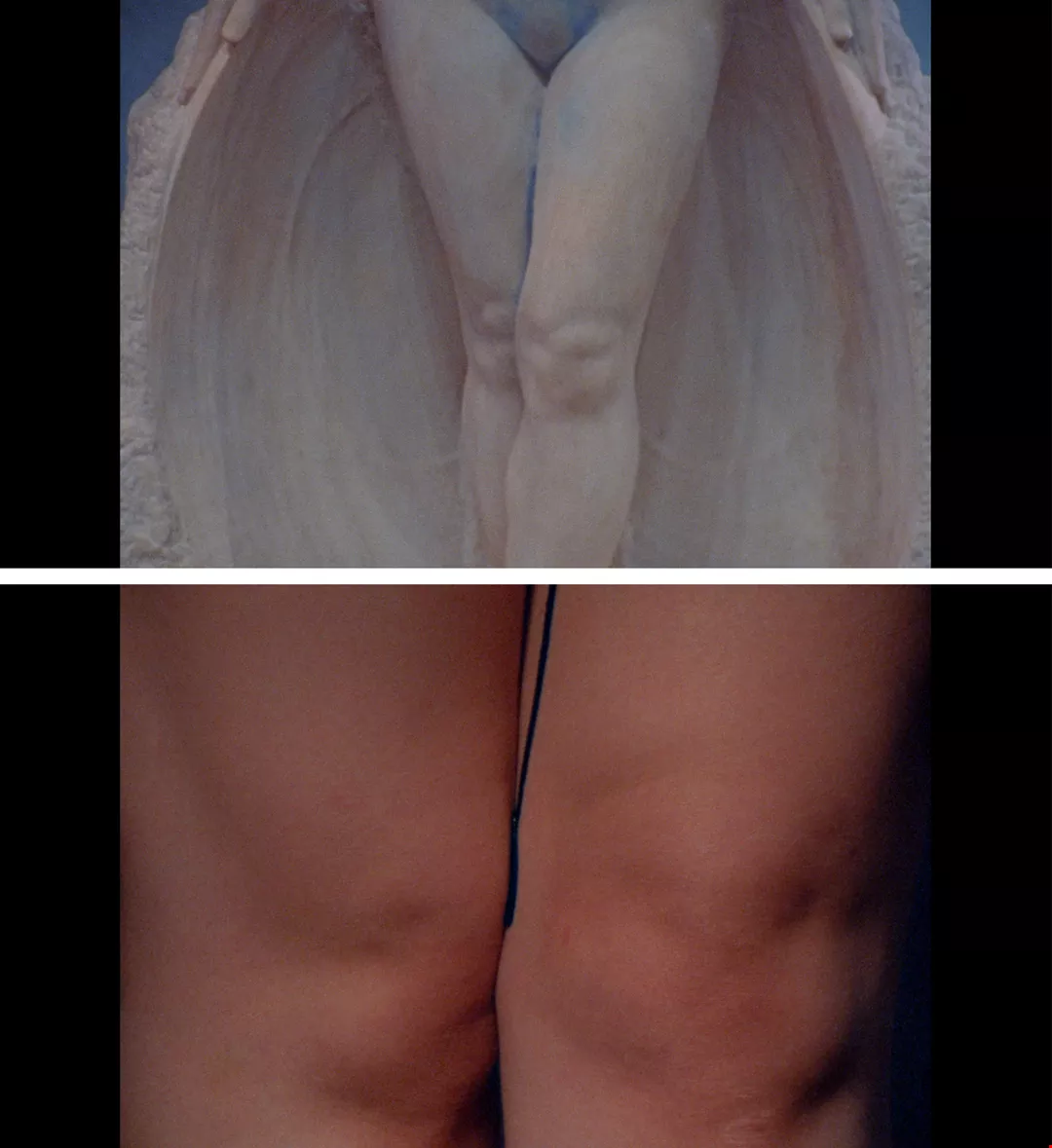
Dancer Lin Hsiu-yu, acting as the statue’s model in the film, meticulously observed every inch of Water of Immortality. By physically experimenting with the poses, she provided crucial feedback that the statue is actually stepping slightly forward in a dynamic display of vitality. (courtesy of MoNTUE)
Lin Chun-ni emphasizes that they viewed their collaborators as independent artists. Therefore, rather than asking them to simply “conform” to a script, the directors encouraged them to engage in a dialogue with the film as equal creators. For example, dancer Lin Hsiu-yu, who played the model for Water of Immortality, meticulously observed every inch of the statue’s texture. Using her own body, she provided crucial physical feedback, revealing that the statue’s posture actually features a subtle, dynamic forward step brimming with vitality.
003.jpg?w=1080&mode=crop&format=webp&quality=80)
The directors used the film to fulfill Huang Tu-shui’s ultimate dream: transforming the works into which he chiseled his very life into immortal human beings, allowing the artist’s spirit to live on forever. (courtesy of MoNTUE)
Huang Tu-shui once declared that he was not creating mere artworks, but rather “immortal human beings.” Through the magic of editing, the film blurs the lines between reality and fiction from one second to the next, effectively fulfilling Huang’s dream of breathing actual life into his creations. While this non-traditional narrative structure may challenge conventional viewing habits, the directors ultimately hope to provoke discussion and reflection, awakening audiences to the sheer power of artistic form.
“Young people of my homeland, let us embark on the path of art together.” Borrowing Huang Tu-shui’s own words, Lin and Huang extend a heartfelt invitation to the audience. This path of art—lined with endless blooms and constant birdsong—awaits more travelers willing to journey toward a realm of crystal-clear spiritual joy.

Viewing the documentary Daughter of Nectar before seeing Water of Immortality up close at the National Taiwan Museum of Fine Arts offers a much deeper appreciation for Huang Tu-shui’s relentless pursuit and dedication to his art.
National Treasure Water of Immortality Permanent Exhibition
Time: Tuesdays to Fridays, 9:00 AM – 5:00 PM; Saturdays and Sundays, 9:00 AM – 6:00 PM
Location: National Taiwan Museum of Fine Arts (No. 2, Sec. 1, Wuquan W. Rd., West Dist., Taichung City)
Admission: Free