Ho Te-lai: An Eternal Dream of Peace
Ventine Tsai / photos art and photos courtesy of Taipei Fine Arts Museum / tr. by Chuck Eisenstein
February 1995


He was Taiwan's first student to enter the Tokyo Fine Arts College with top-place exam scores. But because he opposed the established styles of the official exhibitions and the commercial vulgarization of art, he refused to sell any of his paintings or to participate in the orthodox official exhibitions. What a loss it would be if these circumstances had caused us to forget him, the painter Ho Te-lai.
On the day of the grand opening of the Ho Te-lai 90th Year Retrospective Exhibition at the Taipei Fine Arts Museum, nearly sixty Japanese have arrived specially for the event. Most are members of the Shinkozo-Sha ("New Structure") painters' association. They speak of Ho Te-lai as if he were the Buddha himself, describing him in tones of great reverence. Relatively few, however, discuss his paintings, because for Ho Te-lai, art was a discipline inseparable from life itself.
The themes of Ho's work came from his concern for humanity, from his meditations on the cosmos. His painting sessions started with a poem, a poem he converted into a painting. During his lifetime, he often said to his fellows at Shinkozo-Sha, "What do you do when you lack creative inspiration? Go write some poetry!" The method of art through mental concepts was not only "avant garde" at the time, but his work remains on the forefront even in this day of flourishing "conceptual art." After looking at Ho Te-lai's works of fifty years ago, the installation artist Chu Chia-hua, whose works are often incomprehensible, felt that Ho's style is more modern than that of many contemporary painters!
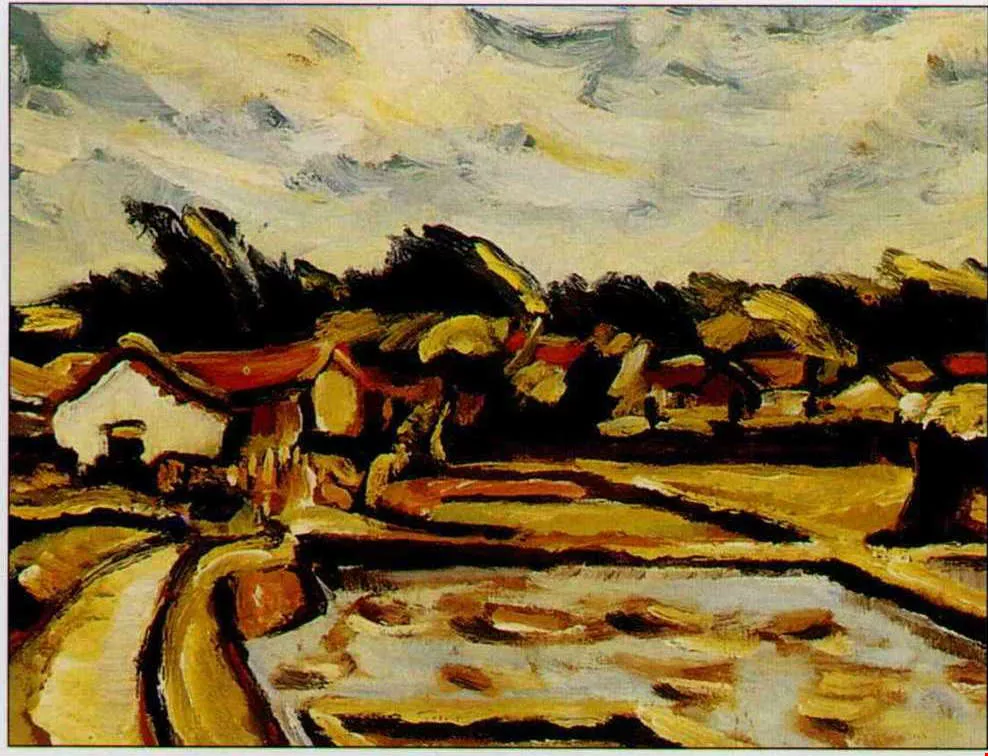
In a brief stay of three years in his homeland, the artist created this enthusiastic "Summer in Hsinchu (Taiwan)," in which we can see something of the bright colors and unconstrained brushstrokes in the style of this old nativist painter. Oil on wood, 24×33, 1933.
Child of peasant and landlord
"Born in Tanwenhu, Miaoli, Hsinchu, Taiwan; childhood days of sweet potatoes and river snails; mother painfully had me adopted away at age six; sent off to study in Tokyo at age nine; born in Taiwan, grown up in Japan,... The atom bomb, sin of mankind; Japan and Western Europe in mutual respect; Van Gogh had his Theo and I my Teng-chin; dreams of tearfully taking human life; white snow red plum fallen leaf black crow; warm-hearted sun blazing for eons..."
The painting entitled "Fifty-five Waka Poems," is covered by the varying black and grey strokes of his calligraphy, behind which is displayed a bright moon high over a tranquil mountain village. The poetry maundering across the night sky is the painter's life of vicissitudes, his own portrayal of his life.
Ho Te-lai was born in 1904 to a family of tenant farmers in Hsinchu, Taiwan. Unable to pay their 100 yuan land rental, his family had to let a wealthy landlord adopt Ho Te-lai when he was six years old. At that point, his fate was transformed--this, after all, was an era where artists literally starved to death abroad; if he had not been adopted into a land-owner's family, it is likely that his hands would have spent their days holding a hoe, not a paintbrush.
In the home of his wealthy adopted father, he spent two years learning the Chinese classics, during which time he was frequently punished by his teacher for his sloppy handwriting. At the age of nine he was sent to Japan to attend elementary school. From thence forward, his fate was to be inextricably tied to Japan. He would go back and forth between the two places many times in his life. After graduating from elementary school, he returned to Taiwan and tested into the Taiwan Number One High School. Graduating from high school, his passion for art led him to persuade his adoptive father to let him go to Japan once more, where he tested into the Tokyo Fine Arts College with top scores. Yet this student, number one on the entrance exam, graduated with very poor grades.
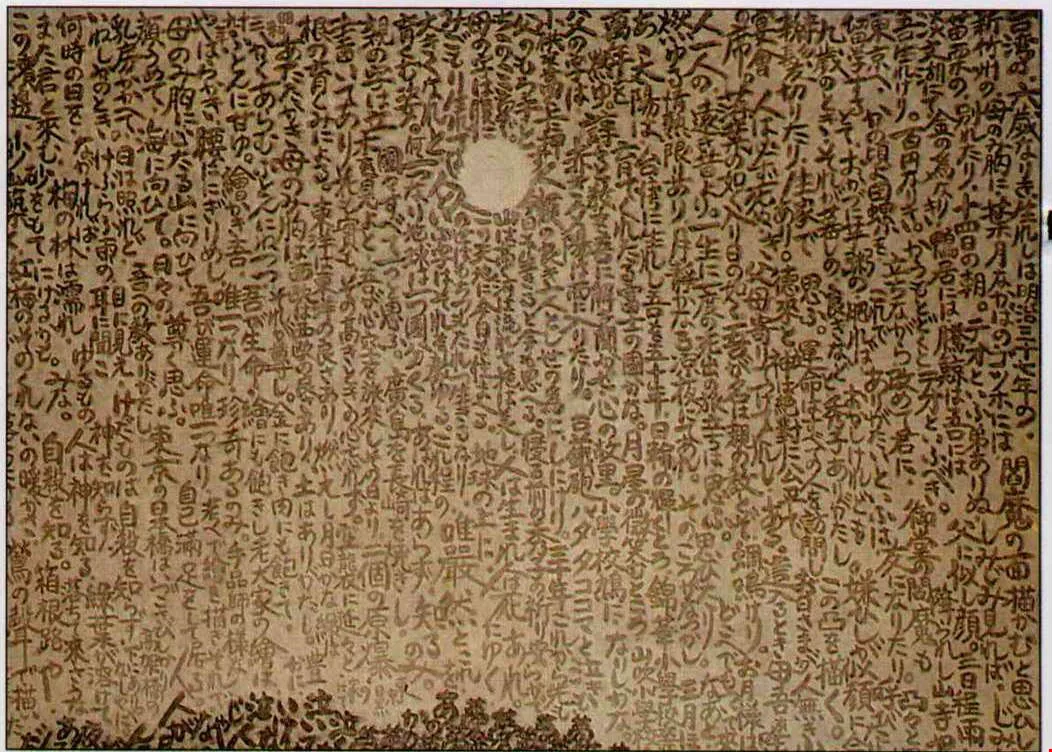
Painting with calligraphy, building an image in words: Ho Te-lar's "Fifty-Five Waka Poems" recounts the artist's own life in a way which combines the traditional and the avant garde. Oil on canvas, 130×194, 1964.
Self-imposed exile from the official exhibitions
There was only one road to fame for painters of Ho Te-lai's era: to test into the Tokyo Fine Arts College, and then to enter into the officially sponsored "Imperial Exhibition." However, the formulaic aesthetic concepts at school and the inflexible set standards at the exhibition entrance competitions could not accommodate the unruliness of Ho's creative work. He therefore chose "his own road," refusing to enter any exhibition or competition with an official imprimatur.
After graduation, Ho, who never had adopted Japanese citizenship, returned with his Japanese wife Hsiu-tsu to his home town of Hsinchu. He was full of enthusiasm to be returning to his warm, friendly home town, as is apparent from his early work "Summer in Hsinchu (Taiwan)." In this painting, white clouds float under brilliant sunlight, while a red tile house stands between a luxuriant bamboo grove and verdant rice paddy. The sharply contrasting blacks, whites, and reds, and the bold, abandoned brush strokes express on the canvas an ardent love for his childhood home.
In addition to painting, Ho also opened up his old home as a studio and organized the Hsinchu Art Research Society. One of the members was the late Li Tze-fan, known as the father of modem art in Taiwan. It is unfortunate that Ho only stayed in Taiwan for three years before a gastric ailment forced him back to Japan to be treated. There he stayed for many years.
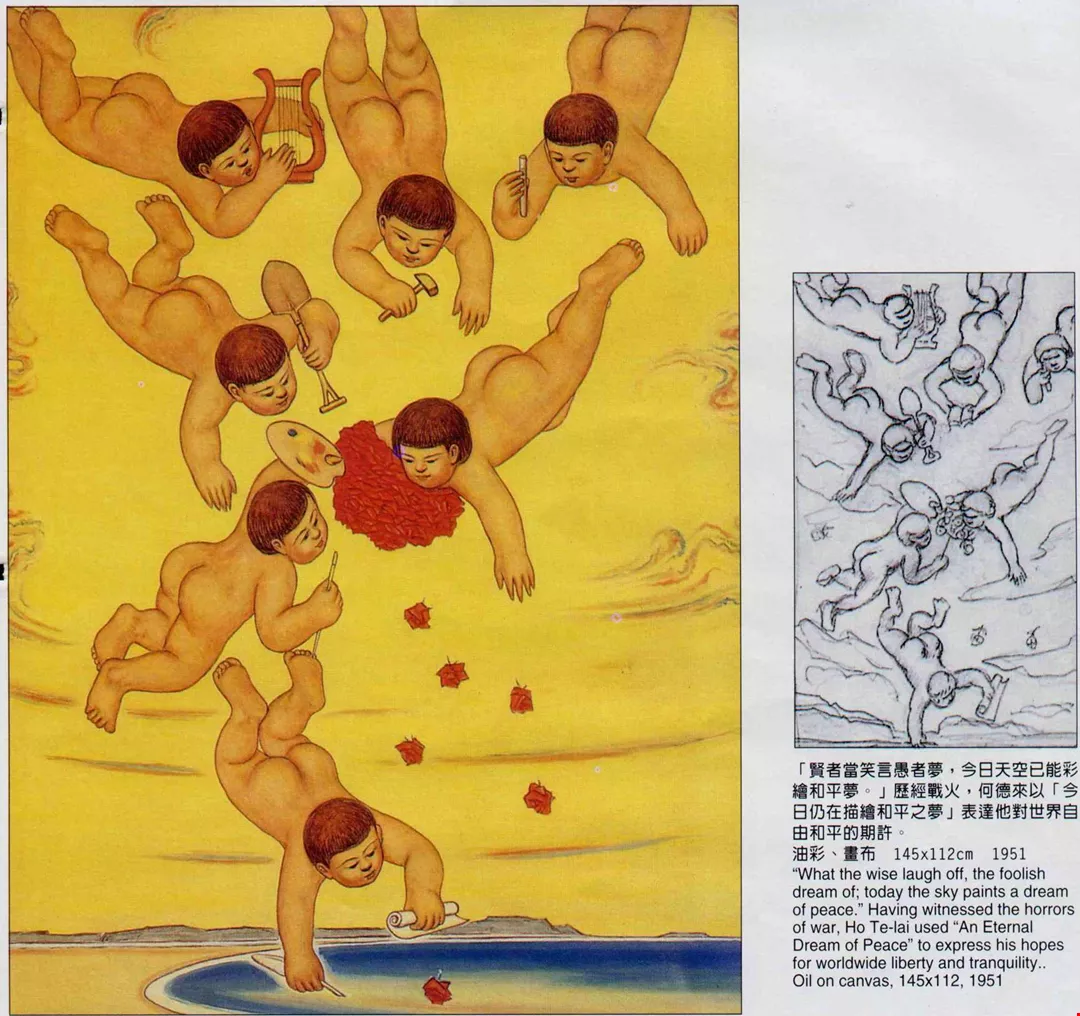
"What the wise laugh off, the foolish dream of; today the sky paints a dream of peace." Having witnessed the horrors of war, Ho Te-lai used "An Eternal Dream of Peace" to express his hopes for worldwide liberty and tranquility.. Oil on canvas, 145×112, 1951.
Resisting war with the brush
In a smoky, abandoned ruin, a solitary night owl perches on the gravestone of a nameless soldier. A short knife, glinting coldly, rests as if in close-up on a table. It is "After the War"; it is "Nightmare"--Ho Te-lai's works tell us that war has come.
After he returned to Japan, Ho's worsening stomach ailment forced him to undergo surgery. The healing process was torturous, and to make matters worse, the Second World War had broken out. Under the pall of such physical and spiritual pain, the painter put down his brush. His brush had stopped, but he remained alive at heart. After the war he took up painting again, but we no longer see the youthful abandon of the works he painted in Hsinchu. Instead, he expresses the horror of war and his unbreakable hope for humankind.
In "After the War" and "Nightmare," Ho revealed the cruel and loathsome side of humanity. But at the same time he also contrasted these works with "An Eternal Dream of Peace." In this canvas, seven angelic children descend from the heavens; their hands grasp a harp, a shovel, a palette, writing paper, and a huge rose--tools with which to rebuild the world. Between golden skies and polychromatic mists, they gaze down at the human world. The cultivated, kindly Ho Te-lai no longer used the broad, direct brush strokes of inner release, but rather exhibited with imperturbable calm the serenely peaceful utopia of his heart.
In addition to thinking about how humanity can become fulfilled, and discarding notions of the insignificance of humankind, Ho went on to explore the enormity of the universe, its eternal boundlessness. He painted the resplendent "The Sun"; the profoundly warm "Sunset"; and "Dawn," with its moon not yet faded from the sky. These Number 200 canvases, each taller and wider than a human being, overflow with the vitality of heaven and earth. Ho had left the shadow of war behind, and entered into the clear-minded acceptance of the fate of middle age.
Accepting fate at age fifty
He depicted life, the spring breeze, the bright moon, the warm southerly winds; he depicted the scenery inside him, not the flowers and woods of reality. In the painting "Spring Thunder," with the damp cold of its steely grey color scheme, a white flash of lightning steaks out from the left, while amid gusts of rain, plants bend rightward in the direction of the lightning. In the lower right corner, wavelets rhythmically lap downward. This unmoving canvas overflows with the vibrant breath and pulse of nature. What is truly amazing is that Ho Te-lai, who spent most of his life in Japan, was still able to display the world of his home town, a world where "I am one with heaven and earth." His landscapes may be likened to the scholarly paintings of China, the product of one's personal care for nature.
From youth to old age, Ho Te-Iai's emergence and position in the art world were invariably avant garde. He was avant garde without trying to be: not in conflict with tradition, but in harmony with it.
The mission of the Shinkozo-Sha painting association is to start from wild spirit to utilize one's personal freedom. It seeks art that is not limited by schools or factions. This non-official painting association, founded in the late 1920's, now has over 700 members, and was the favorite of Ho Te-lai, who detested factionalism. Keeping in contact with many young painters with a fervor for art, the middle-aged Ho Te-lai became all the more graced in spirit; with the support of friends, he hosted the "Flying Bird Exhibition" in opposition to the painting galleries' unfairly priced artworks. Students even formed the "Chia-Te [Good Virtue] Society" named after Ho Te-lai, and met with him periodically for discussion....
A mirror on modern art
Three score years later, Ho Te-lai still remained faithful to himself. Excluded from the mainstream in his younger days, he was venerated and esteemed by students in the more open environment of later years.
Looking back on Ho's life, we see he put little emphasis on style and did not employ pre-set themes. Each painting is a journal of his soul. His sincerity in facing himself comes through in the singular style of his creations. And it is because of this sincerity that his works--accumulated from the sediment of his soul--so ably combine nature and the current events of his time.
[Picture Caption]
p.108
"Spring is here, and the beautiful colors excite the soul. I rejoice that I am a painter." In his old age Ho Te-lai often went outdoors to draw. In warm breeze or spring thunder, he sketched out his concern for life.
p.110
In a brief stay of three years in his homeland, the artist created this enthusiastic "Summer in Hsinchu (Taiwan)," in which we can see something of the bright colors and unconstrained brushstrokes in the style of this old nativist painter. Oil on wood, 24x33, 1933
p.110
Painting with calligraphy, building an image in words: Ho Te-lar's "Fifty-Five Waka Poems" recounts the artist's own life in a way which combines the traditional and the avant garde. Oil on canvas, 130x194, 1964
p.111
"What the wise laugh off, the foolish dream of; today the sky paints a dream of peace." Having witnessed the horrors of war, Ho Te-lai used "An Eternal Dream of Peace" to express his hopes for worldwide liberty and tranquility.. Oil on canvas, 145x112, 1951

@List.jpg?w=522&h=410&mode=crop&format=webp&quality=80)

@List.jpg?w=522&h=410&mode=crop&format=webp&quality=80)


