The Beauty and the Sorrow of the Farm--Wu Sheng
Kuo Li-chuan / photos Chuang Kung-ju / tr. by Scott Gregory
December 2007


It's an autumn day, and this reporter exits ProvincialHighway 1 at Changhua County's Hsichou Township. Traveling local roads, we come to a small village called Chunliao. This is the home of the poet Wu Sheng. His is an old-fashioned three-sectioned house with a courtyard in the middle. Though it's weathered numerous typhoons, its owner has kept it up well. Even the wooden window frames are original. This is where the poet was born, grew up, and raised three children of his own.
Looking out at the high-speed rail tracks that run along the rice fields, Wu says that most every farming community in Taiwan has gone through the same process: the population drifts away, property titles get tangled and land gets subdivided, and then new Western-style homes pop up amid courtyard homes falling into disrepair. A home like his is a rare sight indeed.
Wu Sheng, birth name Wu Sheng-hsiung, was born into a Chunliao farming family in 1944. His father, who had only an elementary-school education, studied for the Japanese colonial government's civil service examinations at the behest of his wife and became a policeman, a teacher, and finally, after the war, an employee of the local farmers' association. Because of his dedication to public service, he was also elected a township representative.
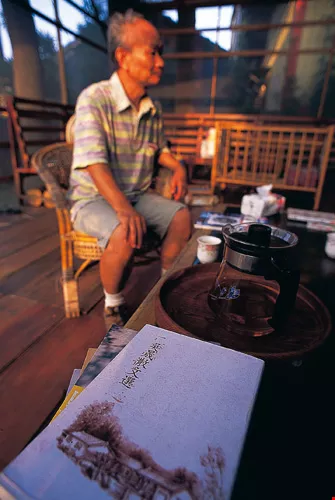
Wu's mother planted some camphor trees late in her life. Now they are in full bloom. Wu has set up a garden tent underneath them where he can leisurely peruse books or share tea and chat with friends.
Against the grain
In times past, working in the public sector was an honor as well as a form of security. Wu's mother was healthy and organized, always providing healthy meals. The family was comparatively well to do, and his parents placed a strong emphasis on education. Wu Sheng was the top student all six years of elementary. "Though my grades were always the best, my father always reminded me that it was only because I had more opportunities than others," he says. His father's exhortations kept him from getting a big head.
Wu had a virtuous personality even as a child. He couldn't stand to see his smaller classmates get picked on, for example. He'd even stand up to the teachers if he thought they were playing favorites. That often got him into trouble at school and at home.
Wu remembers an election for county commissioner when he was in fifth grade. A KMT candidate, Chen Hsi-ching, was running against an unaffiliated candidate, Shih Hsi-hsun. "The teacher had us sing a campaign song," he recalls. "The lyrics were, 'The commissioner is chosen by us / Chen Hsi-ching can do it all!' The teacher even asked us to sing it as we walked home. I thought it wasn't fair, so I changed the lyrics to 'Chen Hsi-ching is all puffed up!'"
In addition to changing the lyrics of the campaign song, he also took up a collection among his better-off classmates and bought firecrackers to light off when Shih Hsi-hsun's campaign truck went by. "That made things more equal," he recalls. "I thought it was great. Ever since, when I've participated in political or social movements, it's always been motivated by this sense of justice."
But that was an era of strict martial law and the White Terror, and his civil servant father knew his son's rashness could lead to trouble. He disciplined him from time to time to keep things from getting out of hand. Wu Sheng was often beaten by his father, and as a result the once open and talkative child became isolated and quiet. In his free time he'd take refuge in books. He especially loved reading books about the great outdoors.
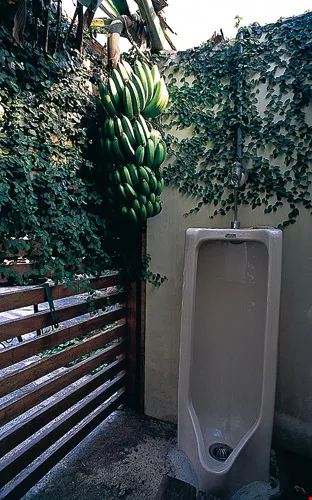
The ever-childlike Wu planted bananas alongside the men's room wall. The ripe bananas and the external urinals bring a smile to a visitor's face.
Poetry and responsibility
Late in his first year of junior high, Wu was transferred to Changhua Junior High School. It was there that he came across literary magazines like New Life and Wild Winds. It was like discovering a whole new world, and he found himself even more immersed in the world of books. He found that just reading wasn't fulfilling enough, so he tried his hand at writing. In his second year of junior high, he published a poem called "Fly Back, My Youth" in the magazine Asian Literature. That was the first of many, and he developed a true love of writing. He was living away from home in a dormitory, and his grades started to suffer. No matter how his father pleaded with him, he would not give up the habit.
As he spent all his time writing, Wu was unable to graduate from junior high. He was also unwilling to repeat a grade, so he had no choice but to enroll in a private high school that would accept him. Later, his brother sent him to Taipei to take the entrance exam for the more prestigious Shulin Senior High School in Taipei County.
During his high school years, he kept writing poetry as he neglected his classes. He then placed into an animal husbandry course in Pingtung, but he kept spending his nights reading literature and writing. He couldn't keep up in even the most basic courses.
In late 1966, his brother, who was studying in America, sent him US$100. That allowed him to publish his first poetry collection, Swaying, which contained 30-odd poems he had written in junior high. He even got a National Taiwan University professor of Chinese, Chang Chien, to write a preface.
Wu says with a sigh, "I managed to write out so many poems of youthful troubles while I was lost in literature. When I published Swaying, it had only been a year since my father was killed by a speeding truck. My family was poor, but in my selfishness I still asked my brother to help me out."
The years went past, and it was time for Wu to graduate, find a job, and help out his family. But he was missing too many credits, and he had to stay behind. Blaming himself for being irresponsible, he took all the leftover copies of his poetry collection to the courtyard behind the house he rented and burned them. Even now, the only copy of Swaying in his home is the one he gave to his then-girlfriend Chuang Fang-hua. It entered the Wu family as part of her "trousseau."
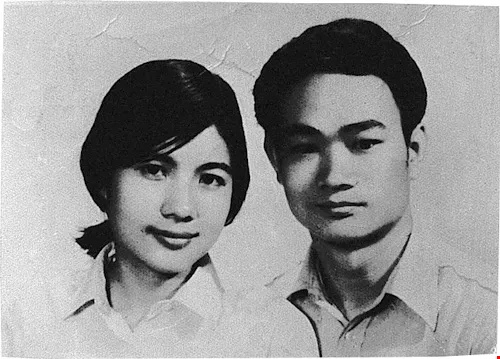
Wu's wife Chuang Fang-hua is his spiritual support. In addition to working as a teacher, she takes care of the home so Wu can write without interruption.
Classroom and field
After completing his mandatory military service, Wu returned to school to make up his missing credits. He still couldn't concentrate on studying, so he stayed yet another year. In 1971, he finally graduated from the program in Pingtung at the age of 27. He'd decided to move to Taipei to take an editing position at a literary magazine called Youth Literary, but his mother's tears pained him when it was time to leave. Then he ran into his high-school literature teacher at the station. He'd recently been made principal of Hsichou Junior High, and asked Wu to stay and teach biology.
For his mother's sake, Wu cast aside the editing job he'd long dreamed of and chose to stay on the farm. He helped her raise the pigs and plant the fields. After work, he'd head out to the field to pick her up, then he'd prepare a hot bath for her. In addition to being so kind, he stayed obedient-the rules of the house remained those determined by his mother. When things didn't go well on the farm, he'd listen patiently to her complaints.
Also, things on the farm were different than what he learned in the animal husbandry program. "Working in the fields with my mom, I realized how difficult life on the farm was," he says. "The poetic romanticism of my youth was replaced by the realities of life." In the early 1970s, the era in which Wu returned to the farm and was teaching, most Taiwanese were still making their living through agriculture. Taiwan's economic stability at the time was largely due to the heavy taxes levied on farmland and water usage, as well as exploitative agricultural policies such as mandating grain-for-fertilizer programs and maintaining artificially low grain prices.
"According to statistics and local records, very few farmers were debt-free," Wu says. Furthermore, the processing and exporting businesses that had started to flourish in the 1960s were attracting more and more young people from farming areas, contributing to the "graying" of farming communities.
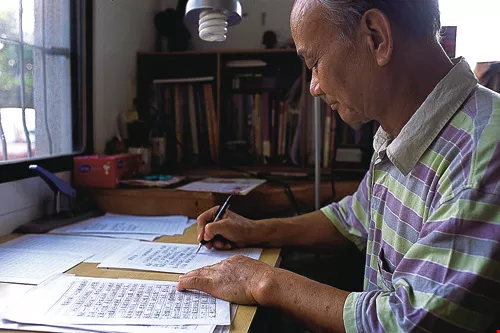
Being diagnosed with cancer hasn't slowed down Wu's writing.
Hometown
The outside world rushing into the farming villages and Taiwan's changing of focus from agriculture to industry brought worries for the times. This, along with the love of the land and the harvest that he'd always had, led Wu to write a well-received series of poems called Impressions of My Hometown.
"Literature is basically a reflection of life. I don't mean to define myself by my 'hometown,' and I'm certainly not going to limit myself to that," he says. "I'm just trying to use poetry to show my experiences and emotions being born and growing up in my hometown." He says he's got a "farmer's personality"-he'd never move away and he dislikes change. He's with the land and the crops every day, and has developed a deep love for them that he's written down in poetry:
"In the brightness, no one knows / When the sun's face will become overcast, / And disappear in a huff, when the Lord of Heaven / Will send down a rush / Of bitter mist, or a bout / Of prankish northwesterly rain.
"The threshing fields of my hometown / At threshing season / Are an amphitheater of panic / From time to time panicking the residents of my hometown."-Threshing Fields, from Impressions of My Hometown.
The tough lifestyle and a direct personality have formed Wu's deep local sensibility. He has a strong awareness of issues concerning farming, the land, and the environment. For example, in the poem "Bitter Smile" from Impressions of My Hometown, he directly satirizes the overuse of pesticides: As a group of lively children sit at the dinner table, happily chewing their rice, "Dowsed with too much pesticide / The bitter grains / Can no longer nod their heads / They can only silently, bitterly smile."
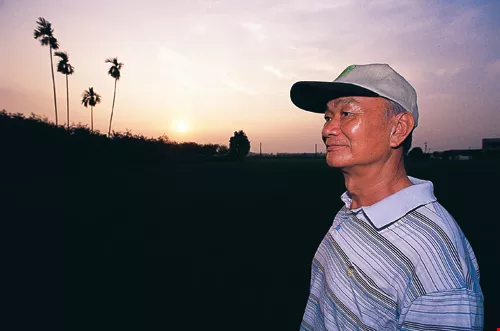
Through poetry and essays, Wu Sheng records the traditional Taiwanese farming lifestyle. His work reflects the changes that have come to the farm with modernization.
Dreams of the "motherland"
In 1980, Wu was invited to stay at the Iowa Writers' Workshop for nine months as an artist in residence. In America, he had access to much information he couldn't get at home, and he was shocked.
"I spent many late nights quietly reading the truth about historical events and deep social criticism, and I always felt pained in my heart," he says. "I'd break out in tears, unable to stop myself. I felt anger and sorrow for Taiwan, and I also felt pain for China."
Before going abroad, he'd placed hope in the "socialist motherland" of China, but after reading reports about the Cultural Revolution, he started to feel deep illusion.
"I couldn't understand what kind of government, society, and culture could so thoroughly bring out the worst in human nature," he says. He even discussed his disappointment with a writer in the program from China, Wang Meng.
Wang turned things around and asked him, "Well, what about Taiwan then?" Just one year before, the KMT government had cracked down on dissidents in the aftermath of the Kaohsiung Incident. "At the time, any sensible person would have realized that that was setting the stage for governmental oppression," he says. "It was just that in the middle of the White Terror, people never got the facts." Wu became even angrier when, a few months later, the family of democratic movement leader Lin Yi-hsiung were brutally murdered the day after he was sent away to prison.
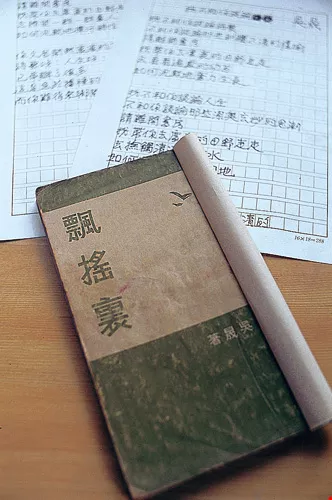
A manuscript by Wu, and Swaying, the collection that brought him pride and shame.
No more poems
In a class, a student from Taiwan translated Wu's poem "For Example": "For example, seeing some people / Respectable and noble, / But shamelessly snatching away other people's things, / You often can't help but want to cry out, / Stop thief, stop thief!"-"For Example," from Speak to the Children.
During the discussion, an American student asked, "Your poems are so critical. Is that because the Taiwanese government is corrupt and tells lies? Do you use these metaphors because there's no freedom of speech in Taiwan?" Wu thought about it and laughed, answering, "I've only been away a few months, and I have to go back soon." Getting what he meant, many students laughed, but Wu felt a great sadness.
Wu's generation grew up in the midst of the White Terror. As a student in Pingtung, his home was searched by four police officers with a warrant from the National Security Bureau for "extremist views" and "spreading extremist speech." Wu wasn't home at the time, but the police took some of his manuscripts. It was only six months after his father's death, and his mother was in a panic. The incident made a deep impression on Wu, and he could only use metaphors in poems to show his resistance to such oppression.
When he returned to Taiwan, his dreams of the Chinese "motherland" were dashed, and he was unhappy with authoritarian rule at home. Feeling that poetry was useless, he fell into a deep depression. In a piece called "Hope" in the collection No Regrets, he describes the emotional turmoil of the period: "I'm disappointed in literature, I've lost faith in myself, and I'm disgusted with the state of the world. I will no longer teach passionately, I will no longer care about this society. Nothing to say, no more poems and no more writing." He doesn't hide the fact that he fell into drinking and gambling, causing heartache for his wife. He even admits to having been slapped by her as she pleaded with him to change his ways.
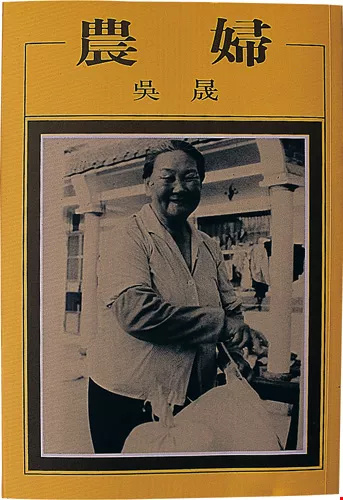
Wu made his mother the main character in his work Farmer's Wife. She's a wise, loving, hard-working, and occasionally foul-tempered woman with a rebellious spirit.
A mother's story
In the end, it was his wife's tenderness that inspired him to take up writing again. He began writing poems and essays, and in 1982 he published a collection of essays called Farmer's Wife. The following year, Reader's Digest magazine put together a condensed version and published it as an 18-page booklet in 16 languages.
In a preface entitled "Changing Hometown," his good friend Tseng Chien-min wrote, "No other writer has captured the image of Taiwan's farming communities of recent decades like this. No other writer has embodied the noble virtues and philosophy of the farmer. And it is precisely these virtues that are lacking in these empty times."
Farmer's Wife is based on Wu's mother. This wise, loving, hard-working, and occasionally foul-tempered 70-year-old had a rebellious spirit that did not come from books or education. It developed naturally from the traditional farming spirit. For example, regarding the overuse of pesticides and the frequent incidents of poisoning, Wu's mother would say: "You have to keep your conscience when trying to earn money! You know it's poison, but you still use it-it's immoral! Is making money more important than human life? Don't their children live here?"
In The Shops, published two years later, he even more directly points to the lack of long-term planning in Taiwan's rice-growing industry. To counter a trade imbalance with America, the government had begun importing American rice in large quantities to the detriment of local farmers. The farmers were operating on slim margins, and a single typhoon or an overabundant harvest could put them into the red.
In a piece called "Take It If You Dare," he describes how some farmers switched their crops from rice to spices for betel-nut. Profits from growing the spices for two or three years could be greater than those from growing rice for a lifetime. To farmers, agricultural crops had become so many commercial products that they could switch between at the whim of the market.
Wu says, "Because agricultural prices were so extremely unstable, farmers had no guarantees and became opportunistic. Just like the society of the time, they thought you had to "take it if you dare" in order to make it. That's how the market was, that's how the government was, and that's how the down-to-earth farmers were. It was a sorry state of affairs."
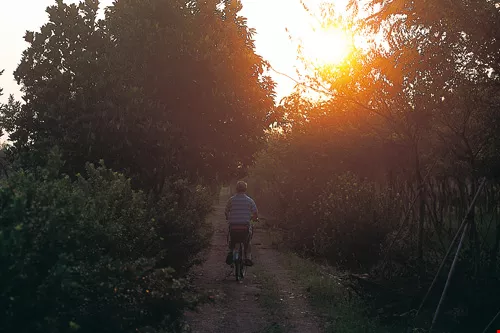
Wu explores his forest plantation by bicycle, hoping that in a hundred years it will be a lush, peaceful place for a future generation.
Tears of the earth
Seeing Taiwan's environment harmed by pesticides and industrial pollution, Wu wrote a scathing critique in a poem called "Stop Them" in 1981: "The mountain forests are your bones, / But there are those who ceaselessly swing axes and cut them down, / Slowly, slowly paralyzing you. / Poisons, wastewater and emissions / Dumped without any qualms, unregulated, / Obstructing your breathing, / Wantonly polluting every river, / Wantonly destroying every stretch of land."
Just a few years after the poem was published, two accidents at chemical plants in Taichung County and Hsinchu led to local protests. The plants were shut down, and Taiwanese found the courage to stand up against polluters. In 1986, residents of Lukang demonstrated against a planned DuPont plant, organizing Taiwan's first march for an environmental cause. The protesters won and the plans were scuttled.
But, was real importance attached to environmental issues? Was there really reform of environmental standards? In Wu's 1999 poem "Farewell to My Hometown," he reopens old wounds:
"A broad excavator / Digging up the earth mile by mile / The island's beautiful shoreline / Tenderly carved out by the waves over millions of years / Hastily cut away."-Seashore Morning Glory-Lamenting the West Coast #2, from Farewell to My Hometown.
From the source
Pained, Wu says that in modern times people have thought of land as a material thing to be bought and sold. Furthermore, Taiwan has for years lacked a land policy. Due to economic pressures, the land has suffered again and again. It is only when nature strikes back that we feel the consequences and come to regret. A highway through Nantou in central Taiwan, for example, collapsed so many times that it could no longer be repaired and the mountains it ran through had to be closed off for a hundred years to let the geology resettle. Blind development along the west coast in the form of fish farms and industrial parks has led to soil subsidence and salinity, for which no solution has been found.
"My poems are like the earth," Wu says. "They aren't noisy and they don't cause incidents. They don't grab the media's attention. They're not romantic. But once the environment is harmed, it's nearly impossible to bring it back." Wu sighs that even though he can cry out in his poems, he can never use them to gain mainstream media or official attention.
One year after retiring from Hsichou High in 2000, Wu became a writer in residence for the Nantou County Government. With his wife, Chuang Fang-hua, he traced the Choshui River from its source. They started from Wuling between Mt. Chilai and Mt. Hohuan, and followed it down through the Aboriginal villages of Wanta, Chuping, Wanfeng, and Wuchieh.
Wu set foot in each of them, and described them in words in his Notes on the Choshui River. Whenever there are heavy rains, the Choshui's three main tributaries flood, causing great damage and loss of life. Wu asks:
"Just what is the source of the river? If there is a source in a fixed location upstream, why does the river disappear downstream? Taiwan was once praised as an island of forests-why can't it maintain a spring? How can it let a period of rain throw the flow of the river into chaos, destroying homes? When it's not flooding, it runs dry-how can we call this the 'Mother River'?" -"Water's Place," from Notes on the Choshui.
Leaving a legacy
Wu's always been low-key, but in recent years he's been getting some media attention for a work of another kind.
More than 20 years ago, his then-60-plus mother decided to plant some camphor trees. The neighbors all thought she'd never live to see the trees grow. She lived until shortly before the Puli earthquake in 1999, reaching 85 years of age. She lived to see the camphor trees sway in the wind, and spent her latter years enjoying their shade.
After she died, Wu's brothers wanted to sell off the farm. But to honor his mother's wishes that the trees be protected, Wu and his two sons bought out his brothers' shares. They decided to turn two hectares of farmland into a man-made forest.
In 2003, the Council of Agriculture approved their plan to create a private artificial forest. As of now, Wu has planted nearly 3,000 trees of native species including Taiwan zelkova, mahogany, incense cedar, cinnamon, and Formosan michelia. That makes him one of the few farmers in Taiwan who've been successful at creating an artificial forest in the plains. He named it "Pure Garden" using a character from his mother's name, and he hopes in a hundred years it will be a lush forest of trees.
Wu writes about creating the forest in his poem "Staring at Death," from the collection Meditations from Latter Years: "Thinking of what I can leave behind / Or, what I shouldn't leave behind." He hopes that he can leave future generations a pure and peaceful spot. Though he learned that he is suffering from bladder cancer and began treatment two years ago, he's still writing and working in his forest.
As a writer who is concerned with farmers, the environment, and society, Wu puts his ideals into practice through action. For more than 30 years now, he's recorded the beauty of Taiwan's traditional farming lifestyle through his poems and essays. He's depicted the farmers' life philosophy of determined hard work and contentment, as well as the social upheavals that have been caused by changing economic conditions. His writing is rich because it comes from his own experience. It's emotional, incisive, and positive. To Taiwanese readers, every word and every sentence reflects life's greatest and sweetest burdens.

@List.jpg?w=522&h=410&mode=crop&format=webp&quality=80)


