Grasping the Universe in an Egg--Egg Carving Artist Kuan Chun-mai
Kuo Li-chuan / photos courtesy of Kuan Chun-mai / tr. by Jon Babcock
September 2003


When you hold an egg in your hand, you're afraid you might drop it or crush it. Imagine the concentrated skill needed to carve on that thin shell.
With an egg from the market, a surgeon's scalpel, a magnifying mirror, two hands, and a precisely focused mind, egg carving artist Kuan Chun-mai creates a microcosm centered on an egg. How detailed and precise must an egg carver be? In Kuan Chun-mai, you see the quintessential northerner, a man who looks exactly like the portraits of the Qing-dynasty Nurhachi royal family that we find in our history textbooks. Indeed, he is a direct descendent of the Nurhachi family and he should be known by his full name, Aixinjueluo Kuan Chun-mai.
Kuan Chun-mai was raised in a family that had escaped along the railroad from Changchun in northeast China in 1950 and ended up living alongside the railroad in Taichung, Taiwan. His parents, both artists themselves, instilled in him a deep appreciation of artistic creativity as expressed, for example, in traditional paintings and carvings.
Kuan was stationed in the north during his military service and often spent his free time viewing the cultural treasures held in the National Palace Museum. Of all the famous artifacts it was the carved ivory balls in particular that captured his interest. The superb craftsmanship expressed in their warm rich hues and intricately carved multiple layers never ceased to amaze him. Seeing these ivory balls he too was determined to carve ivory once he had completed his obligatory military service. But upon leaving the armed forces, as a young man with no viable economic base, he found ivory simply too expensive, and he decided to give up the idea of carving it.
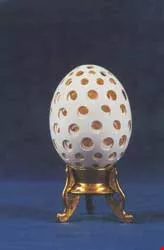
After gaining an understanding of the special properties of eggs, Kuan Chun-mai produced a set of eight hens' eggs that closely resemble traditional multi-layered carved ivory balls.
Wonders never cease-carved eggs
How did he start to pursue egg carving? The opportunity arose in 1977. His wife was about to give birth to their first child, and friends from Pingtung had sent several chickens as a present. One day as he held in his hand a newly laid egg, the feeling of being an expectant father merged with the warmth of the egg to fill him with intense joy. This tiny perfect hen's egg in the palm of his hand, exquisite in shape, in color like ivory, gave rise to a flash of inspiration-he saw here the material for his own creative work: egg carving.
When they heard he was intent on carving eggs his friends ridiculed him saying that if it could be done it would have been done a long time ago, and even if it hadn't, it was next to impossible that he would be the one to do it now. Who would have thought then that this oddball idea would lead Kuan Chun-mai to become a world famous artist as an egg-carver?
As for ridicule, Kuan Chun-mai has this to say, "If you want to dedicate your life to art, you must be different, for creativity and uniqueness are the holy truths of art."
After looking at a huge number of masterpieces of stone, bamboo, rice, and hair carving, he felt it would be virtually impossible to find a way into this field. But as he continued to examine the historical materials and traditional artifacts available in Taiwan, he noticed there was nothing on the art of egg carving.
As far as art and eggs in the rest of the world is concerned, there were the Russian "Faberge eggs" of a century ago during the time of the Tsars. The eggs were incised and then decorated with pearls, jewels and colored designs. Nevertheless, this is not the same as carving the eggshell purely by hand.
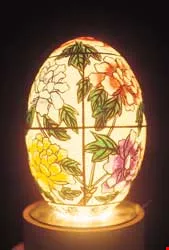
Kuan Chun-mai first carves the pattern or picture on the eggshell in relief. Next, with the lamp light beaming through the shell, using the tip of an extremely fine brush he adds acrylic lacquer. Then he paints the inside through tiny holes that he has bored into the shell. Against the light, the finished works reveal a dazzling display of colors.
Like venturing onto thin ice
So this is how Kuan Chun-mai chose a path of artistic creation that had not been followed before, and why his family garbage was henceforth replete with eggshells. After pursing this course for seven years and breaking countless eggs trying, he was finally able to carve out a few holes on the shell. He was beginning to realize what "carving eggs" really entails.
After spending more than 2,500 days at it over seven years, Kuan Chun-mai had tried out all sorts of carving tools, but no matter how keen the edge, as soon as it came into contact with the eggshell he would invariably hear the sound of cracking. One day a friend who worked at a hospital suggested that he try using a surgeon's scalpel. He discovered that in addition to being razor sharp, the edge of the scalpel blade was somewhat pliant. Suddenly he realized that the tools he had been using before were simply too hard. It was a case of pitting hard against hard-the hard-edged tools pitted against the brittle eggshell-with the inevitable result, a cracked shell. The pliant edge of the surgeon's scalpel on the other hand was a case of "using the soft to subdue the hard," and this finally allowed him to carve a single line upon the shell.
After doing it for many years, what does he feel when he first picks up the knife to carve?
Kuan Chun-mai puts it this way: Once, while visiting China, I walked over the frozen Songhua River to Taiyang Island. Under my feet was nothing but a layer of thin ice. On any given morning, if I had not concentrated completely I would have slipped, and that would have been the end of me. If someone wants to know what the old saying "like venturing onto thin ice" means, I would say it is like my first steps onto that thin ice. It is the same with those first strokes of the knife onto the shell: You "hold your breath and concentrate, alert and apprehensive."
After finding the right tool, and keeping in mind that "it's all a matter of controlling the force," after countless broken eggs due to squeezing or pushing too hard, Kuan Chun-mai eventually developed his own creative "knife withdrawal technique" whereby an even, well distributed pressure is applied when withdrawing the knife point from the cut. The principle is roughly similar to the "cue withdrawal technique" used in billiards.

A direct descendent of the Manchurian Qing royal family, Kuan Chun-mai's works emanate a profound aura of East Asia. The Qin terracotta figure modeling is vibrant and alive.
Knows eggs better than a hen
Selecting the right eggs also requires a certain amount of skill. He examines each egg, one by one, in the light of his flashlight, only to end up buying four or five. The process takes an hour if it takes a minute, and has earned him the appellation "least welcome customer" among the neighborhood egg sellers.
In his experience, eggs must be the proper shape, neither too round nor too oblong, with smooth and even contours, and creamy white like ivory in hue. The whiter the color, the more lime there is in the shell and the less calcium, resulting in a shell that is too brittle and not suitable for carving. When looked at under a strong light, many white spots indicate that the shell thickness varies considerably, whereas an egg without such spots means that the thickness is uniform and the eggshell is suitable for carving.
In 1988, Kuan Chun-mai held his first show at the Taichung Municipal Cultural Center. A cry of surprise arose from art circles throughout Taiwan. In response to media reports, staff from the National Palace Museum were dispatched to Taichung to look at the carvings, and they brought some back to the museum for further examination. Once they were convinced that the eggshell carving was a purely manual effort and that it was indeed a legitimate expression of contemporary art, they issued a special invitation to Kuan to exhibit in the Contemporary Art Gallery of the museum. Upon learning that Kuan Chun-mai's art was completely self-taught, Chin Hsiao-i, head of the NPM at that time, praised him saying, "Your egg carvings may not be the most beautiful works of art of all time, but they most certainly are new masterpieces coming out of an old tradition."
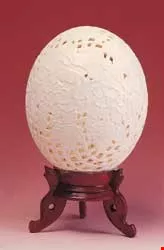
Entitled "Mulberry Grove with Concubine Yang Taking a Spring Nap," this carving of peonies won a Folk Arts Award for Kuan Chun-mai in 1992.
World records
Egg carving is a skill based on a combination of drawing and carving. Regardless of the size of the egg, the carving, be it deep or shallow, is done on the oval-shaped shell, and because the eggshell is so thin and fragile, carving is extremely difficult. Therefore, in addition to having an understanding of the special characteristics of eggshells, it is necessary to know how to apply precisely the right amount of force with the knife. Only in this way will the fluidity and refinement of the lines and the natural beauty of the form emerge.
Because the knife is so important, besides the surgeon's scalpel, Kuan has made several knives of various edge angles of his own "invention" by cutting them out of steel plate and grinding them by hand.
Kuan Chun-mai's egg carving technique can be looked at under three headings: relief, engraving, and leaving the membrane. "Relief" means to carve away the layers beneath a drawing that has been first penciled onto the shell. Whether or not he is able to achieve two or three layers on the 0.3 millimeter thick eggshell depends entirely on the force with which he wields the knife.
"Engraving" means to carve out the unwanted parts of the sketched drawing. In this it resembles the 'protruding' (yang ke) seal carving method. The carved-out gaps generally must have five repeated cuttings along the same incision line so that the shell will come out with a single pry, while the inner membrane remains intact. The membrane must remain unbroken in order to extract the white and the yolk. For this, too, a special method is used: First a small hole is made at the top and the bottom of the egg, then the egg is placed upright in water where it somersaults, thereby causing the white and yolk to flow out. If this is done outside of water in the air, the eggshell will inevitably crack. After the egg has been cleaned out, the membrane is cut cleanly away from the carved gaps, and this concludes the 'engraving' process.
"Leaving the membrane" is done in a way similar to "engraving," just described. But when the membrane that is left is 80% dry, a translucent solution is applied to protect it, and once exposed to light rays, it reveals the layers in shades of gray.
Given his 20-year intimate association with eggs, Kuan Chun-mai figures he understands them better than a hen. He even feels he can control the eggs himself. He once bored 12,000 tiny holes in an eggshell, a feat that far exceeded the Guinness world record of 1,250 holes. After his understanding of the limits of the tensile and torsional strength of eggs, he used the principle of the screw to fashion an interlocking ring of five eggs. After grasping the unique qualities of eggs, he pushed his skill to a new level by nesting a set of eight different sized eggs each within the other resulting in what looked like the traditional multi-layered balls carved from elephant ivory. He called it "Lost in Dense Clouds."
In order to add color to his works, he applies the "mirror image inner painting method" used on snuff bottles. First, he sculpts the underlying picture or pattern onto the eggshell using the "relief" technique. Then with the lamplight beaming through the eggshell, with the tip of an extremely fine brush he adds acrylic lacquer through tiny bored holes, and with lamplight passing through the shell, he uses the "mirror image inner painting method" to paint the colored lacquer on the inside of the eggshell. When the work is displayed against the light, the colors of the inner painting reveal themselves.
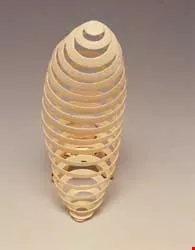
Having understood the limits of an egg's tensile and torsional strength, Kuan Chun-mai was able to carve an eggshell into the shape of a screw, and then stretch it to twice its original length.
The 'egg' of the world
To achieve rich variety of content in his works, Kuan reads and travels widely and seeks creative inspiration from the experiences of his everyday life. Let us illustrate this with "Mulberry Grove with Concubine Yang Taking a Spring Nap," winner of a Folk Arts Awards in 1992. Thanks to a friend who works for the Taiwan Forestry Bureau and has been stationed at the Alishan Memorial Peony Garden for the past 16 years, Kuan has become fond of peonies and studies and grows them. On an average day he will paint or carve them as well.
One time on a trip to Shandong in China, he went to admire the peonies in the Zheng Du Mulberry Trellis Gardens in the city of Heze. The peonies were in full bloom within the grounds, and those in the garden called "Spring Nap of Yang Fei" were especially overwhelming in their beauty. He chose an ostrich egg as the material upon which to sculpt his memory of the scene and called it "Mulberry Grove with Concubine Yang Taking a Spring Nap."
With an egg as the medium the story of the egg, like the work itself, becomes part of the appeal.
Once at an exhibition in Changhua, a man who raised fish in pools by the sea asked Kuan whether he had ever carved a wild bird's egg. It seemed once a Siberian wild goose had passed by his fish farm. In aspiring to a fine feast of fish in the ponds, she became entangled in the fish netting and injured herself. After she had been nursed back to health by the fish farmer, she continued on her journey but not before depositing four eggs which of course she couldn't take with her. The crisscross net pattern carved onto the eggshell in the work called "The Goose's Hard Journey Home" conveys the sadness of the mother goose who, having been caught in a net, was unable to take her young ones with her on her flight back home.
Another somewhat unique egg carving called "Raw Materials" is made using the egg of a bird which is an Australian national treasure, the emu. The emu resembles the ostrich, but is slightly smaller. According to Australian law, no one may take emu eggs out of the country except by submitting a special request. Since there was no egg carving craft activity in Australia at the time, when Kuan first made his request the government authorities didn't believe that the eggs could really be carved. But after seeing his egg carvings, they agreed to supply a limited number of eggs every year.
In emu eggs the layers are clearly distinguished. The outer layer is a deep fleckstone green, the middle layer a rich teal, and the innermost layer is pure white. This lends a great deal of depth to the carved works.
In 2001, Kuan Chun-mai was invited to exhibit his work in Las Vegas. At that time some local people brought eagle eggs to him. This protected species of eagles builds its nest among the high cliffs, and because the total number of eagles is still quite small, the members of a bird protection society sometimes take the eggs from the cliffs and incubate them. The eggs that Kuan had were not fertilized, and the delicate pale green hues were extremely appealing. He bought ten and carved them after returning to Taiwan. The membrane in this kind of eagle's egg is thicker than in most eggs so he applied the "leave the membrane" carving method to them.
Besides these Kuan has carved hen's eggs, ostrich eggs, peacock eggs, swan eggs, the eggs of wild birds, crocodile eggs, turtle eggs and even snake eggs. Crocodile eggs and turtle eggs are not suitable as carving material, he says, because the membrane is too thick. And because they are extremely thin and pliant, snake eggs are nearly impossible to carve.
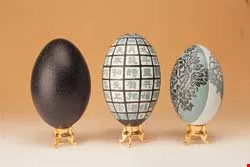
In the Austrailian emu egg the layers are clearly defined. The outer layer is dark green, the middle layer tael, and the innermost layer white. This clear definition of layers provides for ample creative space and endless variety.
Detail and concentration
After Kuan had completed a substantial number of egg carvings, their durability began to be a concern among those who had collected them. But Kuan is not worried that his art is invariably transitory. He gives the example of the 100-year-old Russian "Faberge egg" that the Tsar gave as a present to the King of England and which still remains very much intact in Buckingham Palace. "The crucial point in storing egg carvings is simply whether or not they are well protected," he said.
Zen lover Kuan Chun-mai recognizes walking, standing, sitting, and lying down all as Zen. Time spent carving eggs provides a superb opportunity to "sit" in Zen meditation. Others speak of posture, etiquette and so forth when they discuss sitting meditation, but he attains Zen samadhi while working on his creations. This is reminiscent of what the Fifth Zen Patriarch, Bodhidharma, said: "Outside, each and every connection is cut off. Inside, not a whisper in your heart. Have a heart like a wall. This allows you to enter the holy path." This is the kind of spiritual skill that makes it possible for him to concentrate on the most minute details while maintaining unbroken vigor. Thanks to this he was able to carve the 18 Arhats over a period of 18 months while keeping his thoughts as clear as still water throughout.
If one of his creations is destroyed after he has completed it, out of strict self-discipline he will never make the same thing again. This guarantees that each of his works is one of a kind. "Allowing myself to carve the same thing over again would merely encourage laziness, and soon I wouldn't be able to create anything new," he says.
In the pursuit of perfection, Kuan normally spends 30 to 40 hours on an egg before he considers the work finished. If at the last minute a small crack appears, to avoid letting anyone see it as well as to avoid planting the seeds of regret, he immediately throws that egg away. "In carving eggs it is one hundred percent or nothing. There is no such thing as ninety-nine percent perfection," he proclaims. This attitude toward creativity permits him to make only about ten or 12 finished works a year.
The underside of the forefinger of Kuan's right hand has become a series of six "chicken eyes" (corns) from holding the knife so long, and a hard callus has grown on the outside of the knuckle on his little finger from 20-some years of pressing it against the eggshell while carving. He has experienced "snow blindness" from carving too long under the rays of a magnifying lamp. He would feel pain in both eyes and see nothing but white everywhere. Only after going to the doctor did he recognize that the extremely close-up work of carving combined with the reflection of the white fluorescent lamp light from the white eggshell was, after long-term exposure, injuring his eyes. At his physician's suggestion, he changed the fluorescent lamp for an incandescent bulb and his condition improved somewhat.
Creating a new category of art
Because Kuan has no interest in doing business, the works of art that he has invested so much of his heart and soul in are kept safe for the long term by Lin Cheng-cheng, a friend who is a great fan of egg carving. For Kuan this means that he never has to worry about them and can freely create whatever he wants. Lin says that 15 years ago when he saw his first egg carving, he just couldn't believe that a work of art of such miniature detail could really exist. Then as he discovered that Kuan Chun-mai had already been engaged in learning the art for nearly ten years, and as he himself could see the devotion Kuan put into his carving, Lin came to feel that each carved egg was a one-of-a-kind work of art, and he thereupon began to collect carved eggs.
Twelve years ago, a well-known mainland miniaturist responded to an invitation to visit Taiwan. He, too, expressed his deep admiration for Kuan Chun-mai's carved eggs. He went on to say that he had never seen any purely manual eggshell carving like this on the mainland.
Lin Cheng-cheng, with his long-time interest in the art of egg carving, points out that even though there are currently those on the mainland who have started to practice egg carving, they all enlist the help of machines to one degree or another. For 100% purely manual egg carving, there is only Kuan Chun-mai.
In recent years, Kuan Chun-mai has accepted a few students. But they have yet to achieve his level of mastery of the art. This fact too highlights the rarity and value of Kuan's works.
Twenty-some years of being engaged in this work has led Kuan to believe that there is nothing impossible under the sun. His persistence at egg carving led to eventual success, but he doesn't see this as a reason to be especially proud of himself. It simply means that in the process of succeeding at carving eggshells, he has given mankind yet one more medium for artistic expression. "In the very weakness of the medium lies the challenge of this art. One day all of my carved eggs will be broken. People will have forgotten my name. But I'm optimistic that the art of egg carving will flourish, and that this kind of fighting spirit will persist, unbroken through time," Kuan stresses.
For many years now, in addition to accepting the usual invitations to shows on the Taiwan art exhibition circuit, he has been showing abroad, in the United States, the Philippines, and other places. In all of his works-be it in the modernistic "New York Skyscraper," the secluded and elegant "Peonies in a Mirror," the Zen-inspired "Arhats," or the contemporary abstract "Mother and Child," we see innovation arising out of tradition. Precisely this lies at the very source of Kuan Chun-mai's creative life.
He has broken out of the restrictions of traditional carving by using a completely new medium and new techniques to unveil a previously unseen art, the art of carving eggs. Not only has he given us works of startling beauty, he has added another milestone to the traditional sculptor's art.

@List.jpg?w=522&h=410&mode=crop&format=webp&quality=80)


