

Will we also experience a collapse in our publishing industry, such as happened in Japan? Will the East Asian book market always be in a 'trade deficit' relative to Western publishers? Is the East Asian publishing industry fated to be no more than a miniscule industry, facing challenges to its prospects for growth?"
While frequently heard within Taiwanese publishing circles, these questions also happen to correspond with the persistent concerns of East Asian publishers more broadly.
Building a New Book Road was jointly conceived by an editorial board with members from Japan, Taiwan, mainland China, and South Korea. The book has begun to appear this year, published in five different language versions: Japanese, traditional Chinese, simplified Chinese, Korean, and English. In these critical, transitional times for the publishing industry, its authors hope to use this book to remind each other that they are all in the same boat when it comes to sharing literature broadly based on Chinese characters. It is also a call to work together to redress past times of mutual neglect and missed opportunities.
Building a New Book Road quotes from a poem by the Japanese author Tanikawa Shuntaro:
"But on that planet / Were no longer found those things which had been called 'books.' / The planet shimmered purple / In the telepathic nimbus of its people. / The young, shutting their books, thought to themselves: / 'Can I become a blank page / Upon which to write a hitherto untold story?'"
Surely this romantic sentiment has also surfaced in the mind of each publisher and each reader.
At the dawn of the 21st century, globalization proceeds apace and the interdependence between countries continues to increase. Strangely, however, this has not led to unobstructed cultural and scholarly interchange; Europe and America still occupy an undisputed leadership position. The arrival of the digital age, with the Internet, video and audio CDs and other new media have not only altered reading habits, but have also severely tested the publishing industry's agility. With the trend towards liberalization in East Asian politics and economies, the publishing industry has joined the wave towards reform. As if opening up Pandora's box, the market's rate of change has accelerated to the point where it is impossible to truly grasp it.
"Can I become a blank page?" At the turn of this century, the publishing industries in Japan, Taiwan, China, and South Korea have passed through a tumultuous decade and will never have the chance to start anew, to return to that "blank page." However, how to continue to publish has become the question on everyone's minds.
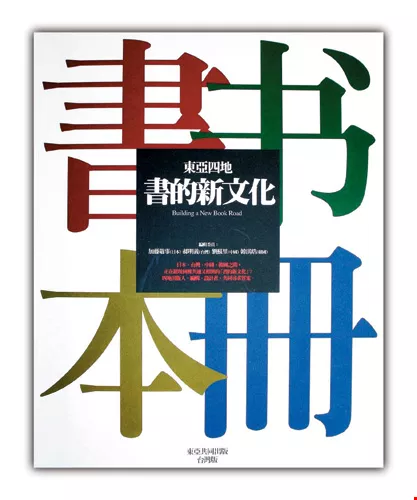
Title: Building a New Book Road Editors:Katou Keiji (Japan),HaoMing-yi (Taiwan),Liu Suli (China),Han Kiho (South Korea) . Publisher: Net and Books Publishing Co. Publication date: July 2004 Price:NT$450
According to Chinese researchers, in the first half of the 10th century there already existed a "Book Road" in East Asia, seen in the interchange of Confucian texts, Buddhist scriptures, poetry anthologies, and popular literature on trade routes from China to Japan. This interchange also solidified a common culture that, despite linguistic differences, utilized the same Chinese script. However, this book network faltered with the coming of Western influences and warfare between East Asian countries, bringing an end to a common culture of books.
In recent years, frequent interchange brought about by international copyright exchanges has led publishers to believe that the mutual distrust and neglect of the past can indeed be overcome. By chance, Tsuno Kaitaro, editor of the Japanese magazine Book and Computer, happened to meet Hao Ming-yi, publisher of Net and Books. They began discussing the idea of rebuilding the Book Road. Along with collaborators in South Korea and China, they used the concept of editing a magazine to pioneer the first publishing exchange platform in the East Asian publishing industry.
As Tsuno Kaitaro admits, the book tends towards the field of mass communications, with limitations on its breadth and depth of coverage, not to mention much content that awaits further development. However, to publishers used to working alone, reading this book can be a revelatory experience. Not only are publishers in these different countries surprised at how little they know about each other, they also discover that despite working in different environments, they face similar challenges and issues.
Repeating the Japanese collapse?The book is divided into five sections that present the experiences of East Asian publishers in the four aforementioned countries, as well as a section containing analysis from publishers in other areas. The third section, on the Japanese publishing experience, should be read first.
Even with the collapse of the economic bubble in 1989, the Japanese publishing industry continued to grow, reaching a high point in 1996. Its subsequent decline, however, was swift, bringing about declarations of a widespread collapse of the industry. The collapse stemmed from a domino effect that extended from readers to distributors, given changes in popular reading habits, proliferation of book categories, continually shrinking sales, and the increase in large-scale bookshop franchise chains.
Why don't people read books anymore? Book and Computer's website has collected a lot of thoughts on this issue and offers some food for thought. Is the decline in reading a manifestation, in part, of a consumer-driven society, or is it a global phenomenon? Is the decline something that can be addressed through the publishing industry, or is a momentous cultural shift now underway?
While the Japanese publishing industry might be a harbinger of things to come, Hao Ming-yi points out that the industry in Japan had passed through a number of stages and reached "middle age" before declining. In contrast to that scenario, the industry in Taiwan passed through a mere ten years of development before its sudden collapse, seeming more like a young person suffering ulcers after bouts of binge eating and drinking.
With the end of martial law in 1987, Taiwanese publishers and readers alike sought to fill the void brought about by past political censorship. Translations of foreign classics poured in and a range of new book categories was introduced to meet the needs of an open society. Seen in a positive light, this was a momentous flowering of knowledge. But in a negative light, it was a case of literary indigestion. Sadly, Taiwanese publishers were unable to change course in time to correct such structural imbalances. Instead, they began casting their gaze towards newly emerging markets in mainland China.
China falters, Korea pushes ahead!As with the country's pace of economic development, China's publishing industry has spurted forward in a blur of growth over the last ten years. Its potential seems unlimited. This sudden growth, though, has overturned conventional models of industry growth. For example, China has leapfrogged over VCDs and moved directly to DVDs, showing that simply importing industry models from other countries will not work.
Enormous activity in upstream publishing has resulted in a tremendous output of books in China. However, this activity is hampered by weaknesses in distribution stemming from vestiges of communist centralized economic planning, and books are unable to reach a wide public audience. Indeed, the challenges faced by publishers in Taiwan, Japan, and Korea seem magnified in China. The country, which seems to be a promising new center for publishing, has also become a challenging "black hole" for publishers.
The chapter on Korea, in contrast to those on the other three countries, gives a more optimistic portrayal of its publishing industry. It lays out in broad strokes the publishing industry's role in facilitating progress towards democracy, successes in Internet literature and youth-oriented books, and the rise of large multipurpose bookstores. Not presented, however, is an in-depth perspective on the growing pains that the industry went through in its development.
Perhaps Korean publishers do indeed see sunny skies ahead. Their gung-ho attitude can be seen from the chapter's coverage of a recently-opened "publishing city." In 2003, this huge complex was built on 1.58 million square meters of land in Paju, a suburb of Seoul. The facility, the completion of which had been one of the biggest dreams of the Korean publishing industry, is a vertically arrayed workgroup that integrates hundreds of upstream and downstream companies throughout the publishing industry, from publishers, printers, and designers, to copyright agents. Regardless of how this endeavor in vertical integration will fare, simply reading about it is enough to tantalize any publisher to want to go and see for themselves what is happening there.
Editing societyIf publishers were willing to lift up their heads from their desks, they would find this book a must-read. However, after finishing, they still have to go back to their desks and think about how the book can offer insight into their own sense of mission.
According to a survey of 168 editors in Taiwan taken this August in the "Formosa" section of the China Times, only 26% of those surveyed felt that editing was a field with a bright future. This low self-assessment may well prove to be an obstacle in Taiwanese editors' attempts to rise to a higher professional level.
Yuan-Liou Publishing chairman Wang Jung-wen laments that, while developing the publishing industry requires the energy that it takes to "build a giant ship," the industry in Taiwan possesses editors but lacks "producers" with international vision and comprehensive planning and implementation skills. This lack calls for a renewed self-awareness and awakening among publishers.
What is an editor?
Enterprise Cooperative Society chairman Lee Ki-ung writes in the book: "A great editor can edit anything, from books all the way to society itself."
Perhaps learning not only the craft of an editor, but also that of a resourceful producer, begins with a more expansive vision of the publishing industry.


