“Emperors’ Treasures” Exhibition Fosters Cultural Diplomacy
Lee Hsiang-ting / photos Chuang Kung-ju / tr. by Geof Aberhart
August 2016


A new page has been turned in Taiwan’s cultural diplomacy as treasures from the National Palace Museum attract the world’s attention through an exhibition in the United States.
The National Palace Museum has worked with museums in San Francisco and Houston to curate an exhibition that will tour both American cities. “Emperors’ Treasures: Chinese Art from the National Palace Museum, Taipei” is a showcase for Taiwan’s cultural soft power, drawing new crowds, familiarizing them with the wonders of the NPM collection, and putting a spotlight on the beauty and vibrancy of Chinese art and culture.
At 10 a.m. on June 17, 2016, the Asian Art Museum of San Francisco celebrated the opening of the biggest exhibition in the museum’s 50 years—“Emperors’ Treasures: Chinese Art from the National Palace Museum, Taipei.”
At the reception that preceded the opening, curators from San Francisco and Taipei joined with people from the local cultural scene, the media, and the ethnic Chinese community, along with staff from the Taipei Economic and Cultural Office in San Francisco (TECO‡SF), to celebrate. One of the biggest surprises for guests was the attendance of California governor Jerry Brown, who was so taken with the lifelike detail of the Meat-Shaped Stone that he spent quite some time poring over it, admiring the intricate craftsmanship.
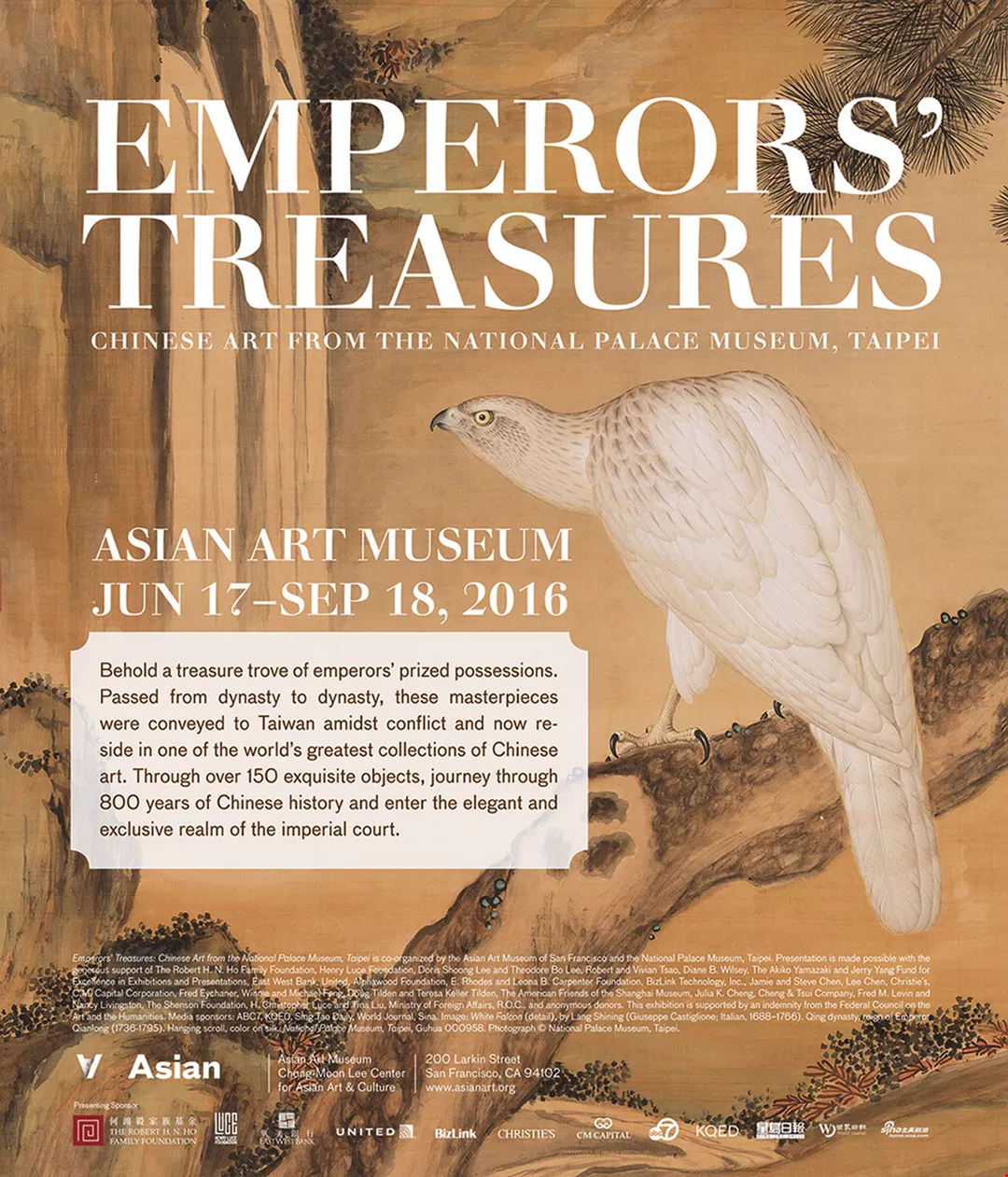
The poster for “Emperors’ Treasures” features the painting White Falcon by Italian Jesuit missionary Giuseppe Castiglione (1688–1766).
US‡Taiwan exchange draws international attention
This year’s landmark exhibition is a sequel of sorts to 1996’s “Splendors of Imperial China—Treasures from the National Palace Museum, Taipei,” which visited five US cities.
The first stop of the present exhibition is San Francisco’s Asian Art Museum, where it runs from June 17 through September 18. Joseph C.L. Ma, director-general of TECO‡SF, along with all of his team, worked hard to make this very special exhibition a reality. Not only has there been widespread coverage of the exhibition in mainstream US media, Chicago’s ABC7 even produced a 30-minute special entitled Emperors’ Treasures: Exploring Taiwan. The next stop for the exhibition will be the Museum of Fine Arts, Houston, from October 23, 2016, to January 22, 2017.
The Asian Art Museum has more than 18,000 Asian artworks in its collection, spanning 6,000 years of history. This year is the museum’s 50th anniversary, an occasion made all the more meaningful by this international cooperation with the National Palace Museum.
Convincing the National Palace Museum, one of the world’s great museums, to lend out some of its collection is no small feat. Asian Art Museum director Jay Xu had been working since 2009 to get this exhibition off the ground, even visiting the NPM in person every year thereafter to advocate for his plan.

California governor Jerry Brown made a personal appearance at the exhibition’s opening, showing particular interest in portraits of ancient Chinese rulers.
Cross-border curation challenges
When making his proposal in 2013 for “Emperors’ Treasures,” he also promised that in 2017 the Asian Art Museum would reciprocate, lending pieces for display in the Southern Branch of the NPM. Touched by his sincerity, in 2014 the NPM agreed to his proposal.
The Asian Art Museum, located in a vibrant hub of culture and modern art, California’s San Francisco Bay Area, has long showcased Asian culture with an array of unique exhibits, including a gilt bronze seated Buddha from 338 CE, the oldest extant Chinese Buddha statue of known date. This statue, along with a Shang-Dynasty bronze ritual vessel in the shape of a rhinoceros, nicknamed “Reina,” is among the museum’s greatest treasures.
NPM director Lin Jeng-yi was unable to attend the opening in person, but remarks that this is the biggest exhibition the Asian Art Museum has put on. The hope is, says Lin, that such joint projects will strengthen exchanges with the NPM and showcase Taiwanese culture, while also introducing more people abroad to the refinement and elegance of the NPM’s collection.
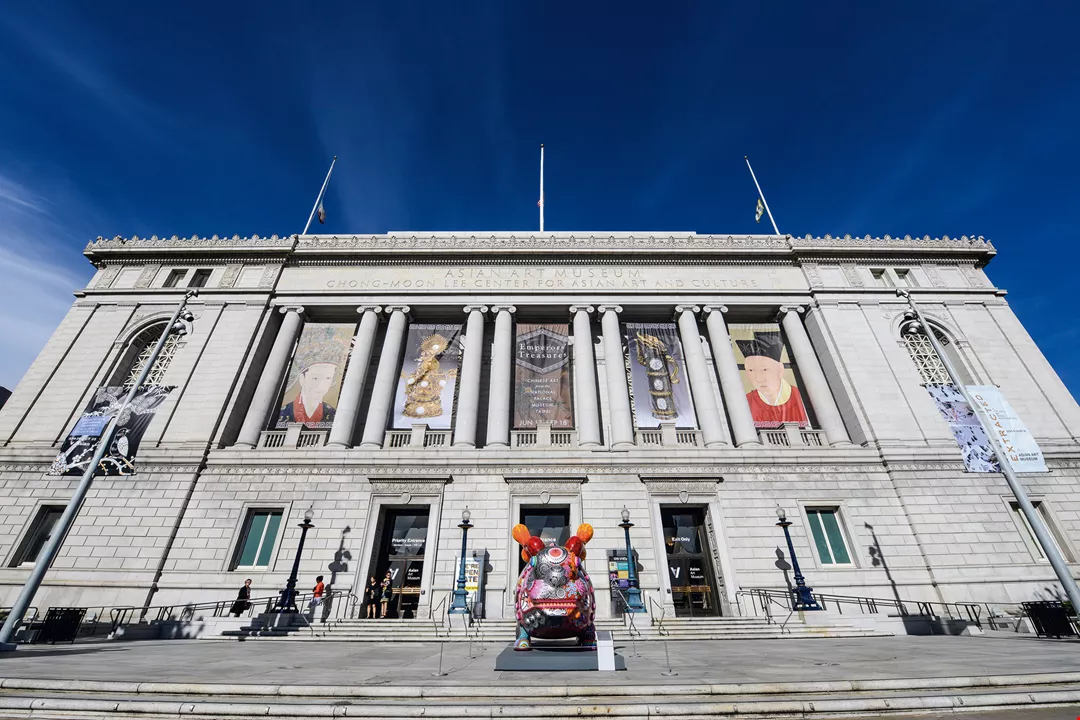
The Asian Art Museum in San Francisco is renowned on the US West Coast for its collection of Asian artworks and artifacts. Outside the entrance stands Fortunate Dragon, a piece by Taiwanese artist Hung Yi that is part of the museum’s permanent collection.
Federal guarantee
Another crucial factor in launching this exhibition in the US was the US government’s acceptance of the Asian Art Museum’s application for federal indemnity.
As the museum is a non-profit organization, the great cost of insurance for exhibitions like this can be onerous, so the US federal government’s willingness to indemnify the exhibition with the nation’s credit was essential for the NPM to be willing to loan such valuable exhibits.
Since May this year, the Asian Art Museum’s outer walls have been adorned with large, eye-catching advertisements for the exhibition, while outside the main door stands a work that is part of the museum’s permanent collection, Fortunate Dragon by Taiwanese artist Hung Yi.
This distinctive piece of installation art is modern and colorful, adorned with Chinese and Oriental patterns and elements in rich, vibrant colors. Every day, innumerable San Franciscans and tourists pose for photos with the dragon, the first piece by Hung to make it into the collection of a heavyweight American museum. It also marked the Asian Art Museum’s first foray into modern Taiwanese art.
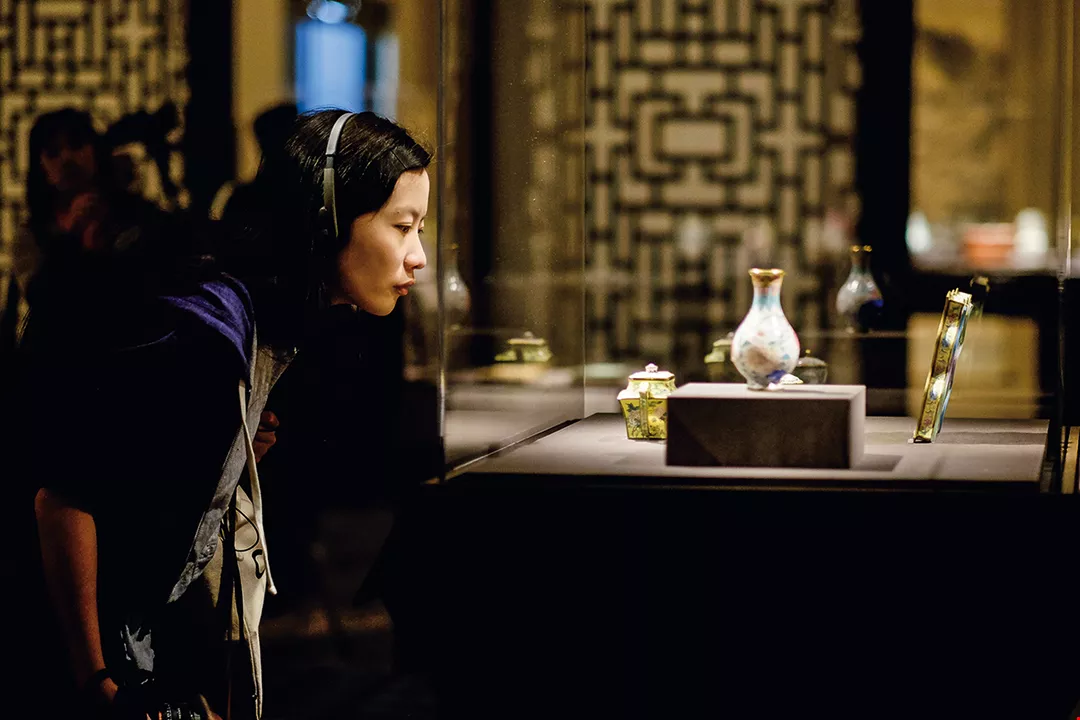
For more than half of the pieces on show, this is their first time in the United States. Over 30 of the items have been classified as “great national treasures,” and the two museums have worked hard to promote this “in-depth cultural exchange” between the US and Taiwan.
All eyes on me
Talking about the origins of this exhibition, Jay Xu shares the tale of how the two museums first came into contact.
The Asian Art Museum was started in 1966 with a donation of over 7,000 pieces by Chicago entrepreneur Avery Brundage which formed the foundation of the museum’s collection. Brundage had a powerful interest in Chinese relics, born of a visit to the Royal Academy of Arts in London, where he saw an exhibition of pieces sent from the Forbidden City in Beijing by the Nationalist government in 1935. That visit would mark the start of a lifelong appreciation of Chinese art.
Years later, Brundage made a special visit to Wufeng, Taichung, where the National Palace Museum had excavated a U-shaped tunnel in Mt. Beigou to store their collection. Accompanied by then foreign affairs minister George Yeh, Brundage was able to visit the collection again, further demonstrating his passion for the items in the NPM’s possession.
Now, the museum he founded finally has the opportunity to display items from that same collection he so loved.
Museum director Jay Xu has over three decades’ experience working with museums in both mainland China and the US. On the day of the present exhibition’s opening, he and NPM deputy director Ho Chuan-hsing personally gave the international media a guided tour in English and Mandarin, with Xu’s English commentary being particularly engaging. When asked which pieces he was most anticipating seeing, Xu laughed and responded that the answer would take too long to go through.
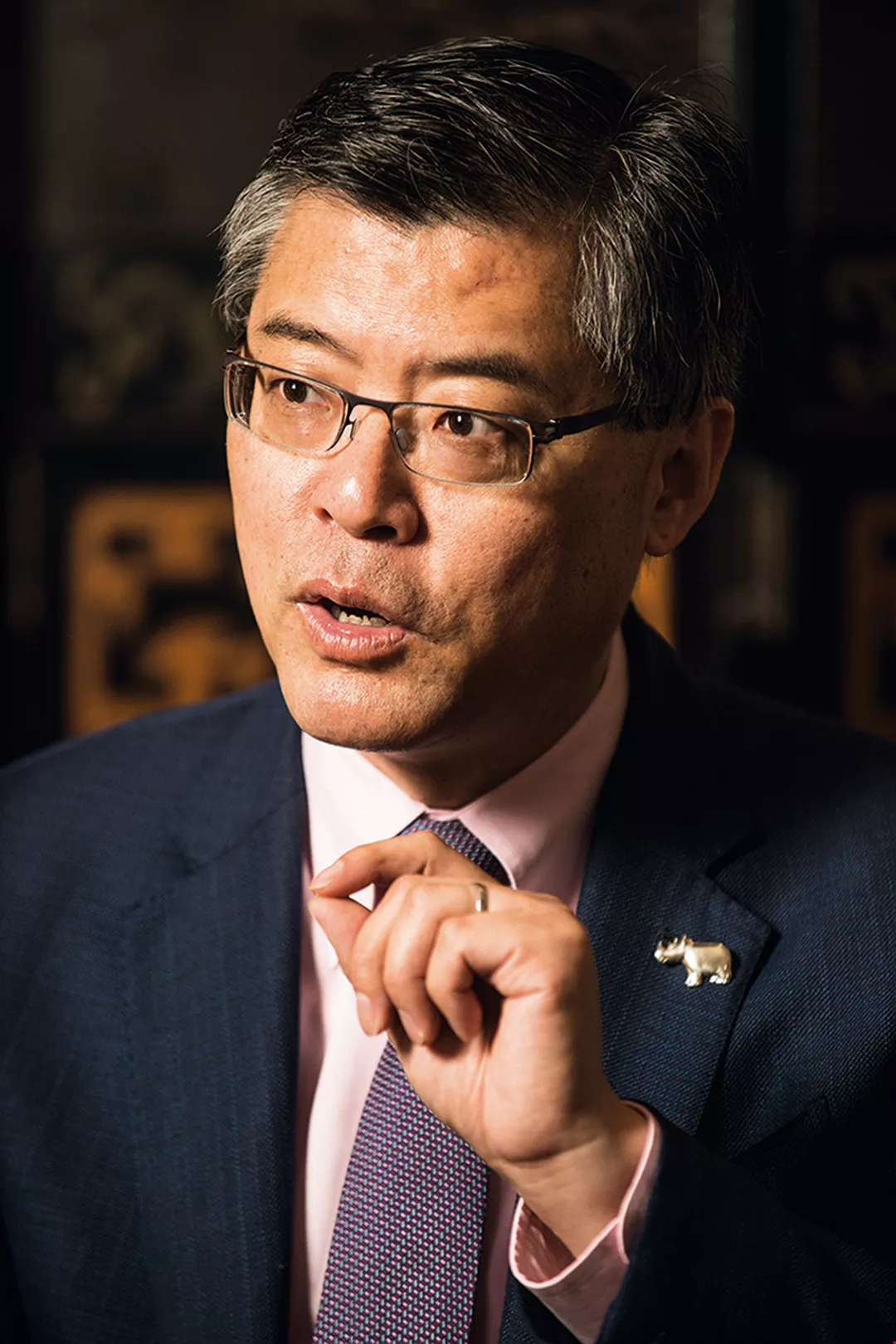
Jay Xu, director of the Asian Art Museum, is well versed in the NPM’s collection, having spent six years fighting for the chance to assemble this exhibition.
A conceptual portrait
One particular entry in that long list, though, is a poem entitled Grotesque Stones, written by the Emperor Huizong of the Song Dynasty in his own signature “slender gold” calligraphy style. “From his calligraphic works we can see his way of thinking, his literary talent, and his artistic skill,” says Xu. “To me, it’s practically a portrait of the man, and through it we can understand Emperor Huizong as a person better than from any ‘realistic’ portrait.”
Xu also mentions two other pieces: a Ru-ware vase of the Northern Song Dynasty with a poem by the Qing emperor Qianlong carved on the base, and a cup with a chicken design from the Chenghua reign of the Ming Dynasty (of a type of which another example fetched about NT$1.8 bn at auction by Sotheby’s Hong Kong in April 2014). “I’ve personally always really liked the carved wooden plaque, inlaid with enamel, that bears the Qing emperor Yongzheng’s admonition to himself to ‘guard against haste and employ patience.’ Similarly, I appreciate this because it paints a picture of the emperor as a man.”
Xu also led the state governor around the exhibition. “Governor Brown was quite interested in the idea of these portraits of ancient Chinese rulers,” he says. Ancient emperors were symbols of authority, and ordinary people rarely had the chance to actually see them. The only way they could understand the emperor’s ideas and personality were through his poems, collections, inscriptions, and so on. More than any portrait, these pieces gave insight into the mind of the ruler.
Being exhibited in America for the first time is one of the NPM’s most prized possessions, the Meat-shaped Stone. Understood at a glance by most people, this piece is not only popular, but also inspiring.
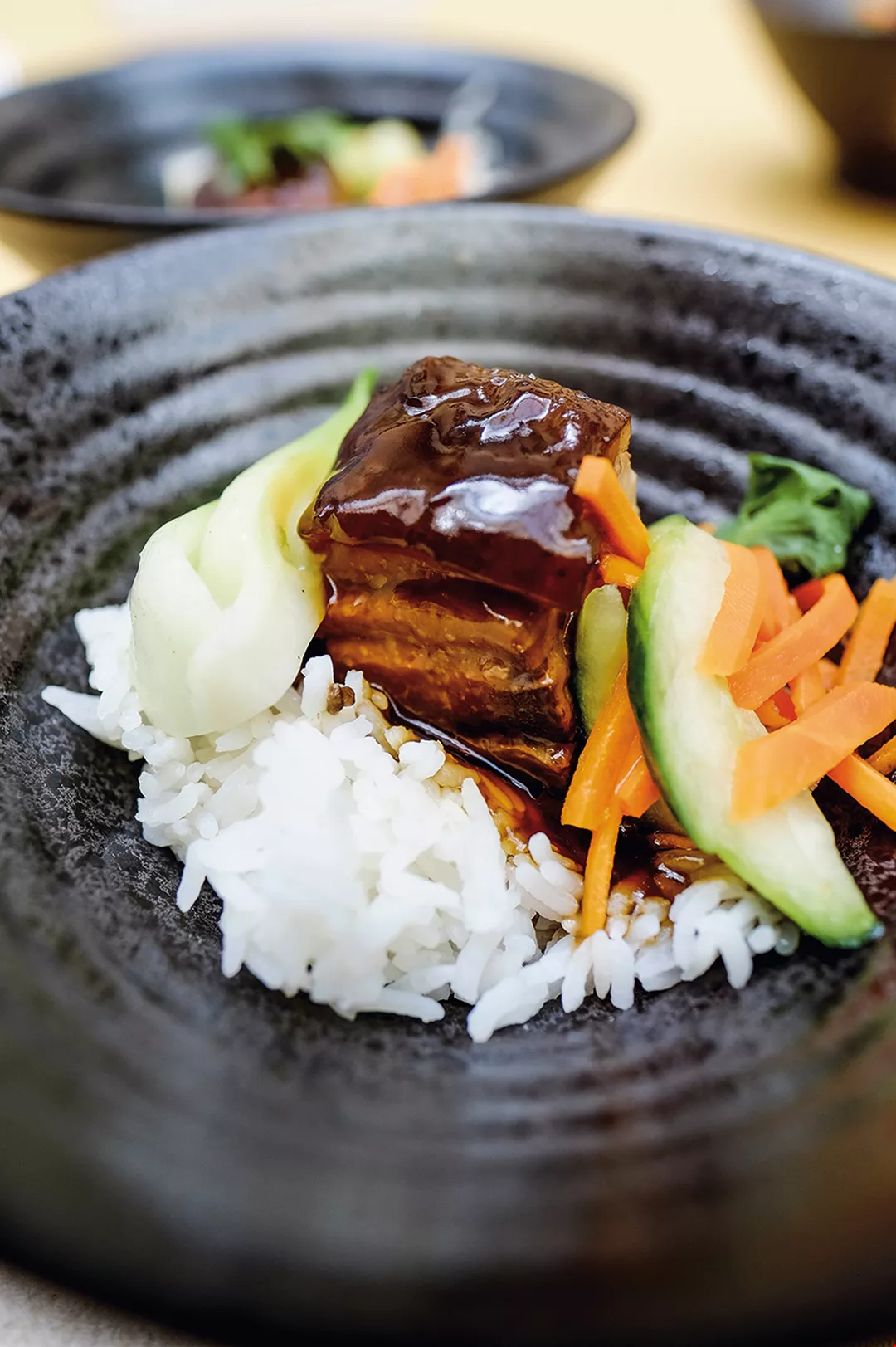
The Asian Art Museum partnered with 13 top Bay Area restaurants to create unique Dongpo pork dishes for their menus, giving audiences the chance to not only see it, but also to eat it.
Good enough to eat
During the exhibition, the Asian Art Museum has worked with 13 of the Bay Area’s top restaurants to each create a dish for their menu in tribute to this “priceless pork belly.” The museum has also created a short educational film about the dish that the stone is modeled after, Dongpo pork, helping promote Chinese cuisine. “Food is the common language in San Francisco,” says Xu, “and we encourage our visitors to ‘see it, make it, and eat it.’ Think about that ancient artisan carefully using the natural color of that stone to create such a lifelike sculpture of Dongpo pork. Now we can help people all over the world appreciate this masterful craftsmanship through the very dish it was based on. It’s incredible, and it has really caught the media’s attention.”
Over 100 court treasures are on display across four galleries on the museum’s first floor. On the walls hang several accompanying photographs of the later pieces’ times, including rare photographic portraits of the Empress Dowager Cixi, giving visitors a feeling of having entered an imperial private space. Additionally, each piece is accompanied by both Chinese and English signage, and an audio tour is available in English and Mandarin, given by Director Xu himself.
Visiting San Francisco to help with the curation, NPM deputy director Ho Chuan-hsing remarked, “When the palace items were first displayed in London in 1935, they gave many people in the older generation an admiration for Chinese art. In the 1960s, when they toured five American cities for the first time, they again influenced many people, this time of Mr. Xu’s generation, to learn about Chinese art history. We hope that as a result of this exhibition, we’ll see another generation of admirers, and we hope to also see more people come to Taiwan and visit the National Palace Museum.”


