

For Taiwan's art markets, 2007 was a truly exceptional year: Taiwan gained two new auction houses, raising its total to six; dealers successfully auctioned more than 1,200 works; and the fall auctions posted phenomenal sales of NT$2.58 billion, or more than double the spring's NT$1.2 billion total.
Contemporary fine arts are on a roll in Taiwan, sending prices for works by the "Fab Four" soaring. These four artists-Yang Mao-lin, Wu Tien-chang, Chen Chieh-jen, and Hou Chun-ming-are part of the post-martial-law "Museum Generation" showcased by Taiwan's new exhibition and performance spaces.
Part of their appeal is that they've contributed to the rise of many new contemporary art galleries and helped the gallery business break out of a years-long slump. Taipei's Tunhua South Road has become a virtual museum of contemporary Asian art, with exhibition spaces that include the Lin and Keng Gallery, Eslite Books, the 99-Degree Art Center, the Soka Art Center, and Impressions Art Gallery.
Will the enthusiasm for contemporary art currently sweeping Asia revive a Taiwanese art community long hungry for support? What do would-be art investors need to know before taking the plunge into the art market?
Back in 2006, the art market was abuzz with talk that prices for works by Taiwanese artists were due for an increase that would bring them more into line with other markets. As expected, the next spring brought good news.
The sale of a 1992 work by Hou Chun-ming at the Sotheby's Hong Kong auction, viewed as a key indicator of the state of the Asian art market, showed something startling was afoot. The piece, a set of eight woodblock prints entitled Erotic Paradise, went for HK$530,000 (about NT$2 million), or more than 11 times its reserve price, and immediately increased the value of all Hou's other work.
Then Hou's 37-print "Sou Shen Ji" series sold for HK$2.64 million (about NT$11 million) at Hong Kong's fall auction in November, making Hou the first contemporary Taiwanese artist to enter the "10 million club."
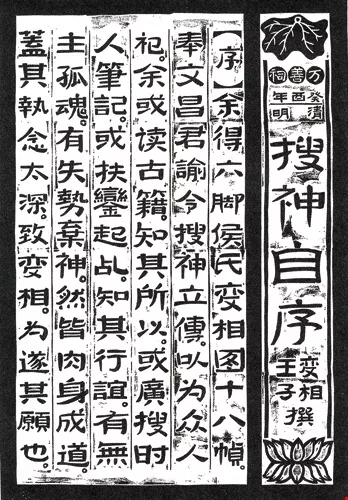
Hou Chun-ming's works consistently do well at auction. He rocked the art world with his 1993 "Sou Shen Ji" series of prints, which include inscriptions like those used to explain fortunes in temples. The contortions of the figures in the prints echo the twisting of repressed human desires.
The "Fab Four"
The fever soon spread from the Hong Kong market to Taipei. Bids for Yang Mao-lin's 1993 painting Zeelandia Memorandum L9302 began at NT$3.2 million and reached a record NT$14.77 million at a Zhong Cheng auction of work by contemporary ethnic-Chinese artists. Before bidders had a chance to catch their breath, Taiwan Island, a 1993 piece by Kuo Wei-kuo, set another record for a contemporary Taiwanese work. The piece, which depicts a black-spiked Taiwan bordered in blue in the south and green in the north, sold for NT$18.13 million, or about six times its reserve price.
The painting, which dates from a time when competition between the green and blue factions wasn't nearly as intense as it is today, sends up the absurdity of Taiwanese politics. It also honors the man then considered the "king" of Taiwan's stock market.
Hou, who was born in 1963, and Kuo, who is three years older, have both undergone self-doubt, creative lulls, stylistic evolutions, "hibernations," and periods of limited interest in their work on their way to achieving their current levels of fame. In fact, their lives in the arts reflect the course of Taiwan's contemporary arts scene.
Following the market's lead, the art world has designated Hou, Chen, Wu, and Yang the New Fab Four of Contemporary Art. Whether this honorific is broadly accepted or not, it has come as a shot in the arm to Taiwan's contemporary arts community.
But the buyers and sellers driving the market are all collectors. Do transactions among such people bring any benefit at all to artists, who are at the core of creative activity, or to galleries?
Tim Lin, chairman of the Lin and Keng Gallery, recalls Taipei having only a few galleries three years ago when the outlook for the contemporary art market was bleaker-basically just Eslite, Impressions, Main Trend, and Lin and Keng. Lin argues that the recent rebound in the art market has been of tremendous benefit to artists and galleries alike.
"The heating up of the market has helped the artists above all," says Lin. "Lin and Keng's asking price for works by artists it represents has risen more than 50% on average." As an example, Lin notes that the gallery raised the price of Kuo's large oil paintings from NT$400,000 to NT$600,000. An artist who painted 12 works a year would therefore see an NT$2.4 million increase in income. The higher prices are of particular benefit to an artist like Kuo Wei-kuo, who is both technically proficient and stylistically advanced. The 48-year-old is still in his prime and likely to paint for at least another 30 years. Prices for his work may rise higher still.
In addition to Yang Mao-lin and Kuo Wei-kuo, Lin and Keng represents six other contemporary artists, more than any other Taiwanese gallery, paying each a monthly stipend of NT$30-70,000. In return, it has complete authority to deal in their works, and takes a 50% commission on each sale.
The Lin and Keng gallery has been popularizing the work of Taiwanese artists in Singapore, Spain, and Beijing for many years. Lin estimates that it spends about US$100,000 per overseas exhibition for catalogs, recommendations from critics, advertising, marketing, transportation, and insurance.
"We are constantly putting more skin in the game, constantly exhibiting overseas to increase the value of the paintings," says Lin. "Our focus isn't on the short term, it's on the future. A painting that sells for NT$500,000 may see its price rise to NT$700-800,000 next year if we promote it and give it exposure with exhibitions." Lin says that as long as the artists regularly produce high-quality work, the gallery can recoup the added costs just by selling a few extra paintings.
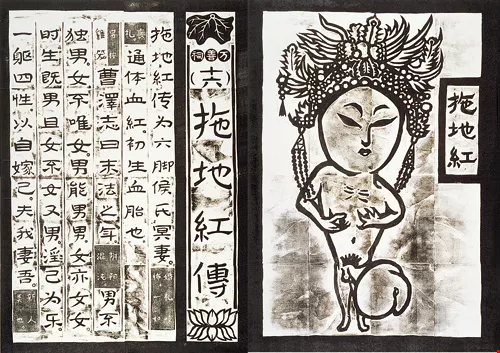
Hou Chun-ming's works consistently do well at auction. He rocked the art world with his 1993 "Sou Shen Ji" series of prints, which include inscriptions like those used to explain fortunes in temples. The contortions of the figures in the prints echo the twisting of repressed human desires.
Contemporary art
As those who like to explore galleries and museums are well aware, contemporary art from Taiwan, Japan, Korea, and China has become the darling of curators in Asia.
In late February, the Museum of Contemporary Arts, Taipei opened an exhibition entitled Infantization featuring the work of 41 young Chinese artists. Zhang Qing, the exhibition's curator and the deputy director of the Shanghai Art Museum, describes China's children of the late 1980s, the generation born under the one-child policy, as gelatin-shiny, formless, and devoured before you really taste it. To him, they are hybrid flowers, grafted onto the stems of the times and nurtured obsessively by their parents. They have resisted growing up, and their extensive educations have further delayed their entry into the working world, resulting in an exceptionally prolonged adolescence.
Infantization consisted of 60 works demonstrating the freedom, rebelliousness, selfishness, and purity of this generation of artists. It included videos, illustrations and animation. For example, Butter No. 1, an oil painting by 26-year-old Wang Zhibo, is a portrait of a slender, dreamy, sweet-as-butter man that breaks down gender lines.
Just before March's presidential elections, Chiu Tsai-hsing, a fixture in Taiwan's tech industry, reopened the Hong Gah Museum on Peitou's Tayeh Road. The revamped museum's first exhibition was Float, which explores the uncertainties and instabilities with which Taiwanese and Taiwanese society must contend. Nine contemporary Taiwanese artists spanning three generations, including J.C. Kuo, Su Wong-shen, Kao Chung-li, Hung Tung-lu and Chiu Chien-jen, were invited to participate and explore the interplay between artistic works and society at large.
Totem and Taboo-Floating, a J.C. Kuo piece from the show, depicts fit, good-looking young people, some of them floating in mid-air, playing with three brightly colored balloons. The balloons themselves are large, but hang low, seemingly keeping the young people down, though the painting is busy and its focus difficult to discern. Another piece, an interactive mechanical work entitled 1750 East-Facing Slopes, II by Chang Keng-hua is a robotic "transformer" made of metal. Dangerous looking at first glance, it sparkles when viewers approach, echoing the way in which modern people use bluster and bravado to hide their inner shyness and fear of interaction.
Analyzing the difference between the ways contemporary art is presented in Taiwan and mainland China, Shih Jui-jen, executive director of MOCA, Taipei, notes that contemporary art's appropriation of media such as comics, cartoons and animation has become virtually a global phenomenon. But the works also make use of culturally specific symbols in their content. For example, a modern illustration exhibited as part of Infantization was done on a long folding page like those in older Chinese texts. Similarly, an animation used an ancient two-headed, three-eyed monster and the concept of genetic synthesis to reflect on modern technology and science fiction and to demonstrate modern humanity's persistent connection to the spirit of the past. Similarly, contemporary Taiwanese art often includes images that echo local culture and folk customs, such as betelnut princesses and electric floats.
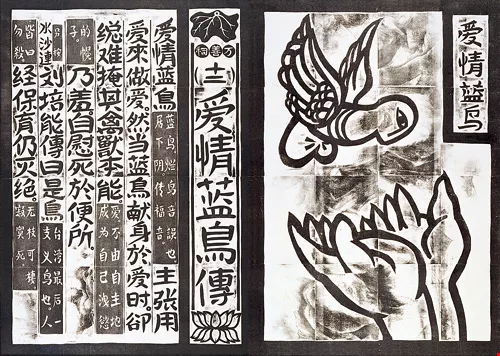
Hou Chun-ming's works consistently do well at auction. He rocked the art world with his 1993 "Sou Shen Ji" series of prints, which include inscriptions like those used to explain fortunes in temples. The contortions of the figures in the prints echo the twisting of repressed human desires.
Coming home
The opening of new galleries and expansion of old ones attests to the new enthusiasm for contemporary art. Impressions, for example, has opened a large new gallery for contemporary art in the very upscale Jen-ai Road Section 4 area. Gallery owners who set up shop a few years ago in Beijing and Shanghai have also noticed the changing winds and are coming home to participate in the resurgence of the Taipei market.
Hsiao Fu-yuan, owner of Soka Art Center, started his career in Tainan. He then moved to Beijing in 2001 intending to open a gallery. Three years later, with the mainland economy booming and the art market taking off, he became the first Taiwanese gallery owner to successfully establish himself in Beijing. Last year, Hsiao returned to Taipei to open a large exhibition space on Jen-ai Road.
The present day enthusiasm for the arts has also resulted in newspapers running stories on the arts in their more heavily read business and investment sections, as well as in their arts and culture sections.
According to Jimmy Lu, a consultant with the Art Galleries Association ROC, the development and maturation of Taiwan's art market in the 1980s was centered on the works of a previous generation of painters such as Chen Cheng-po and Li Mei-shu. The soaring interest in and prices for art seen in 1992 marked the end of the local market's first cycle.
"Global art markets had a banner year in 1992," says Tim Lin. "Then, when the news got out that bankruptcies at Japanese banks had burst the economic bubble, the world's art markets collapsed. They came crashing down like a landslide. Taiwan's market also suffered, leading the Sotheby's and Christie's auction houses to move to Hong Kong." Lin argues that the Asian Financial Crisis and SARS contributed to keeping the Taiwan market very quiet for 13 years. It was only when the economies of China, India and Russia took off, minting a fresh batch of nouveau riche and kickstarting a cultural renaissance, that investing in art reached its current height of fashionability.
"When people hear the phrase 'invest in art,' most think it's about making money," says Jimmy Lu. "They miss out on the pleasurable part and instead make major mistakes." Lu explains that there are five major criteria for investing in art: you have to see it, understand it, have the means to buy it and store it, and be able to resell it. Art is probably not as good an investment as real estate, stocks, and other financial instruments because it is less liquid-you may have to hold onto a work for years or even decades before you can sell it at a profit. He therefore advises people who actually need their money to put it into other investment vehicles.
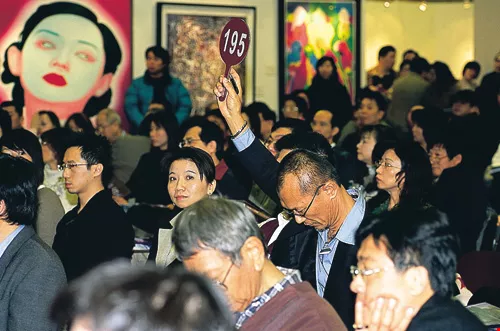
The popularity of the New Fab Four has kicked off something of a renaissance in Taiwan's art market. In recent months, collectors eager to jump on the art-investment bandwagon have been packing local art auctions.
Driving up prices
How should people resist the allure of soaring art prices? "Do you need to keep art and money separate?" asks Lu Tsung-yao. "There's never been an answer to that question." Noting the crowds at Art Taipei 2007, Lu, the financially astute director of the Lu-Chang Investment Group, felt that the time had arrived to invest in contemporary Taiwanese art. The 56-year-old Lu is blunt-he invests in art to make money. Breaking art markets down into Taiwanese, regional, and international, he argues that works by international artists go for hundreds of millions of dollars and are therefore better appreciated in books, and that works by traditional Chinese ink painters are also very expensive and primarily to be enjoyed at exhibitions. The current focus of his collecting activities is therefore works by Taiwanese painters of the past and present.
Tim Lin's advice to art investors for the last 20 years has been: "If you learn from the museums, and establish investment criteria based on art history, you needn't fear making mistakes." With regard to contemporary art, he recommends trusting the taste of professional curators to reduce the risk of mistakes. Lin suggests selecting works that curators like, that are exhibited repeatedly, and that have a high degree of exposure.
No one can tell how long the current enthusiasm for contemporary art will persist or how high prices will go, but when push comes to shove, forget the market. Amidst all the passionate bidding, your greatest desire should be for the pure beauty of art. If you choose what moves you without regard for the profit potential, you'll be a winner.
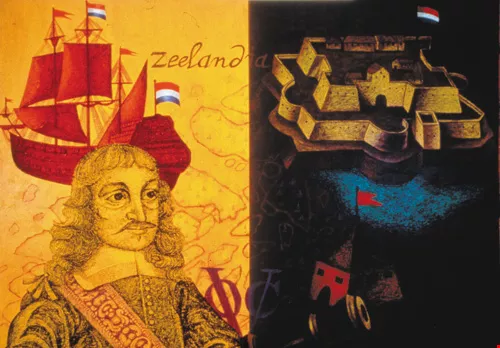
Contemporary artist Yang Mao-lin, one of Taiwan's New Fab Four contemporary artists, focuses on Taiwanese politics and culture in his work. His 1993 painting Zeelandia Memorandum sold at auction for a record NT$14.77 million last year.
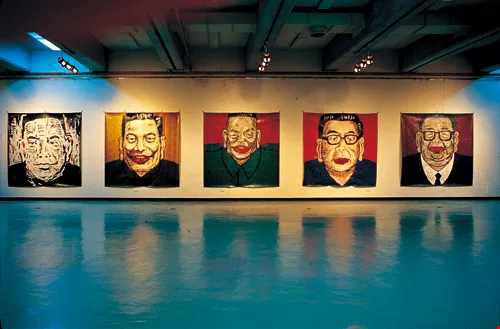
Contemporary art works rarely conform to conventional standards of beauty, and this presents challenges for the collector. Pictured here is the 1989 work The Five Faces of Chiang Ching-kuo by Wu Tien-chang, one of Taiwan's "Fab Four" artists. The piece tracks Chiang's changing political dispositions.


