Queen of Nanguan--Wang Shin-shin
Yang Lin-yuan / photos Yang Wen-ching / tr. by Anthony W. Sariti
January 2006


No sooner had she finished performing Wang Shin-shin on Stage--her first major work--in November 2005, than Wang Shin-shin the very next day gathered herself together and was on a plane to Paris, there to perform for more than 200 French senators and demonstrate the Nanguan music of which she is an acknowledged master.
The invitation had its beginning four months earlier when the president of the French Senate led a six-person delegation to Taiwan. The Council for Cultural Affairs invited Wang Shin-shin and several other artists and writers to help officially receive the delegation. During the dinner Wang Shin-shin sang "Burying Flowers" from Dream of the Red Chamber and accompanied herself on the pipa. This was a new piece she had written in which she experimented with using a Nanguan melody. Although it was an impromptu performance, the French officials were captivated and insisted on inviting her to come to Paris and perform.
Her pipa in hand, Wang Shin-shin entered the banquet hall of the French Senate dressed in the classical style, with antique earrings and necklace, her hair pulled into a bun and stuck with decorative hairpins--and the French officials were magically transported back to ancient China and the image of the beautiful courtesan. Wang then summoned up her concentration, narrowed her eyes and with the purest of voices, a voice seemingly not part of this world, she slowly sang out the words of Daiyu as she talks of "burying flowers." The sorrowful eyes and parted, scarlet lips, the slender fingers as they played over her instrument transfixed the audience. At the cocktail party following the performance many artistic directors from museums and art galleries all over Europe came up to her with invitations, and within a few short hours she had bookings up to the middle of 2007.
After her triumphant return, Wang Shin-shin got busy on her future and two years after having left the Han Tang Yuefu Ensemble has found her own stage.
In mid-November at Zhongshan Hall's Guang Fu Auditorium a Nanguan opera that recaptured the atmosphere of the stage during the Han and Tang eras was playing. It was entitled Wang Shin-shin on Stage. Lin Hwai-min, of the Cloud Gate Dance Theater, had been invited to take on the chores of artistic director, while direction and choreography were done by Wu Su-jyun and Luo Man-fei. Wang Shin-shin performed "Wang Zhaojun Crosses the Frontier" and "Yan Zhi Kou."
This was the first time Wang Shin-shin had appeared on stage as an actress. Although she played the Nanguan music she was familiar with, she did not just sit down and accompany herself on the pipa but rather had to physically act out the story line. She admitted she was very poor at acting. The last time she had done anything similar was at the invitation of the Taipei Crossover Dance Company when she portrayed a female pipa player of the Han-Tang era. She had only to walk from one end of the stage to the other, a short ten meters, but she felt as stiff as a board. This time she played many roles and had to blend into the story line. It was really quite a test.
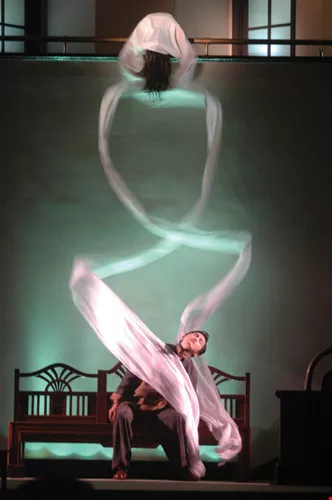
"Yan Zhi Kou" combines traditional Nanguan music with a modern theatrical performance. It satisfies the aesthetic demands of music and drama afficionado alike.
The Shin-shin craze
As the curtain rises at dawn, Wang Shin-shin appears on stage as the Han imperial concubine Wang Zhaojun. She is wearing a broad, red gown edged in black especially designed by Ayako Maeda, the Japanese Noh fashion designer. It is the tragic scene when, soon to be married to the Xiongnu khan on orders of the emperor, she faces the sacrifice of her own happiness in return for peace between China and the barbarians.
She rises from her bed, combs her hair and layer by layer puts on her bridal clothes that symbolize the enormous pressure bearing down on her and the shackles that bind. Then with the imperial escort she gradually approaches the time of final departure. She begins playing and singing Bai Juyi's Ode of the Pipa. In a high, pure and melancholy voice Wang Shin-shin expresses Wang Zhaojun's broken and lonely spirit as she prepares to cross the frontier. On the desolate road she recalls the beautiful and sumptuous life of the Han court she is bidding farewell to. The sorrowful resentment deep within her has no escape and all she can do is quietly express her pain in the mournful music she plays as each step brings her closer to her marriage into a foreign, far-off land.
This bridge piece, a rewrite of the music for "Wang Zhaojun Crosses the Frontier," focuses on the emotional turning point just before Wang Zhaojun crosses the frontier and particularly showcases the character of Nanguan music, so well suited to expressing inner emotions. And to envelop the audience even more in the atmosphere of Han times, there was the rich scenery aided by dazzling lighting and gorgeous costumes, all evoking the grandeur and the melancholy beauty of a dynasty at its apogee but about to fall.
A few evenings later at the Jen Tan Ju Chun teahouse on Yungkang St. in Taipei, a group of writers and artists gathered. Their expansive conversation turned to this production of Wang Shin-shin on Stage and the atmosphere at once became animated. They all were full of praise that the opera had opened up a new door for this cultured, traditional music from the south. Seated in the group, the poet Yu Kuang-chung looked forward to the next performance. But Wang Shin-shin says this opera was specifically designed for the Guang Fu Auditorium, whose design has preserved traditional theater seating. It would probably be quite difficult to find a venue that would reproduce the same environment. But many people have been urging her on and it is possible that a performance will take place in 2006 at Lincoln Center in New York.
After a few rounds--just of tea, not alcohol--these men could not help themselves and broke out in competitive poem recitations. Wang Shin-shin, who was there as well, picked up her pipa and together with her guqin teacher played music that moved her listeners. Even her father, who had made the long trip to see her, could not help himself and joyfully burst into song. Not until the middle of the night did the group finally take their leave.
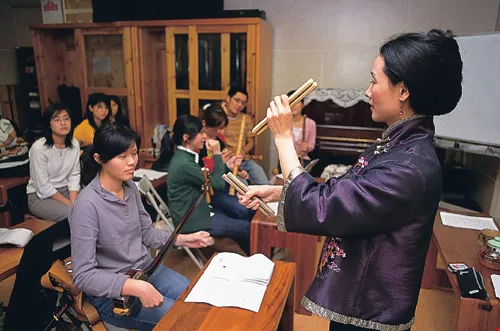
Except for two public performances a year, Wang Shin-shin concentrates all her effort on training new talent. She focuses especially on young people and actively participates in teaching courses at schools.
My cradle songs
For Wang Shin-shin, born 40 years ago in a village in Quanzhou, Fujian Province, such a scene was scarcely imaginable even a short time ago.
Her childhood was a time of the greatest poverty in China. Even among urban dwellers, only a few had electric lights, and it was even worse for the peasants living in the countryside. The peasants of Quanzhou began their work at dawn and finished at dusk. Occasionally there would be some free time and then they would call together their neighbors, relatives and friends, pull out the long bench, pick up an erxian, sanxian or pipa, get together in the front courtyard, and spontaneously strike up a tune from a Liyuan opera. They had no need of sheet music and no need to tune up with each other because all 108 Liyuan "qu pai," or song formats, were seared in their minds, for they were very likely the only musical tunes these farmers had ever heard in their whole lives.
As an infant, Wang Shin-shin played and fell asleep to her father's Nanguan music. When she was four years old and could fool around with a musical instrument, her father give her a pipa, named "Early Morning," that he had made with his own hands. Taught by her father, she gradually learned to play Nanguan melodies that she made all her own. Her ability to play and sing pieces flawlessly, with perfect pronunciation, delighted her father no end, and whenever relatives or friends would gather, he was sure to have this little talent give a performance.
"I thought then that Nanguan was the only music there was in the whole world!" says Wang Shin-shin, recalling her life growing up in a Nanguan world. Her uncle was a primary school academic director and quite a talent himself in Nanguan music. Whether it was children's school songs or lines from government propaganda, he was able to turn them into Nanguan folk songs and teach the students. Every time there was an occasion to celebrate or a holiday in the village, a theatrical troupe was sure to be invited to pitch a tent and give a performance. The repertoire was always pure Nanguan Opera and nothing else.
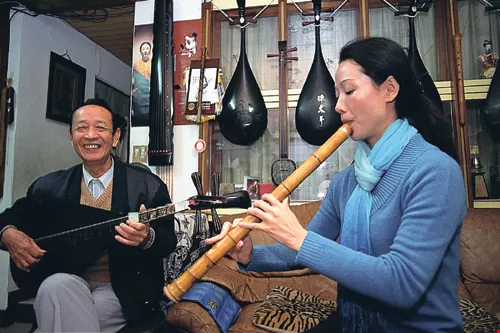
With music a regular topic of conversation between Wang Shin-shin and her father Wang Jiahe (left), not only was their relationship close, they were also bosom friends.
No. 1 at FAS
Growing up in this simple and isolated peasant village, Wang Shin-shin had only her Nanguan music to while away the hours. It was only when, at 14, she was selected as a participant in a Quanzhou Nanguan music competition that Wang for the first time received real instruction from a teacher. And it was only then that she was startled to realize the approach she had stumbled onto for playing Nanguan music, which depended upon her own accurate musical ear, was completely wrong. Each instrument in Nanguan is played in a way to set off the main musical theme, not just to play the theme itself. This gave her quite a jolt. In a very short period of time she would have to learn all over again right from the beginning.
"The process was very hard, and chaotic, but relying on my ability to listen and remember, slowly I began to play correctly." During this period Wang Shin-shin did not study music theory and could not read sheet music. Only after she entered the Fujian Art School (FAS) did she begin to study the proper theoretical foundation of Nanguan music.
To get into the Nanguan music department at FAS, 18-year-old Wang Shin-shin and her older sister left their home for the first time and came to the big city. There she studied dressmaking and with an old master tailor opened up a dressmaking shop. While waiting for the school entrance exam, she worked on getting to know the local Nanguan groups and aficionados to improve her playing. The dressmaking business never did do well because every time she had a holiday--just when customers had the time to come to the shop--Wang Shin-shin would be busy with Nanguan music group activities or performing. She closed the shop one year after it had opened, when she passed the entrance exam to FAS at the top of the arts list.
Wang Shin-shin now entered FAS as the No. 1 arts student, but there was no way she could compete in regular classes with the students from the city, so she concentrated all her efforts on memorizing and singing the Nanguan qu pai. When fellow students all returned home to visit relatives during the winter and summer holidays, Wang was happy to remain at school and ask her teacher to continue instruction.
Always practicing hard right down to graduation day, Wang Shin-shin was picked up by the Quanzhou Nanyin Ensemble because of her consummate playing ability and became an immediate stand-out, winning a string of musical competitions including the top vocal award in the Eastern Six Provinces Red Lantern Cup Competition and first place in the Fujian Nanyin Music Broadcast Competition. Wang Shin-shin also recorded her first Nanguan album, which sold over 20,000 copies its first year out. She now was firmly seated as the leading young Nanguan musical artist in China.
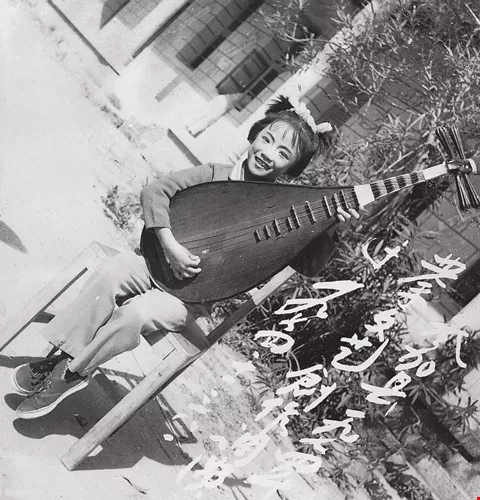
At ten years old, Wang Shin-shin could sing and act beautifully. She regularly put on heavy make-up and wore a costume as she followed her father around to family celebrations in the villages. She already looked just like a star.
A match made in Heaven
Before all this, while she was still studying at FAS, Wang Shin-shin was sent by the Quanzhou municipal government to the Philippines to participate in a Southeast Asian Nanguan convention. She was excited and hopeful because this would be her first performance outside China, and she was one of 11 elite performers from Quanzhou's eight counties and cities. She felt very honored. She was especially excited because she had heard some time previously that many Nanguan music masters were in the Philippines and being supported by overseas Chinese businessmen. This seemed like a place where Nanguan was especially valued. She thought the convention would be an opportunity not only to get advice from the great masters but also a chance to appear on the international stage and broadcast the Nanguan music of which she was so proud to the world.
When she arrived, Wang discovered the performance venue was a restaurant. The performers were to play in a small space surrounded by thick glass and use microphones and speakers to get the music out to customers eating dinner. These customers by no means were focusing their attention on the music but were busy playing mahjong, drinking and playing raucous drinking games, making a big racket and regarding these musicians who had come so far as post-conference entertainment. Wang Shin-shin was totally dispirited as she saw the solemn and refined Nanguan music sink to the level of dinner entertainment. She thought for a time of abandoning the life of a Nanguan musician once she reached age 30.
Just at this time an opportunity to make a major change quietly appeared. Fifteen years ago as cultural exchanges across the Taiwan Strait began to open up, Nanguan groups in Taiwan began going to Fujian in search of talent. One of these groups included Chen Mei-o, born into an operatic family in Kaohsiung and a passionate devotee of Nanguan music. She had started up on her own the "Han Tang Yuefu Ensemble." Chen Mei-o greatly appreciated Wang Shin-shin, her classical, graceful appearance, her clear and penetrating voice and her towering achievements in Nanguan music. She long ago began to plan to win Wang over to Taiwan and develop her career. For her part, Wang Shin-shin much admired Chen, who had been the force behind the first formal presentation of Nanguan music in France. Separated by the strait, they frequently talked by phone and became good friends.
Quite unexpectedly rumors were rife of a romantic connection between Wang Shin-shin and Chen Mei-o's older brother, Chen Shou-chun, and marriage plans were even being talked about. In fact, Wang Shin-shin, who was still completely in the dark, had only met Chen Shou-chun, the executive director of the Han Tang Yuefu Ensemble, a few times. She had never had a serious conversation with him, let alone there being any sparks of love between them. Then one day Chen Mei-o brought her entire family with her for a visit to Fujian and insisted that Wang Shin-shin accompany them around. Wang Shin-shin, still unaware of what was going on, suddenly found herself on the receiving end of a large number of presents: new clothes, new shoes, jewelry... only then did she realize that she had been "taken" by the Chen family as their daughter-in-law.
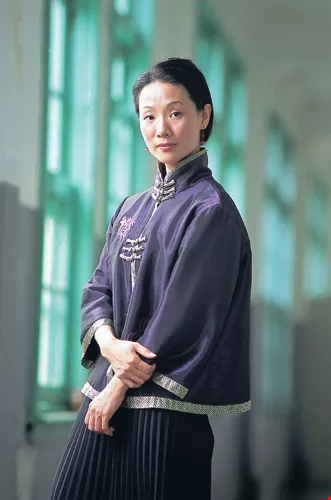
With a nod of the head and concentration in her eyes, Wang Shin-shin immediately became the focus of media attention. Her classical temperament and consummate skill have made Wang Shin-shin a sensation in the world of Nanguan.
The Han Tang Yuefu Ensemble
As bizarre and quick as the marriage was, Wang Shin-shin discovered after a few meetings with Chen Shou-chun that this refined-looking young man was really full of ambition. He planned to make Liyuan Opera, which was then mainly performed in the open air on stages outside temples, into a refined genre and even was planning to open up a teahouse for the quiet appreciation of Nanguan music. Wang married Chen when she was 26 and two years later she followed her husband to take up residence in Taiwan and become the musical director of the Han Tang Yuefu Ensemble. Together they began to plan the future of Nanguan music.
At the beginning they intended to condense what had been a three-day Liyuan opera into a short refined piece. This was really an enormous project because the beauty of a Liyuan opera consists in quietly and slowly developing the emotional nature of the characters and gradually involving the audience in the performance. If the pace is quickened the opera can appear haphazard and empty. But a creative Chen Shou-chun decided to use dance to interpret a sped-up plot and for this purpose selected five student dancers from the Taipei National University of the Arts to send to Quanzhou to study Liyuan Opera for a year. He used a slow rhythm for the Nanguan melody but retained the beauty of the music and showed off the scenery, staging and costuming in an exaggerated theatrical setting, creating a Han Tang Yuefu Ensemble piece rich and fresh in form.
In 1996, Sumptuous Feasting Song, in production for over two years, was an instant hit. Every one of the ten performances in Taiwan was sold out and the piece drew international interest and invitations. The Avignon Arts Festival and the Lyon BienDanse festival in France, the Bergen International Festival in Norway and the Adelaide Festival in Australia saw the visits of Wang Shin-shin and her husband. Sumptuous Feasting Song stayed on top in Taiwan for ten years and not only opened the way for the Han Tang Yuefu Ensemble, it also was responsible for gaining an audience for Nanguan music both in Taiwan and abroad. Wang Shin-shin herself received the Golden Tripod Award for best performance and in 2004 received the Golden Melody Award for best folk music for her piece "On a Quiet Night."
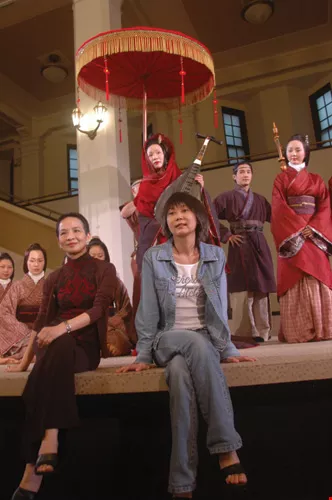
Ten years ago Wu Su-jyun (front row, left), a dancer from the Cloud Gate Dance Theater, became infatuated with Wang Shin-shin and introduced her to Luo Man-fei (front row, right). Although Luo suffers from illness, still the two "Shin-shin fans" join hands and hope to give a new look to Nanguan music.
On her own
Before she made the trip across the strait to live in Taiwan, Wang Shin-shin certainly went through a period of agonizing. Her good friends asked her, didn't going off to Taiwan to live frighten her? Of course, Wang Shin-shin was afraid, but when she thought of being able to opening up new horizons for Nanguan music, she was ready to give anything a try.
Nevertheless, this peripatetic lifestyle was not without its problems. Following the Han Tang Yuefu Ensemble on its well-traveled schedule, finding people to take care of two infant children wherever they happened to be, and even sometimes forced to have her father make the long trip over from Quanzhou to Taiwan to look after them took an enormous toll on her mentally and physically. Added to this were the unbridgeable differences in outlook between her and her in-laws, and the death from illness of her husband--all this decided Wang Shin-shin to leave the Han Tang Yuefu Ensemble. In 2003 she set out on her own creating the "Shin-shin Yuefu Ensemble" and poured herself heart and soul into teaching and promoting Nanguan music.
Wang Shin-shin, who had gone through arduous "old-fashioned" self-study, spent much time in putting together material to systematize the teaching of the music and conducted classes at schools, farmers' associations and communities in the hope of spreading Nanguan music throughout Taiwan and finding and developing superior master teachers. At the same time she hoped to devote herself to work on preserving audio-visual material on Nanguan songs.
"In the Nanguan repertoire there are numerous melodic structures. The shortest melody takes 15 minutes to play, the longest 45 minutes." These different musical structures are all imprinted in Wang Shin-shin's mind but to systematize them takes time and resources, and Wang's single-handed efforts.
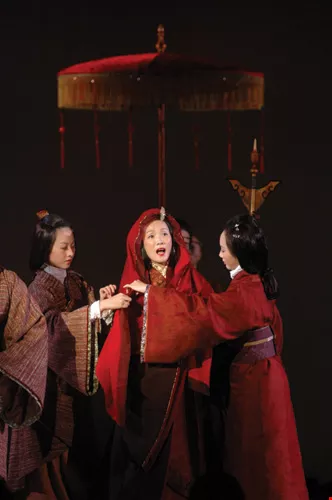
To spread Nanguan music far and wide, Wang Shin-shin happily works across boundaries and appears in a variety of performance modes.
Old tunes and modern times
"I just wish there were more people willing to invest their time so the preservation of Nanguan music could be completed more quickly." Wang Shin-shin feels that although National Taiwan University of Arts and National Taiwan University are taking in Nanguan music students, all they can do is provide a foundation. There is still no systematic plan for developing talent. The pupils who go to the communities and agricultural associations are for the most part adults who listened to Nanguan music as children. They come to rekindle their memories of youth and consider the music purely as entertainment or as a vehicle for learning the ancient pronunciation of the Hoklo dialect.
"It's really a shame that some young people have seen a performance and are attracted by its renown but then discover that Nanguan music itself is so 'gloomy and monotonous' and out of tune with the times that they can't take it and leave mid-way through."
Wang Shin-shin says that authentic performers of Nanguan music must gradually release their deep inner feelings and connect with the audience. This ability to express deep emotion in a quiet manner through music that is a thousand years old cannot be learned, comprehended or appreciated overnight. There are some other young people who want to study "Nanguan dance" that make Wang not know whether to laugh or cry. But this also shows that the past creative performances are able to attract young people.
Precisely because of this, Wang Shin-shin has actively worked with dancer Luo Man-fei's Crossover Dance Company on Heavenly Flute, and with Chiang Sih-mei's Happy Puppetry Company on its production of a Nanguan glove-puppet theater production, Chen San and Wu Niang. She has also worked with the Taipei Chinese Orchestra on a Nanguan symphony. Including her most recent Wang Shin-shin on Stage, all these efforts have been for the purpose of allowing more people to appreciate Nanguan music from more angles.
"All performers should try their hand at an art form outside their own specialty. Only in this way can they enrich themselves and attract the public with a variety of approaches." What marvelous creations this Nanguan music queen has in store for us after Wang Shin-shin on Stage we can only wait and see.

@List.jpg?w=522&h=410&mode=crop&format=webp&quality=80)

@List.jpg?w=522&h=410&mode=crop&format=webp&quality=80)


