This year sees the sixth Taipei Biennial, featuring more invited artists than ever before. In all, 47 artists and teams from 26 countries are participating. It is the first time exhibitions have been held outside of the Taipei Fine Arts Museum. Some performance art works are being staged in downtown Taipei. Passersby can catch a rare glimpse of art on signs on the streets or in MRT stations.
This year's biennial continues the curating system of past years. Vasif Kortun of Turkey is collaborating with Taiwanese curator Manray Hsu on a theme of globalization under neo-liberalism and resistance against it. Highlighted are issues of urban change, the plight of workers, global unrest, and opportunities for change.
Hsu says, "Art may not be able to change the chaotic state of the world, but we hope that we can inject some energy and critical thinking into the world."
Actually, reconsideration of globalization has been a constant topic at biennials over the last ten years. It's just that in Taiwan, discussion of the impact of globalization has been limited to the academic world. It's been rare for artists to act as an intermediary with society in the discourse. Thus, the vision of this biennial has been like a cultural whirlwind for Taiwan.
Upon entering the Taipei Fine Arts Museum, the visitor sees a throng of rebelling human forms. They hold guns and banners with slogans in the air, angrily protesting globalization and the devastating setbacks it has brought them. This is Internacional Errorista, a work of installation art comprising cutout figures, that reproduces the protests outside the 2005 Summit of the Americas meeting in Argentina.
Local Taiwanese graffiti artist Bbrother, whose name derives from the character Big Brother from George Orwell's 1984, has put up a series of works on the streets of Taipei supporting protest movements in Taiwan and abroad, exploring the memory of history and the lines between public and private, and satirizing the mainstream media. This time he used spray paint, charcoal, and stencils to create four-by-eight meter camouflage murals.
In these works that are reminiscent of military defenses, Bbrother used elements of his previous graffiti work, but they are impossible to discern as such. And audiences, accustomed to happening across graffiti on the streets, feel a sense of displacement seeing such pieces in an exhibition hall for the first time due to the tension created between themselves, the works, and the setting.
Austrian artist and activist Oliver Ressler presents his own exhibition, "A World Where Many Worlds Fit," which uses the Mexican Zapatista guerrilla group's struggle against oligarchy and its quest for self-determination as a metaphor. The works exhibited, by 12 artists, present the anti-globalization movement that has protested against the World Trade Organization, the G8, and other groups.
This year's exhibition isn't all so serious, however. Many works are humorous and playful but hold deep messages. For example, the Slovenian artist Sasov Sedlacvek uses old computer hardware to create an automated "Beggar Robot" that says in a computer-synthesized voice, "Good people, I beg of you! Do you have any spare change?" The friendly and amusing machine, which purports to be begging on behalf of the poor, is very popular as it carries out its charitable mission on the streets of Taipei. The concept behind it, however, came about when the creator began to think about how the number of beggars on the streets increased after communism fell and the market economy took over. At the same time, it is a subtle satire of the way modern people have lost the ability to interact in a relaxed way and prefer to express their compassion through a technological interface.
The 2008 Taipei Biennial runs from September 13, 2008 to January 4, 2009.
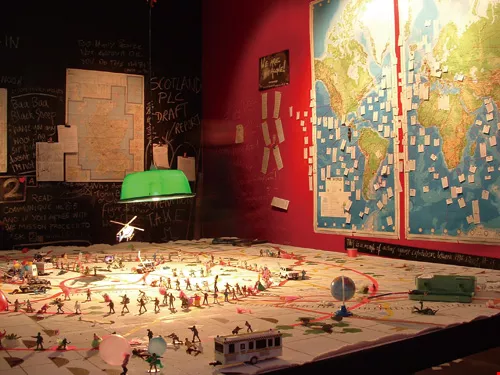
British artist and activist John Jordan's installation piece "The Clandestine Insurgent Rebel Clown Army" uses a large canvas map of the area around a G8 summit. It was given to activists for use in planning protests. The wall maps show the locations of past antiglobalization protests around the world.




