

On the eve of summer, 1994, directors in northern, central, and southern Taiwan were crying "camera!"
In May, filming for Lonely Hearts Club started at a junior high school in Hsinchuang. A young girl with a covert crush on her teacher picks up an unfinished can of cola which he has left in the classroom. She is secretly delighted to finally possess something close to him. Director Yee Chihyan suffered diarrhea for the entire month of the film's shooting.
Taking advantage of the young actors' summer vacation in July, Tropical Fish director Chen Yu-hsun took the main male character, a boy with a propensity to daydream, to the town of Tungshih in Chiayi County to shoot a farcical comedy about kidnappers involved in a "national joint entrance exam plot."
In September, Hsu Hsiao-ming moved the set for Heartbreak Island south to put 1979's Formosa Incident back before the eyes of Kaohsiung's people.
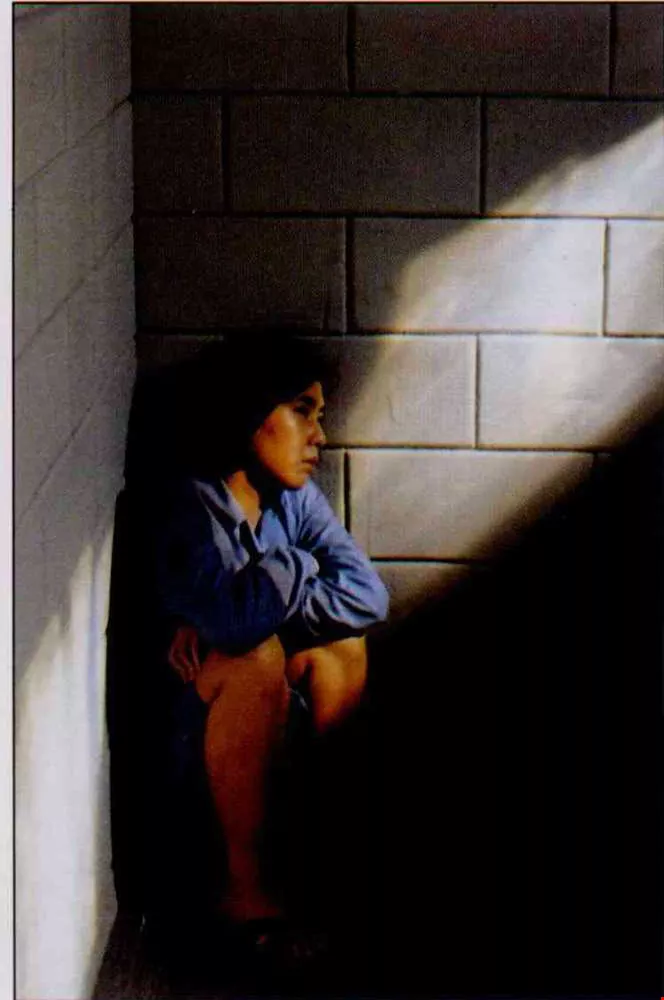
When the Formosa Incident broke out, the female lead character was dragged into prison through association with her lover. There, her youth was consumed. (from Heartbreak Island, courtesy of the Hsu Hsiao-ming Film Co.)
A new generation of new wave
Hsu Hsiao-ming, Yee Chihyen, and Chen Yu-hsun are among Taiwan's new generation of film directors, and all of them have recently completed new works. The three have actually been around for quite a while, but their films are very few. Thus, the appellation "new director" does not necessarily indicate youth, but rather that they have completed only one or two cinematic works to date.
There are many new directors in Taiwan's film industry, but we have chosen these three creators because they have new works about to come out, and because all three take aim at today's Taiwan through the contemporary settings of their films. Why have they chosen film? Why these stories? Perhaps you are curious to know the backstage thought processes of these creators.
Taiwanese film faces a difficult struggle in an environment dominated by the film industries of Hong Kong and the West. Taiwan's film output has dropped from 163 films in 1988 to only 29 last year, and studios and producers are unanimous in their attitude toward making films in Taiwan: "It's not easy."
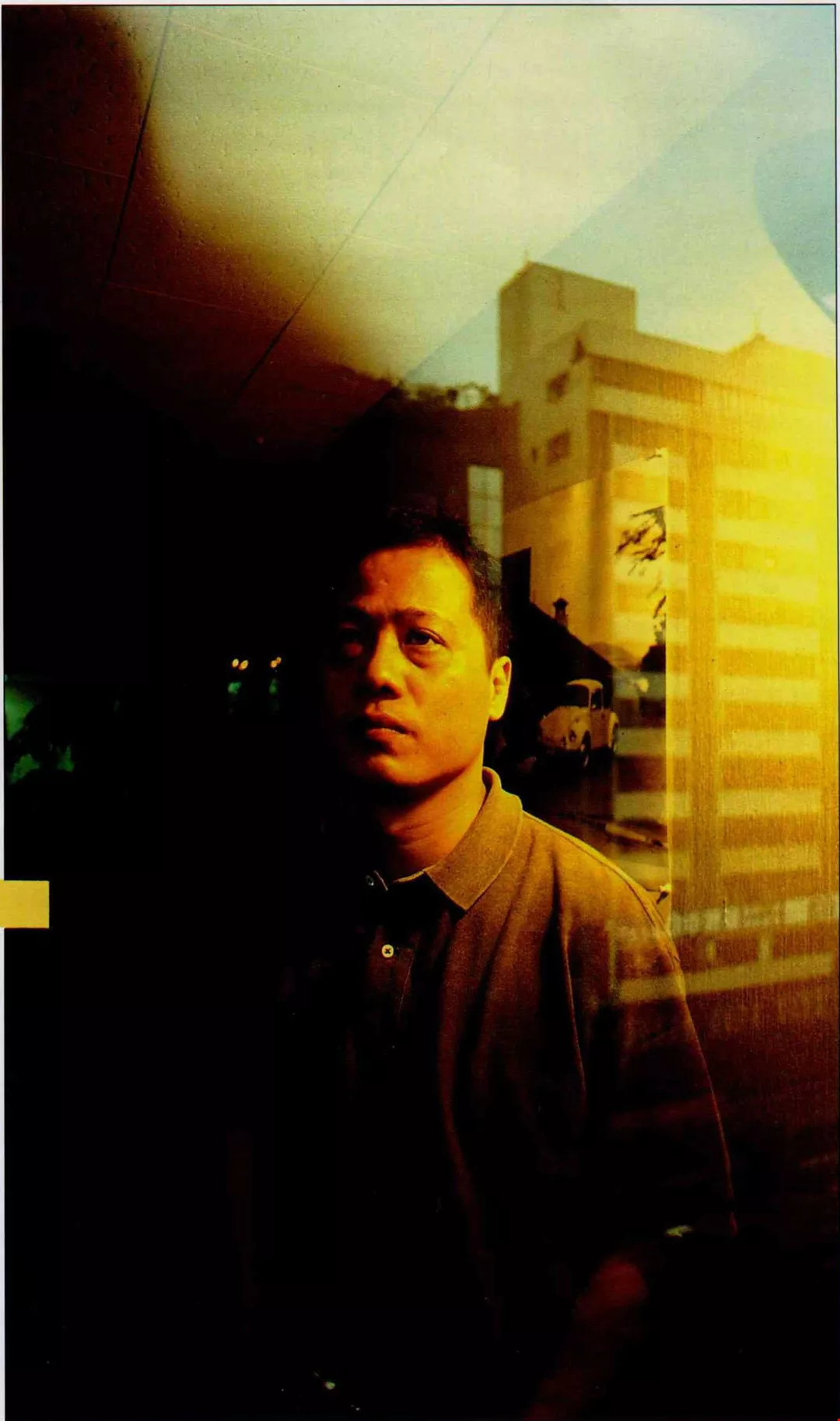
Hsu Hsiao-ming "Film is not romantic. It burns up your ideals, your enthusiasm. It all depends on how much energy you have to hold on." Hsu Hsiao-ming has a deep understanding that in the director's profession, one must remain determined through good and bad times.
Getting worse despite more assistance
Complex reasons underlie the infirmity of Taiwan's fragile film industry. In order to rescue ailing studios, the government implemented a film subsidy program in 1990. Under this system, aspiring film-makers could submit a script or business plan to contend for a spot on the subsidy list. Ironically, this annual NT$50 million assistance fund has become the lifeline of today's film industry. A subsidy of NT$10 million or NT$4 million is the only hope for many directors, especially less recognized ones that studios are afraid to take the risk of investing in. Without the backup of this subsidy, studios would be unwilling to invest in film-making at all.
Heartbreak Island received an NT$4 million subsidy, while Tropical Fish followed the example of Pushing Hands, first earning designation as an outstanding script and then receiving an NT$4 million subsidy before filming could commence.
Grasping for this lone opportunity, many new creators test their patience trying again and again, submitting new business plans every year.
It was a rocky road, and a lonely one, to the completion of Lonely Hearts Club.
Lonely Hearts Club entered the subsidy competition in four separate years. It was not selected at all the first two years, and was put on the waiting list the third year, but in vain. By the fourth year the film was already in the cutting and post-production stage, but according to the rules could still apply once more for a subsidy. The situation looked hopeful this time, but then the evaluation committee decided not to award the Central Motion Picture Company subsidies for any of the NT$4 million film plans it submitted that year, preferring to make these opportunities available to smaller scale producers.
This policy was a blow to Yee Chihyen, who had been very hopeful. But there was nothing he could do about it. Fortunately, the Central Motion Picture Company let him finish filming even without the subsidy, although a subsidy would have been best.
Difficulties abound in the local film industry, but the enthusiasm and determination of these creators gives us some reason for optimism.
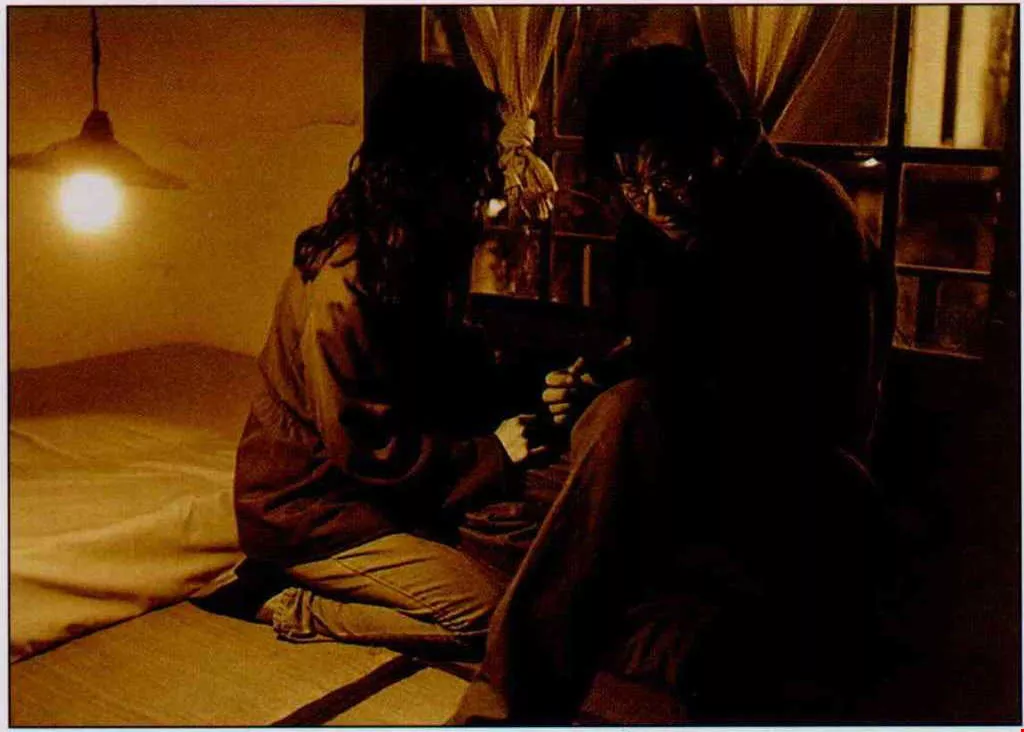
The male lead character is caught between his all accepting wife and the lover who gave up her youth for him. How to choose? (from Heart break Island, courtesy of the Hsu Hsiao-ming Film Co.)
Film first, wife second
Of the three directors introduced above, Hsu Hsiao-ming has the most experience in film. He is fond of saying, "My first love is film; my wife is number two." Fortunately, his wife doesn't get angry when she hears this! Despite his love for film, he often asks himself, "Will I be able to choose the path that's right for me?"
Born in 1955, Hsu Hsiao-ming studied science and engineering at a top high school. The fun-loving young man, who was fond of painting, failed to pass the university entrance exam, and so entered the film department at the World College of Journalism and Communications, where he first began to think seriously about film.
He developed an interest in film through working on film sets, accumulating vast experience and eventually serving as assistant director under Hou Hsiao-hsien and Chang Pei-cheng. Well appreciated as an assistant director, the young Hsu received his share of scars at the hands of the film industry before he ever had the opportunity to direct his own movie.
In 1989, the Central Motion Picture Company (CMPC) decided to follow the model of the early, sensational In Our Time by finding three new directors to co-direct a three-segment film.
The ferociously competitive atmosphere of the conference room where many people came for interviews with the CMPC left a deep impression on the young director. Faced with more than 20 interviewers, he experienced tremendous anxiety. Hsu forgets now who asked him how he would handle a bedroom scene; he only remembers that his mind drew a blank, and that he sat wordless for a good five minutes.
In that era when even prominent directors lacked the opportunity to make movies, Hsu had started to ask himself whether it was time to leave film. The disastrous failure of his interview with the CMPC was the straw that broke the camel's back, crumbling his "resolve to pursue film."
Walking home through Hsimenting, Hsu decided to leave the cinematic world. "Film is not romantic. It burns up your ideals, your enthusiasm. It all depends on how much energy you have to hold on." This is Hsu's current understanding of the setbacks of that year.
Hsu Hsiao-ming returned to his native Kao-hsiung to recuperate, heal, and develop, but had not the means to take his wife back with him. In three years in Kaohsiung, he opened a restaurant, video game parlor, and a small hotel. He had the means to support himself, a foundation for the future, and the trust of others. Eventually, people would happily invest as much as NT$200 or 300 million in a venture if only he said it was feasible.
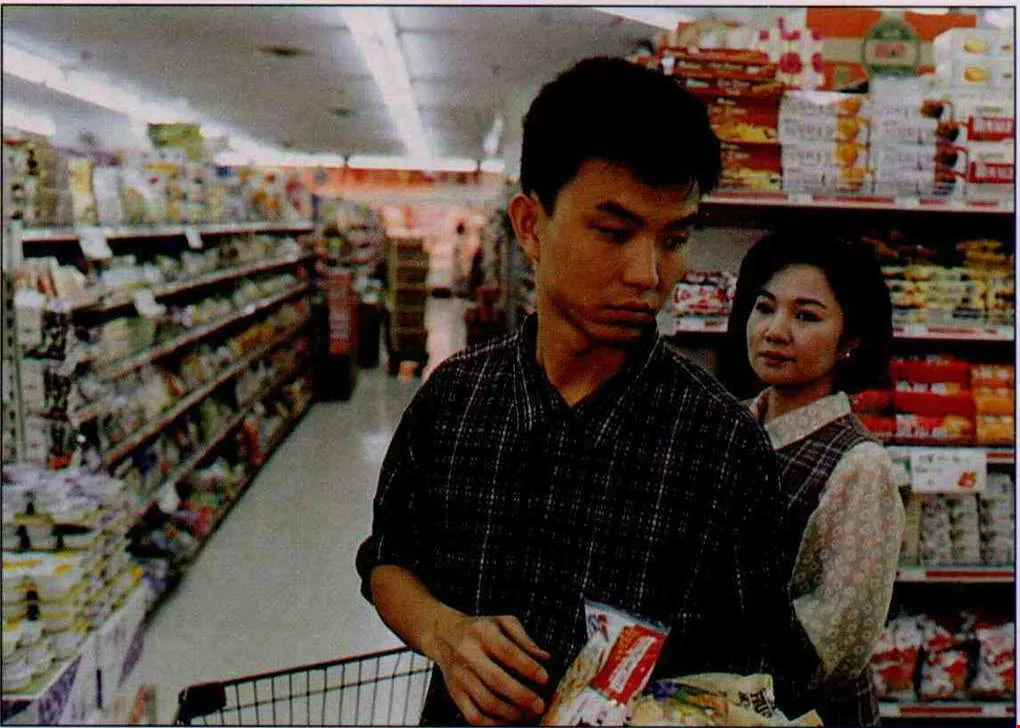
What a coincidence. he's come here shopping too! Approaching somber middle age, the lead female character's heart skips a beat to think that fate may have her cross paths with the young man. (from Lonely Hearts Club, courtesy of the Central Motion Picture Company).
The lover looks back
Throughout his time in Kaohsiung, Hsu never severed his ties with Taipei's cinematic circles. In spirit, he was still part of the film world, maintaining a movie-a-day habit.
At this time, City Films, Ltd. was preparing to film Dust of Angels. Hou Hsiao-hsien was originally to direct it, but he was preparing for The Puppet Master. Producer Chang Hua-kun felt that the "tone" of the story wasn't right for anyone else to tell. Then he thought of Hsu Hsiao-ming, whose youth was also one of hesitation and vacillation, and felt he could definitely handle the material.
Should he return to cinema? Hsu deliberated for three months. His feelings were complex, as if "a lover left me, and now turns around and says she still loves me."
The film's theme of a dirge for youth, coupled with Chang Hua-kun's encouragement, evidently moved Hsu to agree. Under Hsu's skillful treatment, this realistic portrait of Taiwan, with its gun running, amphetamine use, emigration, gambling, etc., let audiences see, in the words of one critic, "the darkness and despair of youths outside of Taipei, outside the middle class, outside Mandarin (which has higher social status than Taiwanese), outside school, and beyond dreams or heroism."
Dust of Angels received excellent reviews and made a good showing at the box office as well. Total ticket sales island wide were NT$35 million.
Two years later, Hsu is now even more ambitious. He wants to use the perspective of the 1990s to portray the Formosa Incident of 15 years ago. In those days, before the Democratic Progressive Party was legalized, and when dissidents were still struggling for freedom of speech, Formosa magazine, established in 1979, could be said to be the main headquarters for the opposition political movement. In December of that year, Formosa decided to organize a large-scale parade on World Human Rights Day, December 10. The parade turned into a bloody clash between civilians and police, and many important opposition figures, including Shih Ming-teh, Chang Chun-hung, and Huang Hsin-chieh, were arrested and sentenced to prison.
Upon hearing he planned to make a film on the Formosa Incident, many people asked Hsu from a sharply political perspective what he planned to express. Not wishing to limit himself to political thinking, Hsu told the story of two lovers caught up in this historical event, describing their helplessness and struggle after their return to a completely transformed society after more than a decade of prison-enforced separation.
When the female lead emerges from prison, she finds out that her lover has married someone else. The power that kept her going in prison has been destroyed. She is devastated. What is she to exchange for the ideals of youth?
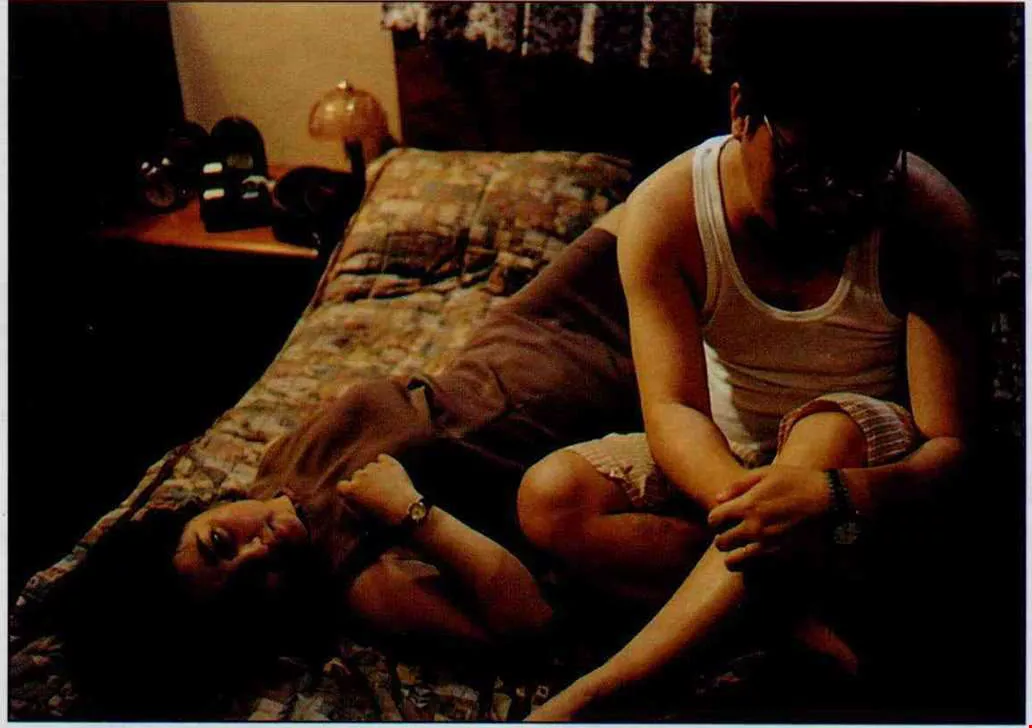
In this bedroom scene between a long-married couple, local actress Pai Ping-ping and the dryly humorous journalist Feng Kuang-yuan leave plenty to the imagination. (courtesy of the Central Motion Picture Company).
Whither feelings?
While Hsu Hsiao-ming is bearing witness to one facet of Taiwan--its heroic proletariat--Yee Chihyen explores the spirit of the modern city.
Yee says himself that Lonely Hearts Club is a "weird" movie dealing with complex human relationships.
Pai Ping-ping is a married woman with a perfectly normal, if dry and dull, nine-to-five job. Her days pass in a blur of going to work, grocery shopping, cooking, television, and sleep. Then, a few purposeful coincidences make Pai Ping-ping, who is nearing middle age, fall head over heels for the young go-fer who has just joined the company. Cracks appear in her routine.
The young man, who often roams the night in search of homosexual companionship, is of course completely uninterested in Pai Ping-ping. The other people surrounding Pai Ping-ping are themselves looking for an outlet for their lonely hearts. Her junior-high-age daughter, in the flush of youth, boldly expresses her love for her teacher, and the seemingly upright husband has a mistress living next door. Even the half-senile grandmother picks up the phone and talks to the answering machines of strangers.
The dramas that play themselves out in this family are like a microcosm of the metropolis of Taipei, containing the shadows of every one of us.
Yee's directorial debut exudes a vague melancholy, much like the man himself.
After graduating in Western languages and literature from National Chengchih University, Yee went abroad to study for five years at UCLA, where he earned a Master's in television and film production--the equivalent in film to a PhD. Returning to Taiwan, he filmed commercials and television programs before entering the CMPC's planning department. Occasionally, he would write movie reviews. He felt perpetually at the "periphery" of the film world.
In four years at the CMPC, when application time for the film subsidy rolled around, besides working on his own screenplay, he also helped others with their applications. In the first two years, the proposals for the subsidies the CMPC received for The Wedding Banquet and Rebels of the Neon God were both written by Yee.
What motivated him to write a story like Lonely Hearts Club? Yee says that the easily understandable plot will evoke a response in everybody. Its special significance for him personally is that "loneliness is the most difficult emotion to deal with."
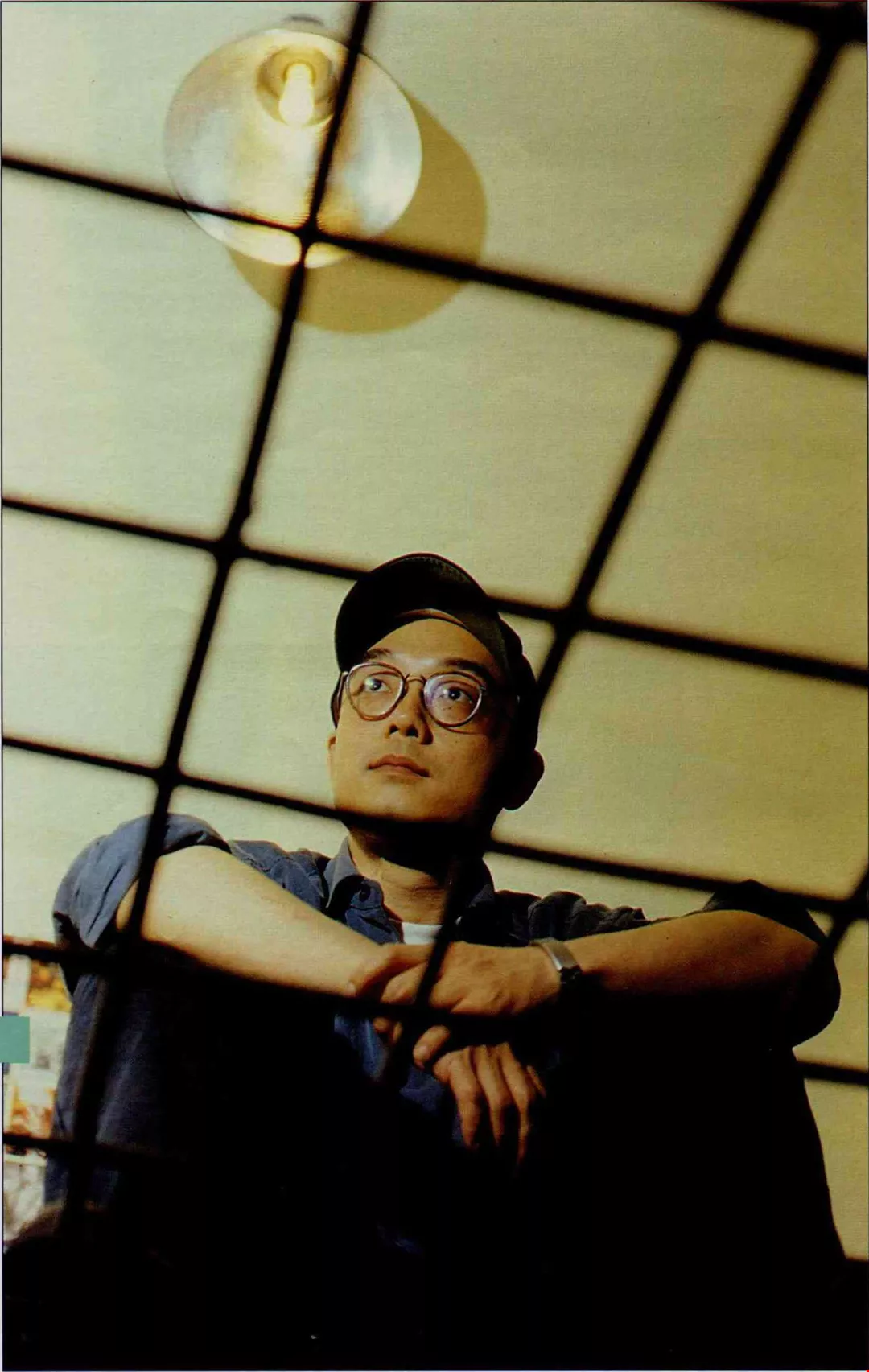
Yee Chihyen Loneliness for Yee Chihyen is a "soft and ambiguous" feeling. At a certain juncture in life, this feeling impels him to express himself through creativity.
Daydreaming is okay too
For film aficionados, movies are intensely visceral creations, yet on occasion, they can also be quite unassuming and accessible.
Such is the youthful vitality of the films of Chen Yu-hsun.
Tropical Fish portrays a dreamy junior high school student who has a fortuitous opportunity to save a small child's life, but instead becomes the victim of kidnappers. Who could guess that the chief kidnapper would die in an auto accident, leaving his somewhat obtuse henchman at a loss as to how to handle the situation? So he takes the two children back to his rural fishing village. The boy, released from the suffocating pressure of teachers and exams, passes his time very happily in the fishing village despite his having been kidnapped. When the kidnapper discovers that the boy has to enter the national high school entrance exams that year, he spurns the ransom money and anxiously hurries to return the boy to Taipei for the exams.
Director Chen Yu-hsun himself has experienced failure in the national exams. He had to repeat the tests for both high school and university before being accepted. But, he says, he never underwent the "exam syndrome." He feels that people's do-or-die attitude towards fame and fortune today doesn't bring them happiness. "Sometimes people should let themselves be a little foolish, a little stupid, not so competent. Daydreaming can be a good thing too." This is the concept the film tries to convey.
Upon graduating from Tamkang University's department of educational science, Chen got involved in television program editing and directing, producing such programs as The Happy Household and The Hen and the Duckling.
This new director likes to draw and read comics and to make an appearance in his films' soundtracks. He has the happy disposition of Taiwan's "new new youth." He says, "Every night before I go to bed I put on some raucous music, or I can't fall asleep." Chen put together a band in college, and his greatest wish was to be a rock and roll guitarist. He never imagined that one day he would be making films, or that he would undergo such hardship to do so.
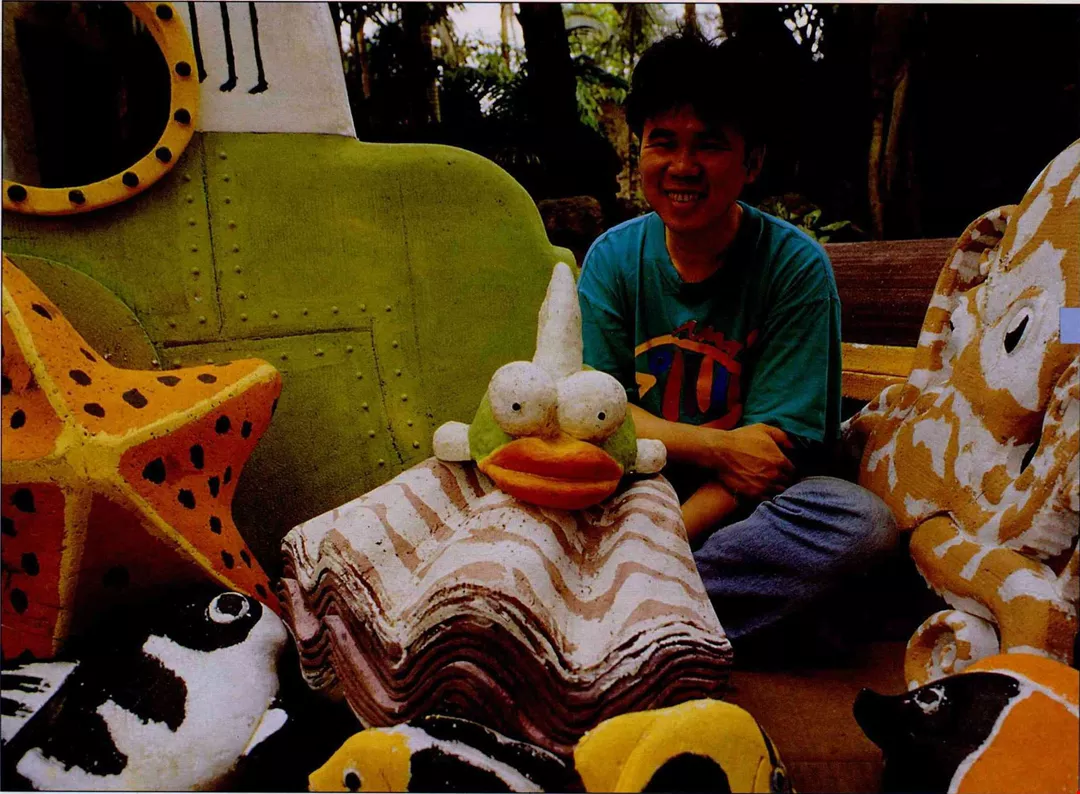
"Sometimes people should let themselves be a little foolish, a little stupid, not so competent. Daydreaming can be a good thing too." In keeping with the spirit of his film, Chen Yu hsun sits like a big child among the props for Tropical Fish.
A lonely road
When the audience sits down in an air-conditioned theater and sees the flickering images projected onto the big screen, they are unlikely to be able to identify with the difficulties involved in putting together each frame. Many unforeseeable circumstances arise in the shooting of a film.
Only a few minutes of the Formosa Incident appear in Heartbreak Island. The scene was filmed on the eve of the December 1994 elections for city mayors and provincial governor. Because the original Formosa building had to be restored to its original appearance and then burned down again, Hsu Hsiao-ming first had to apply to the local police station to control access to adjacent roads; he also communicated with the central headquarters of the Democratic Progressive Party.
Perhaps due to the sensitive atmosphere on the eve of the elections, the filming site was surrounded that night by a large crowd of onlookers. A clamorous mood arose in which shouts and mutterings could be discerned: "Who's making this movie? What is its purpose?" The complexity of the situation was compounded by uncooperative sound recording equipment. One of the fire scenes had to be re-filmed four times before it was acceptable. As the situation threatened to get out of control, Hsu Hsiao-ming broke out in a cold sweat.
Under a blazing sun in Chiayi's Tungshih, a fishing boat going out to sea was to be filmed for Tropical Fish. Chen Yu-hsun anticipated that the film crew might get seasick, so he gave everyone a motion sickness pill before departure. Maybe someone bought the wrong pills--true, no one got seasick, but everyone became so drowsy that they spent the entire day sound asleep.
Outdoor scenes are difficult to film, but indoor scenes are not as simple as one would think, either.
Critic Wen Tien-hsiang compiled a notebook of his observations as he watched the filming of Lonely Hearts Club.
He describes Yee Chihyen's search for sets as "heroic martyrdom." Wen jokes, "In the history of Taiwanese cinema, there has probably never been a director like Yee--he has not only contributed his own home to the film, but has even heroically painted his walls three different colors to produce three different scenes."
Yee's small living room is first a study where a teacher corrects exam papers, then the living room of a mistress, and even the room from which Pai Ping-ping's coworker makes a telephone call. Watching the movie, you can't tell they're one and the same room. Incredible!
Happiest of all to have a movie filmed at home was Yee's mother. She invited a whole group of friends and neighbors to watch the star actress Pai Ping-ping. Yee and his mother ended up in an argument over this matter.
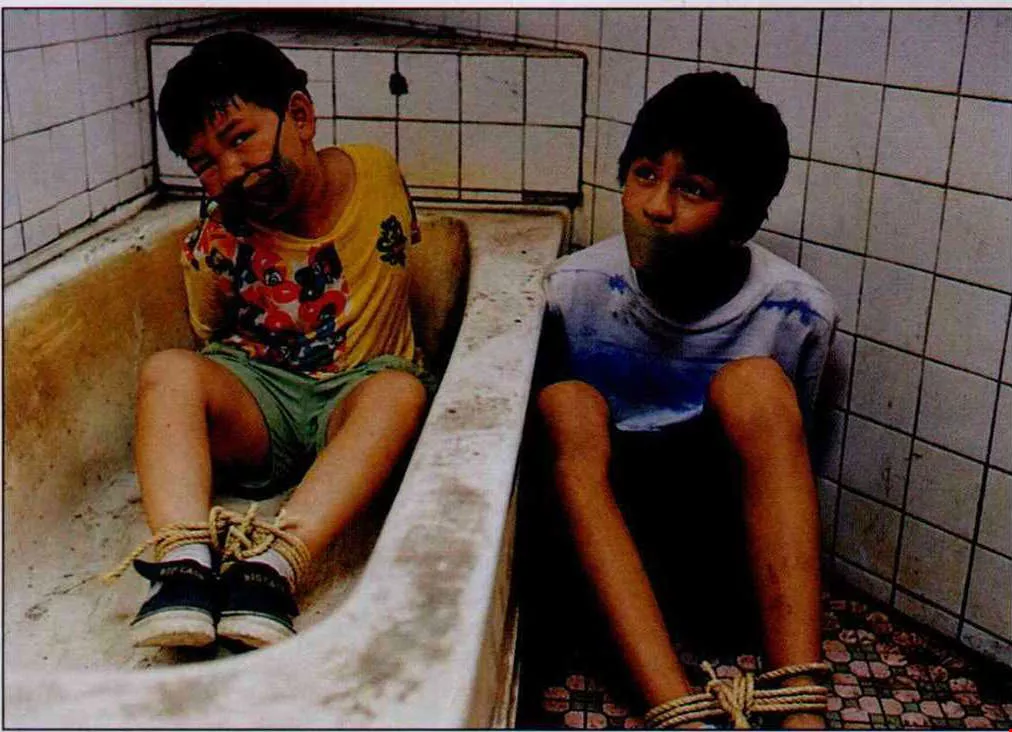
Looking to be the hero, the young main character becomes a kidnapping victim himself in trying to save another child. (from Tropical Fish, courtesy of the Central Motion Picture Company).
The director gets really tired
" The director gets tired. . ." There are few who would try to refute these words of Chen Yu-hsun. Only those who have directed a film themselves can really know the frustrations of creation.
"When the work gets really frantic there's no time to complain." Yee Chihyen compares film-making to "a rite of passage." After it has passed, he can only sigh, "I'm not cut out for Taiwan's film work environment."
A reporter asks Yee whether he ever met with any interference working for the KMT-run CMPC organization. He answers with a deft metaphor: It's not that he has no freedom, but "It's like carrying an old woman on your back. She won't tell you to go left or right, forward or backward, she won't give you any instructions at all, but carrying her, you can't go anywhere." He then humorously observes that if the metaphor is somewhat disrespectful to women, you can replace her with a large stone.
"At the film site, the camera operators are more qualified than you are, and as for the actors, they were acting before I was even born. Any director wants to take his time shooting, but a new director cannot possibly have the resources to do this." Chen Yu-hsun is not complaining, just acknowledging the fate he must bear.
The director must bear up under all the pressures of the creative process, but cannot say what the remuneration will be for one's investment.
Hsu Hsiao-ming, who regards himself as an extreme optimist, says that he could live quite happily without a penny to his name. But in order to allow himself to experience the pressures of real life, he established a studio upon completion of Dust of Angels, which makes him think constantly about providing for the livelihoods of the several workers employed there.
When one of Taiwan's directors finishes a film, he usually has no idea where the next opportunity will be. On average, it takes two years to make a movie, including writing the screenplay, revising the screenplay, casting, training the actors, cutting, and post-production. During those two years, the director's thoughts and aspirations are dominated by his brainchild, about which "no-one cares more than the director."
Given the unreliable income of the film-maker's profession, real-life pressures force many directors to enter the more profitable advertising industry. It's just that the rules of the game of the advertising industry entail that the director comes on only after planning is finished, after the creative concept is finalized, and even after the colors of the props have been settled on.
This setup holds little interest for Hsu Hsiao-ming, but his attitude has already shifted from "refusal to even talk about it to a willingness to try it out."
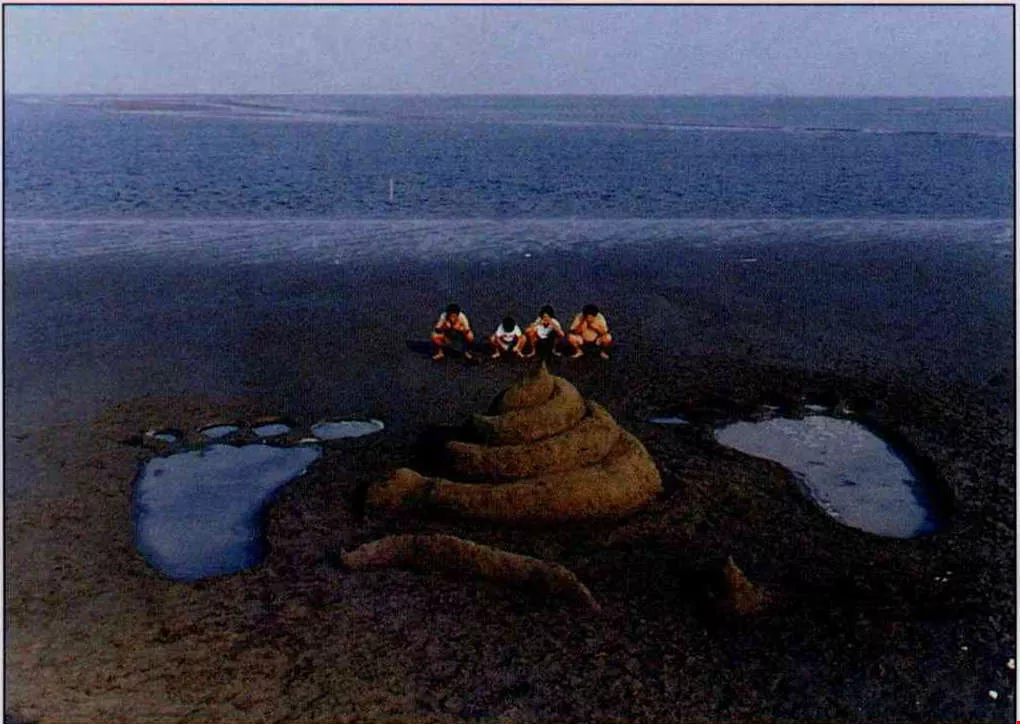
The main character gets an unexpected holiday when he is kidnapped shortly before the national high school entrance exam. Chen Yu-hsun, a comic book fan, applies his childlike spirit to his film-making. (courtesy of the Central Motion Picture Company).
After becoming addicted
With all the obstacles to creating a movie, why do some continue throwing themselves into the fray? In a word, "Film-making is addictive," says Chen Yu-hsun.
How does Yee Chihyen get his sense of accomplishment? "You get to know lots of good actors. Directing is like falling in love with the actors, like falling in love with nine people at once."
A film critic once said that if you like movies, then go see them. But if you are intoxicated by movies, so intoxicated that you go to the extreme of becoming a director, then you must bear the emotional and creative solitude of film-making yourself, be cause no one is able to help you.
[Picture Caption]
p.44
Hsu Hsiao-ming
"Film is not romantic. It burns up your ideals, your enthusiasm. It all depends on how much energy you have to hold on." Hsu Hsiao-ming has a deep understanding that in the director's profession, one must remain determined through good and bad times.
p.44
When the Formosa Incident broke out, the female lead character was dragged into prison through association with her lover. There, her youth was consumed. (from Heartbreak Island, courtesy of the Hsu Hsiao-ming Film Co.)
p.45
The male lead character is caught between his all accepting wife and the lover who gave up her youth for him. How to choose? (from Heart break Island, courtesy of the Hsu Hsiao-ming Film Co.)
p.46
What a coincidence. he's come here shopping too! Approaching somber middle age, the lead female character's heart skips a beat to think that fate may have her cross paths with the young man. (from Lonely Hearts Club, courtesy of the Central Motion Picture Company).
p.46
In this bedroom scene between a long-married couple, local actress Pai Ping-ping and the dryly humorous journalist Feng Kuang-yuan leave plenty to the imagination. (courtesy of the Central Motion Picture Company).
Yee Chihyen
p.47
Loneliness for Yee Chihyen is a "soft and ambiguous" feeling. At a certain juncture in life, this feeling impels him to express himself through creativity.
p.48
"Sometimes people should let themselves be a little foolish, a little stupid, not so competent. Daydreaming can be a good thing too." In keeping with the spirit of his film, Chen Yu hsun sits like a big child among the props for Tropical Fish.
p.49
Looking to be the hero, the young main character becomes a kidnapping victim himself in trying to save another child. (from Tropical Fish, courtesy of the Central Motion Picture Company).
p.49
The main character gets an unexpected holiday when he is kidnapped shortly before the national high school entrance exam. Chen Yu-hsun, a comic book fan, applies his childlike spirit to his film-making. (courtesy of the Central Motion Picture Company).
p.50
Do you like movies? There's no telling how many eager young people have been drawn to the scintillating images of the silver screen.
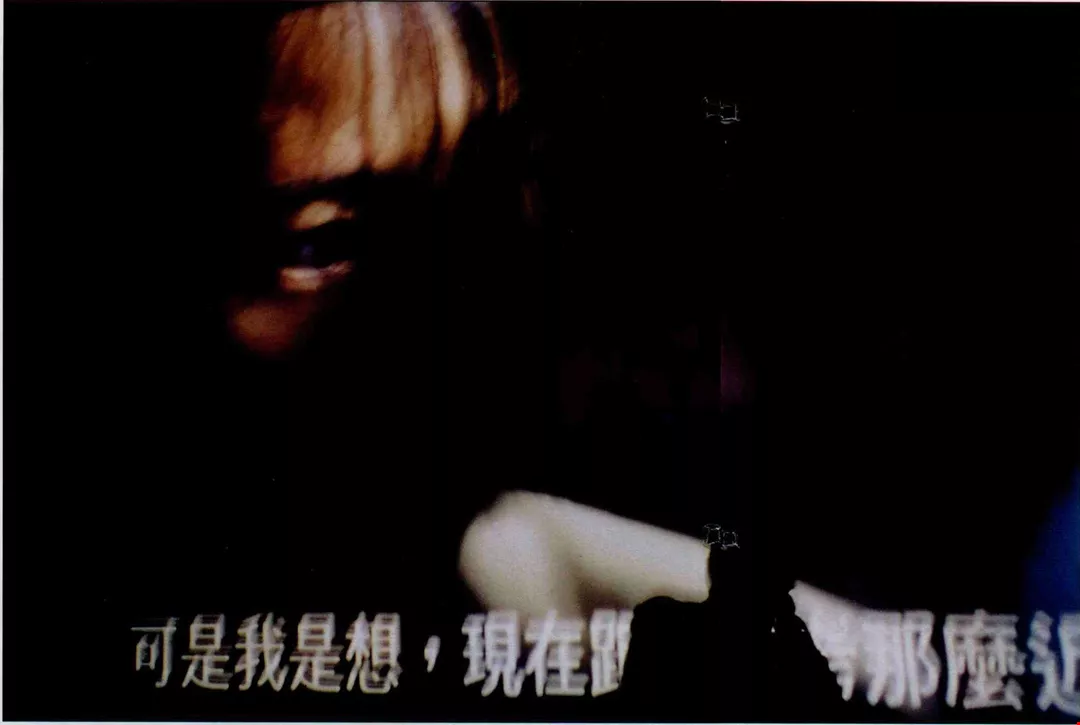
Do you like movies? There's no telling how many eager young people have been drawn to the scintillating images of the silver screen.

@List.jpg?w=522&h=410&mode=crop&format=webp&quality=80)


