Always Cutting Edge: Fashion Designer Lin Goji
Kuo Li-chuan / photos courtesy of Lin Goji / tr. by Scott Williams
August 2009


Over the last decade, a creative genius has appeared on Taiwan's fashion scene. Renowned for incorporating Eastern elements into Western couture, Lin Goji utilizes everything from Qing-Dynasty painting and Song-Dynasty poetry to contemporary computer keyboards and traditional Taiwanese woodcarving. Possessed of design DNA that blends international fashion trends and rural Taiwanese naivete, Lin has built a brilliant new Taiwanese couture house.
Now known within the industry as a designer always on the cutting edge, Lin Goji hasn't always had it easy. In fact, he suffered greatly at the hands of Taiwan's educational system before becoming a fashion designer.
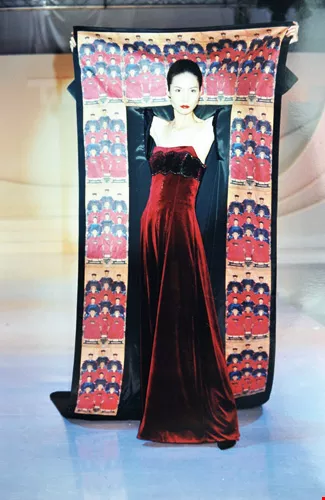
Lin's bold and avant-garde Ancestral Images line (2000) features portraits of emperors.
A flower grown in barren soil
Lin was born into a farming family in Quanzhou Village, Taixi Township, Yunlin County in 1962. Located near the coast and cursed with poor soil, Taixi has been ranked the poorest township in Taiwan for more than two decades running. Its poverty is a byword among farmers around Taiwan, who have long used it to threaten crying daughters. "Keep crying," they say, "and we'll marry you off to Taixi, where you'll have nothing but sweet potatoes to eat."
Poverty and the need to feed six children compelled Lin's parents to work hard in the fields every day, but even that wasn't enough to ensure regular meals. "Sometimes I was so weak from hunger that I couldn't even lift my head," recalls Lin. "Friends and relatives thought I was shy, but really I was just so hungry that I didn't want to waste energy by raising my head." He still remembers the whole family sleeping together on a large platform over a pile of sweet potatoes. When they got hungry, they just reached under the mattress to grab a sweet potato to gnaw on.
When he was in elementary school, his parents used to awaken him at dawn to help them plant asparagus and weed their fields. Often late for school, he made poor grades and was shunned by classmates. "They wouldn't even let me play a tree in class plays," he says. His teachers made an example of him, too, making him kneel in the doorway of the campus store as punishment for his poor scores.
Things changed for the better in the fifth grade. When a teacher posted one of Lin's drawings on his class's bulletin board, a girl who was among the better students in his class complimented Lin on it. Feeling a little more confident in himself, he began sketching plants and animals while out minding the family's livestock. In fact, he often became so absorbed in his drawing that he failed to notice when his family's cattle made a meal of another family's sweet potato field. Such oversights resulted in scoldings from neighbors and beatings when he got home.
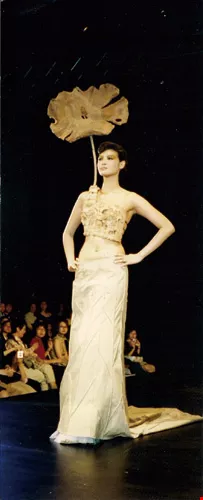
Another bold effort, Lin's Lotus collection (2003) combined high fashion with traditional wood carving.
Troubled teen years
This boy whom family and friends thought introverted developed a sense of design early on and used it to brighten up his hand-me-downs with swaths of fabric. His clothes and even the bamboo-leaf hats he wore in the fields were always more brightly colored than everyone else's. As a boy, his fascination with glove-puppetry and Taiwanese Opera costumes led him to shuck peanuts for his neighbors in exchange for the chance to watch such programs on their TVs.
By middle school, he was regularly representing his class in school-wide drawing competitions, but also became enamored with the young thugs on campus. "Taixi's extreme poverty resulted in an extremely polarized society," says Lin. "There were two routes to status: becoming a gangster or throwing yourself into your studies." Gangsterhood sounded pretty good to Lin, as a poor student who had noticed the way the young thugs strutted around campus. "But they turned me down in three consecutive 'interviews' because I was too scrawny," he laughs.
After graduating from middle school, Lin came to Taipei to work for an uncle who was a chicken vendor at the city's central market. "At the time, I couldn't help but wonder if this was how I was going to spend the rest of my life," he recalls. In an effort to give himself a shot at something better, he enrolled at a cram school just six months after coming to Taipei. The gamble paid off, and he was admitted to Fuxing Junior College of Technology in Ilan (now the Lan Yang Institute of Technology). There he studied mechanical engineering-a field in which he had no interest-because he thought it would lead to a job that paid well enough to support a family.
His family sold six pigs at the start of every semester to pay his tuition, so he went home on summer and winter breaks to help out on the farm. He learned a great deal about raising pigs on those visits, including porcine first-aid and CPR techniques, and over the years helped deliver more than 1,000 piglets. Back at school, he covered his living expenses by delivering newspapers and winning prize money in drawing competitions held both on and off campus.
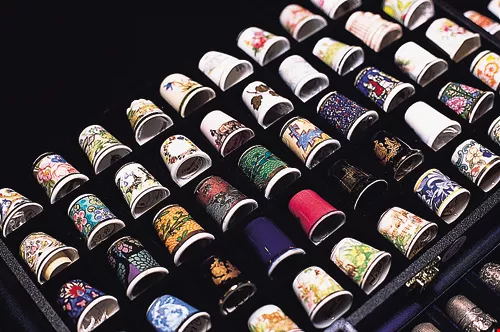
Lin doesn't just collect Barbies; he also happens to be Taiwan's best-known collector of thimbles.
A search for beauty
Five years later, after he'd graduated from school and finished his military service, Lin went to work for an auto parts firm as a machinist. But, still passionate about the arts, he soon began thinking about changing career tracks. He reached a turning point in his life when, at the age of 26, he began taking evening classes on fabrics, sewing, color theory, design, fashion history, pattern making, draping and 3D cutting, fashion illustration, and window display design at a private fashion design school.
From the moment he started the classes, Lin knew he'd found his calling. Six months later quit his job to study fashion design fulltime. In his second year at the school (in 1989), he finished third in a Fengqun Department Stores fashion design contest, which also awarded six of his pieces prizes for excellence. ShanShan Fashion was impressed and hired him as a designer, giving him his formal start in the clothing field. When ShanShan's owner decided to shut down the company one year later after suffering heavy losses on investments, Lin bought him out and took over, forming the Guqi Fashion Design and Manufacturing Studio.
Filled with a youthful desire to create, Lin had by the end of just three short years had earned significant amounts of money and developed a passion to learn even more. At the age of 32, he decided to turn the management of his company over to his elder brother and headed to New York to study English at Columbia University. He had very little English when he first arrived in the US. Uncomfortable with restaurants because he couldn't read menus, he ate fast food for three months straight. The experience only made him still more determined to learn.
After six months, he began taking pattern-making and fashion-illustration classes at New York's Fashion Institute of Technology. Having received A's on his coursework there, he emerged much more confident in his abilities. He arrived back in Taiwan just as the University of Central England in Birmingham was recruiting students. Thinking he might give the school a try, he went for an interview. When the school surprised him by granting him admission, he packed his bags and headed to the UK to pursue his master's degree in fashion design.
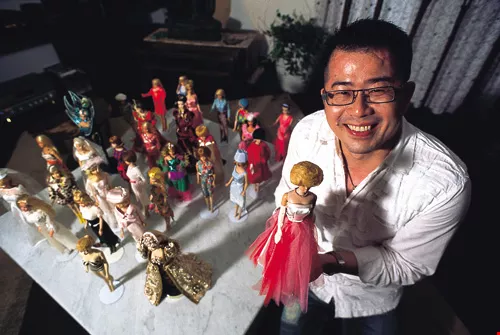
Cutting edge fashion designer Lin Goji also happens to have Taiwan's largest collection of Barbie dolls and accessories. (photo by Chuang Kung-ju)
Tradition and fashion
Recalling his years abroad, Lin laughs and says that classes took up only about one-third of his time. He spent the rest going to museums and traveling. In his two years in the UK, he made six circuits of the island, travelled by Chunnel to Paris, and used the City of Lights as a base for his explorations of the rest of Europe.
"I found travel more enlightening than my classes," says Lin. "Whenever I arrived somewhere, I'd note the colors of the sky, the architecture, and the clothing, examine lines and shapes, and soak up different cultures and lifestyles. I also had conversations with artists from different fields, who broadened my perspective and helped me wrap my head around unconventional, highbrow creative concepts."
Lin loves old things, and finds everything from ancient paintings in museums to flea-market antiques inspiring. His approach is much like that of Western designers who find inspiration in sexy Renaissance corsets and farthingales. "You can transform traditional elements to create new fashions," explains Lin. "But you have to spend some time digesting and processing the ideas; you can't just quote directly."
Lin's 1996 graduation piece was based on the Tang Dynasty's three-color ceramic glaze, with the models wearing ceramic tops made from molds of their upper bodies. The work blended the mysterious charm of the East with new trends in couture, and was the only graduation piece from that year invited to take part in a traveling exhibition visiting British art museums.
It was also during his graduate study in the UK that Lin discovered the love of his life: Barbie dolls. Lin found himself captivated by the dolls' myriad expressions and every aspect of their designs when he stumbled across an exhibition at Harrods of Barbies made to look like the world's top three models.
"I love clothing and accessories with history and style, but I'll never have enough space or money for all the ones I'd like to have," says Lin. "Barbie dolls are small enough to let me to indulge my desire to collect fashionable things." Lin's collection, which includes more than 1,300 Barbies acquired over the course of more than a decade, is the largest in Taiwan.
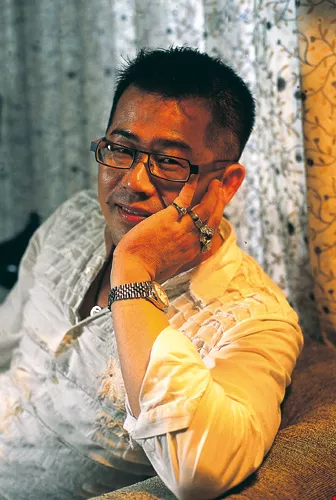
Though he works in the incredibly competitive fashion field, Lin approaches his hectic life as a game that he has "designed" to maximize its challenge and interest.
Blending old and new
In 1997, Lin returned to Taiwan and took a position as a lecturer in fashion design at Shih Chien University. He also continued seeking inspiration in historical Chinese clothing and accessories. For example, he printed all of the massive painting Going Upriver on the Qingming Festival on the fabric he used for his clothing line of the same name, and gave his "Ancestral Images" line a bold and avant-garde look by putting portraits of emperors on the tops.
He's also used ideas that relate to contemporary everyday life. In July 2000, at the invitation of the Environmental Protection Administration and the Taipei Computer Association, Lin presented pieces at a show highlighting recycling and the environment, including clothing and tall boots decorated with keys from discarded keyboards. In December of the same year, he presented his Red Cliffs line at a show sponsored by the Textile Research and Development Association International. The fabric he used for the line included a striking decorative pattern-the text of Song poet Su Shi's "Red Cliffs" rendered in Su's own calligraphy.
Lin loves browsing antiques shops, and a shop window full of fine sculptures-temple carvings of people, landscapes, birds and flowers that fell into the hands of dealers when the temples were renovated or torn down-served as the inspiration for his blending of traditional wood carving with high fashion. To create form-fitting tops, he had to persuade his models to let him make plaster casts of their bodies, then talk wood carvers into sculpting them using traditional techniques. For the introduction of the Lotus line in 2003, he delighted the audience by having his models carry lotus leaves carved from wood on their shoulders.
Already a topic of discussion for his use of new materials and his incorporation of design elements from other fields, Lin brought something entirely new to the runway in 2007 with the introduction of his Mazu line at the FUSE Fashion Week. The line featured not only cute Mazu dolls and contemporary super mini-suits, but also tops decorated with images of the goddess's head. Though reactions to the line varied, it was inarguably the first to blend high fashion and Taiwanese folk religion.
Lin went for a "young Chinese" look with his Tao Collection, introduced in 2006. The name comes from the Dao De Jing, which describes the dao (also spelled tao) as something vibrant, inclusive, and filled with possibilities. Eschewing the qipao of the old gentry and the folk customs beloved by the literati, Lin took the collection in a new direction. He aimed it at young people, hoping to interest them in clothing featuring distinctively Chinese elements such as frog fasteners and cloud patterns.
In 2007, Lin established his Western clothing concepts studio, which focuses on Western clothing and party dresses. Intrigued by his unique grasp of the feminine, a number of female stars have hired him to design clothes just for them. He is direct and cutting when commenting on celebrity couture, which has made his fashion pronouncements as much a hot topic in celebrity circles as his creations.
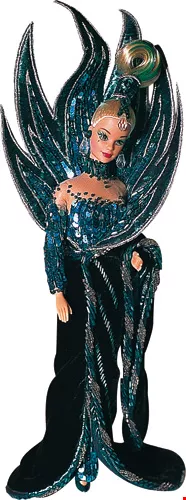
Cutting edge fashion designer Lin Goji also happens to have Taiwan's largest collection of Barbie dolls and accessories. (photo by Chuang Kung-ju)
Perfectionist
Lin is no flatterer; he's a perfectionist. Notorious for demanding a great deal of his students, he teaches an integrated fashion design course that students at Shih Chien must take to graduate. As he guides his students through the production of pieces for Fashion Week and their graduation show, he insists that they keep a daily journal to spark the creative process. He has them make note of any interesting issues or ideas they encounter (for their own future reference), and also encourages them to glue in swatches of handmade fabrics, photos of buildings, and even images of the patterns they find in things such as tree bark and the cracks in ice cubes. "It teaches them to pay attention, and gets them in the habit of jotting things down."
In class, he clinically dissects and critiques their work in one-on-one discussions that leave many in tears. "Competition is fierce in the fashion industry," explains Lin. "Those who aren't constantly seeking to improve their work are quickly left behind. You have to push students while they're still in school." In addition to providing design and production assistance, Lin also accompanies his students on trips to Yongle Market and Nanjing West Road to select fabrics, to Taiyuan Road to pick out accessories, and to Tianshui Street to buy dyes.
After more than a decade of teaching, Lin knows well that Taiwanese students are both creative and competent. But the government emphasizes hi-tech industries, while the educational system slights vocational training, creating a gap between the creative levels attained by designers and the capabilities of firms and their employees to realize and commercialize the designs. Issues like this handicap the Taiwanese fashion industry over the long term.
Jason Wu, a Taiwanese living in the US, became an overnight sensation this year when US First Lady Michelle Obama wore a white gown of his to the President's Inaugural Ball. "But this takes not only great ability, but a certain amount of luck or fortuitous timing as well," says Lin. He argues that if Taiwan's fashion industry is to earn a permanent spot on the global catwalk, it must not only build its own brands, the government must develop an integrated industrial policy for the industry, and help businesses create a platform that will be on the same track with the international fashion industry as a whole.
Taiwan's own fashion market is small and exceptionally competitive. Lin and his two in-house designers produce at least 300 new outfits every season. Working under such intense pressure, design is practically a reflex-new ideas just emerge as needed.
Lin's work as a designer also enables him to travel overseas regularly to see shows, check out fabrics, and get a handle on international fashion trends. He treats his frenetic life as a game, always making sure to "design" it to maximize its interest and challenge. Perhaps that's how he keeps the new ideas flowing!
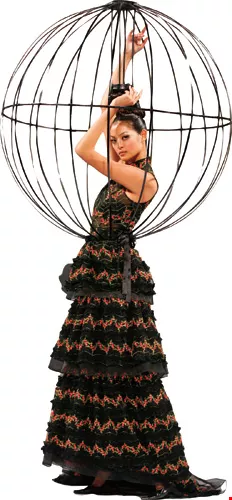
When Lin showed his Tao Collection in 2006 at the invitation of the Taiwan Textiles Federation, he highlighted the importance of environmental conservation by printing images of 12 species of flora indigenous to Taiwan on the fabric.
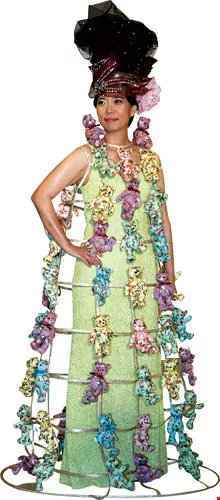
On Mother's Day 2009, Lin presented a new take on classical fashion to the hardworking mothers who volunteer at Taipei's National Palace Museum. From left to right: a dress decorated with 100 replicas of the famous jade carving "Jade Cabbage"; another decorated with teddy bears made from fabric printed with images from the work of Giuseppe Castiglione; still another made from ties printed with scenes from the museum's collection; and finally a low-cut gown accessorized with silk scarves featuring patterns from museum artifacts.
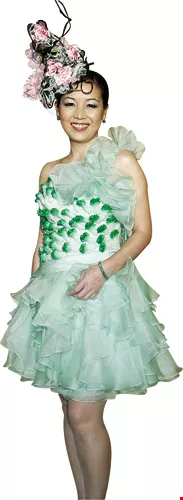
On Mother's Day 2009, Lin presented a new take on classical fashion to the hardworking mothers who volunteer at Taipei's National Palace Museum. From left to right: a dress decorated with 100 replicas of the famous jade carving "Jade Cabbage"; another decorated with teddy bears made from fabric printed with images from the work of Giuseppe Castiglione; still another made from ties printed with scenes from the museum's collection; and finally a low-cut gown accessorized with silk scarves featuring patterns from museum artifacts.
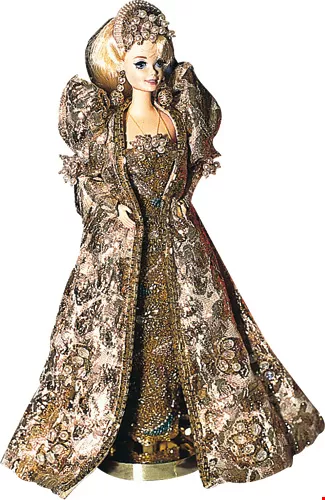
Cutting edge fashion designer Lin Goji also happens to have Taiwan's largest collection of Barbie dolls and accessories. (photo by Chuang Kung-ju)
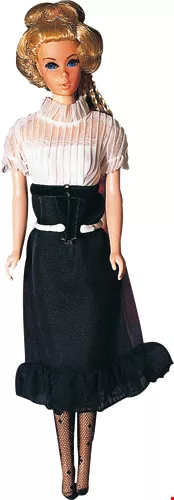
Barbie dolls and accessories.
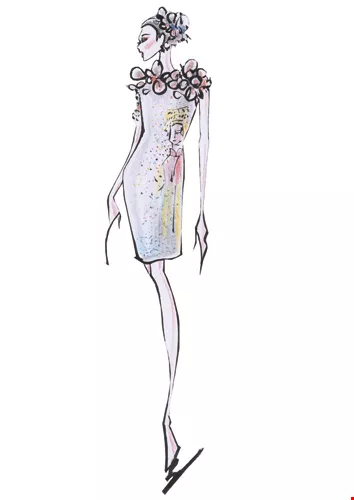
In 2007, Lin turned the traditional solemnity of Mazu worship on its head when he designed a line of modern mini-skirted outfits for the Zhenlan Temple.
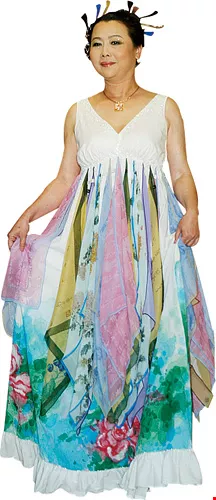
On Mother's Day 2009, Lin presented a new take on classical fashion to the hardworking mothers who volunteer at Taipei's National Palace Museum. From left to right: a dress decorated with 100 replicas of the famous jade carving "Jade Cabbage"; another decorated with teddy bears made from fabric printed with images from the work of Giuseppe Castiglione; still another made from ties printed with scenes from the museum's collection; and finally a low-cut gown accessorized with silk scarves featuring patterns from museum artifacts.

@List.jpg?w=522&h=410&mode=crop&format=webp&quality=80)

@List.jpg?w=522&h=410&mode=crop&format=webp&quality=80)


