Way to Go!Breathing New Life into an Old Game
Lin Hsin-ching / photos Jimmy Lin / tr. by Jonathan Barnard
February 2008


Said to date from the rule of the leg-endary emperor Yao, the game of Go is a crystallization of the wisdom of the Chinese ancients. In Chinese it is known as weiqi, or "surround chess"-one achieves victory by surrounding territory on the board. Although its rules are simple, its nuances are many. It is easy to learn but hard to master. The supercomputer Deep Blue defeated the world's greatest human chess player. But even today's computers are helpless when faced with the complex calculations required for Go. Even novice players can beat them.
As long ago as 1979 a system for professional Go players was established in Taiwan, but the field has suffered from a lack of comprehensive planning and management. Whether in terms of financial compensation or the training environment, Go in Taiwan has lagged behind the game in neighboring countries such as China, Japan and Korea. Yet in recent years there have been signs that Taiwanese Go is on the upswing: The Taiwan Chi Yuan Culture Foundation has been established with corporate support; the homegrown Go master Chou Chun-hsun won the first LG Cup World Baduk Championship; and a younger generation of Taiwanese Go players who moved to Japan, including Chang Hsu and Hsieh Yi-min, have also won important titles there.
On December 11, 2007, Taipei was basking under a warm sun-a rare joy in winter. Yet a cold and tense atmosphere suffused the Go room of the Taiwan Chi Yuan Culture Foundation on Taipei's Roosevelt Road. The Wangzuo Tournament, one of Taiwan's three major Go events, was underway there. The final was between Chen Shih-yuan, a seventh-dan professional, and Chou Chun-hsun, a ninth-dan professional and the 2006 Wangzuo champion.
Chen was last year's top performer in domestic Go championships, winning both the "Tianyuan" and "Guoshou" titles. Chou Chun-hsun, on the other hand, is generally acknowledged as the greatest of Taiwan's Go players, having won the 2007 LG Cup World Baduk Championship, which is held in Korea. The best-of-five match between Chou and Chen was receiving an extraordinary amount of attention within the Go community.
One false move...
At 10 a.m. sharp, the match began. The two competitors, who had long been in the Go room, nodded slightly to each other as a courtesy. Then, by guessing whether an odd or even number of pieces were in each other's hands, the players determined that Chou would be black. In Go black goes first, but because that is greatly advantageous to capturing territory, those who draw black cede six and a half "eyes" to white (an eye is a unoccupied spot on the grid surrounded by one's stones). The players change colors every game.
After thinking for a few seconds, Chou Chun-hsun quickly placed his first piece in the upper left "star position." (A star position is where the fourth vertical and horizontal lines from any corner of the board intersect.) Chen Shih-yuan also played his first white piece in a star position. These have become the most popular opening moves.
After about two hours, the lower right corner of the black side became a site of intense combat. Originally Chen's white pieces had the upper hand, but with move 49, Chou made an unexpected play that successfully blocked white's advance. At that point the match turned from white having a slight advantage to being evenly balanced. Whether because of the room's strong air conditioning or because he was nervous, the slightly built Chen put on a jacket. As he rested his chin on his right fist, his face betrayed a slight look of anxiety. Known as "the red-faced king of Go," Chou maintained his inscrutable visage-his eyes squinting ever so slightly, like an old monk in meditation.
Before the break for lunch, the two become engaged in another battle on the left side of the board. Set on victory, Chen overextended himself with moves 70 and 72, giving Chou an opportunity to gain the upper hand. Unfortunately for Chou, with move 97 he was unable to successfully surround the white, and on move 117, he made a bad mistake. From that point on, white steadily gained territory and black was in retreat. By move 210, Chou could see that the game was lost, and he conceded.
Victory or defeat
Said to date from the rule of the leg-endary emperor Yao, the game of Go is a crystallization of the wisdom of the Chinese ancients. In Chinese it is known as weiqi, or "surround chess"-one achieves victory by surrounding territory on the board. Although its rules are simple, its nuances are many. It is easy to learn but hard to master. The supercomputer Deep Blue defeated the world's greatest human chess player. But even today's computers are helpless when faced with the complex calculations required for Go. Even novice players can beat them.
As long ago as 1979 a system for professional Go players was established in Taiwan, but the field has suffered from a lack of comprehensive planning and management. Whether in terms of financial compensation or the training environment, Go in Taiwan has lagged behind the game in neighboring countries such as China, Japan and Korea. Yet in recent years there have been signs that Taiwanese Go is on the upswing: The Taiwan Chi Yuan Culture Foundation has been established with corporate support; the homegrown Go master Chou Chun-hsun won the first LG Cup World Baduk Championship; and a younger generation of Taiwanese Go players who moved to Japan, including Chang Hsu and Hsieh Yi-min, have also won important titles there.
On December 11, 2007, Taipei was basking under a warm sun-a rare joy in winter. Yet a cold and tense atmosphere suffused the Go room of the Taiwan Chi Yuan Culture Foundation on Taipei's Roosevelt Road. The Wangzuo Tournament, one of Taiwan's three major Go events, was underway there. The final was between Chen Shih-yuan, a seventh-dan professional, and Chou Chun-hsun, a ninth-dan professional and the 2006 Wangzuo champion.
Chen was last year's top performer in domestic Go championships, winning both the "Tianyuan" and "Guoshou" titles. Chou Chun-hsun, on the other hand, is generally acknowledged as the greatest of Taiwan's Go players, having won the 2007 LG Cup World Baduk Championship, which is held in Korea. The best-of-five match between Chou and Chen was receiving an extraordinary amount of attention within the Go community.
One false move...
At 10 a.m. sharp, the match began. The two competitors, who had long been in the Go room, nodded slightly to each other as a courtesy. Then, by guessing whether an odd or even number of pieces were in each other's hands, the players determined that Chou would be black. In Go black goes first, but because that is greatly advantageous to capturing territory, those who draw black cede six and a half "eyes" to white (an eye is a unoccupied spot on the grid surrounded by one's stones). The players change colors every game.
After thinking for a few seconds, Chou Chun-hsun quickly placed his first piece in the upper left "star position." (A star position is where the fourth vertical and horizontal lines from any corner of the board intersect.) Chen Shih-yuan also played his first white piece in a star position. These have become the most popular opening moves.
After about two hours, the lower right corner of the black side became a site of intense combat. Originally Chen's white pieces had the upper hand, but with move 49, Chou made an unexpected play that successfully blocked white's advance. At that point the match turned from white having a slight advantage to being evenly balanced. Whether because of the room's strong air conditioning or because he was nervous, the slightly built Chen put on a jacket. As he rested his chin on his right fist, his face betrayed a slight look of anxiety. Known as "the red-faced king of Go," Chou maintained his inscrutable visage-his eyes squinting ever so slightly, like an old monk in meditation.
Before the break for lunch, the two become engaged in another battle on the left side of the board. Set on victory, Chen overextended himself with moves 70 and 72, giving Chou an opportunity to gain the upper hand. Unfortunately for Chou, with move 97 he was unable to successfully surround the white, and on move 117, he made a bad mistake. From that point on, white steadily gained territory and black was in retreat. By move 210, Chou could see that the game was lost, and he conceded.
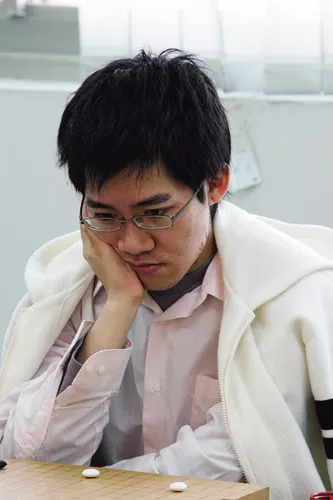
Lin Chih-han, who is currently ranked second among Taiwan's Go players, has a degree in international business from National Taiwan University. To pursue an education, he stopped playing Go for six years.
The whole competition was wrapped up by 4:30 p.m. Afterwards, the two spent more than an hour discussing their moves with observers. Winner Chen Shih-yuan explained that he was lucky to have won. "If my opponent hadn't made a mistake, I would have lost early on." The loser Chou Chun-hsun seemed less calm than when playing. One could feel a sense of loss and frustration behind his smile. At the end of the meeting, he quickly departed, and the Go players who had been onlookers said nothing to him. For Go professionals, losing is a dish that one must frequently eat. Offering kind words provides little solace. Letting players calm down by themselves is best.
For Go professionals such as Chou and Chen every game is a bitter test. "The toughest thing to handle are those matches when you're losing from start to finish and never gain a grip," says Chen. "Or when victory seems assured and then you make a mistake to bring defeat. That's when you really regret losing. Sometimes it will put you in a funk, and you'll lose several games in a row."
Cultivating Go talent
Chou and Chen are both affiliated with the Taiwan Chi Yuan Culture Foundation. Established in March of 2000, Taiwan Chi Yuan is the nation's second-oldest professional Go organization and is currently the most active. It was founded by Bob Wong, the chairman of CMC Magnetics, who is himself a sixth-dan player. Every year he contributes NT$25-30 million to support its development. Currently, Taiwan Chi Yuan has 49 pros, and each year it holds at least eight to ten competitions. It also selects 60 junior players (under-18s) and places each of them in one of five training groups, graded from A to E.
Apart from Taiwan Chi Yuan, there is also the Chinese Taipei Wei-Chi Association, which had previously existed in pre-Communist mainland China as the Chinese Wei-Chi Association. It was re-established in Taiwan in 1952 and took on a professional component in 1979. Ing Chang-ki, a famous entrepreneur and the main backer of the club, pushed for the nine-dan ranking system, which was meant to mirror the nine ranks of mandarins in imperial China. Since the 1990s, when its main source of financial support, the Ing Chang-ki Weichi Educational Foundation, moved to mainland China, the association has suspended its sponsorship of many competitions.
Because the Chinese Taipei Wei-Chi Association had largely suspended operations, Taiwan Chi Yuan was established in 2000, and various professionals who were previously connected to the association, such as Chou Chun-hsun, Lin Sheng-hsien, Peng Ching-hua, Tai Chia-shen and Chen Kuo-hsing, joined Taiwan Chi Yuan. It has thus became the most important organization in Taiwan for developing professional Go talent.
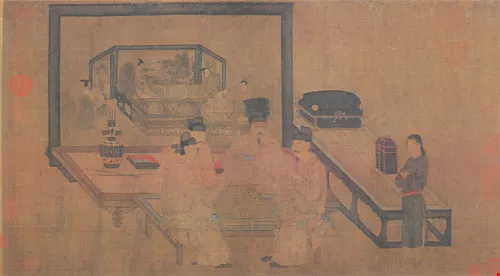
Go is one of the four arts-along with music, calligraphy and painting-that scholars in ancient China pursued as a means of self-cultivation. In the painting Game of Go and Multiple Screens the second seated figure on the right observing the match is the Southern Tang emperor Li Jing (reigned 916-961). The other three men are his younger brothers.
Victory or defeat
The whole competition was wrapped up by 4:30 p.m. Afterwards, the two spent more than an hour discussing their moves with observers. Winner Chen Shih-yuan explained that he was lucky to have won. "If my opponent hadn't made a mistake, I would have lost early on." The loser Chou Chun-hsun seemed less calm than when playing. One could feel a sense of loss and frustration behind his smile. At the end of the meeting, he quickly departed, and the Go players who had been onlookers said nothing to him. For Go professionals, losing is a dish that one must frequently eat. Offering kind words provides little solace. Letting players calm down by themselves is best.
For Go professionals such as Chou and Chen every game is a bitter test. "The toughest thing to handle are those matches when you're losing from start to finish and never gain a grip," says Chen. "Or when victory seems assured and then you make a mistake to bring defeat. That's when you really regret losing. Sometimes it will put you in a funk, and you'll lose several games in a row."
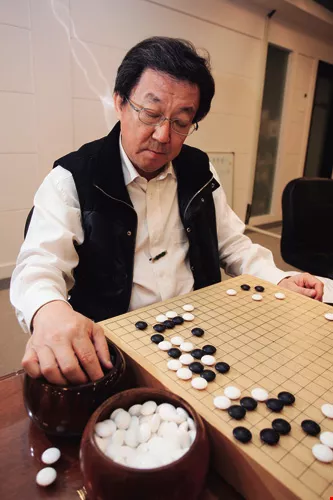
Bob Wong, chairman of CMC Magnetics and himself a sixth-dan player, is currently Taiwan's most important promoter of professional Go.
Problem 1: lack of income
Although CMC Magnetics and other businesses have been generous supporters, the environment for professional Go in Taiwan falls far short of that in China, Japan and Korea.
The main reason that excellent Go players are hesitant to devote themselves to the game is the lack of a stable income. Most professionals must teach on the side because it is very hard to make ends meet just on prize money. Earnings in Taiwan last year for world champion Chou Chun-hsien, who performed relatively poorly in domestic competitions, were only around NT$1.6 million. Yet simply by winning the LG Cup he earned NT$8.8 million. Thus his winnings for that single event far outstripped what he earned in Taiwan all year.
And it's not just world championships; the purses for domestic competitions in other nations are also much higher than in Taiwan. The prize money in China is highest. The champion of the Changqi Cup, sponsored by the Chinese Weiqi Association and the Ing Chang-ki Weichi Educational Foundation, earns RMB400,000 (about NT$1.7 million), and the winner of the Korean LG Refined Oil Cup earns 50 million Won (NT$1.75 million). And we haven't even mentioned Japan, where professional Go has been established longest. The winner of Japan's Kisei Tournament, which offers that nation's highest prize money, comes home with ¥42 million (NT$12 million). "But the winner of the 'Tianyuan'-Taiwan's highest-paying Go competition-only gets NT$800,000," says Chou wryly. "There's just no comparison."
Even if you include all of the domestic Go championships, the potential winnings would only amount to NT$2 million. And if you are talking about second and third place, the total would drop to NT$1 million or below. As for newcomers or lower-ranking pros, or those who don't fall in the top few spots, all they can expect to earn is a few thousand NT dollars from "competitor stipends" each month. "If the top three players can only earn NT$1-2 million, how can you expect more people to want to enter this field?" wonders Lin Chih-han, an eighth-dan player and Taiwan's second highest ranking.
Problem 2: Go or school?
The value placed on educational advancement in Taiwanese society also harms the professional development of Go.
In Sword Stained with Royal Blood Louis Cha, the master martial arts novelist, wrote: "In Go, mental agility is paramount. It's often said that if you're not a champion by 20, there's no hope." Consequently, the very best Go players, such as Wu Qingyuan, Lin Hai-feng, or Chang Hsu (all of whom now compete in Japan), left school in their teens or earlier to focus on Go. Even Chou Chun-hsun, who remained in Taiwan, dropped out after third grade to focus on Go.
The Chang Ching Children's Go College has four branches in Taipei, with more than 2000 students in all. Its director Shan Chia-ping points out that of 100 children who study Go there, only one will have the determination to pursue a career in it.
"Go can cultivate children's logical faculties," says Shan. "Students who study Go typically do well in school. The vast majority of parents wouldn't let their kids forsake school to study Go."
Lin Chih-han, an eighth-dan pro, holds a degree in international business from National Taiwan University. He once stopped playing Go for six years to pursue his education. Chen Feng, a second-dan player who was accepted at Taipei Municipal Jianguo High School last year, must apply for a leave of absence from school when he wants to take part in a competition. He frankly states that when he enters 11th grade next year and his coursework grows heavier, he may have to bite the bullet and suspend his study of Go.
The problem with having to choose between a career in Go and an education, argues Lin Chih-han, is that Taiwanese society doesn't regard playing Go as a legitimate profession. Most people feel that electing to go to school and cultivating other educational skills will provide more security. "If everyone viewed a career as a Go player like a career as a lawyer or doctor, the number of people willing to participate would naturally increase."
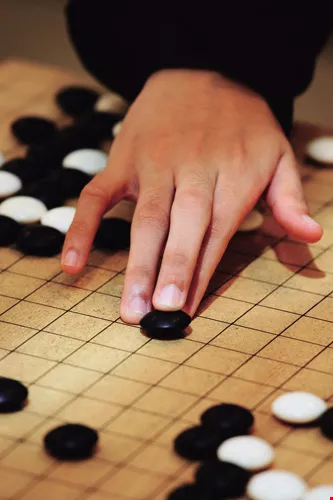
Go puts a premium on consistent focus, logic, calculative precision, and memory. One must be careful with every move and think comprehensively. Otherwise, you can lose an advantage with a single wrong move.
Cultivating Go talent
Chou and Chen are both affiliated with the Taiwan Chi Yuan Culture Foundation. Established in March of 2000, Taiwan Chi Yuan is the nation's second-oldest professional Go organization and is currently the most active. It was founded by Bob Wong, the chairman of CMC Magnetics, who is himself a sixth-dan player. Every year he contributes NT$25-30 million to support its development. Currently, Taiwan Chi Yuan has 49 pros, and each year it holds at least eight to ten competitions. It also selects 60 junior players (under-18s) and places each of them in one of five training groups, graded from A to E.
Apart from Taiwan Chi Yuan, there is also the Chinese Taipei Wei-Chi Association, which had previously existed in pre-Communist mainland China as the Chinese Wei-Chi Association. It was re-established in Taiwan in 1952 and took on a professional component in 1979. Ing Chang-ki, a famous entrepreneur and the main backer of the club, pushed for the nine-dan ranking system, which was meant to mirror the nine ranks of mandarins in imperial China. Since the 1990s, when its main source of financial support, the Ing Chang-ki Weichi Educational Foundation, moved to mainland China, the association has suspended its sponsorship of many competitions.
Because the Chinese Taipei Wei-Chi Association had largely suspended operations, Taiwan Chi Yuan was established in 2000, and various professionals who were previously connected to the association, such as Chou Chun-hsun, Lin Sheng-hsien, Peng Ching-hua, Tai Chia-shen and Chen Kuo-hsing, joined Taiwan Chi Yuan. It has thus became the most important organization in Taiwan for developing professional Go talent.
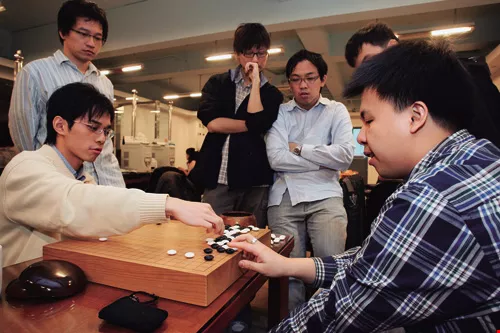
After a professional game of Go, the winner and loser typically sit down to ask each other questions and analyze how the match proceeded. The photo shows Chen Shih-yuan (left) and Chou Chun-hsun discussing key points in their match with other Go players after the "Champions' Challenge."
Problem 3: training and research
Before the Taiwan Chi Yuan Culture Foundation was established, most children who showed outstanding talent at Go were sent off to study Go in Japan. For the past decade, China and Korea have also started to put a lot of emphasis on the profession, stirring up a craze for Go in those nations. On the other hand, the passion for Go in Japan has been waning. Recently most of the champions of international Go competitions have been from China or Korea.
Chen Shih-yuan, 22, who studied at Kwon Kam Hyo's Baduk Academy for eight years, points out that Go is so popular in Korea that one out of four people there know how to play it. The government and private citizens have spared no effort promoting it, not only establishing Go departments at colleges but also excusing Go world champions from military service.
There are many privately established Go academies, including Kwon Kam Hyo's, Heo Jang Hoi's and Kim Won's, which cultivate new Go talent through rigorous training.
"Back when I was at Kwon Kam Hyo's, we'd start in at Go as soon as we woke up-whether studying strategy, practicing scenarios, or actually playing," Chen recalls. "We practiced Go more than 12 hours a day. If we played badly, the instructors would beat us. And they used group punishment. If anyone didn't perform well, then everyone would get punished." He jokes: "Maybe it's part of the national culture. In Korea the 'spare the rod, spoil the child' philosophy is prevalent, but it would be deemed unacceptable in modern-day Taiwan."
Chen Shih-yuan also believes that the research climate for Go players in Taiwan isn't outstanding. "Take, for instance, the professional Go scene in Korea. There are a lot of regularly scheduled seminars, in which pros come together in great numbers to talk about Go matches and go over Go diagrams. But in Taiwan players seem to be busy with all kinds of miscellany, and the research climate isn't robust."
In China the situation is similar to Korea. Apart from a national academy established by the government, which trains Go talent with a strict regimen like those adopted for athletes, there are also numerous private academies. At the same time, Chou Chun-hsun, who has professional Go player credentials for China, regularly goes to the mainland to challenge top players there and let them mutually benefit from the competition. "If you are always playing with people who are worse than you," he says, "it's hard for your Go skills to improve. But in Taiwan, apart from Chen Shih-yuan and Lin Chih-han, few players can put pressure on me. It's not like in China, Japan or Korea, where there are so many good players that a top player need only relax for a moment to be overtaken."
Educational incentives
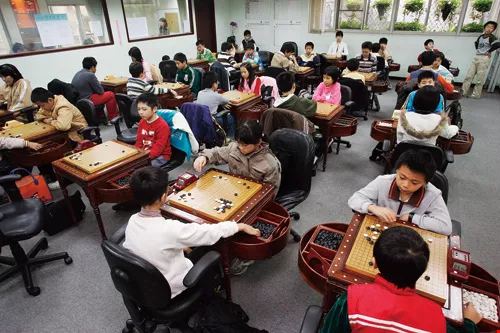
The Taiwan Chi Yuan Culture Foundation each year sponsors 60 junior players, who are placed on one of five squads (ranked from A to E). Based on their match records, they advance toward the goal of becoming a professional player. The photo shows these juniors at one of their regular Saturday meetings at Taiwan Chi Yuan.
Problem 1: lack of income
Although CMC Magnetics and other businesses have been generous supporters, the environment for professional Go in Taiwan falls far short of that in China, Japan and Korea.
The main reason that excellent Go players are hesitant to devote themselves to the game is the lack of a stable income. Most professionals must teach on the side because it is very hard to make ends meet just on prize money. Earnings in Taiwan last year for world champion Chou Chun-hsien, who performed relatively poorly in domestic competitions, were only around NT$1.6 million. Yet simply by winning the LG Cup he earned NT$8.8 million. Thus his winnings for that single event far outstripped what he earned in Taiwan all year.
And it's not just world championships; the purses for domestic competitions in other nations are also much higher than in Taiwan. The prize money in China is highest. The champion of the Changqi Cup, sponsored by the Chinese Weiqi Association and the Ing Chang-ki Weichi Educational Foundation, earns RMB400,000 (about NT$1.7 million), and the winner of the Korean LG Refined Oil Cup earns 50 million Won (NT$1.75 million). And we haven't even mentioned Japan, where professional Go has been established longest. The winner of Japan's Kisei Tournament, which offers that nation's highest prize money, comes home with ¥42 million (NT$12 million). "But the winner of the 'Tianyuan'-Taiwan's highest-paying Go competition-only gets NT$800,000," says Chou wryly. "There's just no comparison."
Even if you include all of the domestic Go championships, the potential winnings would only amount to NT$2 million. And if you are talking about second and third place, the total would drop to NT$1 million or below. As for newcomers or lower-ranking pros, or those who don't fall in the top few spots, all they can expect to earn is a few thousand NT dollars from "competitor stipends" each month. "If the top three players can only earn NT$1-2 million, how can you expect more people to want to enter this field?" wonders Lin Chih-han, an eighth-dan player and Taiwan's second highest ranking.
Although the professional Go environment in Taiwan may not be on a par with China, Japan or Korea, when Chou won the world championship and thus shook the East Asian Go world, the government and the private sector discovered that Go was an area in which Taiwan had potential, so they gradually began to come up with plans for developing the game here.
So as to encourage more children to play Go, at the end of January 2008 the Ministry of Education held its first national Go competition for schools of all levels. The top three placers at each level would qualify for the athlete's bonus, receiving an extra 5-10% added to their scores when they applied to high school or university.
Nevertheless, this national competition was only open to amateur players. Pros were not allowed. Chen Feng, a second-dan pro at Jianguo High School, and his brother Chen Hsi, a sixth grader who has just turned pro, still face the double challenges of academics and playing Go professionally without catching any break. "This way of doing things punishes professional Go players," complains their mother Su Li-min. "The Ministry of Education ought to devise some other measures for adding to the scores of Go professionals."
In response, Chuang Ching-pao from the MOE's Department of Physical Education noted that professional athletes need to focus their energies and concentrate their wills. They shouldn't think they can go to school at the same time. Consequently, extra credit is currently usually only awarded to amateurs. If professionals wanted to participate in this competition, they would have to "temporarily" suspend their professional status.
Fighting for more resources
Apart from providing more inducements to encourage people to learn Go, improving the current professional Go environment is another common wish of people in the Go community.
Wearing the crown of the world Go king, Chou Chun-hsun suggests that Taiwan Chi Yuan, currently led by only a single company, could be given a national-level status. They could either follow the example of China, where the government consolidates all private resources, or follow the examples of Japan and Korea, where private Go academies have been incorporated as foundations, with independently operating boards of directors steering their development.
Bob Wong, chairman of the Taiwan Chi Yuan Culture Foundation, emphasizes that Taiwan Chi Yuan isn't the private property of CMC Magnetics but is rather the "common asset" of all of Taiwanese society.
"In 2008 we will attract more businesses to help the foundation. For instance, Bough Lin, chairman of Siliconware Precision Industries, is an excellent Go player who once won the Meijin Tournament. He is joining the ranks of those supporting professional Go, so that the number of tournaments the foundation sponsors in a year will rise to 12," says Wong.
He points out that currently the foundation is working with the Council for Cultural Affairs to plan a "President's Cup" competition, which might be held as early as later this year. The 2010 Asian Games in Guangzhou have already chosen Go as one of their two exhibition sports. It will provide an outstanding opportunity for Taiwan's Go competitors to make their mark. "In the future, if all levels of government continue to plan more competitions and increase the prize money and number of competitors, it will provide greater scope for Go professionals to develop."
Problem 2: Go or school?
The value placed on educational advancement in Taiwanese society also harms the professional development of Go.
In Sword Stained with Royal Blood Louis Cha, the master martial arts novelist, wrote: "In Go, mental agility is paramount. It's often said that if you're not a champion by 20, there's no hope." Consequently, the very best Go players, such as Wu Qingyuan, Lin Hai-feng, or Chang Hsu (all of whom now compete in Japan), left school in their teens or earlier to focus on Go. Even Chou Chun-hsun, who remained in Taiwan, dropped out after third grade to focus on Go.
The Chang Ching Children's Go College has four branches in Taipei, with more than 2000 students in all. Its director Shan Chia-ping points out that of 100 children who study Go there, only one will have the determination to pursue a career in it.
"Go can cultivate children's logical faculties," says Shan. "Students who study Go typically do well in school. The vast majority of parents wouldn't let their kids forsake school to study Go."
Lin Chih-han, an eighth-dan pro, holds a degree in international business from National Taiwan University. He once stopped playing Go for six years to pursue his education. Chen Feng, a second-dan player who was accepted at Taipei Municipal Jianguo High School last year, must apply for a leave of absence from school when he wants to take part in a competition. He frankly states that when he enters 11th grade next year and his coursework grows heavier, he may have to bite the bullet and suspend his study of Go.
The problem with having to choose between a career in Go and an education, argues Lin Chih-han, is that Taiwanese society doesn't regard playing Go as a legitimate profession. Most people feel that electing to go to school and cultivating other educational skills will provide more security. "If everyone viewed a career as a Go player like a career as a lawyer or doctor, the number of people willing to participate would naturally increase."
Currently, among professional athletics in Taiwan, only baseball garners much notice. Other sports receive very limited attention and resources. After Chou Chun-hsun won the Go world championship, this lonely realm suddenly found itself in the spotlight. Nevertheless, improving the situation of professional Go in Taiwan is a long-term project. It can't be done overnight. Only if government joins hands with the private sector can a long-term plan for cultivating Go talent be conceived and implemented. And only then will Taiwan's outstanding Go players be able to continue to perform well internationally.Problem 3: training and research
Before the Taiwan Chi Yuan Culture Foundation was established, most children who showed outstanding talent at Go were sent off to study Go in Japan. For the past decade, China and Korea have also started to put a lot of emphasis on the profession, stirring up a craze for Go in those nations. On the other hand, the passion for Go in Japan has been waning. Recently most of the champions of international Go competitions have been from China or Korea.
Chen Shih-yuan, 22, who studied at Kwon Kam Hyo's Baduk Academy for eight years, points out that Go is so popular in Korea that one out of four people there know how to play it. The government and private citizens have spared no effort promoting it, not only establishing Go departments at colleges but also excusing Go world champions from military service.
There are many privately established Go academies, including Kwon Kam Hyo's, Heo Jang Hoi's and Kim Won's, which cultivate new Go talent through rigorous training.
"Back when I was at Kwon Kam Hyo's, we'd start in at Go as soon as we woke up-whether studying strategy, practicing scenarios, or actually playing," Chen recalls. "We practiced Go more than 12 hours a day. If we played badly, the instructors would beat us. And they used group punishment. If anyone didn't perform well, then everyone would get punished." He jokes: "Maybe it's part of the national culture. In Korea the 'spare the rod, spoil the child' philosophy is prevalent, but it would be deemed unacceptable in modern-day Taiwan."
Chen Shih-yuan also believes that the research climate for Go players in Taiwan isn't outstanding. "Take, for instance, the professional Go scene in Korea. There are a lot of regularly scheduled seminars, in which pros come together in great numbers to talk about Go matches and go over Go diagrams. But in Taiwan players seem to be busy with all kinds of miscellany, and the research climate isn't robust."
In China the situation is similar to Korea. Apart from a national academy established by the government, which trains Go talent with a strict regimen like those adopted for athletes, there are also numerous private academies. At the same time, Chou Chun-hsun, who has professional Go player credentials for China, regularly goes to the mainland to challenge top players there and let them mutually benefit from the competition. "If you are always playing with people who are worse than you," he says, "it's hard for your Go skills to improve. But in Taiwan, apart from Chen Shih-yuan and Lin Chih-han, few players can put pressure on me. It's not like in China, Japan or Korea, where there are so many good players that a top player need only relax for a moment to be overtaken."
新增網頁1
How to keep score in Go:
| Go is all about acquiring territory, but there are slightly different ways of keeping score: "Territory scoring": The winner is the player with the largest number of "eyes"-unoccupied intersections on the grid that are surrounded by one's stones-minus the number of stones that have been captured by one's opponent.Japan, Korea and Taiwan all use this method "Area scoring": This method adds one's stones on the board to one's eyes to find one's total score. It is used in mainland China. "The Ing rules": Drawn up by Ing Chang-ki, these are a variation on the Chinese rules. |
Educational incentives
Although the professional Go environment in Taiwan may not be on a par with China, Japan or Korea, when Chou won the world championship and thus shook the East Asian Go world, the government and the private sector discovered that Go was an area in which Taiwan had potential, so they gradually began to come up with plans for developing the game here.
So as to encourage more children to play Go, at the end of January 2008 the Ministry of Education held its first national Go competition for schools of all levels. The top three placers at each level would qualify for the athlete's bonus, receiving an extra 5-10% added to their scores when they applied to high school or university.
Nevertheless, this national competition was only open to amateur players. Pros were not allowed. Chen Feng, a second-dan pro at Jianguo High School, and his brother Chen Hsi, a sixth grader who has just turned pro, still face the double challenges of academics and playing Go professionally without catching any break. "This way of doing things punishes professional Go players," complains their mother Su Li-min. "The Ministry of Education ought to devise some other measures for adding to the scores of Go professionals."
In response, Chuang Ching-pao from the MOE's Department of Physical Education noted that professional athletes need to focus their energies and concentrate their wills. They shouldn't think they can go to school at the same time. Consequently, extra credit is currently usually only awarded to amateurs. If professionals wanted to participate in this competition, they would have to "temporarily" suspend their professional status.
Fighting for more resources
Apart from providing more inducements to encourage people to learn Go, improving the current professional Go environment is another common wish of people in the Go community.
Wearing the crown of the world Go king, Chou Chun-hsun suggests that Taiwan Chi Yuan, currently led by only a single company, could be given a national-level status. They could either follow the example of China, where the government consolidates all private resources, or follow the examples of Japan and Korea, where private Go academies have been incorporated as foundations, with independently operating boards of directors steering their development.
Bob Wong, chairman of the Taiwan Chi Yuan Culture Foundation, emphasizes that Taiwan Chi Yuan isn't the private property of CMC Magnetics but is rather the "common asset" of all of Taiwanese society.
"In 2008 we will attract more businesses to help the foundation. For instance, Bough Lin, chairman of Siliconware Precision Industries, is an excellent Go player who once won the Meijin Tournament. He is joining the ranks of those supporting professional Go, so that the number of tournaments the foundation sponsors in a year will rise to 12," says Wong.
He points out that currently the foundation is working with the Council for Cultural Affairs to plan a "President's Cup" competition, which might be held as early as later this year. The 2010 Asian Games in Guangzhou have already chosen Go as one of their two exhibition sports. It will provide an outstanding opportunity for Taiwan's Go competitors to make their mark. "In the future, if all levels of government continue to plan more competitions and increase the prize money and number of competitors, it will provide greater scope for Go professionals to develop."
Currently, among professional athletics in Taiwan, only baseball garners much notice. Other sports receive very limited attention and resources. After Chou Chun-hsun won the Go world championship, this lonely realm suddenly found itself in the spotlight. Nevertheless, improving the situation of professional Go in Taiwan is a long-term project. It can't be done overnight. Only if government joins hands with the private sector can a long-term plan for cultivating Go talent be conceived and implemented. And only then will Taiwan's outstanding Go players be able to continue to perform well internationally.
新增網頁1
How to keep score in Go:
| Go is all about acquiring territory, but there are slightly different ways of keeping score: "Territory scoring": The winner is the player with the largest number of "eyes"-unoccupied intersections on the grid that are surrounded by one's stones-minus the number of stones that have been captured by one's opponent.Japan, Korea and Taiwan all use this method "Area scoring": This method adds one's stones on the board to one's eyes to find one's total score. It is used in mainland China. "The Ing rules": Drawn up by Ing Chang-ki, these are a variation on the Chinese rules. |


@List.jpg?w=522&h=410&mode=crop&format=webp&quality=80)


