Tastes for All Seasons--The Kuo Yuan Ye Museum of Cake and Pastry
Tsai Wen-ting / photos Chuang Kung-ju / tr. by David Mayer
April 2004


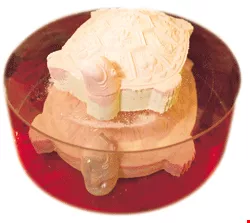
The Chinese traditionally celebrate a child's first birthday by making a big "tortoise cake," symbolizing the hope that the child will grow up "big and plump" just like the tortoise. Upon the occasion of a wedding, friends and relatives can look forward to receiving "happiness cakes" to share in the good cheer of the occasion. And when someone dies, a big gu'a cake (a mound of cooked glutinous rice, packed down hard) is set out, in hopes that the deceased will be well-fed and warm on the way to the next world.
From cradle to grave, traditional pastries are very much a part of every major rite of passage in Taiwan. If you're looking for a fun and educational place to take young kids, you might think seriously about the Kuo Yuan Ye Museum of Cake and Pastry. Run by Kuo Yuan Ye Foods, a pastry shop that's been in business for over a century, the museum offers kids a place to go and learn all about pastries, using their eyes to see, ears to hear, hands to make, mouths to taste, and noses to smell! The scrumptious delights there teach visitors much about traditional etiquette and local Taiwanese culture.
Before visiting children step through the front door, a museum staffer bangs out a hearty welcome on gong and drums.
Tour guides at the museum dress up as all sorts of different characters, here a green sprite, there a cowboy, here a prince, and there a swarthy sailor with a patch over one eye. The kids, naturally, are enthralled.
Website: www.kuos.com/culture
Delicious aromas
"You take the cake mold and pound on it once from straight above. Then you pound three times from the side. One, two, three... and the pineapple cakes all fall right out!" A pastry chef in a tall chef's hat shows the kids all the different pastry molds and demonstrates how they're used. The instant the chef finishes his spiel, the kids set immediately to pounding and banging. That's the way it's meant to be at this pastry museum in northern Taipei's Shihlin District.
Before they're set free to make pastries, the kids are first shown a video that tells all about the making of flour, sugar, pineapples, and other ingredients that go into pineapple cakes. They marvel with each discovery: "Wow, it takes 36 steps to turn wheat into flour! Whoa, then the flour gets sieved 24 times!"
Once they've learned how much has gone into the making of the ingredients, the kids roll up their sleeves and follow the master chef's instructions. First they take dough made of flour, butter, and eggs, and roll out a bunch of round, flat skins. They then wrap up pineapple fillings inside the skins and place them in cake molds shaped like all sorts of cartoon characters, including monkeys, penguins, and koala bears. Amidst the happy sounds of pounding and laughter, the pineapple cakes are completed. Lots of kids make designs of their own, such as smiley faces, whales, persimmons, and baby chicks.
Activities at the museum are pegged to the calendar. At the time of the Lantern Festival, midway through the first lunar month, museum visitors roll out traditional yuan xiao balls. On Father's Day, mothers and kids are invited to the museum to make Father's Day cakes. At Mid-Autumn Festival, kids make mooncakes and the cute little tags that indicate the various mooncake flavors. Throw in some shiny ribbon and voila! You've got a mooncake just like they used to make in the old days, eliciting a wave of nostalgia among the parents.
Kuo Yuan Ye Foods established Taiwan's first pastry museum in 2001 at Taoyuan County's Youth Industrial Park, housed in a building featuring traditional Chinese palace architecture. Then in August of the following year, when the company put up a new headquarters building in Taipei City's Shihlin District at the very first Kuo Yuan Ye location, the fourth and fifth floors of the building were set aside for a second museum. The Shihlin museum features a bakery, parent-child activity hall, display hall, and outdoor recreation area. Guided tours at the Youth Industrial Park museum have been expanded to include a trip around the production floor, which features the longest tunnel oven in all of Asia.
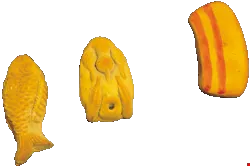
These fun "three animal" cakes (symbolizing the sacrifice of chicken, pork, and fish) are seldom seen anymore outside the museum.
Museums of the commonplace
While the experimenting children laugh and chatter, I look around at the shiny metal baking ovens all around the room and wonder: Are these also museum exhibits?
Museums have been undergoing changes for a long time now. In recent years, the trend has been toward "decentralization." Traditional museums headed by scholars, experts, and professional curators have been booted out of the mainstream, to be replaced by "museums of the commonplace" run by everyday people and focused on catering to the interests of everyday people, especially entertainment. The word "museum" is no longer defined so rigorously as it once was.
There are many museums in Japan that focus on facets of everyday life and industrial activity, such as curry, beer, or noodles, to name a few. According to Chiang Shao-ying, dean of the Graduate School of Folk Culture and Arts at Taipei National University of the Arts: "Modern museums are very diverse in focus. New-style museums focusing on any number of different economic activities are very closely tied in with people's lives." Chiang notes that the four main functions of traditional museums-research, collecting, preservation, and display-have given way to leisure, information, and education as the top priorities. And the style of exhibits, says Chiang, "increasingly caters to the experience of audiences. The point now is to let visitors enjoy knowledge, enjoy the atmosphere.... This is going to be a trend, just like the way museums of fine art have evolved into theaters."
Because Kuo Yuan Ye is an industrial museum run by a private enterprise, all the museum staffers are senior company employees, not professional museum curators. The pastry museum defines its role very clearly. It is not well equipped to focus on collection, research, publishing, or the development of souvenirs. Instead, the museum has clearly identified elementary school students as its main target audience, and uses games and hands-on activities to create a lively atmosphere. The height of the display cases, the planning of activities, and the outfits worn by museum guides were all chosen with the aim of entertaining children while introducing them to the world of pastry making.
With its lively atmosphere and abundant opportunity for hands-on activities, the museum has been a big hit ever since it first opened to the public. The museum in Shihlin alone has attracted over 80,000 visits since opening a year and a half ago. Even though the museum gives two tours a day every single day of the year, the current spring semester was already booked solid from the very start, with some 600 groups waiting for their chance to visit.
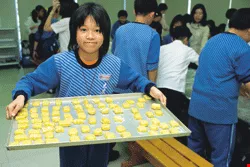
Making their own one-of-a-kind pineapple cakes gives children a rare multisensory introduction to the world of pastry making.
Eat, drink, and be merry
After the kids send their handiwork into the ovens, they head over to the parent-child activity hall for snacks and refreshments provided by Kuo Yuan Ye.
A guide asks: "So, kids, who do you think has had to work hardest today?" Some kids say it was the chef. Others say it was their teacher. Still others say that the kids themselves had it toughest! The guide then teaches the kids about a saying from the Analects of Confucius-"Whenever you are given food or drink, you should offer it to your teacher first"-and invites the parents and teachers for some snacks first before allowing the children to dig in.
After refreshments, the games begin. In the "beanbag toss," kids throw beanbags onto a table with names of 12 Chinese festivals. When someone throws a bag onto the space for the sixth day of the sixth lunar month (the "airing out" festival), for example, the thrower gets six points and a museum guide explains that the mid-summer "airing out" festival was when people in the old days traditionally aired out their books and washed their bedding.
The museum serves meals in oversize earthenware bowls ordered specially from the famous kilns in Yingko. The meals consist of various traditional fare, such as pork lard over rice, braised pork rice, danzi noodles, fried white radish patty, mochi balls, candied crabapples on a stick, and banana candy. Every detail of the tour highlights how highly Kuo Yuan Ye treasures Taiwan's local culture.
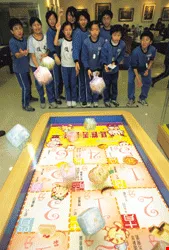
There's lots to see, eat, and do at the museum. In the beanbag toss, kids learn about 12 traditional Chinese holidays and come away with a lot of happy memories in the process.
A part of every passage
The museum on the fifth floor is divided into five areas showing, respectively, the part played by traditional pastries in life's major rites of passage, a map indicating where various Taiwanese pastry specialties are made, the pastries associated with the major holidays and events throughout the year, the history of Kuo Yuan Ye Foods, and marriage customs past and present. While the focus is on pastries, the museum displays are also about the lives of the Chinese people.
There is a traditional ceremony held on the third day after an infant's birth called the "rite of the third morning." Back in the days of high infant mortality, parents didn't dare celebrate a child's birth until the third morning. On the 24th day following birth, it was customary to place a chicken egg, stone, coin, and green onion in a basin of water, which was then used to wash and shave the baby's head, signifying the hope that the child would have a face as smooth and beautiful as an egg, have a skull as hard as a rock, make lots of money, and be smart. At four months the parents would carry out a "curb the slobber" ceremony, stringing up 12 or 24 bread rings (something akin to a bagel, but smaller) on a red thread and asking neighbors and elder members of the family to wipe the baby's mouth with a bread ring while reciting auspicious bits of doggerel, such as: "No more slobber, / La dee dee, / Next year bring a little brother. / No more slobber, / La dee dah, / Next year learn to say, / 'Hi, father.'"
In addition to rites of passages like this, pastries are also an indispensable part of holidays and celebrations throughout the year. During the lunar new year holidays, pastries play a good-luck role because the word for cake (gao) can also mean something akin to "onward and upward" when written with a different Chinese character. And of course, no lunar new year would be complete without yellow and white candies symbolizing big piles of gold and silver. About three months after lunar new year comes the Tomb Sweeping Festival, when people in ancient China gave "tomb sweeping candy" (made from cudweed) to goatherds to have them come and help clear weeds away from the family tombs.
At major occasions of worship at temples, the "keeper of the censer" for the current year will use cane sugar to fashion dragons, phoenixes, and other such mythical beasts. During "ghost month" at mid-summer, "Buddha's hand" cakes remind the faithful that the Buddha is busy rounding up wandering ghosts and ensuring that the spirits of the departed make it off to paradise. These quintessentially Chinese crafts and traditions are rarely seen these days anywhere other than the Kuo Yuan Ye Museum of Cake and Pastry.
The display area also features a big map showing where all sorts of local pastry specialties are made in Taiwan. Next to the map are various pastry models that look so real you want to eat them. Included among them are zhuqian cakes from Hsinchu, butter crisps from Tachia, square cakes from Chiayi, dragon-eye cakes from Lukang, potato croquettes from Hualien, black candy from Penghu, and much more. There's something from just about everywhere, giving visitors a chance to imagine themselves eating their way across the country!
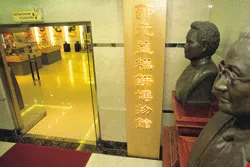
To commemorate the company's founders Kuo Chin-ting and his wife Ah-chiao, Kuo Yuan Ye Foods dipped into its own resources to found the Kuo Yuan Ye Museum of Cake and Pastry.
Starting with a shoulder pole
Every time a group of school kids comes to the museum's display on the history of Kuo Yuan Ye Foods, you can be sure that a bunch of puzzled children will ask: "Huh? Why is there a pile of bricks and a shoulder pole here?"
The founder of Kuo Yuan Ye Foods, Kuo Liang-chen, came to Taiwan from mainland China's Fujian Province in 1867 and set up operations at the foot of Shihlin Bridge in northern Taiwan, baking pastries in a clay oven. After finishing with the baking, he would walk the streets with his products slung from a shoulder pole, hawking the pastries to all within earshot. He named his business Kuo Yuan Ye in memory of the "Yuan Ye" characters over the entrance to his old home in Fujian.
Museum president Wu Yu-chiao explains to visitors the story of the shoulder pole: "Kuo Yuan Ye Foods got its start with this shoulder pole more than 130 years ago."
The business prospered, and after Taiwan became a Japanese colony, second-generation head of the family business Kuo Pa-chiu switched to a brick oven and started making Japanese-style treats such as breads stuffed with red bean paste, which were becoming increasingly popular with ordinary Taiwanese. Moving into the third generation, Kuo Chin-ting and his wife were running the store when the Nationalists recovered Taiwan from Japan and people poured in from all parts of the mainland, bringing a wide variety of pastry preferences with them. And as the business moved into its fourth generation under the joint ownership of four Kuo brothers, Western-style confections grabbed the limelight away from traditional Chinese treats. It was also at this time that the family adopted corporate management methods.
On display alongside the shoulder pole-with its dark, shiny surface hinting at a long history-are a number of other important historical mementos from the company's past, including a ceiling beam, a brick, and a foundation stone quarried in northern Taipei's Chili-an district. All these items were taken from the original building before it was torn down to be replaced by the new company headquarters building. The century-old history of Kuo Yuan Ye Foods is a microcosm of the history of Taiwan's confectionery industry.
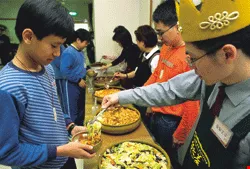
Serving up authentic local dishes in custom-made oversize earthenware bowls, the museum hopes to familiarize young visitors with traditional culture.
Little chefs
To hold the interest of visiting children, the museum includes in the tour a lot of games related to what the visitors are seeing, and after the tour is over the guide takes the kids outdoors to play Chinese games once popular in centuries past, including a toss of the xiu qiu ball (in which a girl tosses a ball and whichever boy catches it will be her betrothed), and a bo zhuangyuan game (a Mid-Autumn Festival dice game in which the luckiest player gets the biggest mooncake).
Right about this time, the pastries that the kids made earlier are just coming out of the oven, and the young ones rush to see whether their handiwork has turned out okay. The kids put their handmade treats into boxes prepared especially for the purpose, and every face is smiling as the half-day tour draws to a close.
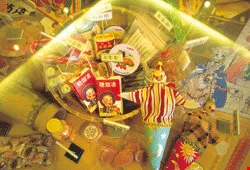
These handmade toys and simple candies are among parents' happiest and tastiest childhood memories.
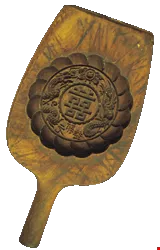
A traditional wedding pastry mold.

@List.jpg?w=522&h=410&mode=crop&format=webp&quality=80)


