The Rise of the Well-Versed Society --A Poetry Renaissance in Contemporary Taiwan
Coral Li / photos Vincent Chang / tr. by Phil Newell
November 1995


Once the famous writer Po Yang was in a taxi when he heard a new poem, "My Wife's Hand," being broadcast over the radio. He had never had much appreciation for modern poetry before, but he was suddenly deeply moved in some inexplicable way. The poem kept running through his head, spurring him to seek further. As soon as he got home, he immediately found a collection of works by the poem's writer, Hsiang Ming, and began reading it with great attention. Yet, after some time, Po began again to lose interest--the verses on the page lacked the same emotional impact of the one that he had just heard. Though disappointed, Po had also become aware of something: Poems are most effective when read aloud.
This type of story in which Po Yang quite accidentally "hears" the beauty of poetry has recently played itself out in many places in Taiwan, as "spoken poetry" has experienced a wave of popularity. It appears that modern poetry, in decline at the beginning of the 1990s, is reviving.
On Mid-Autumn Festival in August of this year, with a light breeze and misty rain passing through the darkened evening sky, the sound of Chang Cheng-chieh's violin resonates through the air outside the Confucius Temple in Taipei.
Every morning, before the sky has lightened Father takes his lunchbox and rides off on his bicycle Leaving his abode, he heads to the river....
The unadorned but moving voice of poet Hsiang Yang weaves itself in and out of the violin strains, embroidering a romantic atmosphere....
This is the "Music, Mid-Autumn, Leap August" program sponsored by the Council for Cultural Planning and Development. Many such evenings of this type, merging poetry and music, have been held in Taipei of late. More than 3,000 people were attracted to a program in Taipei's Ta An Forest Park, entitled "Graceful Autumn Poetry" and featuring well-known folk singers Li Chien-fu and Hsu Ching-chun and also the renowned modern poet Cheng Chou-yu. A large crowd took in the "Dialogue Between Poetry and Music" at Taichung's Museum of Science. At the end of September, poets read their works as part of the opening ceremonies for the special exhibition of paintings from the Louvre being held at the National Palace Museum....
On another front, publishers and recording companies have been hitting the market with "spoken poetry" works in Mandarin or Taiwanese, on cassette or CD, creating quite a stir. Recently Taipei city buses have become a stage for verse--posters of contemporary poetry have been put up inside, poetry cards have been passed out, and tape recorded readings have been played over the sound systems. It is hard to say when it all started, but it seems like poetry--often seen as an elaborate art form for a select few--is percolating into the lives of the general public. Moreover, it is appearing in many novel guises. No longer just passive words-on-paper as in the past, it now uses lively, diverse forms employing voice, music, and dance.
In this atmosphere of a burgeoning "poetry revival," "spoken poetry" has attracted the most attention. Why have so many poets suddenly produced spoken poetry? What concepts underlie their work? Two figures in the movement, Chang Shiang-hua (who in April released the CD Tea Does Not Speak) and Chen Ming-jen (who has released two Taiwanese language spoken poetry tapes, A Wanderer's Record and The Mute Poet), both trace the roots to broadcasting.
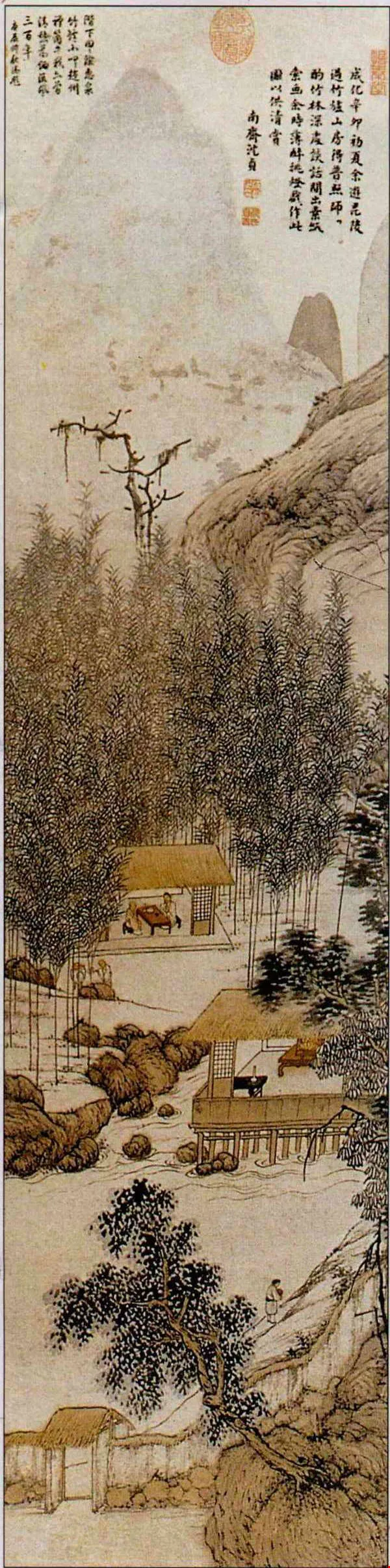
For millennia, Chinese people recited or chanted poetry-as-song to vent their feelings or express their ambitions. In imperial times, no gathering of literati friends was complete without wine and poetry. It goes without saying that this poetry was not "unvoiced." (courtesy of the National Palace Museum)
Someone to understand
Three years ago Chang Shiang-hua began hosting the program "Poetry Tete-a-Tete" which is broadcast on Sunday nights at 10:40 on the Public Radio System. Just tune in and you can hear her delicate, engaging voice reading all types of poetry, introducing the backgrounds of the writers, and explaining the imagery of the poems, as she draws listeners in to chew over the inner substance.
Chang had a poem published in the then-renowned literary magazine Wen Hsing when she was just a youth, and she has promised herself for life to vernacular poetry. She is accustomed to the isolation of the world of poetry, which is often ridiculed as "having more actors than there are people in the audience." She didn't harbor extravagant hopes about the size of her audience when she first started the program. Yet, quite unexpectedly, "perhaps because people are tired of hearing every day about the same old political bickering or the latest hullabaloo on the stock market," the number of listeners has been growing. Moreover, they come from all comers of society: A woman about to be married wants to hear a romantic poem before her wedding to bring her luck. A taxi driver calls in to ask Chang whether everything is OK at home, because she seems a little distracted on tonight's broadcast. Many people send in submissions, asking for criticism or to have their work read. There are even those who record the program for friends and relatives abroad who enjoy writing poetry, to encourage them to keep on creating.
The enthusiastic response of the audience gives Chang confidence that modern people can accept and love poetry. And spoken poetry is the bridge by which poets have been able to find people who understand what they are trying to do.
In Tea Does Not Speak, she has achieved a remarkable synthesis of music and poetry. Unlike previous similar efforts, which simply backed poetry readings with genteel mood music, on this occasion composer Weng Chih-heng, who wrote the music for the CD, took a different approach. He chose several poems of Chang's that he found especially moving, and then composed pieces designed to conform to their innate rhythm and structure; the works were then "performed" using electronic synthesizers to produce the effects of various musical instruments.
Thus, for examples, the sound of an erhu (a stringed gourd instrument) is employed for "The Red Flannel Shirt," which depicts the traditional "intricately mingled" feelings between husband and wife. A guitar tone accompanies another poem, "A Sheet of Blotting Paper," to match the somewhat more playful tone:
I am a sheet of blotting paper Lightly pressed against the page you've written on Absorbing the drops you left there
With synthesized sounds ranging from the nanhu (another stringed gourd instrument) to the piano and guitar, and styles as varied as classical and jazz, the music highlights the emotions expressed in the poems and helps listeners to better appreciate them.
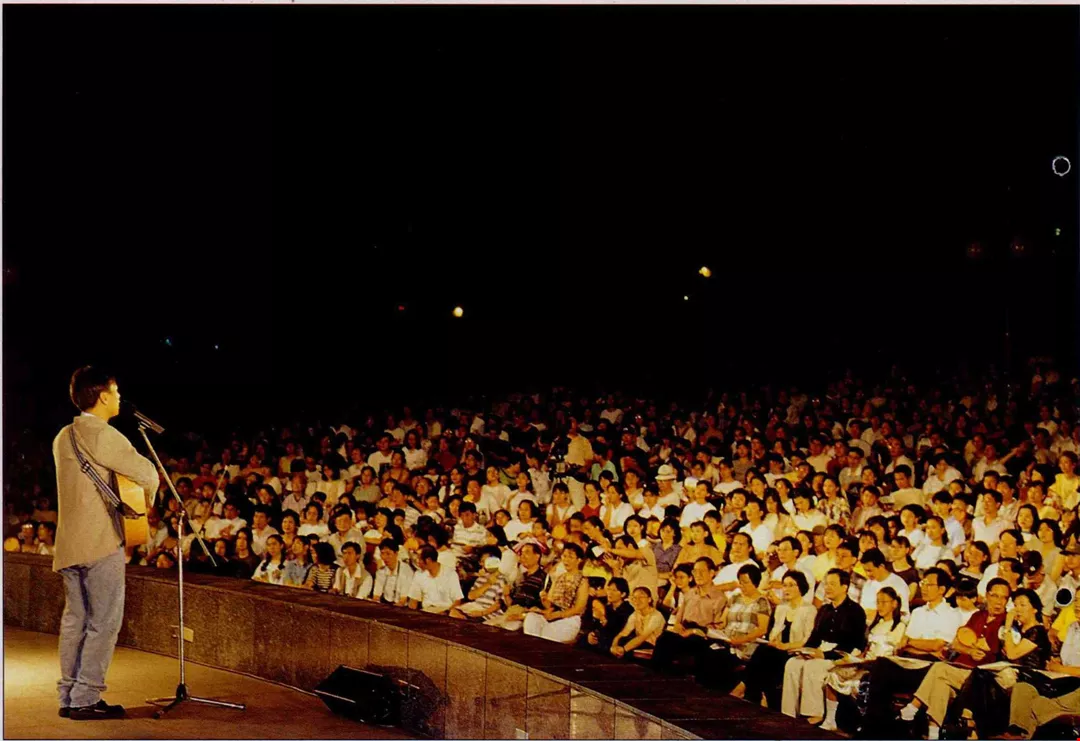
More than 3000 people were attracted to the Ta An Forest Park for "Graceful Autumn Poetry--A Meeting of Verse and Song." The interplay of poetry and folk music created a moving atmosphere.
Read Taiwanese poems
The Taiwanese language writer Chen Ming-jen has in recent years frequently appeared on "underground" radio stations like "All People's Radio" to read and discuss poetry. Encouraged by listeners, he has also released recordings of spoken poetry. Writing creatively in Taiwanese, Chen is often hamstrung by the gap between the written and spoken word. Taiwanese is a spoken regional dialect, but there is no actual written form. Written Chinese is based on standard Mandarin, so a poem written in characters is not "Taiwanese" unless read in the Taiwanese dialect. Moreover, there are many Taiwanese expressions with no equivalent in Mandarin, so that these must be written using characters that approximate, but cannot actually reproduce, the sounds of the Taiwanese phrase.
As a result readers can't always "read in" what the poet is trying to "say." Therefore, after publishing the collection In Search of Wandering Taiwan in 1992, he tried going around to various places to read the poetry for people. Beginning on university campuses, he progressed to political rallies and then to overseas Taiwanese associations in the United States. Within half a year he had sold 1,500 copies of the first edition. Though this figure obviously is not in the same ranks as a bestselling novel, it compares well to, for example, the roughly 1,000 copies sold of the famous poet Hsiang Yang's collection Song of the Land in the decade since its publication. This success encouraged Chen to go on to broadcasting, and to devote himself to promoting reading of Taiwanese poetry.
Also this year, Shangyang audio publishers released Confessions From the Heart of a Poet, a collection of Taiwanese spoken poetry by Li Min-yung. Li selected 21 socially and politically relevant poems, doing the readings himself, with a backing of mood-setting music.
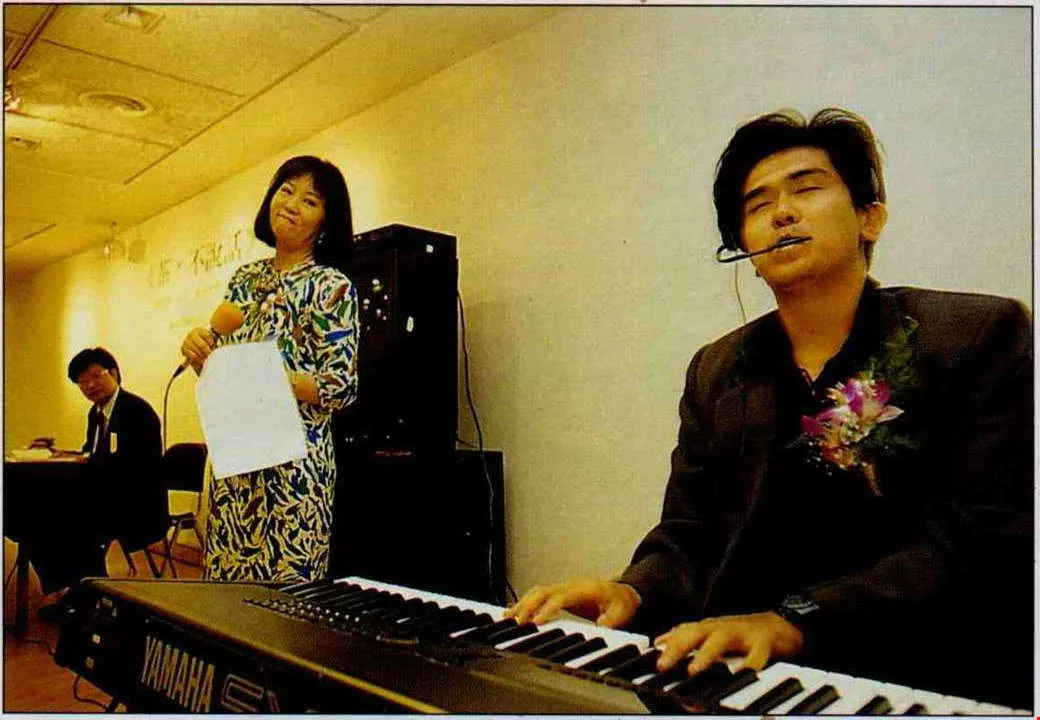
At a public reading to promote the spoken poetry CD Tea Does Not Speak, Weng Chih-heng used MIDI to accompany readings by poetess Chang Shiang-hua, making for an innovative synthesis.
Poetry through folk music
In fact, attempts have been made for a long time now to bring poetry to people through different media. Many people probably remember the folk music trend that swept through college campuses 20 years ago. In 1974, National Taiwan University student Yang Hsien set the poems of the internationally acclaimed poet Yu Kuang-chung to music, and held a concert in Chungshan Hall, sparking a response of unprecedented enthusiasm. At that time the pop music market was dominated by Western recordings or by superficial Mandarin bubble-gum music. Yang's appeal on behalf of "modern folk music" touched a deep chord with young intellectuals, and inspired many like-minded young people to create their own works. The style spread rapidly from campuses to restaurants, television, and every nook and cranny of society.
When I was small, nostalgia for my hometown was a tiny postage stamp
I am here and my mother is there
After growing up, nostalgia was a very thin boat ticket
I am here and my bride is there
Later, nostalgia for my hometown was a small gravestone
I am outside, my mother is inside
Now nostalgia for my hometown is a shallow strait
I am here and mainland China is there
Most everyone can recite some of Yu Kuang-chung's poem "Nostalgia for My Hometown." Many people have internalized much modern vernacular poetry because it has been transmitted through folk music forms. In the 1980s, Li Tai-hsiang wrote music for the poems of Hsu Chih-mo, Cheng Chou-yu, Ya Hsien, and Luo Men. Performed by Chi Yu, they created quite a sensation. "Olive Tree" was the most popular of these songs.
Beyond folk music, in the 1980s attempts were made to bring spoken poetry into contact with the public. In early 1980, the poetry journal Yangguang Xiaoji (A Modest Gathering of Sunlight), headed by Hsiang Yang and others, sponsored a tour whose performances were entitled "An Evening of Modern Poetry and Folk Music," promoting the interplay of poetry and music on the same stage. Though their staging, lighting, and sound equipment were not so sophisticated as today's, they still attracted many lovers of the arts, while sparking wide discussion in the arts community.
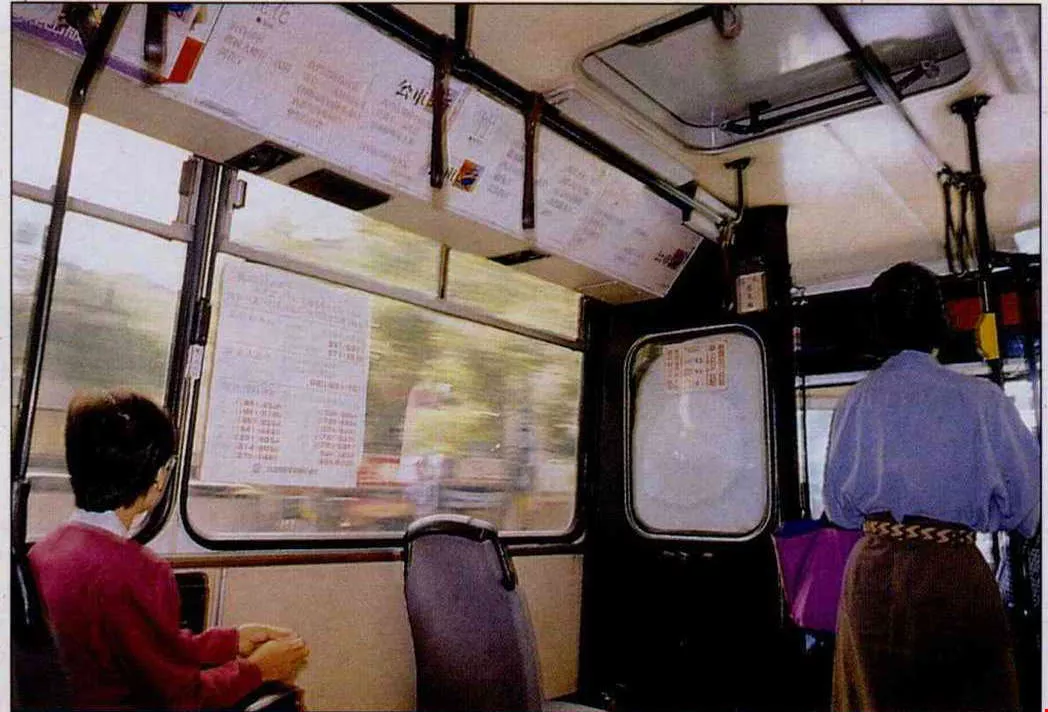
Taipei city buses ply the streets carrying "poetic works." It's possible that these are giving passengers on the typically crowded buses contemplative space.
An audience crying in unison
A few years after, the poet Do She-sun released Spoken Poetry by Do She-sun. In that period, before the rise of recorded books, this was a tremendous innovation. He also put on several live poetry performances under the heading "The Sound and Light of Poetry," in which one of the most memorable works, "Coal," described his feelings about the coal-mining disasters that had recently occurred.
Child, it is fixed that the colors of our lives are dug up from the blackness under the earth
The green vegetables and white rice on our dinner table
The colorful second-run movies in the street
Mother's red slippers....
All of these require father's sweat, and are dug up from the hole of blackness
After today father will no longer be spending time with you....
Poetry reader Chao Tien-fu's richly emotive voice was intertwined with the sound of mining shovels, trains, and heartbeats, and backed by music of the erhu, creating a moving and chilling effect. When moved to the full stage, lighting, backdrops, and simple body language were added, making the effect even more stirring. Do recalls that when the performance ended, there was a profound silence. Within a few seconds many in the audience began to weep openly.
It can't be denied that part of the force behind spoken poetry is the same kind of fast-food mentality that produces "books on tape" for busy people. But when you open up books on Chinese history, you find that in fact originally all poetry was meant to be vocalized.
Millennia of voiced poetry
The earliest "collection" of poetry, the Book of Songs, was simply a record of popular songs that had been circulating orally among the people for the 500 years between the early Chou dynasty and the Spring and Autumn Period. Do She-sun points out that before writing was widespread, poetry was carried from this mountain over the next, from this lake to the next, by the human voice. It was thus transmitted to succeeding generations.
In the yuefu verse of the Han dynasty, verse was set to melodies of various styles, creating songs that could be performed. These were used at all kinds of occasions, including affairs hosted by the emperor, ritual worship, or friendly gatherings.
Lushi ("regulated verse," referring to poems with eight lines, and five or seven characters to a line) and jueju (another form of regulated verse written in four lines) were developed in the Tang dynasty. Mainly chanted, they emphasized tonal prosody (building on the tonal nature of the Chinese spoken language) and rhyming.
At that time the emperor, courtiers, nobility, literati, and gentry were all besotted with poetry. At all events, whether for one's own amusement or for guests, there would always be courtesans to sing or recite. Sometimes the vocal element would be complemented with music by woodwinds and strings, or with dance. At the same time poetry began to penetrate into the daily lives of the common people. The most famous author was Bai Juyi. His works were accessible to young and old alike, and could be recited even by children. His poems spread widely, and ordinary sing-song girls would memorize and perform them to give themselves a touch of class.
In the Song dynasty, changdiao and duandiao ("long mode" and "short mode") forms of ci poetry were developed. These could be set to various kinds of melodies. One can tell how widespread these forms became from this well-known line, referring to the renowned Liu Yong: "You can hear voices singing Liu Yong's ci poems anywhere people gather around a well." In the Yuan dynasty, ci evolved ito pieces with plot lines and stories of dramatic interest. Drama, poetry, and music were brought together to create a performance art.
An old-fashioned love song
Yeh Chia-ying, a former professor in the Department of Chinese at National Taiwan University who now lives in Canada, points out that chanting played an important role in early poetry. Reciting their own poetry not only allowed the poets to vent their feelings, it also had a far greater impact on the audience. In his work "A Preface to Poems About Liu Zhi," Li Shangyin, the finest romantic poet in Chinese history, recorded the story of a love affair brought about by the reading of a poem.
One day Rang Shan, a cousin of Li Shangyin, was reading one of Li's poems, "Swallow Tower," in the vicinity of Liu Zhi's home. Liu, a passionate and talented woman, of whom it was said, "she can compose melodies like the wind and the waves, and sounds of profound sadness," knew as soon as she heard the poem that she had found a soulmate. She then asked Rang Shan to arrange a meeting with Li. Naturally the two fell deeply in love. Alas, later Liu Zhi was taken in marriage by the "Eastern Duke," and all that remained of their romance were the love poems that Li Shangyin wrote. Perhaps Li's familiar verse "A silkworm produces silk until it dies/ A candle weeps until it burns itself out" is also a reference to this love affair.
Yeh Chia-ying suggests that the really touching part of this passion play from Chinese history is that the lovers were brought together by the sublime feelings expressed through a chanted poem, and not by crude physical attraction.
Li Jui-teng, an associate professor in the Department of Chinese at National Central University, opines that the eloquence and beauty of a poem can only be expressed through a sensitive reading. Traditional Chinese poetry placed the greatest importance on the tones of the words, rhyme, and parallelism (or symmetry). As a result the poems are by nature very musical. Take for example Bai Juyi's "In My Thoughts": "The River Bian flows, the River Si flows/ Flowing to the dock at Guazhou Valley." It seems like you can hear the sound of gently flowing water.
Intimidating obscurity
Since verbalized poetry has such a venerable history, how is it that modern poetry has ended up voiceless? This goes back to how xinshi poetry developed in the 1950s. (Xinshi, meaning "new poetry," refers to all modern free verse in the vernacular. This form, pioneered in the 1920s and 1930s, is called "new" to distinguish it from the traditional Chinese poetic forms described above.) Before the 1950s, xinshi was romantic and emotive. Just look back at works like Hsu Chih-mo's "Coincidentally," Liu Pan-nung's "How Can I Not Miss Her," or Luo Chia-lun's "A Passage Through the Great Wall." Poets working in this style also gave attention to intervals and rhythm, which is perhaps why the poems were so popular when set to music.
But there was a dramatic transformation in poetry circles in the 1950s. In 1953 Chi Hsien founded the "Modern Poetry Society." This group was influenced by the French symbolists, who venerated the 19th century French writer Baudelaire and his worldweary style; indeed the Society strongly promoted the study of modern Western poetry. They also sought to replace "emotionalism" with "intellectualism." They rejected the direct expression of emotion, and advocated converting emotion into thought and reflection, or using the intellect to dominate emotion. In response, the "Blue Star Poetry Society," formed in 1954, opposed transplanting modern Western poetry to Chinese soil, and was inclined to stick with traditional poetry-as-emotion. The two factions engaged in a great debate, with the modernists emerging as the mainstream.
Li Jui-teng states that in those harsh years in Taiwan, it was best--perhaps one should say safest--to leave many feelings unexpressed. "Surrealism," which emphasizes exploring the inner world of the mind and soul, was just the right thing for avoiding collisions with an unpleasant reality, thus providing a channel of release. This trend reached its apex in the 1960s. The content of xinshi drifted further and further away from reality, so that it did little to speak for (or to) the people, places, and events of the surrounding environment.
Arms pull us up toward, God
But blood is trying to keep us down
Creating an absolute cessation of movement
We are swinging like an idle right leg
Idly wondering whether cutting itself off would shame it like being so fat that the belt breaks
We are so tired that we cannot turn our spit into fiery breath
We are not virgins
This selection from Luo Fu--"Death in a Stone Room"--was very well-received in poetry circles at the time. But, in retrospect, you can see how obscure these poems were. Deliberately illogical, they are difficult to comprehend by poring over them, let alone to grasp by hearing them read once. At the same time, there was strong opposition to musicality in the language, and it was even said that "anything that rhymes is by definition not poetry." The separation between poetry and song reached its extreme in that period.
This style, which insisted on transplanting Western culture to Taiwan, and whose tremendous obscurity turned off many people who might have been attracted to poetry, has been roundly attacked by later critics. But, as poet Hsiao Hsiao has written, this school opened the door to many new concepts, such as "the discovery of new methods" or "emphasizing the intellectual," which have been extremely enlightening to contemporary poets. After all, poets are always trying to avoid repeating what others have done before, and are constantly pursuing innovation, and every new approach has contributed to the rapid progress of modern vernacular poetry.
Back into daily life
"There was another great transformation in poetry circles in the 1970s," notes Li Jui-teng. Post-war baby-boomers were reaching adulthood, and there were great economic and political changes. The expulsion of the ROC from the United Nations and the breaking of diplomatic relations between Japan and the ROC set overseas students thinking about Taiwan's situation. In Taiwan the opposition was slowly growing in strength, and there was a wave of reassessment and critical thinking. Alongside these changes the economy was developing rapidly. The new era stimulated a great deal of cultural reflection.
The young generation of poets who grew up after the war spoke with a new voice, calling for a return to tradition to counterbalance the excessive Westernization of the past, and also for relevance to real-life issues. The language of the poetry became increasingly concrete and down-to-earth. A look at a work by Luo Fu from this period shows how different the new style was from something like "Death in a Stone Room."
Sorrow grows from the earth
The war destroyed my home
So I built another dream
The war destroyed my childhood
So I built another swing
The war destroyed the sky
So I changed the angle at which I look upward
Looking back on the world of poetry in those days, it appears newly vibrant. Poets were increasingly outgoing, and participated in all kinds of social activities. For example, there were debates in the mass media, and many activities related to poetry. An era replete with passion and vitality was unfolding. The campus folk music with which we are all so familiar grew out of these trends.
The broad realm of poetry
Although poetry once again aimed to reach out to people and its language was no longer dark and obscure, it was still less accessible than novels or essays. Chang Shiang-hua states, "Its language is concise and to the point, rich in images. It expresses very well the sense of transience of the phenomena of human life." At the same time, because schools offered no classes in appreciation of modern poetry, the general public still needed some guidance before it could really accept this work.
If one cannot necessarily understand a poem even by rereading it several times, how could one possibly get it just by giving it one quick listen? Chang Shiang-hua is not worried--she says that not all xinshi is suitable for being read aloud. Those poems that are suitable usually have language that is not hard to understand and images that are not particularly complex. They have no curious literary techniques nor profound allusions. It wouldn't be hard to understand such poetry by reading it in print. It's just that most people are like Po Yang--they haven't read much poetry in their lives and don't really know how to interpret the beauty of poems. But when the poet explains how he or she felt when creating the piece, and reads the work in an expressive, emotive voice, it's not even necessary to listen all that attentively--it is still easy to enter the realm the poet is creating in the piece. This way people can develop an interest in poetry and truly become cognoscenti.
"But some poetry is very profound. It can only be understood if read with great concentration and no distractions." Understanding deep poetry in this way has its own rewards.
But must a poem have a sense of rhythm or melodiousness to be suitable for a reading? Not necessarily, says Chang Shiang-hua. She says that she has no intention of deliberately crafting her future poems to make them fit for public readings. This is because there should be no restraints placed on the creative spirit, and there should not be arbitrary limitations placed on creative forms. The written and spoken word each have their own beauty.
The live poets' society
"Poetry should be like a friend, or lover, something that breathes and has flesh and blood," says Do She-sun. With his innovative release of spoken poetry 13 years ago, Do pointed the way to the vigorous life that poetry could enjoy. Now we are seeing releases of spoken poetry, performances like "A Dialogue Between Poetry and Music," and poetry appreciation on city buses. Aren't these all efforts to draw poetry and ordinary people closer together, so that poetry can enter into daily life?
Hsiang Yang believes that the communications revolution and the social revolution will allow poetry to adopt many new forms in the future; it could find expression through computers, in karaoke parlors, on the stage, on the street, or in art galleries. He expects that it will develop in the direction of diversification. "Poetry has the responsibility to move away from the small circle in which it originates and become an organic part of Taiwan's rapidly changing society."
Modern vernacular poetry--xinshi--is coming face--to--face with a novel, constantly changing environment. It is attempting to adopt an interactive relationship with kinetic modern people, and to draw readers back. At this juncture, might not we stop for a moment ourselves and reconsider how we might enter into a dialogue with this muse?

@List.jpg?w=522&h=410&mode=crop&format=webp&quality=80)


