Rooted in the Soil--The Private Opera School of Lutang Village
Text and photos by Tsai Wen-ting / tr. by David Mayer
November 2001


Whenever mainland Chinese authori-ties commission a performance of gezai xi (Taiwanese Opera) in connection with a national holiday or a big academic conference, you can be sure that it will be a big production, put on by a state-run troupe, and the opera will in many ways resemble a Broadway play. But there is another face to gezai xi in the mainland, perhaps less visible to the outsider, yet a powerful presence on its own turf. Anyone who wants to understand gezai xi on the mainland should not by any means overlook what thriving private troupes are doing in rural southern Fujian Province.
An intriguing case in point is the private opera school in Lutang Village, Tongan County, Xiamen Municipality. It all started with a father and son tilling the fields side by side, the elder teaching his offspring one line of operatic verse after another. Things grew naturally from there. The family now runs an opera school and four troupes. The similarity to Taiwan's Ming Hwa Yuan Taiwanese Opera Company is striking.
The drive to Lutang starts off comfortably enough. We wend our way first through the heavily populated and prosperous Xiamen City and zip along a straight, smooth expressway toward Tongan County, better than 50 kilometers distant. Soon, however, we get off the modern highway and onto bumpy gravel and mud. After an hour and a half we arrive at Lutang Village. We thread our way through narrow lanes lined on either side with homes made of granite masonry. Cattle graze lazily. Chickens and ducks forage. It is as if we had traveled back in time to the rural Taiwan of the 1950s and 60s.
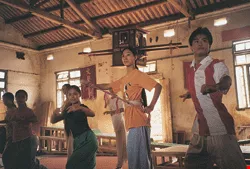
We come to a two-story building and head into the auditorium, which was once used during the Cultural Revolution for struggle sessions. Today it serves as a village activity center. The big carpeted hall on the first floor is where the students at the private Lutang Opera School practice and rehearse.
More than 20 troupes are there right now, practicing hard for "Empress Takes the Reins," the biggest performance of the year. Director Liu Saiyu has come out from the Fujian Provincial Arts Institute and is going to stay for about ten days to try and get everything completely ironed out by the time of the final dress rehearsal. Says Liu, "If you do well on this, you'll make it all the way to Beijing."
Mainland China is a big country with over 300 different genres of regional opera. Fujian Province alone has three to four hundred gezai xi troupes. To advance past the competition at the county, municipality, and provincial levels and make it to the national capital would be a phenomenal accomplishment.
It is PRC, or is it Taiwan?
On the stage, actors play the parts of empress and general. Off stage, musicians beat on gongs and play cellos. But at home, many of them are from the same family. The story of this stage family begins with the late Hong Dianxun, father of the current patriarch.
Hong Dian-xun and Cai Zaihua met in the midst of the war between China and Japan. Hong, a native of Henan Province on the North China Plain, was in the Kuomintang army, which he followed as far south as Fujian Province. There he met up with Cai, an overseas Chinese girl returning from Singapore. The two fell in love and got married. Hong had been an opera performer in the army and was well versed in Peking Opera. Cai was a fan of Gaojia Opera, one of the five main types of opera in southern Fujian (very similar to gezai xi, but featuring a greater emphasis on martial scenes, and with song lyrics mostly in the Nan'an dialect of Quanzhou). They taught opera to their five children whenever their busy lives on the farm permitted.
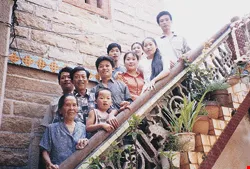
Their oldest son, Hong Jinsheng, is 60 years old. The founder of the opera school, Jinsheng used to help his father plow the fields, with one person leading the water buffalo and the other guiding the plow. His father would sing a line of opera, and Jinsheng would repeat it. The boy was nine when he first performed at a village festival. His three sisters became Gaojia Opera performers. All of the siblings married opera performers. Jinsheng's wife has performed modern theater. The husband of his third sister is one of the stars of Gaojia Opera in the Tongan area, and now the tradition has extended to a third generation, for Jinsheng has two sons, two daughters, and several nephews and nieces with a passion for opera. Jinsheng's younger brother, Hong Shuiyong, is the only one in the family who's been to university. A government employee, he takes advantage of his free time to handle PR for the opera school. It is he who has proposed most of the major decisions about how to run the family's opera business. All told, more than 20 family members make their living from theater.
After the policy of reform and liberalization was adopted in the late 1970s, it became acceptable once again to dabble in all things traditional. Folk beliefs and Chinese opera have come to flourish. In Lutang Village alone, with a population of little more than 1000, there are three stages. On average, each of the seven hamlets located within the administrative boundaries of Lutang Village will sponsor two or three opera performances per year, lasting about three days each. That means that about 50 to 60 works are performed in Lutang Village every year. "Religious festivals are a lot bigger deal than they used to be. A lot of people in the countryside may not be able to read, but they sure know their opera," says Hong Jinsheng, who adds that some rich townships near the big cities have been known to hire opera troupes to perform for three months straight. With the market booming, Hong Jinsheng in 1995 opened the Lutang Opera School, staffed by the members of his extended family. He started recruiting students and performing for hire, doing both gezai and Gaojia Opera in order to satisfy two different types of audiences.
A bag of rice for tuition
The income gap in China between urban and rural areas is enormous. Many kids in the countryside don't go to school. They mature quickly in their tough environment, and are not afraid of hard work. Lutang Opera School draws its recruits mainly from poor rural children who've dropped out of the regular school system. During the three years they spend in attendance at Lutang Opera School, the only tuition they are charged is 15 kilos of rice per month, and even that is waived once they advance to second year. Room and board are also free. The school meets its expenses through proceeds from the performances put on by its four troupes.
16-year-old Ah-Lou, who hails from a neighboring village, didn't have to pay the rice tuition even in his first year. Orphaned at an early age, he only received an elementary school education because his grandmother couldn't afford any more. She entrusted him to the opera school, where "at least he would have something to eat." Ah-Lou has now completed two years at the school and performs on stage. Soft-spoken and measured in his behavior, he concentrates intensely during the performances. He explains: "Up on stage I can forget all about my sad circumstances." Liao Wen-chin, a Taiwanese man doing business on the mainland, is impressed by the children in the PRC: "When mainland kids study opera, they're willing to study and work very hard, and they really do take a genuine interest in theater." Liao used to run an opera school in Zhangzhou and had once been planning to send his students off to Taiwan and Southeast Asia.
The management of Lutang Opera School is very much "catch as catch can." Hong Jinsheng plays the drums, does grocery shopping, and cooks meals. Chen Wen-chang, husband of Jinsheng's third sister, is both principal and performer, and he also works on stage art. Whatever needs to be done, someone will step up and do it. As soon as the school started recruiting, they immediately attracted over 100 students. Some students live on the second floor of the village activity center, and some have crowded into Hong Jinsheng's home. Every time they boil a pot of rice, they use over 50 kilos of rice.
Learn by doing
Everyone at the Hong household gets up shortly after 6 a.m. and does vocal practice. Outside in the forest of pine and cedar, performers practice tumbling, work on their stage movements, and do calisthenics to strengthen and limber up their legs, all of which they've been working on in class as well. The students at Lutang Opera School get a lot more chances to take part in actual performances than students at most state-run opera schools. "Learning to perform by performing is one of the things that make our school special," says Principal Chen, who explains that the average student at a state-run school might only get the chance to appear in a real performance about 10 to 20 times in four years, but in three years at Lutang Opera School, the kids will on average take part in over 400 performances. Director Liu Saiyu, who started out as a performer herself, feels it is a very good system: "Their students improve very quickly. They're every bit as good as the performers in a county-level professional opera troupe."
Up on stage, the private opera troupes display a different philosophy than what you see in a state-run troupe. Commenting on the highly refined vocal techniques of the state-run troupes, Hong Jinsheng says: "We don't want to go that road. We try to achieve an artistic style that is very accessible to the average opera goer." Jinsheng's younger brother, Hong Shuiyong, feels that the state-run troupes these days are only performing for the sake of a few experts, and that that they're becoming more and more estranged from everyday people.
In the five-plus years since the school's founding, the four troupes under the Lutang Opera School have been very active in Tongan, Jinjiang, Nan'an, Yongchun, Shi-shi, Huian, and Anxi. Each of the four troupes performs over 250 times per year, and they're booked solid until the end of next year. The four troupes are each at a different level of sophistication, and if a performer in the top troupe gets careless, he will quickly find himself transferred down to the second-tier troupe. This is very similar to the way they run Ming Hwa Yuan Taiwanese Opera Company, one of the best known gezai xi troupes in Taiwan.
In addition to private engagements, Lu-tang Opera School also participates actively in public performances and contests. In 1996, in order to do a dress rehearsal for a big show in Tongan County, the school had to cancel a scheduled performance in Jinjiang. The client was incensed, however, and impounded both the school principal and his vehicle. The principal wasn't set free until someone from the Tongan culture bureau personally interceded.
Unlike most gezai xi troupes, the performers at Lutang Opera School are well versed in both the martial skills required for Gaojia Opera and the soft, sweet vocal style of gezai xi. The Lutang Opera School performers do a rousing rendition of an episode from "The Legend of the Yang Clan." Hong Jinsheng's youngest daughter plays Mu Guiying, a girl with phenomenal martial arts skills. Her voice may be sweet and her eyes full of warmth, but she's invincible with a sword or halberd in hand. Chen Shuiyuan, husband of Jinsheng's youngest daughter, has a limpid voice and delicate features that make him perfect for playing the part of the kind-hearted, slow-tongued Yang Zongbao, and he is always a favorite with women in the audience. Presenting this work in 1998 at an opera event for private troupes, Lutang Opera School took top prize and was named by the provincial department of culture as one of the top ten private opera troupes in Fujian. Not only that, but the male and female leads also won top prizes as well.
This past March, Lutang Opera School represented Xiamen Municipality at the Fu-zhou Opera House in a contest for professional opera troupes from throughout the province of Fujian. There they picked up yet another top prize, and their reputation in southern Fujian soared.
Movin' on up!
Lutang Opera School has its sights set high, and in November 2000 began building a new 3500m2 teaching facility on their 20,000m2 campus at a projected cost of RMB 2.5 million (US$300,000). The building, designed in the style of a private residence in southern Fujian, is to include a rehearsal hall, performance hall, and lecture hall, and will help get the school officially sanctioned as a vocational high school. The plan is to take in over 200 students per year.
The Hong clan has virtually bet the farm on the new venture. The idea is to go beyond Tongan County and perform not only in Beijing, but also abroad. Construction of the new building has been suspended for lack of funds, and the project has fallen behind schedule, but everyone in the clan remains optimistic about the future of private opera.
Says Hong Shuiyong: "Nearly everyone in the countryside has a TV these days, but TV just offers one-way communication. People in the countryside still prefer to get together in front of a stage and chat while they take in an opera.
The Hong clan's troupes are also keeping in step with the changing times. Hong Shuiyong, who handles PR, feels that the PRC theater community is wrong to put greater stress on vocals than on acting and the visual aspect. He argues that the two deserve equal priority, and that physically attractive performers who have won prizes should be molded into stars.
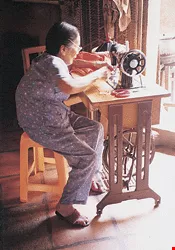
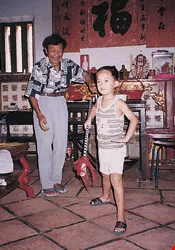
Lutang Opera School will travel in November to Kinmen to perform for ten days. Everyone in the clan is busily preparing for the occasion. Even Cai Zaihua, now an 80-year-old granny, is skipping her noon naps and donning her reading glasses to prepare costumes and headgear on a treadle-powered sewing machine. Hong Jinsheng's grandson, six-year-old Hong Jian, does a flawless job on the gongs and drums, and he clearly has a good idea of how to handle the sword and halberd too. The future looks bright indeed for this homegrown stage clan.
p.073
"Learning by doing" is the name of the game at Lutang Opera School, where each student will take to the stage over 400 times in three years at the school. Private opera troupes in mainland China are run very flexibly, and the quality of their performances is every bit as good as that of the state-run troupes. (courtesy of Lutang Opera School)
p.074
Amidst the shabby surroundings of the village activity center, Lutang Opera School students are practicing hard for "Empress Takes the Reins," the biggest performance of the year. They hope to go all the way to Beijing with it.
p.075
In preparation for a November appearance in Kinmen, 80-year-old Cai Zaihua, matriarch of the Lutang Opera School, dons her reading glasses every day to prepare costumes and headgear on a treadle-powered sewing machine.
p.075
Six-year-old Hong Jian can already do a flawless job on the gongs and drums for an entire performance, and he clearly has a good idea of how to handle the sword and halberd as well. Behind the boy is the opera school's most important figure, Hong Jinsheng, who after years of over-exertion fell seriously ill in mid-October. He now lies paralyzed in the hospital.
p.076
All of the 20-plus members from four generations of the Hong clan are big fans of traditional Chinese opera.

@List.jpg?w=522&h=410&mode=crop&format=webp&quality=80)


