Everybody Was Kungfu Writing! Academia Looks at Jin Yong and the Martial Arts Novel
Teng Sue-feng / photos Diago Chiu / tr. by Jonathan Barnard
December 1998


In a peaceful and elegant traditional setting, 74-year-old Jin Yong participated in the China Times' "Chat with Jin Yong over Tea," in which the author came face to face wit h more than 400 of his fans.
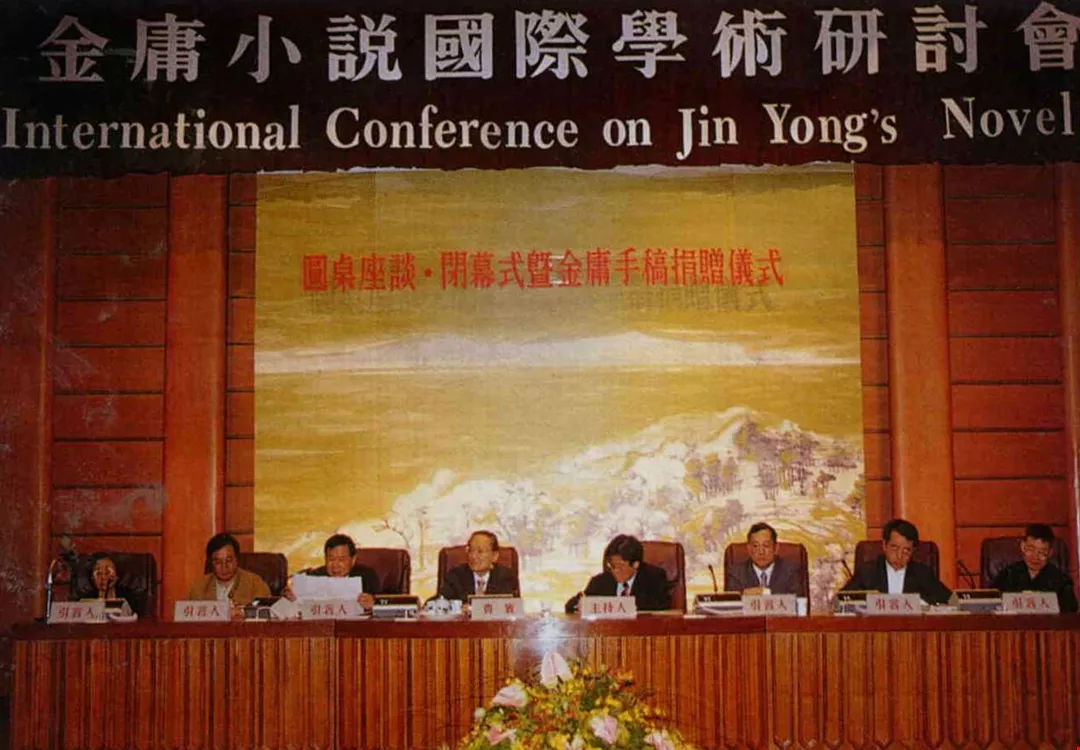
Academics at the "International Conference on Jin Yong's Novels" used the term bachang from Beijing opera (master teacher) to describe Jin Yong, who sat listening attentively in the audience for all three days of the conference.
It was almost like something out of one of his own novels: "The master's tour of the land caused a sensation in the realm of martial arts." Despite the media blitz surrounding last month's mayoral race, martial arts novelist Jin Yong was able to usurp the candidates' place in the spotlight, as the press and his fans chased after the old master, basking in his brilliance.
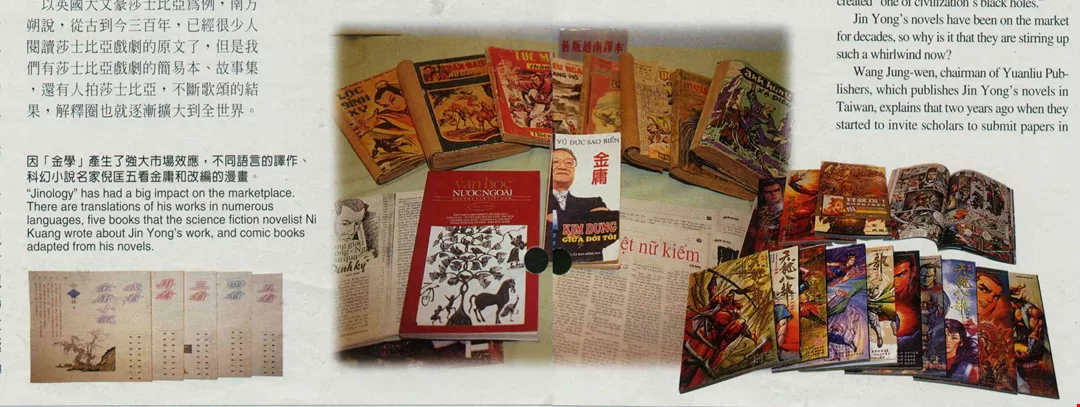
"Jinology" has had a big impact on the marketplace. There are translations of his works in numerous languages, five books that the science fiction novelist Ni Kuang wrote about Jin Yong's work, and comic books adapted from his novels.
It has been said that Jin Yong's martial arts novels are the lingua franca of the modern Chinese world. The chivalrous and tender kungfu fighters-cum-knights errant that populate his books have caused countless Chinese to sink into wistful imaginings of days gone by. Yet why, when there are so many martial arts novels, do Jin Yong's works stand unchallenged, head and shoulders above the rest?
Among the Chinese novelists of his generation, Jin Yong's brilliance and luck are without rival. He has enjoyed the remarkable experience of being able to participate in academic conferences about himself initiated by his readers.
A conference on Jin Yong (also known as Louis Cha) was held at the University of Colorado in May, and then, just a half year later, a second was held in Taipei. At both meetings, Jin Yong was there in the audience, listening to discussions about the characters and structure of his works, the challenges they present to translators, and about how his novels relate to sexuality, religion, psychology and so forth. "If only we could get Cao Xueqin to come and answer questions for a conference about The Dream of the Red Chamber," quipped one scholar.
Many of the scholars presenting papers didn't forget to "pay their respects to the old master." Some shared similar experiences: "I was turned on to Jin Yong's novels when I was ten. . . " or "After reading Jin Yong's novels, anyone else's paled in comparison."
Chen Mo, an assistant researcher at the Beijing Film Institute, spent seven years researching Jin Yong and wrote 12 books totaling about 2 million words in the field of Jin Yong studies-or "Jinology" as those in the field call it. Chen, who has read Tianlong Ba Bu 22 times, says he "could never finish saying" all the things he has to say about Jin Yong. He reveres Jin Yong for "not imitating others or himself, being both classical and modern, popular and literary, and appealing to both Chinese and Westerners."
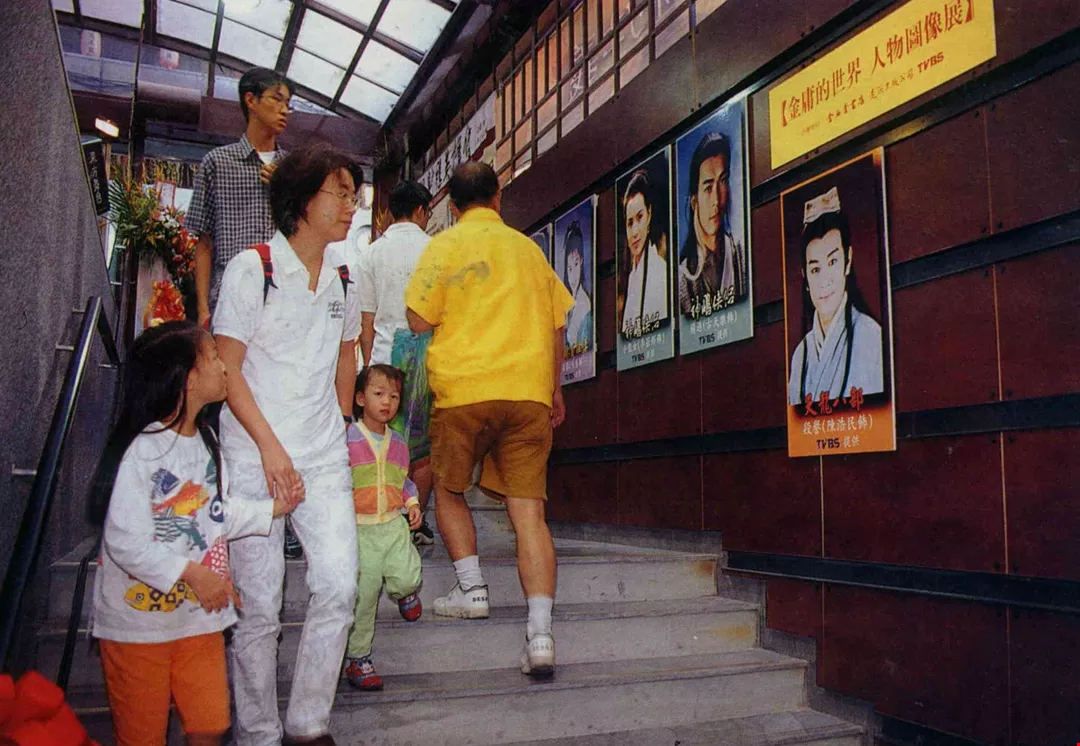
Many of the younger generation first get to know characters from Jin Yong's novels on television. Quite a few Hong Kong movie stars made a name for themselves acting in these series. The photo shows an exhibition on Jin Yong at Kingstone Bookstore.
When a 13-year-old girl surnamed Mei who has read all of Jin Yong's works learned that he was coming to Taipei, she insisted on her parents letting her take time off from school to attend the conference. There she asked the author, "What in life has influenced you most and how was it that you started to write martial arts novels?"A literary "black hole"
Jin Yong completely dominates the field of Chinese martial arts literature, and his work has attracted a great deal of research and discussion, both by academics and enthusiasts who join in entirely for their own pleasure. At the Taipei conference, scholars from all over the Chinese world compared the fruits of their research and found much to debate.
In his paper, "The Martial Arts Novel's Influence on Narrative Traditions in Chinese Fiction," the writer Chang Ta-chun recounted this story: In 1966 UC Berkeley Professor Chen Shih-hsiang was teaching in Japan. Because he couldn't buy a copy of Tianlong Ba Bu there, he wrote to Jin Yong himself, asking for a set. "It's the earliest documented example of a university professor studying Jin Yong's novels." Four years later, Chen would write Jin Yong a second letter, praising him as "the sole figure of note" in contemporary Chinese literature.
The view that "there is no one to follow Jin Yong" has been expressed again and again. In 1980 the science-fiction novelist Ni Kuang wrote of Jin Yong, "From ancient times to the present, in China and abroad, he's it-the alpha and omega." At the Colorado conference in May, the mainland scholar Yang Chunshi said with certainty, "There will never be martial arts novels that surpass Jin Yong's, because Jin Yong has already completely succeeded in his experiment of creating a model for the modern martial arts novel. In the process, however, he has destroyed the models created by his predecessors."
Other martial arts novels seem forever condemned to circle in Jin Yong's orbit. "Both in terms of discussions of the texts themselves and in matters related to them, they are constantly oppressed by existing in the shadow of Jin Yong's work and Jin Yong scholarship," said Chang Ta-chun, who believes that the strong tendency by readers to reject the works of other martial arts novelists (under the assumption that Jin Yong's are the only ones worth reading) has created "one of civilization's black holes."
Jin Yong's novels have been on the market for decades, so why is it that they are stirring up such a whirlwind now?
Wang Jung-wen, chairman of Yuanliu Publishers, which publishes Jin Yong's novels in Taiwan, explains that two years ago when they started to invite scholars to submit papers in preparation for the conference, they had no idea that it would stir up such a Jin Yong storm this year. In looking for more immediate reasons, Wang points out that several dramatic serials based on Jin Yong's novels are now being aired on television, including TTV's Shendiao Xialu and TVBS's Xiaoao Jianghu. The only extra step that the publishers took themselves was to bring together the skills and experience to create the "Jin Yong Teahouse" Internet site, taking materials that had been collected by individual readers and making them available to all.
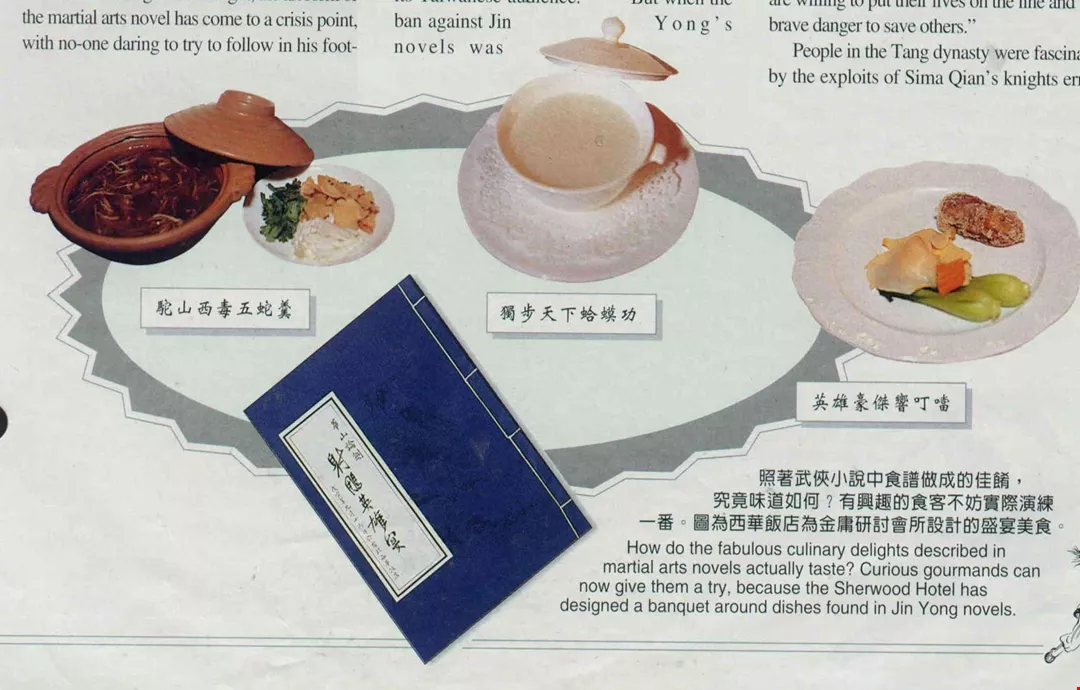
How do the fabulous culinary delights described in martial arts novels actually taste? Curious gourmands can now give them a try, because the Sherwood Hotel has designed a banquet around dishes found in Jin Yong novels.
Who needs Jin Yong?
As a result of Jin Yong's great popularity, many are looking to grab a seat on his gravy train. Hotels have advertised "Eagle Shooting Hero Feasts" in which every dish is taken from a Jin Yong novel, such as "In Whose Home Does the Jade Flute Sound Like Falling Plum Blossoms?" which is the name of the roasted beef strips that Huang Rong prepared for his master Hong Qigong. It is so named because the beef strips are cut in a shape much like a flute. The politicians who were invited to that feast were happy to compare themselves to the benevolent and righteous Guo Jing, the protagonist of The Eagle-Shooting Heroes.
Jin Yong's work has proven perennially attractive to the creators of movies, television shows, cartoons and computer games in Hong Kong, Taiwan and Singapore. In these places, one need never wait long for Jin Yong characters to appear in new incarnations on one kind of screen or another.
In Hong Kong they've filmed versions of every single one of Jin Yong's novels. Ten years ago when Jin Yong television series from Hong Kong first came to Taiwan, they topped the popularity charts at video stores. After finishing airing a TTV production of Shendiao Xialu, producer Yang Pei-pei immediately broadcast a newly edited version of Yitian Tulongji that had aired three years ago. It too met with great audience approval. Yang Pei-pei believes that the most compelling thing about Jin Yong's novels is the way they integrate classical history with outstanding characters and deep feelings. They make great material for dramas. Now she is preparing to produce a new television version of Xiaoao Jianghu, for which many television versions already exist.
In light of these popular adaptations of Jin Yong's work, cultural critic Nanfang Shuo muses that it is the fate of a writer either to be forgotten or to be remembered. When no publishing houses are printing writers' books and no readers are discussing them, they have been forgotten. But when is a writer being remembered? "It is when groups of readers are forming discussion groups to interpret his work, when they are applying make-up over his flaws, rationalizing logical inconsistencies, and building a base on which he can stand in history as a great literary figure."
Nanfang Shuo says that over the past three centuries relatively few people have read Shakespeare in the original, but there are many simplified versions of Shakespeare and prose versions of his plots appearing in collections of stories, as well as numerous films based on his plays. The result of all the constant singing of his praises is that his circle of readers has expanded to include the whole world. "The classics also need promotion," he says. "Works are never deemed classics when they are first published. The canonization of a work is a complex process, and Jin Yong's novels are right now just going through it."
Lin Pao-chun, an associate professor of Chinese at Tamkang University, says that fewer people have read Jin Yong's novels for themselves than have experienced the works in adaptations for other media. Over the last three years, he has been teaching a departmental elective, "Selected Novels by Jin Yong." The 70 students who signed up for the class were all very familiar with the story lines, but when asked who had actually read the books, only 10 to 20 raised their hands.
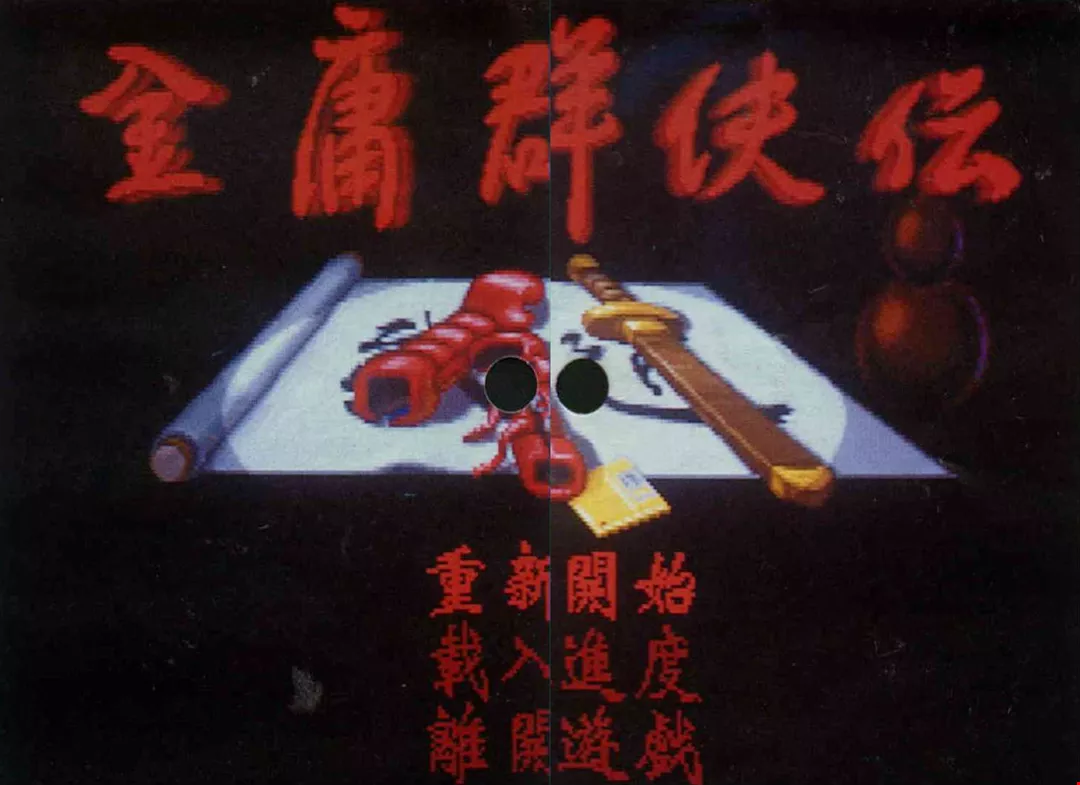
Jin Yong's work has consistently proved alluring and challenging to other creative artists. Yet giving the characters from novels a concrete visual form may stifle the readers' own imaginations.
Attaining masterhood
With Jin Yong getting all the glory, like a black hole sucking in all the light, the art form of the martial arts novel has come to a crisis point, with no-one daring to try to follow in his footsteps. A lot of people believe that apart from Jin Yong, no other martial arts novelists are worth reading.
Lin Pao-chun doesn't agree with the chorus of negativism. He holds that in looking at a form of literature, scholars shouldn't let personal taste interfere with research and jump to the conclusion that other martial arts novels are unworthy of study.
In his analysis, martial arts novels were one of the most important forms of mass entertainment in Taiwan in the 1960s and 1970s. Jin Yong finished all his works between 1955 and 1972, but during the era of martial law, because the authorities in Taiwan suspected that Jin Yong's The Eagle-Shooting Heroes was perhaps making an allusion to a line of Mao Zedong's poetry, "Pulling the bow to shoot the eagle," Jin Yong's works were banned in Taiwan. The vast majority of Taiwan readers didn't know of Jin Yong. His novels, however, were available under the names of other martial arts novelists, such as Ku Lung, Shih Mashan, and Ouyang Sheng.
"Back when martial arts novels were in, all the novelists were hot," says Lin Pao-chun, noting that when Wo Lung-sheng's Jade Hairpin Vow was appearing serialized in the Central Daily News, many readers would wait outside the paper's offices for the first copies to appear. The Flying Swallow Startles the Dragon was also extremely popular. And Ku Lung's Chu Liuxiang was even more successful in riveting its Taiwanese audience. But when the ban against Jin Yong's novels was lifted in 1979, the era of Jin Yong's dominance began. His remarkable popularity has shown no signs of abating.
"Jin Yong made a great contribution to the modern era of the thriving Kungfu novel, but he was not alone," Lin argues. "In truth, it was brought about by the collective hard work of more than 500 novelists, who wrote over 4000 novels." Jin Yong's novels just point to "how a kungfu novel ought to be" or "can be" but don't show "simply how kungfu novels are."
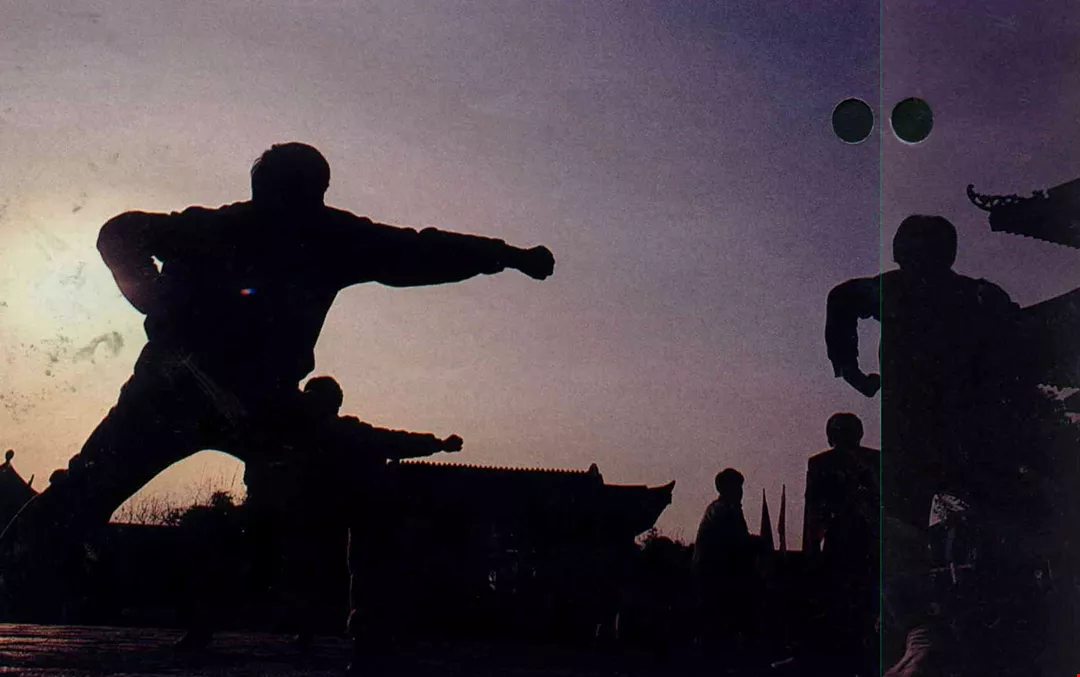
The martial arts world has proved a realm of romance, chivalry and imagination for so many people. The photo shows a martial arts school in mainland China.
Dreaming of heroes
Moving beyond the issue of the relative merits of different writers' work, it's worth discussing why the genre of martial arts novels as a whole has such a hold over Chinese.
One possible factor is that Chinese society has a need for chivalry and justice. Taking up a millennia-old tradition of knights errant in Chinese literature, Jin Yong's novels have become particularly popular.
In ancient Chinese documents, the terms xia (knight) and youxia (wandering knight or knight errant) are seen very often. Xia first appeared in the Warring States' era Han Feizi, in which these knights errant would use their kungfu to challenge the status quo. In his Historical Records, the Western Han dynasty historian Sima Qian included a chapter in which he gave descriptions of Chinese knights errant and assassins: "While the lives they lead may be immoral, they are true to their word, steadfast in their goals, and faithful to their promises. They are willing to put their lives on the line and will brave danger to save others."
People in the Tang dynasty were fascinated by the exploits of Sima Qian's knights errant and assassins and many anecdotes were told about them based on rumors and hearsay. The exaggerated tales of their exploits resulted in novels being written filled with many such characters. Among these were The Curly-Bearded Stranger, The Story of Hou Xiaoyu, and The Red Thread. After the Song dynasty, markets packed with stalls offering different wares began to be found throughout the land, and various folk performance arts such as story telling accompanied by music, as well as various vaudeville-like acts, grew up around them. Novels written in the vernacular language of the time included many tales about gallants, criminal cases, spirits and monsters, demigods and fairies. In the Yuan, Ming and Qing dynasties there were many collections of fiction whose descriptions of studying kungfu, revenge, derring-do, and marvelous and strange encounters would provide the foundations for many a modern martial arts novel. The Water Margin is probably the best of these old books. In the Qing dynasty there appeared numerous novels about knights errant doing heroic deeds and engaging victoriously in combat. These included The Three Heroes and Five Gallants, The Five Heroes and Seven Gallants, The Shi Cases, and The Heroic Sons and Daughters.
In the early years of the Republic of China, with constant fighting among the warlords, intellectuals wrote martial arts novels to amuse themselves, and magazine stories grew more and more decadent and extravagant, leading Lu Xun to describe them as "monstrous and evil at heart, and filled with descriptions of romance." These works invited their urban readers to escape the painful realities of their lives. Among them, Exploits of Knights Errant and Huanhu Louzhu's The Story of Mount Shu's Swordsman were best known. After the KMT left for Taiwan in 1949, martial arts novels were banned on the mainland as "spiritual pollution," but there wasn't a day when newspapers in Hong Kong, Taiwan and Singapore didn't include serial installments of martial arts fiction. It was in such a social climate that Jin Yong started out writing in Hong Kong. He has ended up immensely popular in Hong Kong and Taiwan.
Fallen from favor?
But there are people who wonder why, now that we are marching into the 21st century as an advanced society with rule by law, we still find martial arts novels, with their tales of sweet revenge and their black-and-white morality, so alluring.
"Sweet revenge" is a convention of the martial arts novel. The deed is committed both to exact revenge and to gain pleasure. There seem to be few moral qualms about killing another human being. In taking revenge, the character Wu Song in The Water Margin bloodily killed Chang Bulan and his entire family, young and old alike-some 15 souls altogether.
"Much of the content of martial arts novels is ridiculous and completely illogical. What goes on always far exceeds what could happen in real life. By taking thousands of years of legends about demigods and immortals, and leavening them with the chivalrous spirit of knights errant, these novelists have created a unique fantasy land," wrote one social critic in a newspaper. This critic held that by employing a lot of classical Chinese vocabulary to name the postures in their kungfu move sequences, martial arts novelists are in fact pulling one over on readers who have little understanding of ancient Chinese. They are charming people by being intentionally mystifying. "All writers of martial arts novels are to some degree cynics, and thus when I read these novels there is somewhat the feeling of a clever person pulling the wool over my eyes. When you fall completely in its thrall, it's a little bit like being led by the nose."
"The Chinese have long held the knights errant tradition in particularly high esteem," says Nanfang Shuo, who believes that educated people shouldn't expand the realm for lawlessness by putting the exploits of these kungfu gallants up for unreserved praise. "The world of these kungfu fighters is an escapist realm par excellence for the modern reader." By holding these knights errant in too high esteem, intellectuals may be prevented from moving on.
Yan Jia-yan, a professor of Chinese at Beijing University, begs to differ. Holding that Jin Yong's novels reject the notion of "sweet revenge," he cites how Guo Jing, the hero of The Eagle-Shooting Heroes, having killed Wan Yan-hong and thus getting both revenge for his family and his nation, still has doubts: "As soon as he thought of the word 'revenge,' memories of the Khorasm massacre surged to mind. Although he had taken revenge on his father's murderer, he had also killed many innocent people in the process. How could he live with that? It seemed perhaps that revenge wasn't all it was made out to be." He even began to have doubts about having learned martial arts.
Some people believe that martial arts novels are a lot like Bao Qingtian and Shi Gong, popular television series about magistrates in ancient China that provide a release for people in their dissatisfaction and frustration with modern life.
Highly literary
Apart from giving a more modern feeling to the knights errant tradition, Jin Yong has a very serious attitude about his work, and this is another reason he is king of the field.
Young readers may be unaware that the editions of Jin Yong they purchase now are the final result of many years of revisions. They are quite different from what first appeared in installments in Hong Kong newspapers years ago. In 1972, when Jin Yong finished The Deer and the Cauldron, he stopped writing. In 1979, when the ban against his works in Taiwan was lifted, the rights were first bought by Taipei's Yuanching Publishing Co. and then transferred to Yuanliu, whose editions are those most widely circulated now.
In a paper "The Publishing History of Jin Yung's Novels," Lin Pao-hun notes that after Jin Yung published his 15 novels (totaling nearly 30 million Chinese characters), he began making revisions, which ran the gamut from tiny details and minor stylistic changes to major changes involving plot and characters.
Many scholars believe that Jin Yong's prose style was even more elegant after his revisions. The mainland writer Li Tuo says that Jin Yong's work has "brought Chinese vernacular writing to a new peak."
Plot revisions were even more the focus of Jin Yong's "decade of revisionism." The most famous example is that in the old version of The Deer and the Cauldron the main character Wei Xiaobao was quite the typical kungfu knight errant. Yet after half the installments had been published, Jin Yong decided to get rid of his kungfu. In order to make up for the inconsistencies between the beginning and end, Jin Yong removed many passages and revised others before publishing the work in book form, so that Wei Xiaobao became "the single character in martial arts novels who had no kungfu yet was still able to succeed brilliantly in martial arts society."
Lin holds that in the early period Jin Yong's works also had blemishes and thus it is unfair to compare his works to those of other authors who never revised their novels. But revision is an author's prerogative. Hence, Lin is only more certain that Jin Yong's glory is well deserved, because in the field of martial arts fiction "he was the first writer to take a serious look at his own work."
Literature or history
The literary merits of Jin Yong's work have been widely acknowledged, and quite a few people have suggested that his works be read in secondary school as "writing textbooks." Yet immersed in their historical backgrounds, his novels seem like they could also be used as history texts.
Jin Yong's novels have always been famous for their historical atmosphere. For instance, Tianlong Ba Bu takes place at the beginning of the Northern Song dynasty, when the Han Chinese Song and the Tartars of the Liao dynasty were fighting for territory; Sword of Loyalty describes the last days of the Ming dynasty, when bandits roamed the land and the Manchurians of the Qing dynasty were starting to invade China proper; The Deer and the Cauldron describes the halcyon days of Kangxi's rule in the Qing Dynasty, and Book and Sword, Gratitude and Revenge is about the secret life of the Qing emperor Qianlong. Largely meshing with historical realities, they make readers curious about just what in them is history and what isn't.
Jin Yong has such a strong understanding of history that sometimes readers can't tell if his books are historical novels or martial arts novels. For The Deer and the Cauldron in particular, Jin Yong himself has said himself, "You might as well just go ahead and call it an historical novel."
When Jin Yong meets with his fans, readers often ask him about the likelihood of Chen Jia-luo really being the Qing emperor Yongzheng's son. Some readers have even found the novels help in taking history tests in school. A writter of a letter to the editor in a newspaper recalled one question that asked about how long the Song had held out against the Mongolians in the city of Xiangyang. The writer said that he remembered that in Jin Yong's Shendiao Xialu Guo Jing and Huang Rong were defending Xiangyang before Guo Niang was born and that when Guo Niang was 16 the city hadn't fallen yet, so he guessed 16 years. His teacher took only three points off.
Yitian Tulong Ji discussed Zoroastrianism in China, combining martial arts exploits and true historical events. As a result, what was a little-known religious sect rose to much greater renown thanks to the book's high sales and the high ratings of the television serial. Jin Yong's descriptions of Zoroastrian rules and customs won praise from the mainland historian Chao Huashan as "remarkably accurate."
Yet in Jin Yong's novel, after Zhang Wuji unites the Zoroastrians in China and becomes their high priest in China, "although Zhu Yuanzhang takes a bad turn and engages in many deceptions to become emperor, because the Zoroastrians [known in China as the Ming], helped him to conquer the land, he felt obliged to name his dynasty after them." In regard to this claim that the Ming dynasty was named after the Ming religion, Lin Wushu, a scholar in Taiwan, has weighed the evidence and come to the conclusion that "there is nothing to support the notion; it's taking the word too literally."
With this gap between Jin Yong's novels and historical reality, Lin Fu-shih, an assistant researcher at the Institute of History and Philology at the Academia Sinica, says, "My feelings about Jin Yong are complicated: as a reader I have nothing but respect for him, yet as an historian he makes me feel uneasy." Lin says that in any case Jin Yong certainly has achieved remarkable results in transmitting knowledge of history.
Jin Yong's love of history has won the praises of historians. "Jin Yong himself is willing to be called an historical novelist because historical novels enjoy a higher literary status," holds Lin Pao-hwun, who believes that Jin Yong worries that martial arts novels are regarded as an "inferior form of literature."
Foam on waves
In any case, most scholars feel that Jin Yong's novels' place in history is almost assured.
"There won't be another wave of martial arts novels," says Lin. It has been a long time since there has been an academic conference dealing with them, and now the topic seems fresh, but the fever for them will cool. Lin says pessimistically that we have already entered the "age of literary decline." A parallel can be made to the "Three Kingdoms mania" that has followed in the wake of the mainland television production of Romance of the Three Kingdoms being aired in Taiwan. Everyone now knows the heroes of those kingdoms and the famous knights errant of Jin Yong's novels, but not everyone has read the books, and with each succeeding generation there will be fewer and fewer who have.
Yet some people argue that "it makes no difference if there is anyone to carry on the tradition of martial arts novels or not." Changing times have brought detective novels, horror novels and so forth. If one form of novel dies, there will always be a new form to replace it.
As the great Song dynasty writer Su Dongpo once wrote: "Heroes of history are like the foam on a wave, here but for a moment. Yet every generation has great talents of its own!"

@List.jpg?w=522&h=410&mode=crop&format=webp&quality=80)

@List.jpg?w=522&h=410&mode=crop&format=webp&quality=80)


