Painters at the Ceramics Kiln
Tsai Wen-ting / photos Pu Hua-chih / tr. by Christopher MacDonald
May 2000


"It requires a combination of art and technique to make ceramics," says artist Lee Ku-mo, who often displays both ink-wash painting and ceramic works at his own shows, "and who you work with really makes a big difference." Ceramics is a specialized craft in which there is always an element of uncertainty, with success or failure hinging on such factors as the unfired form of the work, the ratios used in glaze preparation, and the firing temperature.
With over 20 years of experience in ceramics, Lin Chen-lung, co-owner with his wife of the Ciyang Kiln, provides artists from a range of different backgrounds with a bridge into the art of ceramics.
The hubbub of the city falls far behind as you follow the road to Ciyang Kiln, snaking through the hills near Tucheng, Taipei County, amid a sea of greenery. On arriving at the kiln's secluded location on the flank of Tienshang Mountain, you notice a number of large ceramic works among the trees and ferns-pieces that failed during firing and were abandoned by their makers. These colorful creations have been saved by the kiln owners and attractively positioned throughout the grounds.
I'm a worm
Lin Chen-lung says he has felt a bond with clay ever since he was a child, and likes to describe himself as a worm: "Clay is what I'm busy with all day long, it's what I eat and it's what I spit out, because I'm totally single-minded about my work with pottery."
At the age of 18 Lin joined the workshop of the ceramicist Wang Hsiu-kung, and subsequently he trained under the late Lin Pao-chia. Clay and fire have dominated his world ever since.
Lin was bothered that the greater part of Taiwan's ceramics output at the time consisted of antique-type reproductions for the export market, devoid of any contemporary or creative spirit. He was determined to give Chinese ceramic art a much-needed boost, so in 1979 he and his wife Huang Yen-hsueh set up the Ciyang Kiln. The kiln has since become a kind of Shangri-La retreat for Taiwan artists, over 200 of whom have used its facilities during the past two decades.
Lin, who has presented many exhibitions of his own work and was part of the avant-garde art group Apartment 2 when he was younger, has a broad circle of acquaintance among contemporary artists in Taiwan. He began firing works for other ceramic artists when the painter Chen Ching-jung, with whom Lin's sister was studying at the time, needed help developing his idea for ceramic painting. With his zest for the craft and his aspiration to raise the profile of ceramic art, Lin began to devote more than half of his working hours to helping other artists, furnishing them with the materials and skills needed for working in the medium of ceramics.
Bespoke firing
The first artist to use the services of the Ciyang Kiln, Chen Ching-jung, paints in a dark, brooding style reminiscent of charcoal sketches. It took Lin a year of experimentation before he found that the most effective way of expressing Chen's art through the ceramic medium was by using an underglaze of carbon black plus a dark blue pigment. Hu Ling-yu, another artist who has worked with Chen, produces large-scale human sculptures which are usually left unglazed. Lin needed to achieve a plain, pottery-like finish for Hu's ceramic works, and found he was able to generate a deep earthy hue by firing them in high-temperature smoke. "The works of different artists have different colors and attributes," notes Lin, "and it's often necessary to use the whole kiln for just a single work."
As an artist himself, Lin has complete respect for creativity. Artists who are not too familiar with ceramic technique often overdo it with the glaze, which then runs during firing. With some works, the thickness of the clay is so uneven that they shatter when fired, splattering glaze over the inside of the kiln. But Lin doesn't mind: "That's just the way it's done. Things don't get interesting until artists start being really experimental!"
Accommodating manner
In addition to his professional skills, it is Lin's accommodating manner that has enabled him to attract so many creative types to his facilities. By their nature, artists tend go about things their own way. Some demand absolute quiet when they are working, and though they may bring their own music, they are easily disturbed by anyone else moving about nearby. Some want all the lights off except for one directly overhead where they are working, so that they don't get dazzled. Some like to show up with a bunch of buddies, while others keep entirely to themselves. "They wouldn't be artists if they weren't a bit eccentric!" says Lin with a broad grin.
As to the matter of remuneration, some artists pay Lin a share of the proceeds after selling works made at his kiln, while others leave him with one-third of their output, keeping the rest for themselves. This form of cash-free collaboration means that Lin, who still has to cover the costs for works that fail during production, often has to turn to his credit circle just to make ends meet.
"Maybe I haven't made a lot in cash terms," acknowledges Lin, "but I've had the chance to learn for free from over 200 different artists. If you reckon it up in tuition fees, I could never have afforded it! Not to mention that many of these artists don't even take on students."
Non-paying collector
With his enthusiastic and unselfish personality, Lin has been collaborating with grateful artists in this way for 20 happy years. In the process he has amassed an entire storehouse full of ceramic works-a veritable museum of ceramics-without paying a single cent.
In the Chinese tradition, ceramic vases and vessels have tended to be regarded as "handicraft" articles rather than as works of art. At the Ciyang Kiln however, the relationship of trust between Lin Chen-lung and the artists who work with him has given rise to limitless new creative possibilities, while also fostering the bonds of artistic community in Taiwan.
p.53
The display room is filled with works by artists from a host of different creative backgrounds. Lin Chen-lung and Huang Yen-hsueh, the husband and wife ceramicists that run the Ciyang Kiln, have guided upwards of 200 other artists into ceramics making.
p.54
These large ceramic works, positioned around the grounds, contribute to the distinctive scenery of the Ciyang Kiln.
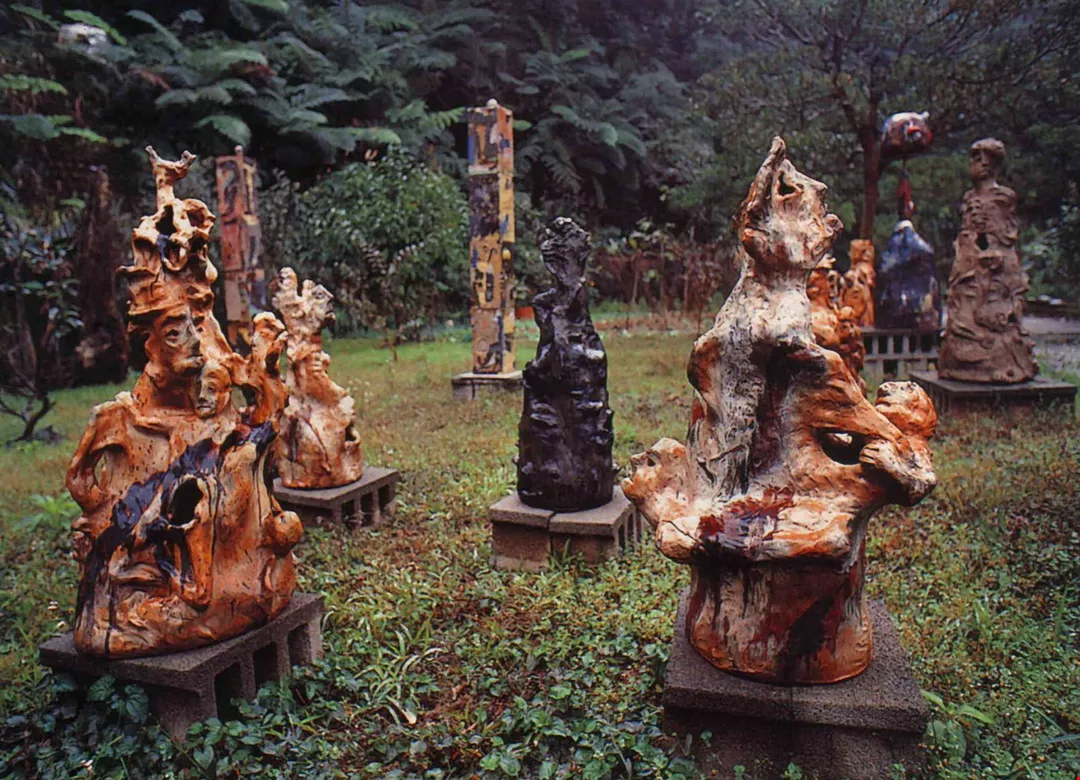
These large ceramic works, positioned around the grounds, contribute to the distinctive scenery of the Ciyang Kiln.

@List.jpg?w=522&h=410&mode=crop&format=webp&quality=80)


