A Novel Breakthrough: Author Chang Ta-chun Leads Martial Arts Literature Down a New Road
interview by Daisy Hsieh / photos Diago Chiu / tr. by Robert Taylor
August 2000


Author Chang Ta-chun holds a master's degree in Chinese literature from Fu Jen Catholic University, where he is a lecturer in the Department of Chinese Literature. With his series of books published under the pen-name "Big-Head Chun," he established an irreverent and satirical realist style; his subsequent works The Lying Disciple and No One Writes to the Colonel, which combine topical news stories with imaginary scenarios, elicited a broad response and gave rise to much controversy. Chang has long been regarded as an enfant terrible of literature, and the thematic diversity of his works and the breadth of their content are truly breathtaking.
His recently completed series of novels, Gangsters in the City-State, represents another breakthrough in his diverse individual style. Eschewing the ornate romanticism conventionally associated with the martial arts novel, the Gangsters in the City-State novels have been heralded as "new, modern martial arts works." Do they represent a new departure for the martial arts novel after Jin Yong? And what is the motivation and inspiration behind Chang Ta-chun's creative work?
Q: What is "modern" martial arts writing?
A: Actually, phrases like "modern martial arts novels" or "the modernization of the martial arts novel" have been invented by publishing companies. From my point of view, the martial arts novel is not a major literary genre, and as yet there is no theoretical structure specific to the Chinese martial arts novel. At best it is a "sub-genre," so there is a great deal of flexibility in how the term is applied. Just about any work containing kung fu action, intrigue and black magic, or just with a rather imaginative content, may be categorized as a martial arts novel. It is a product of recent times and has its own particular form: a young person goes through various trials and tribulations in the process of learning and growing up, and finally succeeds against the odds, in a story which is set in a particular time, place and social environment. It has some similarities with Western "coming of age" novels, but the process by which the main character in a martial arts novel grows up is centered around martial arts elements.
Martial arts novels first appeared in the late Qing dynasty, and largely featured fight action. The time and place in which they were set differed little from those in which people at that time lived. But the 20th century brought enormous changes, with dramatic advances in civilization, science, technology and lifestyles, and as a result the setting of the martial arts novel lost its connection with everyday life. In the 20th century, there also emerged a very important philosophical movement: modernism, or what we might call the "issue of modernization." Anyone who sets about writing a martial arts novel today must inevitably give some thought to whether this novel has any connection with our modern life. I think it is very important that there should be such a connection. If today we simply carry on in the old style of writing, with plots like: "in an ancient temple deep in the mountains there is an old abbot who knows a secret martial arts style, or has a secret book describing one, and someone falls down a cliff and discovers the secret, etc.," you end up with something utterly ridiculous. Or to put it another way, this kind of material has already been worked to death. Writing about martial arts can't just revolve around a few styles such as Shaolin, Wudang and Kunlun, either. Hence I would want to consider whether there is anything new-any new content, or concerns of people today-that can be introduced into a martial arts novel.
Escaping fate
What I have observed is that modern people have a certain concern, a certain fate. Perceptive people will discover that this fate is to "escape"-to run away, to hide, to not want to be caught up in the chaotic illusions of this world, to want to escape from such relationships. So I introduced this theme into my novels. I don't think this was something that was present in martial arts novels before. In the past, martial arts novels seem to have been all about attack and combat, about struggling hard to overcome one's opponents, about fighting, winning, and facing up to people. But the main characters in my martial arts novels are constantly attempting to escape from their lives, from the situations they find themselves in, from being used by others, from all kinds of rules, from the hateful reality of collective violence, and most importantly from power. This emerges as a clear theme throughout.
Therefore the characters in my books who study martial arts are forced into it by circumstances. The character in this latest book who is best at kung fu is a lad called Sun Xiaoliu. He gets kidnapped by six different people in turn, all of them martial arts experts who want him to study kung fu. The reason they pick on him is because of the particular day he was born. Through astrology, they discover that a boy named Sun Xiaoliu, born on that day, is fated to revive the fortunes of a major gang. But Sun Xiaoliu doesn't believe he's up to the job, because he's just a frightened kid. Those people keep on harassing him, so that by the time he's in his thirties he has become very good at kung fu. But what use is this skill to him? So he uses his ever-greater skills to keep on "running," trying to escape from the mission which has been forced on him.
This touches on many people's lives, including the way that I bring in this modern fellow Chang Ta-chun at the same time as talking about the past lives of those old chaps, combining the two together to produce themes which have some relevance to modern life. I hope that by doing something in the way of a "history of the common man" or "local gazetteer," I can bring into the fictional martial arts world something of the way people in Taiwan live.
If you want to look closely at my works' relationship with martial arts novels, I would tend to emphasize the narrative form I use in the book. My technique is rather wild and free, and wherever my writing takes me I may dally for a while before coming back to the previous topic. In other words, I don't follow a line of narrative, but rather details of life, or snippets of knowledge and pearls of wisdom, discovered by the narrator in various different times and places, which I insert wherever I see fit. This was the style of the old-time storytellers, who would embellish their stories ad hoc according to the situation or the audience's response. Their skill was in focusing on detail, so they would put in a lot of effort, and impart a lot of everyday knowledge. Among the common people, a great deal of general knowledge was communicated by this storytelling method. This is an old, traditional narrative technique, but modern novelists don't know how to use it.
Oodles of knowledge
Q: Could that be because the technique is so hard to use, since it requires one to marshal vast amounts of knowledge?
A: Yes, or you could say that it's a very bold technique, and most writers are afraid it will cause problems with the structure of their work. My novel is something over 400,000 Chinese characters long, and readers have to have the patience to read right through to the end before they know the denouement. You have to read over 300,000 characters before you find something which links up with what went before. Authors today can only cope with relatively simple things. But I feel that by using simple narrative, one will only produce novels like those written by everyone else before. Only by making things a bit more complicated can one discover new ways of writing and new ways of narrating, and for me that's more interesting.
Q: Is this the new way forward for the martial arts novel which its aficionados have long been looking for?
A: If the martial arts novel as a sub-genre can't be expanded with new content or with more meaningful or more robust material, it will fizzle out with Jin Yong's The Deer and the Cauldron. The reason people have found martial arts novels so fascinating in the past is not simply because of swashbuckling swordplay and imaginative, suspenseful plots, along with such themes as violence, love, power and politics, which were added later. All these elements were finally consummately brought together by Jin Yong, and we can't deny his status. But the martial arts novel has gradually come to exist in its own universe, with no connection with real life. Why shouldn't there be an enriching or integrating technique to recreate those links with real life, like piecing together a patchwork quilt? I don't believe modern authors are thinking along these lines. The year before last, a martial arts novel came out called Ren Jian Xiaoyao, in four volumes, totaling over a million Chinese characters. The author, Wang Chi-fei, put a tremendous amount of effort into it, and it took over ten years to write. But it still follows the same old path, and doesn't develop the content from a new angle. We can't make demands as to how other authors should write, and we shouldn't be overcritical. But as far as I'm concerned, I'd rather look for a new orientation and a different method and perspective of interpretation, to breathe some new life into this sub-genre.
A reflection of society
Q: Is that why you bring modern life and social conditions, and even recent history and politics, into the martial arts novel?
A: Yes. Let me give you an example. In my book there's a little notebook, handwritten, over 500 pages long, with a record of a different place on each page. For instance, at the top of a page there might be the name of such and such a pawnshop, and its owner, while below there's a description of the place's real activity, perhaps that it is actually a fencing operation, or a front for a gang or secret society. These are all set in real places such as Tahsi, Taipei or Hsinchuang. I also note the street name and house number, and other details about the place, what it looks like, and dialogues with characters. These are all based on life in Taiwan today, as it is lived before our very eyes. This notebook is very small, no more than 3,000 characters, but the whole novel is an accumulation of this type of thing. What I try to do throughout the book is to explain and reflect how in our modern society, the environment in which we live is in fact controlled by various violent gangland organizations. Some people might say this isn't a martial arts novel, and I wouldn't try to argue the point. Someone who takes that view is someone who wants to see the death of the martial arts novel. We've gone to all this trouble to find a new way forward to keep the martial arts novel alive, but they don't accept it as a martial arts novel.
Q: When you talk about the concept of "escape," is that also what you see as the way forward for people in today's social environment?
A: People in Taiwan really do try to "escape" whenever they get the chance. Not necessarily by leaving Taiwan-it might be by escaping their work. Haven't you noticed how many people go off to Zen meditation camps, build themselves a house in the country, collect stones or teapots, or, once they've earned enough cash, open a little cafe rather than working nine to five for a company? There are loads of yuppies like that in Taiwan who bail out once they've earned a little money, because they really can't stand the pressure of work. Escaping means escaping a collectivist society, an environment which may look free and pluralistic but which in fact is highly regimented and conformist. I'm sure the desire to escape is one that many people secretly share.
Q: In your book you also say that to succeed in "escaping," you have to develop your skills to a higher level?
A: That's right! That's why so many people try to accumulate wealth, and some to accumulate status. What we see most clearly here in Taiwan is people trying to accumulate wealth. Everywhere you can hear people say things like: "Once I've saved NT$20 million, I'm not going to work any more!"
Q: In the course of your literary creative life, have you had the desire to "escape," or even acted on such a desire?
A: No. Whenever I write, I try to approach a problem or a subject I haven't dealt with before, and by writing about it, think it through clearly. By the time the work is finished, then I'm more or less done with thinking about the topic, and I can very naturally turn to another one which interests me.
Outsmarting the readers
Q: In your writing you use a tremendous amount of Chinese traditional material, such as numerology, historical allusions, poetry, song lyrics, and underworld vocabulary. Apart from trying to break with the existing form of the martial arts novel, do you have any other purpose in using these things?
A: I want to express elements of traditional Chinese life. For instance, the main characters in my book include seven old men, each of whom is a master of a very important skill: astrology, cooking, painting, martial arts, medicine, knowledge of history and legend, and numerology. In fact, China had even more such things, but they would be too much to include. Writing about them also expresses the continuation of a cultural heritage. These are subjects I've been taking notice of for many years, and they've been stored away in my brain but not forgotten. When I'm writing a novel, I bring out the things I'm more familiar with, and use them. Since last year, I've also been writing another novel, Wulin Waishi. Together, these two novels total about a million Chinese characters, so I always have to be collecting such material.
Q: Don't these traditional topics and forms of words present something of a barrier to today's reader?
A: Yes, and my work has been criticized as too intellectual. I find this really laughable. What is "intellectual"? Is anything you don't know or don't understand, "intellectual"? In fact, I'm sure that for many readers, these things really do present a barrier to some degree. For instance, they include many things they won't have heard of or won't understand. But-and this is a big failing in our literary education-our readers are a strange lot too: they can't accept a challenge, and tend to only choose things they can understand without any effort. The result is that in modern literature, people only write about things readers will understand-and all that modern readers want is titillation and chat.
Q: So you think readers should be willing to accept this challenge? Or are you deliberately playing games with them?
A: It's not really deliberate, because I've got no particular wish to show off. In fact, whatever a reader's motives might be for approaching this book, if after reading it he finds it lively, and has discovered some new ideas and been stimulated to some new ideas of his own, then he's my kind of reader. But if he thinks it's too intellectual, and can't understand it or can't be bothered to, then never mind. He's not my kind of person, and if he wants to be a second-rate reader that's his lookout. Judging from the sales figures of my books, I have around 200,000 long-term readers, because every book sells at least 200,000 copies. These 200,000 people are enough to keep me in business, and I don't ask for more people to know about my work or to like it.
Q: But for your faithful readers, isn't Gangsters in the City-State a vastly different reading experience than your more accessible works such as A Week in the Life of Young Big-Head Chun, or My Little Sister?
A: That's true. Big-Head Chun sold 260,000 copies, and there's a reprint due out next month. But that doesn't mean I should write another Big-Head Chun. When My Little Sister first appeared, a lot of people expected the same kind of book, but when they found it was heavier going they dropped it. The Wild Kid was even harder, and it only sold 50,000 copies. Those readers who have dropped me are gone, but that's their loss, not mine. There's no need to for me to serve low-grade readers; I've never worked according to such external factors.
Something missing?
Q: Looking from the perspective of the martial arts genre, most people would say that apart from heroism, another essential element of a martial arts novel is romance, yet there is little of that in your books. Why is that?
A: Love stories are hard to write-there are so many people writing them that it's difficult to make them special. That's why I hardly touch that stuff. I feel that if I can't find a better technique or form, I prefer not to write at all. They're all the same! How many love stories has Chiung Yao written? Can anyone write them better than Chiung Yao? It's entirely a question of technique, just as when a carpenter gets fed up with making chairs with four legs, he might feel like making them with one leg. Only then does one feel that what one is doing has meaning, and expect something of oneself.
As far as sex is concerned, in Gangsters I only write about it in a couple places, and I deal with it in a very different way from most novels. In one section it is completely animal in nature-the girl and boy "do it" as soon as they meet; in the other, you can't even describe it as love-it's a barely detectable feeling. In fact, these two very different manifestations are also forms of "escape"-a person wanting to run away even when faced with love. This is designed to fit in with the main theme.
Q: Why is the book structured mainly around gangs? Are you alluding to any real-life social or political issues?
A: I haven't put too much real-life political stuff into the book, because it's too fleeting and superficial, and forgotten as soon as it's past. For instance, during the last presidential elections, everyone was going all-out to do down their opponents, but three or four years later, it was all completely forgotten. The sensational aspect of current news never stays in people's memories. When I wrote The Lying Disciple, some people said I was writing about President Lee Teng-hui. But I never mentioned his name in the book, because I didn't consider him to be in the same league as my work. In a few years time, people's assessment of Lee Teng-hui will have changed completely, and he may be forgotten, but my books won't.
As for gangs and secret societies, these are organizations which have existed among the common people in China since ancient times. They began to grow more widespread in the late Ming and early Qing dynasties, and particularly after the Yongzheng and Qianlong reigns [1723-1795], they spread all over China like a cancer. I call them "local armed fighting groups," and in fact what they did was to fight and grab territory. This was a genuine social phenomenon among the Chinese common people.
Q: Is there a lot in the book which is realistic and in accordance with historical records?
A: Yes, there's a lot which is backed up by historical evidence, but there is also a great deal which is invented. But I deliberately present it in such a way that people can't tell the difference, and think it's true. But there are also some true things which I deliberately wrote in such a way as to make people think they are fiction. For instance, there's a poem in there which is supposed to be by Emperor Qianlong, but in fact it's by me. I can write a seven-character-per-line poem which obeys all the metrical rules, so that when others read it they think it was written in ancient times. In fact I'm playing a game of persuasion. I like to think of myself in the role of a "craftsman," using all kinds of skills not only to test my own writing ability, but also to change readers' ability to think and to read. If a reader passes this test, and gets enjoyment out of it, and discovers something meaningful, then that reader will have surpassed the author.
p.121
Author Chang Ta-chun forges a new path for martial arts literature with his latest opus, the 500,000-character Chengbang Baolituan.
p.123
In his latest work Chang Ta-chun traces the story of the underworld, from its 17th century swordsmen to the gangsters of the present day.
p.124
Perhaps martial arts aren't as widespread as they once were, but whose to say there are no more great warriors in our midst? The picture shows kung fu practice at Shaolin Temple.

In his latest work Chang Ta-chun traces the story of the underworld, from its 17th century swordsmen to the gangsters of the present day.
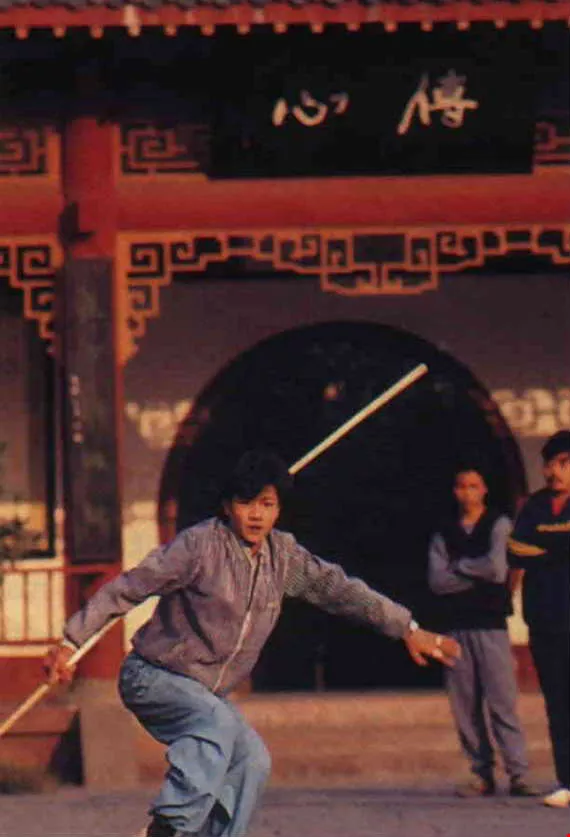
Perhaps martial arts aren't as widespread as they once were, but whose to say there are no more great warriors in our midst? The picture shows kung fu practice at Shaolin Temple.

@List.jpg?w=522&h=410&mode=crop&format=webp&quality=80)


