The Crystallization of the Jadeite Cabbage
Sam Ju / photos Jimmy Lin / tr. by David Smith
October 2009


Against the icy white heart of cabbage,
The locust lies with the katydid.
Go forth! Multiply! Find contentedness!
What was jade, is now crystal.
When the public was invited to vote on what they considered the single most important piece in the collection of the National Palace Museum (NPM), the Jadeite Cabbage emerged as the people's choice. Indeed, people find it hard to tear themselves away from the work when they come to it in the museum. Its lustrous semi-transparency is lush, yet understated. The fact that one of the antennae on the katydid is broken off does not diminish its preciousness in the least.
The world is full of fine jade and fabulously talented craftsmen, but it seems unlikely that another piece will ever come along to rival the beauty of the Jadeite Cabbage.
The year after the Japanese army touched off the Mukden Incident in September 1931, the NPM began its retreat to the south. All pieces were boxed and coded using a character from the Thousand Character Classic to identify which building they had been kept in at the Forbidden City. The character 歲 (sui) indicated that the Jadeite Cabbage came from the pavilion once occupied by the concubine Jin Fei, consort of the Guangxu Emperor. Jin Fei came from a Manchu clan called the Tatara, and was noted as a person of very refined taste. In addition to her love of fine cuisine, she liked to appoint her living quarters with flower vases and planters. The Jadeite Cabbage was part of her dowry and signified the purity of her family background, while the locust and katydid perched on the leaves symbolized a wish for many offspring and abundant happiness.
The Jadeite Cabbage was sculpted from a single piece of half-white, half-green jade full of imperfections, including cracks and discolored blotches. The clever craftsman, however, turned the defects to his advantage. The cracks, for example, became veins in the stalks and leaves. If ever the proverbial "skill surpassing the abilities of a god" did exist in a human, surely this was it!
While visiting the museum, I can't help overhearing the comments of a pair of young women speaking in a Shanghai accent at the souvenir shop: "Look, it's a stalk of bok choy!" "The small one next to it is nice, too." One of them murmurs to herself: "Are they made of glass?"
It is lead crystal, to be precise, with the same silica that goes into regular glass, but 24% lead oxide by content, which yields a higher refractive index and creates an attractive sparkling effect. These properties make lead crystal a popular material for the crafting of imitation jade.
I talk with Li Caiwang, a craftsman who makes Jade Cabbage adaptations for the NPM, to learn more about how he does his work. His home and workshop are both located in Yingge, Taiwan's premier ceramics town, where he stands out from the crowd by working with crystal rather than ceramics. His original works and pieces made on contract include Buddhist statues and decorative items.
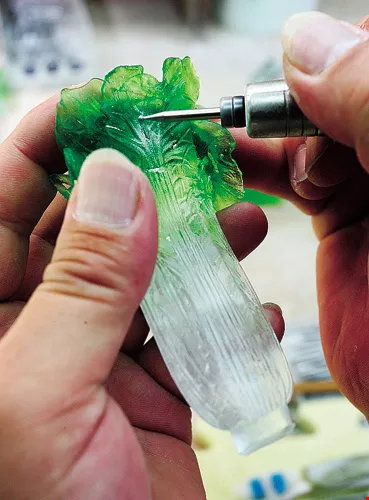
Production includes the following steps: preparation of a wax model (1st and 2nd photos from left), then creation of a plaster mold°?dewaxing°?filling of the mold with glass pellets°?firing for three to seven days°?removal from the mold°?touch-up and polishing (right).
Wheels within wheels
It is generally thought that making an imitation simply means to "ape another's work in its entirety," but that is not the case. With the Jadeite Cabbage, for example, the NPM only provides photos, and would under no circumstances lend out the original. The supplier working on contract to the museum has to use the photos to fashion a three-dimensional image and sculpt a model. This is then supplied to a craftsman, who produces imitations based on the model. If the model is not right, anything made in imitation of it will naturally be defective.
After Li receives a model, he follows the same procedure that one would use to make a bronze casting (see the next article). The first step is to use the model to make a silicone mold. This is then filled with casting wax, and the silicone inner mold is encased in a thick outer mold of plaster. Li places the mold in a steamer to melt away the wax (which occurs at 60°C.), yielding a hollow plaster cast, the inside of which is the exact negative of the original Jadeite Cabbage model.
A view of the contents of the plaster mold would reveal what might appear at first glance to be an upside-down ice cream cone set at an angle. After the piece is fired, the "cone" portion will make up the cabbage stalks, while the "dips of ice cream" below will become the leafy part of the cabbage.
Li then takes some deep-green crystal, crushes it to pellets about the size of corn grains, and stuffs them into the plaster cast. He explains: "The crushed green pieces fall into the position of the ice cream balls, and during firing turn the leaves green."
After that, he takes clear crystal, cuts it into thin slabs about the size of a cell phone, places them over the mouth of the mold, and places the mold into a kiln for firing. The clear crystal turns to liquid during firing and seeps into the center of the casting, where it fuses with the green liquid, yielding a gradual progression of color in the cabbage stalks, from light green to perfectly clear.
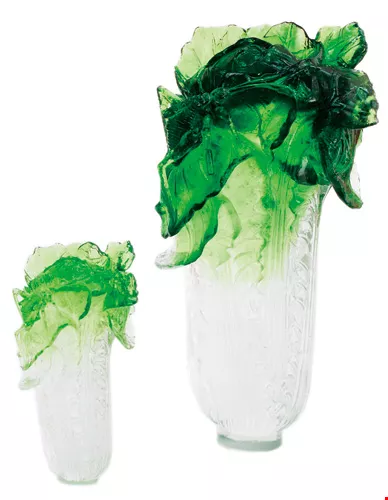
The lead crystal imitation may not have the same weighty feel as the original Jadeite Cabbage, but it's still a big seller at the museum gift shop.
Fire and sword
The original Jadeite Cabbage measures 18.7 centimeters long x 9.1 cm wide x 5.07 cm thick, while the museum's supplier delivers its crystal adaptations in two different sizes, one enlarged at a ratio of 1:1.3, and one downsized at a ratio of 1:0.5. Li makes his pieces according to the supplier's specs. The larger the piece, the longer it takes to fire it.
Says Li: "The electric kiln stays between 850°C and 900°C. I fire the big pieces for seven days, and the small ones for three." Why so long? Li explains that raising the temperature too fast would crack the plaster cast, while lowering the temperature too fast would cause internal cracking in the crystal. "I set the kiln to automatic temperature control to ensure the proper temperature curve. After it reaches peak temperature, I let the temperature gradually drop by about five or 10 degrees per hour."
After seven days of firing, Li removes the cooled plaster cast from the kiln, measures out the position of the cabbage, and cuts carefully into the cast with electric saws. As the cabbage gradually emerges from the cast, he slows the pace and takes extra special care. Like an archaeologist, at this point he has to use tiny little scoops and brushes.
After spending more than a half hour breaking away the mold, Li finally removes the crystal cabbage and puts it on his workbench. "I still have to check to make sure I haven't accidentally broken off one of the insects' legs. If I have, then the whole thing is for naught. I have to start all over, because you can't fix the damage." For Li, apart from the "natural defect" of the broken katydid antenna on the original Jadeite Cabbage, no other breakage can be forgiven.
The piece is not quite finished at this point. The next step is to do detail work with a diamond polishing tool and spray on some emery powder so that it gets into the cracks and makes the traces of repair become obscured. The final step is buffing, to turn out a brilliant crystal cabbage that looks just like the museum original.
In the final analysis, however, crystal is a type of glass and therefore does not have the feeling of density one finds in jade. Most crystal cabbage knock-offs manage to recreate the shiny brilliance of the original, but fail to capture the white color of the stalks. To further improve his adaptations, Li has begun experimenting with fluoride to emulsify the crystal and create a creamy white color to replace the clear crystal of current products. He hasn't achieved a definitive breakthrough yet, but the testing continues.
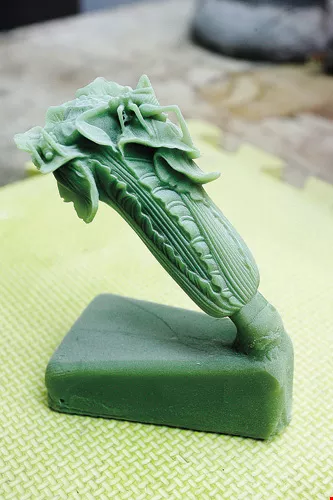
Production includes the following steps: preparation of a wax model (1st and 2nd photos from left), then creation of a plaster mold°?dewaxing°?filling of the mold with glass pellets°?firing for three to seven days°?removal from the mold°?touch-up and polishing (right).
Price sensitivity
For Li and others engaged in the production of adaptations of artifacts from the National Palace Museum, prices are a closely guarded secret, for some consumers might look askance at the big gap between their prices and the cost of materials. The only price information available is at the museum's souvenir shop, where the larger crystal cabbages sell for NT$15,000 and the smaller go for NT$6,000.
The young women leave the museum without buying a Jadeite Cabbage adaptation or reproductions of any other of the museum's three-dimensional collection pieces. Instead, a family of four visiting from Hong Kong buy one large and one small crystal cabbage just before the shop closes. One of them, a fashionably dressed young guy, comments: "It's not the real thing, but it's very pretty. You can give it as a gift, or keep it yourself. At any rate, you can't buy the original Jadeite Cabbage!"

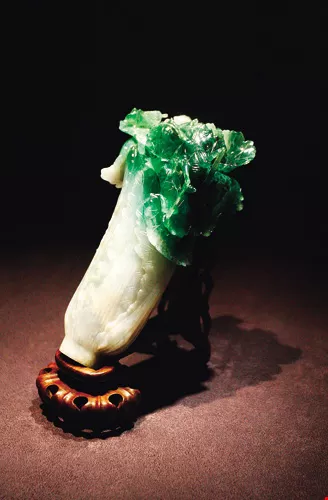
The lead crystal imitation may not have the same weighty feel as the original Jadeite Cabbage, but it's still a big seller at the museum gift shop.


