Diabolo Dance Theatre:“Devils on Sticks”
Kobe Chen / photos courtesy of Diabolo Dance Theatre / tr. by Geoff Hegarty and Sophia Chen
October 2012


Amid waves of light, shimmering diabolos slowly ascend from the dancers’ hands, like glistening pearls rising from the sea. With an abrupt halt to the rapid whirling, they suddenly fly into the air, then fall slowly to regain the embrace of the ocean.
Diabolo Dance Theatre has performed not only across Taiwan but also on the international stage, in 300-odd shows across 30 countries. In September 2012, with funding assistance from the ROC Ministry of Foreign Affairs, the company performed its rearranged classic program Ocean Heart in four Latin American countries, thus taking the art of diabolo performance to the far side of the Pacific.
Diabolo Dance Theatre (DDT) is the first performing arts group from Taiwan that integrates the skills of diabolo, dance, and gymnastics with professional theater techniques. With the diabolo as the core of their performance, these young artists have relentlessly explored new forms of expression over the past two decades, leading their audiences into a dazzling world.
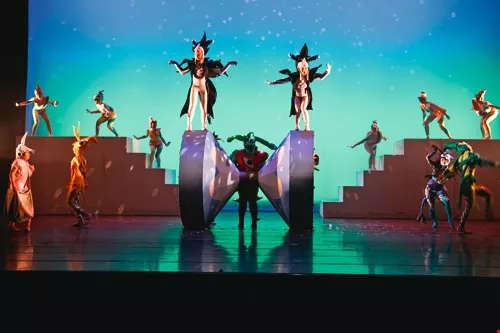
In 2011 Entrance, with its large diabolos and vivid costumes and props, created a bustling and exciting atmosphere.
It’s a little-known fact that DDT’s founder, Liu Le-chun, was once a school math teacher. In 1985, at age 20, Liu graduated from Taipei City Teachers’ College and was beginning his teaching career in an elementary school, where he was put in charge of the school’s diabolo team. With no formal training and little idea of diabolo performance, he watched lots of videos to learn the skills and gave instructions to his students according to what he could pick up.
Interestingly, this total lack of formal training was in fact an advantage, freeing him from the conventions of diabolo technique. Liu has a true feel for music and dance, which helped him to think creatively in crafting performances. However, there were not many diabolo videos on the market, and those that were available showed performances more akin to acrobatic shows, with performers dressed in traditional garb and sporting old-fashioned hair buns.
The diabolo is simply a juggling prop spooling on a piece of string, but for Liu, it had a magical attraction. So he resolved to create something new for diabolo performances.
Liu consulted experts if there was anything he didn’t understand in the videos, and also employed a dance teacher to coach his students. Eventually, Liu was able to lead the Youth Diabolo Dance of Taipei Municipal Zhong Zheng Elementary School in public performances. Over time their reputation grew, and they were eventually invited to perform in the folklore section of the procession marking Taiwan’s National Day. The freshness of their performance created a sensation.
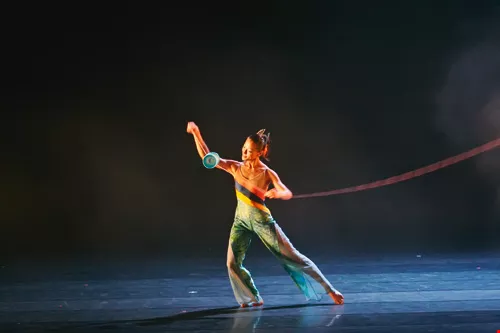
In DDT’s classic performance Ocean Heart, the elegance of the dancers represents the dynamic rhythm of the sea.
One day in 1995 when Liu was busy preparing for a diabolo performance at the school, one of the parents suggested that they try out for a performance at the Taipei Cultural Center.
Enthused by the suggestion, Liu went to have a look at the theater. He realized that they would need to organize lighting and sets to make it a real theatrical performance, but he decided to accept the challenge. Their debut performance on a professional stage, Passing On Diabolo Dance, was very well received.
Then, in 2002, DDT was invited to perform at New York’s Lincoln Center Arts Festival. Up till then, Liu himself had taken charge of everything from administration to set design. For the first time, he had the opportunity to collaborate with other theater artists including composer Chen Young and costume designer Lin Ching-ju. Lin’s costumes brought a new elegance and style to the group that they had never experienced before.
In 2005, they were invited to perform at Expo 2005 Aichi, Japan, giving them the chance to work with some of Taiwan’s most prestigious dance groups including Cloud Gate Dance Theatre and U Theatre. Liu felt great pride in being invited, but was also under a lot of stress. One day he got a phone call from Cloud Gate’s artistic director, Lin Hwai-min, suggesting they meet to discuss their work. Lin brought along a number of videos of some of the world’s top performing arts groups, and they discussed the music which would be an important part of their performance. From this, Liu realized that they would need to perform to adagio rhythms, creating a whole new set of challenges to be overcome.
Liu describes himself around this time as being like a little white rabbit that had strayed into a tangled artistic jungle. Preparing for the event he felt breathless, as if forced down to the bottom of a pool. But when the performance was over there was an overwhelming exhilaration: a sense of mastery over the diabolo.
The Game of Diabolo Dance, created especially for the expo, used music that DDT had never tried out before, including Franz Schubert’s Die Forelle (“The Trout”), and Ma Shui-long’s Bamboo Flute Concerto. The key theme of the performance is a story that follows the sequence of the four seasons.
Lin praised DDT as “a team that takes its work very seriously and has quietly gathered momentum.”—“It’s Taiwan’s Riverdance!”
Liu had, in fact, been doing some serious thinking about DDT’s future even before he received the invitation to Aichi. In 2004 he courageously resigned his teaching position, restructured the group and renamed it Diabolo Dance Theatre.
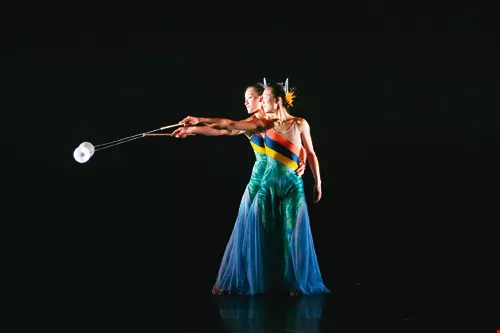
In DDT’s classic performance Ocean Heart, the elegance of the dancers represents the dynamic rhythm of the sea.
In addition to honing the group’s professionalism, Liu also became a sort of inventor, developing a new style of diabolo.
The traditional diabolo is made of wood. When operated at high speed, it can become quite dangerous and if it gets out of control, it can cut like a knife. So if there were an accident, it could cause serious injury to performers or audience. Liu invented a “magic” diabolo made from plastics, less prone to breakage and much safer for the performers.
In 2005, in order to extend the duration of the spin in the adagio sections, Liu began to use a ball-bearing axle with much reduced friction, creating a spin time twice that of the traditional design. He also invented a diabolo lit up by LED lights, and then a single-sided unit (a monobolo), in which the direction of spin can be controlled. These innovations were all employed in the 2007 performance of Ocean Heart.
In general, diabolo performance includes five basic techniques: twisting, tossing, throwing, tangling and springing. By combining these techniques in a variety of ways, the diabolo can create the illusion of overlapping ripples stirred by falling stones, an atmosphere of kaleidoscopic twisting and tangling.
The team members are the core component of a successful performance. They currently have 20-plus dancers aged 10–29, many of them still at school. Principal dancer Yang Xinyi joined the team at age 10, and her 19 years of hard training enable her
to integrate diabolo, dance, and gymnastics in a performance approaching absolute perfection. At one point in her performance onstage, she whips the string, flipping the LED diabolo high into the air—as high as a three-story building. Somehow she manages to spin around twice balancing on one foot before firmly catching the tumbling diabolo as it falls. The audience is stunned at this display of skill.
“While other people practice an action once, I would practice it at least 20 times.” In one of her rehearsals, Yang missed catching a flying diabolo because of the flashing lights. It hit her front teeth, making her mouth bleed. Since that experience she has insisted all the more on practicing every move to perfect mastery.
In fact, the first compulsory lesson for new team members to learn is how to avoid being struck by a falling diabolo. If you feel that something is amiss, you immediately shout loudly to warn others. Then the artist who was preparing to catch the diabolo covers their head with both hands and jumps quickly out of the way to escape injury from the miscreant missile.
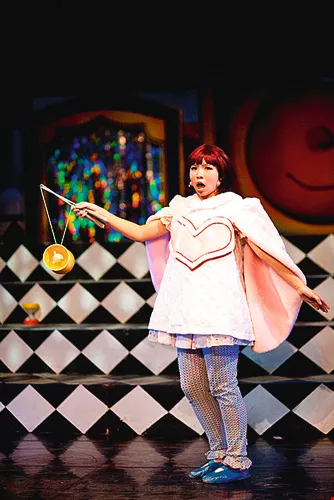
Blossoms in Wonderland, adapted from one of Jimmy’s picture books, attracted an audience of over 200,000 during Taipei’s 2010 Flora Expo.
As DDT’s performance stage has broadened, Liu’s dreams have also become full grown.
DDT performances are ideal for tourists since most of the show uses no words, and the stories are usually quite easy to follow. And the dazzling lighting and sound effects are other attractions. After the Taipei International Flora Expo closed in 2011, the then Council for Cultural Affairs (CCA) invited DDT to participate in a repertory program, helped along by a grant of NT$5 million.
At the end 2011, Liu rented the Expo Hall at Taipei Expo Park for three months to launch the 4D repertory show Entrance. Imagine a room opening out from an entrance, and a group of bizarre but kind creatures that walk the audience through day and night, culminating in an enjoyable carnival.
But it wasn’t all blue skies. The program’s average audience for the 66 shows was less than 40% of capacity, resulting in a financial loss of nearly NT$10 million. Fortunately, thanks to assistance and negotiations by the CCA and the Taipei City Government to reduce their rent for the venue, along with intensive marketing, the box office gradually picked up and relieved at least some of their financial woes.
From this experience, Liu realized that even with a top program and excellent performers, no performance group can operate sustainably without a comprehensive marketing plan and advertising package. DDT needed to develop a solid and professional administrative capability.
Liu changed his operating strategy to actively seek cooperation with various entities, planning a number of performance programs both domestically and abroad. They also joined with government-organized overseas tours, designed to promote cultural diplomacy, in order to create opportunities for travel and performance in the most economical way.
Recently he rearranged the classic work Ocean Heart for performance on their September 2010 tour of Central and South America.
With no words uttered throughout, the performance relies entirely on the performers’ physical movements to tell the story and express emotion. Yang plays the part of a beautiful and elegant mermaid princess leading a naughty bubble elf. There’s also a clown fish who likes showing off but who often ends up as the butt of jokes, and a smug shark. Together they explore every corner of the sea and sketch out a rich and colorful underwater world.
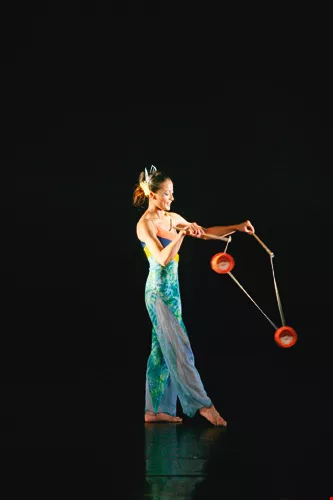
In DDT’s classic performance Ocean Heart, the elegance of the dancers represents the dynamic rhythm of the sea.
Amid waves of criss-crossing light and shade, and before the audience realizes what is happening, dancers appear suddenly in the aisles, and as the lights dim, a host of fluorescent diabolos—on stage and in the midst of the audience—fly like shooting stars into the darkness. The scene rouses waves of stunned screams from the audience.
While the audience are still pondering over the previous scene, six dancers on stage begin to toss and catch colorful diabolos to each other as stringed orchestral music plays. Then the background suddenly shifts into black and white stripes, with only one performer left on stage, following a lighthearted jazz melody. With the background alternating between vertical and horizontal stripes, the visual effects simulate an atmosphere of 3D space. This magnificent show could be described as a small-scale version of Canada’s Cirque du Soleil.
“Diabolo performances are in many ways similar to sky lanterns, symbols of Taiwanese culture, so they should continually ascend, remain luminous, and be shown off across the world,” says Liu.
It is said that the diabolo arrived in Europe in the 18th century, where it was immediately dubbed “a devil on two sticks.”
The devil has been spinning on its string for over a thousand years. When it rolled into Liu’s life, it became a magical charm luring his complete attention, and eventually taking a leading role on the stage.
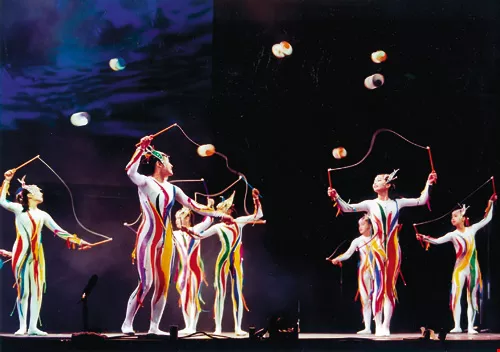
Magic Diabolo in 2000 was DDT’s first performance for a paying audience, who were stunned by the level of skill displayed.
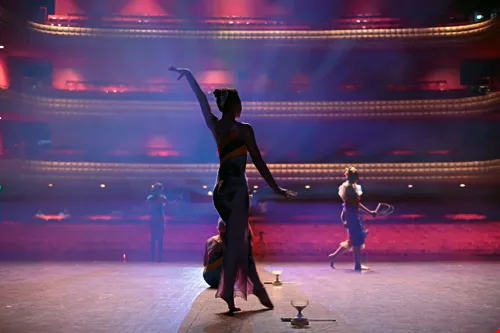
DDT rehearses in Nicaragua’s Rubén Darío National Theatre, proudly representing Taiwan on the international stage.
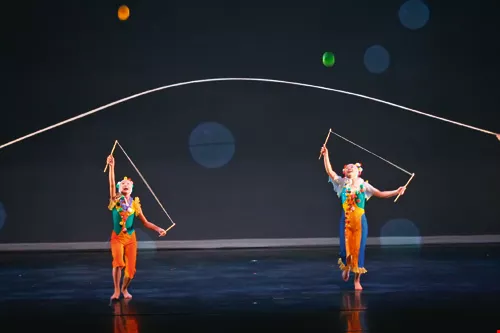
In DDT’s classic performance Ocean Heart, the elegance of the dancers represents the dynamic rhythm of the sea.
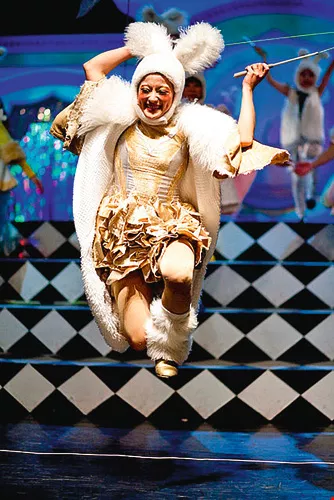
Blossoms in Wonderland, adapted from one of Jimmy’s picture books, attracted an audience of over 200,000 during Taipei’s 2010 Flora Expo.

@List.jpg?w=522&h=410&mode=crop&format=webp&quality=80)

@List.jpg?w=522&h=410&mode=crop&format=webp&quality=80)


