The Secret Genealogy of Tunghai Architecture
Andre Huang / photos Hsueh Chi-kuang / tr. by Phil Newell
February 2008


What do you think of when you hear the word "building"? A prodigious industry that drives the economy? An imposing expression of state power? Or the showing off of private wealth and taste? When you hear the word "architect," what image appears in your brain? A well-heeled young urban professional? Or a black-clad master of style and design?
In Taiwan, there is a group of architects who stand out from the crowd. For them, a building is a harbor in daily life, a community platform, a living memory. They understand very clearly that a building is not the artistic creation of an architect alone, but a product of the interaction of many social forces. Therefore they combine their aesthetic convictions with softness and flexibility in execution. They have not deliberately formed any "school" or "style," but their works reveal social trends and humanistic depth that they share in common.
Behind much of contemporary architecture in Taiwan lies a secret genealogy: Tunghai University. It can be found as far back as the "Utopia" community on Mt. Tatu or "Tang Village" in Taichung, considered classics of early community planning in Taiwan, and also in recent landmarks of public infrastructure designed by people like Huang Sheng-yuan in Ilan County or Chiang Le-ching in Taichung. It also underlies the work of architects like Lu Shichieh and Hun T.W. Hung, who have carved out names for themselves in residential and commercial building design.
Tunghai University, located in Taichung, has always been known as having the most beautiful campus of any university in Taiwan. Surveys show that over 40% of students who make Tunghai their first choice do so because they long for the elegant surroundings. Meanwhile thousands of newlyweds stage their wedding photographs there each year, and for the more than 50 years since the school's founding more than 100,000 tourists have visited the grounds annually. The Tunghai University campus has imprinted itself on the hearts of Taiwanese as a definition of classic beauty.
This kind of charm is merely eye candy for visitors, but for the students who live there-and especially those from the department of architecture-the campus deeply implants a gene of humanistic aesthetics in their persons, a gene which grows more influential and robust over time.
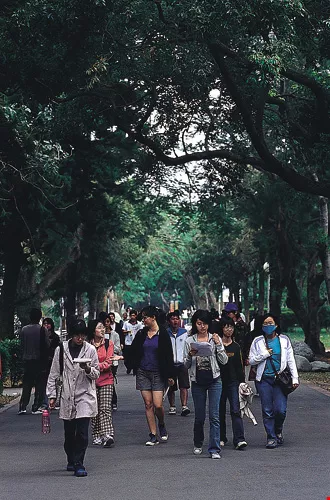
Living for four years amidst elegance, people who graduate from Tunghai are especially sensitive to aesthetics. The photo shows the campus' University Road.
Learning aesthetics
The design for the Tunghai University campus was created by a team of architects of Chinese ancestry including I.M. Pei, C.K. Chen, and Chang Chao-kang, with financial support coming from Christian groups and individuals in the US and Taiwan. For Taiwan, then still a very poor country, it created an unprecedented high-quality space that transcended its era. Whether it be the Luce Chapel, with its curved structure, or the "family-compound"-style buildings that house the various colleges, with their Sinified modernism, all are classic works remarkable for their materials, structure, and spatial design. Considering that outsiders come from far and wide to admire and study these buildings, is it any wonder that Tunghai people themselves-for whom these structures are basic elements of daily life-are acutely sensitive to architectural aesthetics?
Nonetheless, one only has to stroll through the grounds once to realize that the character of Tunghai goes far beyond these individual structures in themselves, but lies in the quality of the overall environment, which offers a humanistic ambience that is harmonious on the large scale and refined on the small.
When you first walk into Tunghai University, after passing through the low-key, simple front gate, you hit Beauson Road (commemorating the first school president Beauson Tseng). This long and winding path is designed in such a way that you cannot see the ends from the middle, and it effortlessly carries you deep into verdant surroundings. The gymnasium, not far from the front gate, is a huge building, but through the use of slopes, distance, and vegetation, the visual impact of this enormous structure is altered so that it maintains a sense of proportion with its environment.
On Campus Mall, the buildings of the various colleges stay within approachable, non-intimidating heights that do not block sunlight or obstruct cool breezes, and they also keep a comfortable, friendly distance from the main road. Betwixt and between run flagstone paths, heading off to other parts of campus, so that a stroll among the green trees and ivory towers is experienced not only with the feet, but with the heart as well. And of course there is Luce Chapel-renowned as a standard-setter in Taiwanese architecture-situated in the middle of a broad grassy expanse, facing Campus Mall only obliquely rather than straight on, so that religious persuasion does not create any barriers to the spiritual pleasure of the route.
There are many examples of this kind of spatial arrangement at Tunghai, with each and every well-conceived design serving a single end: to push the buildings themselves into the background, while putting people at the forefront.
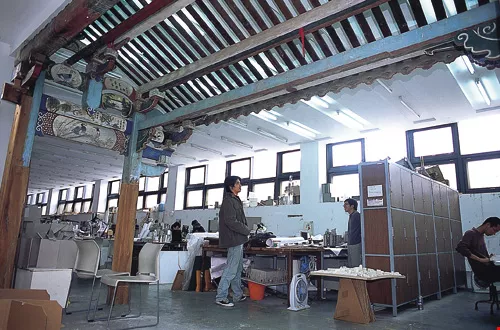
The fine arts, music, and humanities programs at Tunghai all have their own strengths, and the degree to which there is interdisciplinary study among students is probably unique among universities in Taiwan. The photo shows a section of the always bustling Department of Architecture building.
Progressive, humanistic
The Department of Architecture is famously rigorous. Right from the start the school adopted European and American ideas, and while other universities stayed stuck at the level of civil engineering formulas and flat drawings, Tunghai was using models, cross-sections, and actual structural experiments to develop in students a mastery of space. Lo Shi-wei, the current chairman, recalls that in his student days, "When you entered the department building there was almost nowhere to walk, the place was covered with models!" But the department's demands have never been in the nature of obedience to professorial authority, but rather, "Students have always been encouraged to think independently and bring their creativity into play, and to express their own opinions, while professors have been there to discuss ideas and offer inspiration from the sidelines."
Besides the professionalism of its instruction, Tunghai is even more attractive to people for its humanistic atmosphere. The architecture courseload is heavy, and students routinely work through the night, yet you can still find them frequenting all kinds of cultural activities and events on campus, and their presence is felt in school clubs, publications, and performances. The cross-disciplinary fertilization of ideas is part of what makes up the strong capabilities of Tunghai architects.
These abilities are strongly manifested in the person of 1989 graduate Lu Shichieh, whose works include the United Hotel and the StephaneDou-ChangLeeYugin boutique. Lu, a lover of music, film, and literature, makes extensive use of the theme of "paper" in his designs, creating flowing, twisting, or cutting effects, thereby expressing the whimsy of a multi-layered phenomenology. He has also crossed over into furniture and teaware design, including putting the form of the constructivist masterpiece "Monument to the Third International" by the Ukrainian designer Vladimir Yevgrafovich Tatlin on a porcelain cup. When discussing his concepts about space, he liberally makes allusions to people like the Italian leftist writer Italo Calvino and the Latin-American magical-realism master Jorge Luis Borges in support of his explanations, serving himself as a living monument to the power of cross-disciplinary integration.
"Training in the humanities and social sciences is the very basis of being an architect," he says.
Moreover, because of the foreign origins of the school, the Department of Architecture has often been a conduit for importing new ideas into Taiwan. Look for example back to the 1960s, when the famous architect Han Pao-teh (now director of the Museum of World Religions) was department chairman. At that time people in the West were already beginning to reassess post-war modernism as putting too much importance on the building itself while neglecting the social background. Han, who calls himself "a socialist in the tradition of Sun Yat-sen's Principle of People's Livelihood," added into the mix his own observations about social problems in Taiwan and called for using architecture to help address social issues. His views had enormous influence.
Yet original thinking at Tunghai also expressed itself in tapping into Taiwanese traditions. Han's successor Hung Wen-hsiung drew on his expertise in Minnanese traditional architecture to contribute to the then-novel trend of "localism" or "Taiwanization" in the arts.
Tunghai University has offered its students the freedom to think and the courage to be at the forefront, while the school's demands for practical experimentation have ensured that its students have had mastery over the possibilities of spatial design. This is the "secret genealogy" that sets Tunghai architects apart from the crowd.
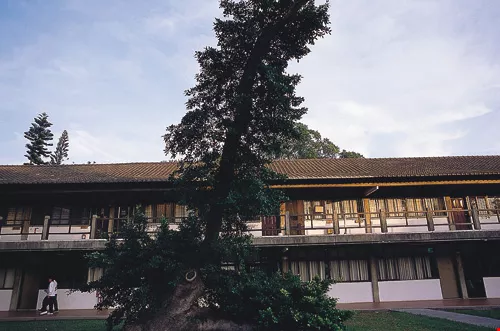
The buildings for the various colleges, laid out like traditional Chinese family compounds, but with openings connecting the interior with the exterior at the corners, naturally exude a sense of peace and tranquility.