Brushes With Death, Brushes With Life: Painter Wang Shou-hsiun
Anna Wang / photos paintings by Wang Shou-hsiun / tr. by Phil Newell
July 1999


The philosopher Nietzche is known for having said, in effect, that those whose lives are hard can't afford to be pessimistic. How many people can really understand the profound sentiment of this sentence? It tells of a courage that does not give in no matter what life may bring.
Kuo Tai-chun, a professor at Tamkang University, uses this sentence to describe her painting instructor Wang Shou-hsiun. A child prodigy who enjoyed early fame, Wang nevertheless has not had an easy ride in life. While other painters created in their personal studios, she was usually at one hospital or another personally looking after her eldest son who was often on the edge of death. Wang would use her free moments to paint on hospital rags, towels, or cloth that she brought with her. Her paintings were nevertheless serene and joyful, like a rainbow reflecting off a cloud, and filled the room with the freshness of a spring breeze. You could say that she is Taiwan's most legendary brush and ink artist.
"The brush is my hand, painting is my life." Wang Shou-hsiun, now 75 and with a full head of silvery hair, is dressed simply. The first impression she gives is one of glowing beauty. She is like her paintings: There is an underlying vitality which makes it hard to take your eyes off her-or them.
Wang has truly had a lifetime of painting. Her career began very early; indeed she was painting from the earliest time she can remember. Moreover, it wasn't the usual childish doodling. Wang recalls herself as a little girl of no more than three or four years old. She was living with her stepmother's parents, and they doted on her. During the day Grandfather put out a small stool for her to sit on and instructed her at a table on the proper way to hold a brush when writing calligraphy, frequently withdrawing the brush from her grasp to check that the positioning of her wrist was steady. At night, as bedtime approached, she could always be found lying on the floor painting a "big girl." On a large piece of paper bigger than the child herself, she would draw in detail a mature woman, often giving her a different hair style, or different apparel. She painted like this for several years.
Why did she always paint women? No one ever asked her, and she herself cannot say. But she suggests that perhaps she subconsciously missed her natural mother, who died when Wang was only four months old.
Wang's unusual life may well be the result of her unusual upbringing. Her family hailed from Liaoning Province on the mainland, though she was born in Harbin. Her family was well connected, and her father once served as Minister of the Interior. They lived in a large house with an enormous courtyard, and servants floated around them like clouds. But, just like the character Lin Daiyu in Dream of the Red Chamber, who lost her mother at a young age and was sent to live with her grandmother, she always felt a sense of loneliness and not belonging. From the time she was small, "in virtually everything I saw or came across, I thought about the downside."
But perhaps it was this very environment which caused her to see that life is not always what it seems, and to use incredible will power to face the trials and tribulations fate dealt her.
A portrait of the artist as a young woman
Her stepmother, named Sun, who married Wang's father when Wang was just one year old, did not treat Wang badly. But Sun was not, after all, her own mother, and later had six children of her own to look after. At that time, the country was in crisis, and Wang's father, as a government official, was often transferred from one post to another. You can imagine how hard life was for Wang's stepmother. She has no complaints about her stepmother, but can't help thinking that if she had had her natural mother, would she not have been sent to school and university? Perhaps she wouldn't have married so young, and her life would not have been made up of so many painful episodes!
But if this were the case, would she be the painter that she is today?
"I probably still would have pursued a career in painting, because I have loved it ever since I was a child, and I put in a lot of hard work at it." Wang lapses into distant memories. But perhaps she would have painted a very different world.
Besides what she learned from her stepmother's parents, after Wang returned to her own home, her father hired a tutor for her who was also an accomplished painter. Besides teaching her the usual school subjects of Chinese, mathematics, and the like, he systematically introduced her to Chinese art, particularly calligraphy, drawing, and bronze and stone inscriptions. He guided her in learning calligraphy and painting, and gave her a solid foundation. She was a precocious student, as can be told by the fact that she would sometimes secretly alter her teacher's paintings, and even the teacher did not notice!
Later, she came to Taiwan. At that time her son had not yet become ill. She studied under the master Chinese painter Chang Ku-nien. Her teacher often asked her to paint the faces on human figures, and frequently told others that she was the most naturally gifted of all his students.
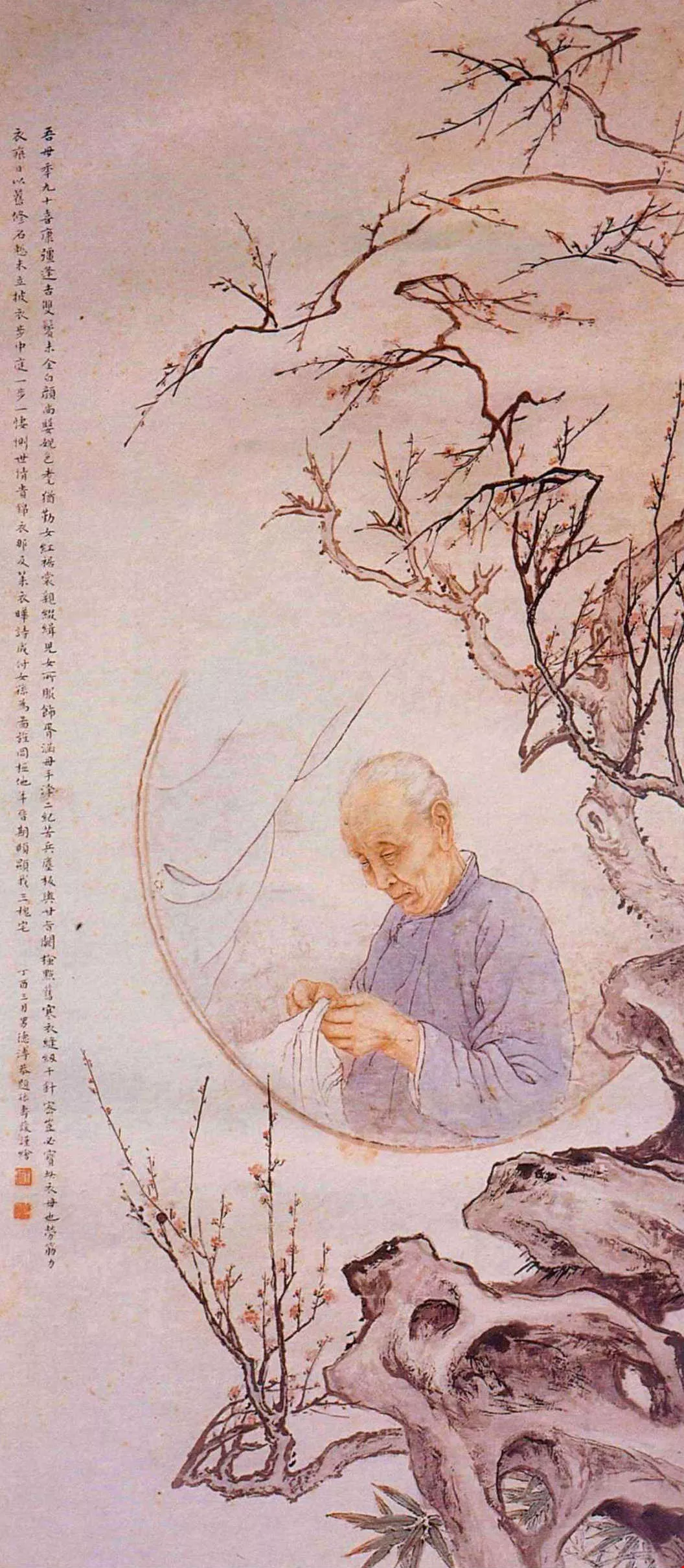
Wang lived with her grandmother as a child. The painting Grandmother was executed only later, from memory, at a time when Wang's son was suffering from serious illness. The realistic depiction of the compassionate eyes and nimble hands is unusual in the tradition of brush-and-ink painting.
From copying to creating
Besides having a great natural gift, Wang Shou-hsiun also worked very hard at studying the ancient masters of brush-and-ink painting. She herself most admires the work of Fan Kuan and Li Cheng of the Northern Song dynasty. The first has powerful, firm, darting strokes, while the latter is quiet and mysterious. She also likes Ma Yuan of the Southern Song.
Besides copying her favorite painters, she also studied the works of the great masters Ni Tsan, Wen Wei-ming, and Huang Kung-wang. Her teacher Chang Ku-nien told her, as he told all his students, that she must also ponder the work of "the four Wangs"-Wang Shimin, Wang Jian, Wang Hui, and Wang Yuanxi of the late Ming and early Qing dynasties-who Chang felt must be the first objects of study for all brush-and-ink students. Wang Shou-hsiun carefully studied all of them until she mastered brush strokes of the same forcefulness and flair.
As a teacher, Wang consistently emphasizes to her students that they should copy techniques from the great masters of old, but not slavishly be tied down to their styles. She does not give her students copying assignments, but hopes they will bring their own feelings into play as much as possible.
Many people are curious on two levels when they see her paintings. First, her brush strokes are powerful, broad, and generous, and are not what many might consider to be typical of the work of a woman. Secondly, in her portraits, she sharply delineates light and shadow, and depicts external appearances and the subject's inner spirit with the kind of merciless realism that might be associated with years of training in Western art-yet she has never studied Western painting. In fact, her style is something she has worked out completely on her own. She responds to questions about it by retorting: Why is it necessary to characterize everything as Chinese painting or Western painting? Why must sketching be "Western"?
For Wang what matters is content, not geography. She recalls how in 1991, when the Government Information Office sponsored an exhibition tour of Europe for her, she felt drawn to the Picasso Museum. It was like, she recalls, "an enormous magnetic field, I could feel his tremendous vitality." She says: "Technique is admirable, but it's life force that really moves people."
Are not her own paintings this way as well? She has spent half her time painting on the run. In between looking after her son, she would steal some time to allow herself to float free in beautiful landscapes. Because she spent whole days running around between her home, hospital, and office, and cloth and canvas are easier carry and preserve, she trained herself to paint on these materials (as opposed to the traditional ink-and-brush material of paper). She thus became the first ink-and-brush artist to paint on canvas, which is normally used for oil painting.
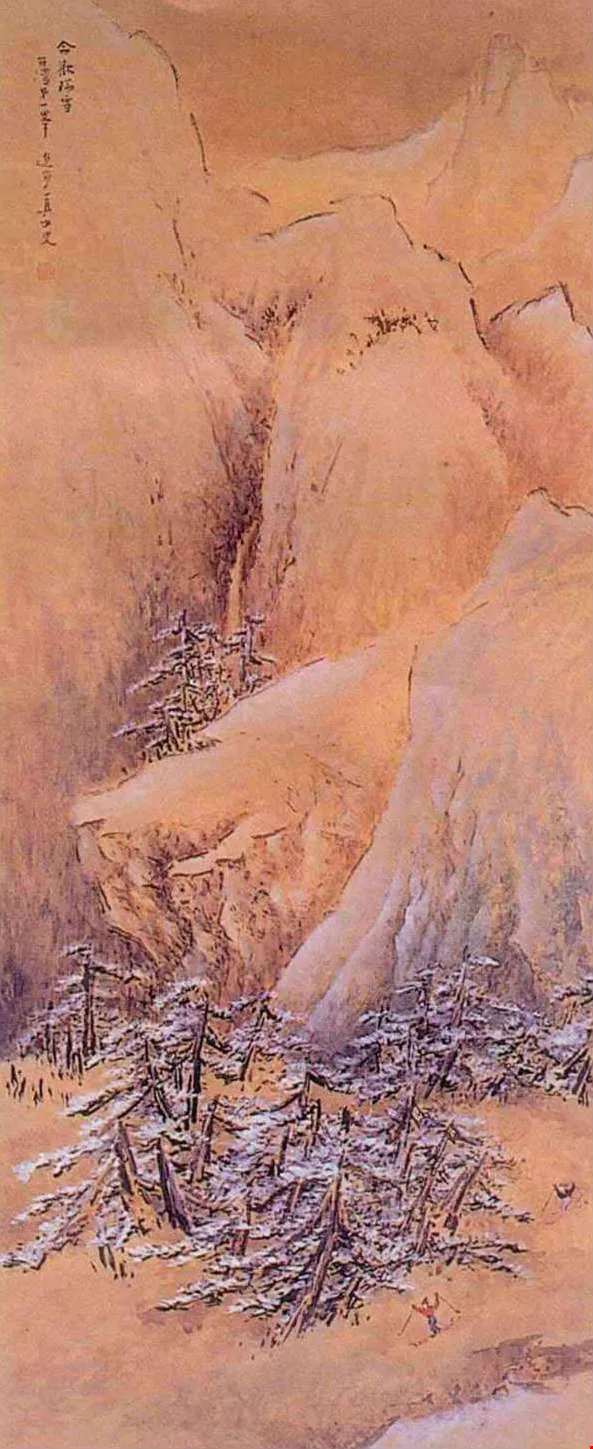
You can almost hear the children's laughter in this snow scene, called Snowcapped Hehuan Mountain, which also reveals Wang's playful, unrestrained side.
Painting over the rough spots
Canvas is rough, and it is not easy to get the free-flowing and subtle brush touches typical of ink-and-brush painting. But once she overcame this difficulty, her work showed its inner strength even more. Such work confirms to an even greater degree the idea that her painting is grand and free flowing, not at all in a stereotypical woman's style.
In fact, what mother who fights for her children can be weak? It's just that when you see her in person, or look at her paintings, it is hard to imagine that over the last 70 years she has hardly had one day of peace.
She has never been able to enjoy unhindered happiness from the earliest time she can remember. At home she was always trying to please her mother. When she had just turned 16, her father married her off to a subordinate. It turned out that this man's widowed mother could not accept this "stranger," and Wang Shou-hsiun could not fit into the family no matter how hard she tried.
Even more sadly, her eldest daughter and eldest son, both difficult births, suffered poor health. Her eldest daughter, Wang Lin, was a victim of chondropathy (cartilage damage). Her eldest son, Wang Chi, born two years later, got tubercular meningitis when he was seven; he barely survived, and lost his hearing. When the boy was 11, remnant tubercular bacteria invaded his bones, end it took three surgical procedures to save his life. Sadly, thereafter he was completely paralyzed from the chest down. Later he got a serious case of bed sores and again nearly died.
The family wanted to give up on this child, but Wang never did. When one hospital said there was no hope, she called an ambulance and had her son transferred to another hospital. She spent more than 20 years, it seems, going from one hospital room to another. The hardest time was when her son was literally rotting away from bed sores, and when she cleaned his wounds chips of bone simply crumbled off.
But Wang would not give in. She took her son to hospitals large and small, tried every traditional remedy she could find, and even tried veterinary medicines, not to mention praying to gods, consulting priests and ministers, and going to mediums and Taoist exorcists. She left no stone unturned.
Finally, when one hospital told her that compressed oxygen treatment had failed and there was nothing further to be done, she had an inspiration, and recalled the idea from Buddhism of the chain of cause and effect. She asked her son to read Buddhist sutras every day on behalf of people in trouble, while she collected money for her old father to build a place of worship for the Tien Teh Sheng sect. As Wang says, "When one person is dedicated, 10,000 cannot stop her." In only one month, she helped her father build a simple place of worship, which was even given a "grade of 100" by the founder of the sect.
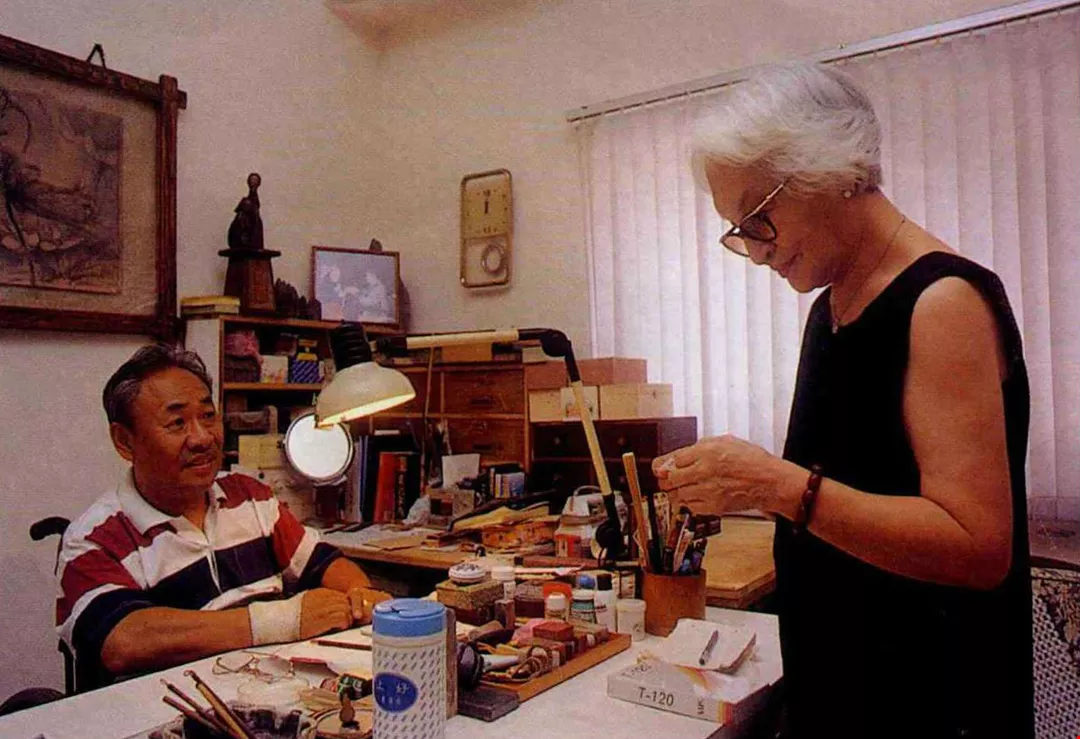
Wang Chi is a highly successful carver in his own right. His mother cannot hide her pride in his achievements. (photo by Vincent Chang)
A miracle?
After completing this task, she rushed to her son who was at the Keelung Naval Hospital. Strange is it may sound, with all of the treatments stopped, her son was in better spirits. Every day he read Buddhist sutras, and if he heard of any unfortunate incident anywhere, he would read sutras on behalf of those victims. Over time he slowly began to recover. And after two months of being closed up, Wang Chi finally came out of the hospital, and with his mother they started up a small business.
Early on, to raise money for her son's treatments, Wang held her first exhibition in Taiwan. She achieved a small measure of recognition in painting circles, and became good friends with a number of artists. In the early 1980s, she opened a small tea house on the corner of Hoping East Road and Shita Road, where she also exhibited her work and gave lectures. This became a salon for traditionally-oriented artists.
In fact, the reason she sold her house to open the gallery was also because of her son. As a child, Wang Chi had studied watch repair. Later, when he was too ill to do anything, he said to his mother: "I'm really too useless!" Wang Shou-hsiun replied with a smile: "Don't talk nonsense. You have never had a chance to use the skills you've learned! Have you forgotten that in the future you want to have a watch shop?" When her son regained his health, she opened her tea house and art gallery, within which was a small watch repair area, so her son could learn to stand on his own.
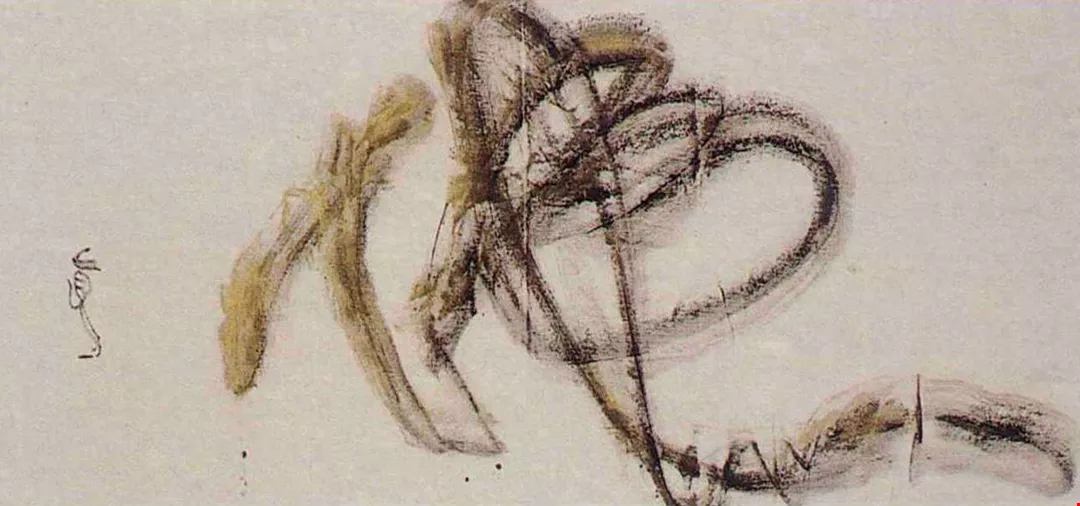
Everyone writes the character for "Buddha" differently; what is Wang's idea of the Buddha?
Enough of life, never enough of art
Although eventually the gallery closed because Wang, a true artist, was not really very good at business, she organized a painting association with students and friends met through the gallery. They held a number of exhibits, even holding a charitable exhibition on behalf of handicapped people. Meanwhile, her son, under the tutelage of Wang Pei-yueh, a master of incised inscriptions, steadily improved his carving ability; a growing number of people came to him to have name chops cut, and he was increasingly able to be independent.
Wang finally had some time to herself. She dedicated herself to learning new things, and wherever she went she would take in the scenery and paint it-from Taroko Gorge and Tienhsiang in Taiwan to the Three Gorges and Huangshan in mainland China to locations in Europe and America where she held exhibitions.
Very few painters, even professional painters, have been as dedicated to art as Wang has been. In her simple studio, she has painted a number of giant-sized paintings. Among her most impressive works are larger-than-life portraits of the Buddhist masters Shun Yin and Cheng Yen which she painted in 1994, and a portrait of Sun Yat-sen, which she painted two years ago. All are triumphs of realism and capture the inner spirit of the subjects.
Wang has never confined herself to Chinese or Western styles; she just paints what she feels. She still thinks she has much room to grow creatively. She says, "As for life, I've seen and done just about enough! But as for painting, I hope to live several more years because I can still improve."
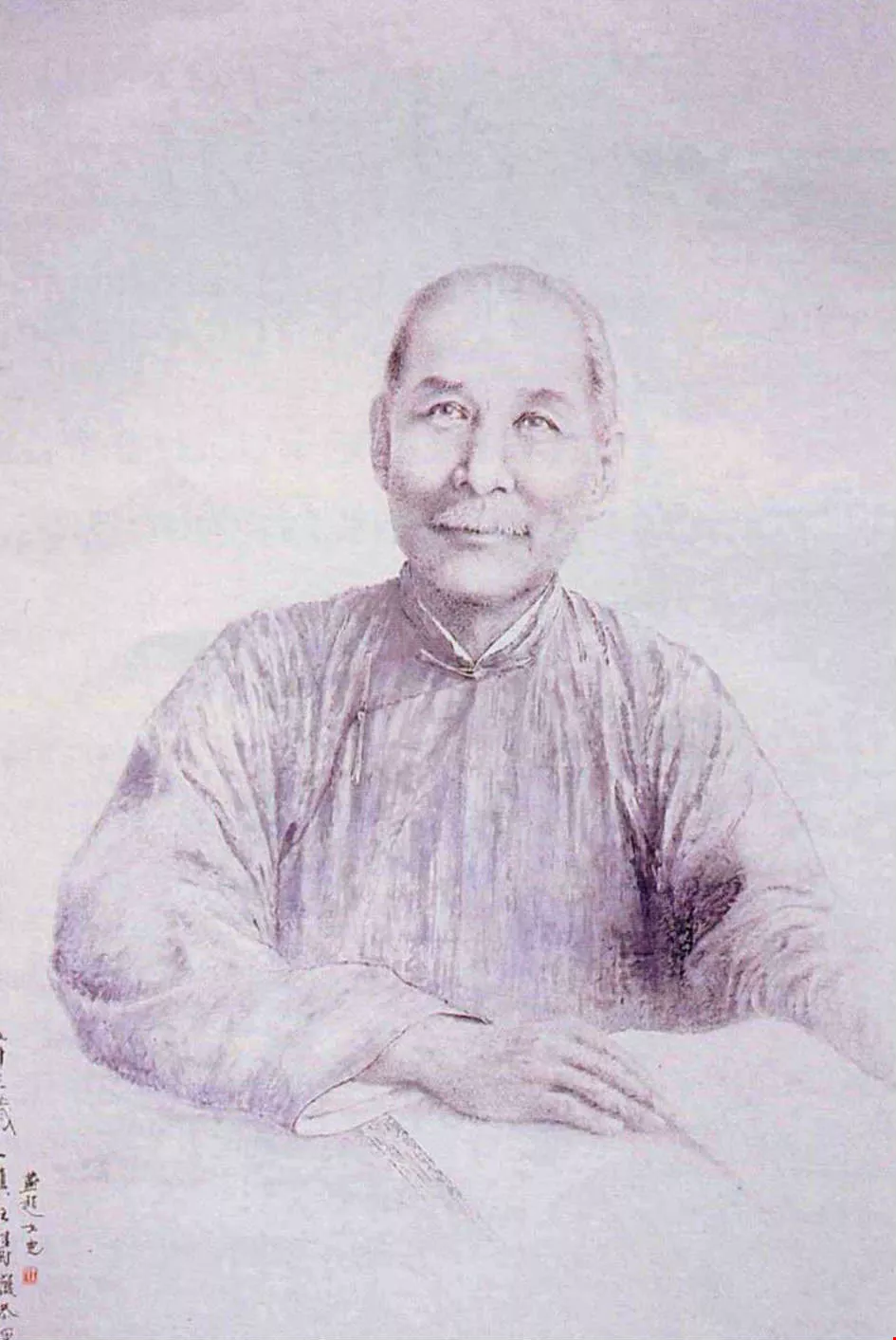
This captivating portrait of Dr. Sun Yat-sen that Wang did at age 73 shows the inner Sun, a philosopher with many things on his mind.
A floating life
In recent years, her mood has changed, and she has become increasingly interested in religious art. Last year, to allow her son to be completely independent, she moved to a Zen monastery in Taoyuan County. It was only recently, to accommodate a Government Information Office-sponsored exhibition of hers in Japan, that she returned to Taipei to prepare her paintings. She says that her next plan is to paint a picture of the Buddhist goddess Guanyin. But she doesn't want this to be in a temple, because painting is a very emotional experience for her and brings out all her bursting vitality, and it is difficult for her to feel free in a temple.
Wang says that her favorite writing is Six Chapters of a Floating Life, the story of author Shen Fu and his beloved wife Chen Yun, who lived in the late 18th century. Wang has not been as fortunate in love as Chen Yun, but in some ways she has been luckier. As a modern woman, she has been able to stand on her own, and to create paintings which express her great passion, talent, and life experience while lifting the viewer beyond the mundane concerns of daily life.
p.104
Wang Shou-hsiun's calligraphy of the character shou, meaning "longevity," is elegant yet strong, like the painter herself. (photo by Tang Keng-li)
p.105
Wang lived with her grandmother as a child. The painting Grandmother was executed only later, from memory, at a time when Wang's son was suffering from serious illness. The realistic depiction of the compassionate eyes and nimble hands is unusual in the tradition of brush-and-ink painting.
p.106
You can almost hear the children's laughter in this snow scene, called Snowcapped Hehuan Mountain, which also reveals Wang's playful, unrestrained side.
p.107
Wang Chi is a highly successful carver in his own right. His mother cannot hide her pride in his achievements. (photo by Vincent Chang)
p.107
Everyone writes the character for "Buddha" differently; what is Wang's idea of the Buddha?
p.108
Wang did this large painting of the Goddess of Mercy in 1982, when she herself was recovering from illness. It is so lovely as to make one wonder if her brush hand did not have providential inspiration.
p.109
This captivating portrait of Dr. Sun Yat-sen that Wang did at age 73 shows the inner Sun, a philosopher with many things on his mind.
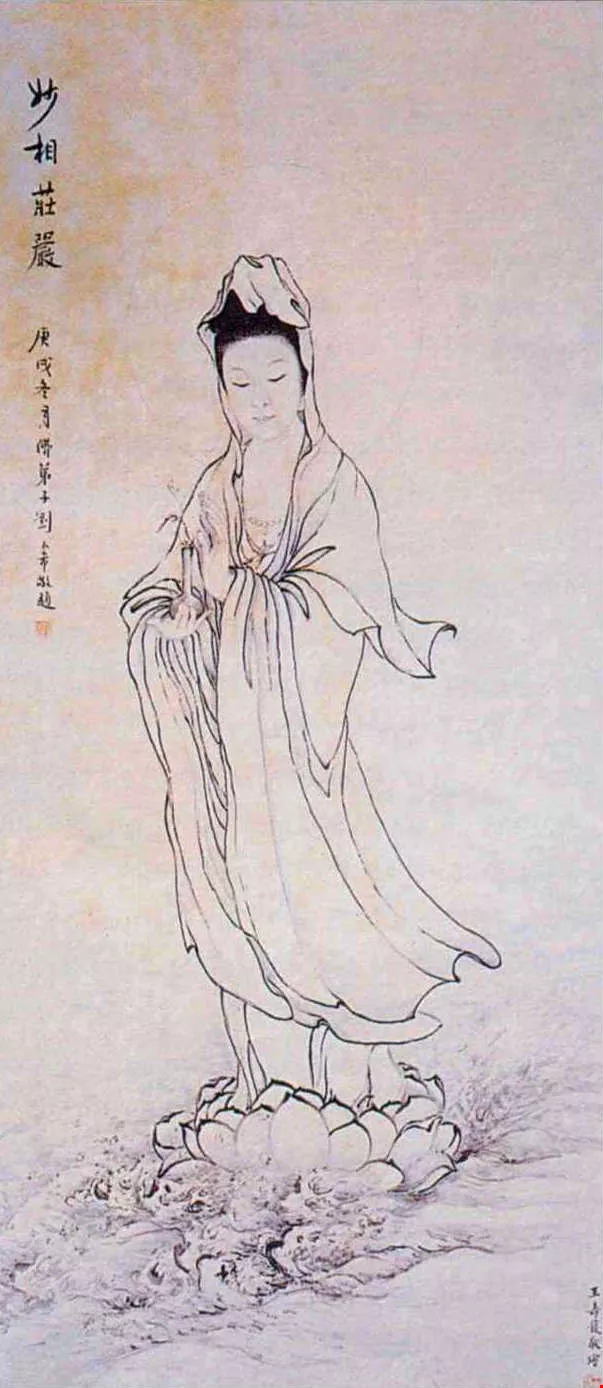
Wang did this large painting of the Goddess of Mercy in 1982, when she herself was recovering from illness. It is so lovely as to make one wonder if her brush hand did not have providential inspiration.


@List.jpg?w=522&h=410&mode=crop&format=webp&quality=80)


