Evangelists on Wheels50 Years of Mormonism in Taiwan
Vito Lee / photos Chuang Kung-ju / tr. by Christopher J. Findler
March 2007


Pairs of clean-cut young white males sporting white dress shirts, black slacks, and bicycle helmets pedaling along the streets and alleys--when you mention Mormon missionaries, this is the image in many people's minds.
Mormonism, officially referred to as the Church of Jesus Christ of Latter-Day Saints, is a branch of Christianity, but due to discrepancies between its doctrines and those of other traditional Christian groups, they have long been criticized by the Protestant, Catholic, and Orthodox Churches.
The static, however, has failed to drown out the message being spread by Mormon missionaries. Since its founding in America in 1830, the LDS Church has extended to all corners of the planet. It is the fastest-growing new religious sect in the world today. The church recently celebrated 50 years of mission work in Taiwan, once again piquing curiosity.
After a quick lunch, 19-year old Nathan Payne Spjute and 20-year old Blake Vierra hop back on their bikes and pedal single file from Chi-an Township along the road through Hualien City to Peipu.
Hualien may be small, but the road is tough to navigate. Not only do they have to dodge pedestrians, scooters, and cars, once they leave the city proper, they have to keep out of the way of heavy trucks barreling up and down the provincial highway.
Despite the danger, the two young men continue to pump along unruffled. When they come to a red light, Vierra, the "senior companion," comes to a well-practiced halt. He sets his right foot down and greets the motorcyclist that pulls up beside him in Taiwanese. If close enough, he will reach out and give the person a firm handshake and a name card. If the opportunity presents itself, he'll even whip out his notebook to jot down the person's phone number and name in Romanization.
They belong to the church in Hualien, which is under the jurisdiction of the Taipei Church, and they are tasked with missionary work in the northern Hualien area. A simple jaunt from the church located on Chi-an's Chungyuan Road to Peipu takes about half an hour. They make the journey at least once a day.

The LDS Church also encourages retired members to get involved in mission work. Gerald H. Walker (far left), president of the Taipei Taiwan Temple, and James Morehead (second from right), who is in charge of Asian area public affairs, are serving abroad again with their wives after retiring. In the background, surrounded by six spires, is Taiwan's only Mormon Temple, on Taipei's Chinhua Street.
Mission on wheels
The Bible says that soon after Jesus' ascension, his apostles, led by Peter, struck out on their mission work. They carried their message first to the Jews, then to Asia Minor, and then throughout the sprawling Roman Empire, planting churches along the way and bringing the gospel to all.
It's hard for people today to appreciate just how difficult missionary work was almost 2000 years ago. Travel was grueling and the "flow of information" was slow. Witnessing these two young men shaking one hand after another and knocking on door after door, we realize that the work hasn't got much easier.
"It'll probably take a few more months before I'm as good as him," confesses Spjute as he stands behind Vierra. He admits that his lack of familiarity with Taiwan culture has resulted in a number of awkward moments. Spjute confides, "When I first arrived, I invited a Buddhist monk to one of our gatherings."
They head to Peipu's Chaili Village, then to Chialin Community. They use their notebooks to find homes of members that have been absent from church for a while in hopes of bringing them back to the fold. Even in remote villages like this, most everybody is either at work or in school on Monday afternoon, which explains why their knocks are rarely answered. But if nobody is home, all is not lost. Vierra makes a beeline for a neighbor's house and knocks on the door. "Would you like to get to know Jesus Christ?"
The LDS Church, which in 2006 celebrated its 50th anniversary in Taiwan, has had more than 3,000 young missionaries serve in Taiwan. Most of these mainly Caucasian missionaries speak fluent Mandarin and many, like Vierra, can greet people in Taiwanese. Back when foreign tourists were still a rarity, most people's impressions of foreigners in Taiwan consisted of Mormon missionaries complete with bicycle, slightly twanged Chinese, white shirts, and black trousers.

Apostolic image
In 1955, Captain Stanley Simiskey, an American soldier stationed in Taipei, stumbled across other Mormons in the service. Cheerful by nature, Simiskey took it upon himself to begin organizing meetings and he asked other Mormon members of the US military to join him in prayer. The Mormon Church had been expanding for over a century, but it had somehow missed Taiwan. Simiskey decided to rectify that.
Simiskey petitioned Mormon headquarters in Salt Lake City, Utah and laid out the problem. The church promptly designated Hong Kong head Grant Heaton to survey the situation. Of course, Simiskey was responsible for receiving him.
The first Mormon missionaries had spread from America to Britian and gradually expanded to other places around the world. The fact that the British were still ruling Hong Kong and English was in common use were important considerations in the church's decision to use Hong Kong as the center for their proselytizing work in the Asia-Pacific region. In sharp contrast, Taiwan still lacked people who could even speak standard Mandarin, much less English. Just how much good would it do to send young English-speaking missionaries to Taiwan? Heaton couldn't be sure.
However, after being founded in the early 19th century, Mormonism had soon become the fastest-growing Christian sect. This testified to the missionary zeal of all Mormons. Despite misgivings, Heaton assigned four missionaries to Taiwan in April 1956, signaling the official start of the LDS Church's proselytizing work in Taiwan.
In sharp contrast to their counterparts today who are supplied Chinese language study materials, the first missionaries studied Mandarin using elementary-school Chinese textbooks. In 1957, the missionaries began proselytizing in Chinese. In April of the same year, they baptized their first two Taiwanese converts. By year's end, they had won over 50 believers. As of 1959, the number of missionaries to Taiwan had increased to 46 and the church in Taiwan had expanded to include 500 members.
The numbers of both missionaries and believers would continue to grow steadily. By the late 1970s, the church was growing by more than 1,000 people per year.
As of the end of 2006, Taiwan had in excess of 45,000 believers and 480 missionaries. "In view of figures like these, we expect to see 2,600 new recruits annually," maintains Norman S. Nielson, president of the Taipei Mission.
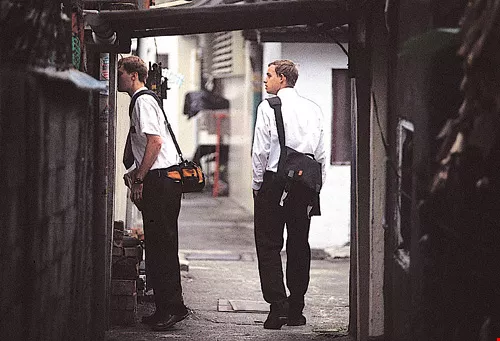
In many ways, including one veteran taking a rookie under his/her wing and the emphasis on discipline, mission work is very much like life in the military. This enables these youngsters to fearlessly face unfamiliar circumstances as they perform their mission work. These photos show Blake Vierra and Nathan Payne Spjute spreading the word in the streets of Hualien.
The church's wealth
Devoted missionaries, trained, managed and supervised from their headquarters in Utah, are the backbone behind the LDS Church's irresistible expansion. But these youngsters wouldn't be pedaling very far if the church wasn't doing its part by planning and investing its vast material resources.
In 1960, the church began building up assets in Taiwan in accordance with plans laid out by Gordon B. Hinckley, then member of the Quorum of the Twelve Apostles (the LDS Church's policymaking body) and today world leader of the Church of Jesus Christ of Latter-Day Saints. In 1966, construction on the first Mormon church and assembly hall in Taiwan was completed in Taipei. This feat not only provided believers with a regular venue in which to gather, young missionaries would no longer have to go to the trouble of looking for places to live. To this day, the missionaries, who pay their own way, all live in and pay rent for rooms in church dormitories.
Another 16 churches have been built in Taiwan since, including the magnificent temple on Taipei's Chinhua Street completed in 1984. According to conservative estimates, the LDS Church's assets in Taiwan currently weigh in at over NT$5 billion. For example, the church in Hualien County's Chi-an Township, completed in 2005, has a floor area of nearly 3,300 square meters and boasts such facilities as an indoor basketball court for church members. The NT$230 million-plus price tag for the construction is the highest doled out by any of Taiwan's imported religion.
In addition to the tangible, the church has no qualms about spending on the intangible. In 1957, the LDS Church set up a commission to translate the Book of Mormon into Chinese. It took eight years. It later began compiling Chinese language training program materials for its missionaries which today consists of a two-book series. Book one uses Romanization and is intended to enable missionaries to rapidly learn the Chinese that they will need to live in Taiwan and to share their message. The second book teaches reading and writing and is aimed at those who want to take their Chinese to a higher level. The Salt Lake City headquarters began offering intensive basic Mandarin courses in the '80s to help prepare those about to embark on a mission trip to Taiwan.
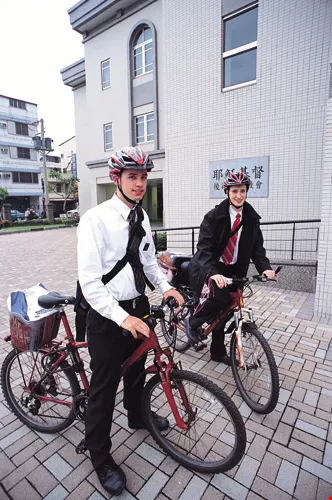
After giving reports on their week's work, Blake Vierra (right) and Nathan Payne Spjute mount their bicycles as they prepare to set out from the Mormon Church in Hualien to make house visits.
Tomorrow the world
The LDS Church was started in 1830 when American Joseph Smith claimed to have received a revelation from God and began preaching from the new "Bible" (the Book of Mormon). This new religion would spread across both America and Europe on its way to becoming the fastest-growing Christian sect. The Semiannual World Conference held in Salt Lake City is regularly interpreted into 86 languages and broadcast around the globe. The Book of Mormon has been translated into 105 languages.
American sociologist Rodney Stark once predicted that Mormonism would become the next "global religion" following the founding of Islam in the fifth century and that it would claim more than 260 million adherents by the middle of the 21st century. Although this number proved to be high, at a time when other major world religions have stagnated, the LDS Church has done relatively well, swelling to 127 million members by 2006.
The Mormon Church as a whole is astonishingly passionate about the "mission of mission." This is personified in current world president Hinckley. At age 96, he continues to personally preside over constructing plans for churches and temples around the world. To supervise church activities, he has been to more than his share of countries. He's visited Taiwan alone eight times.
"Our work keeps us busy almost nonstop from 6:30 in the morning to 10:30 at night every day," Spjute explains as he opens his notebook crammed full of notes. The mishmash of English and Chinese, almost too small to read, includes a detailed daily to-do list: "Get up early, read scripture, study Chinese...." Home visits start at 10:30 a.m. The church generally has various small group meetings in the afternoons and evenings and those don't usually let out until 8:00. "After I get back to the dorm, I make a few phone calls to contact the people I'll be visiting the next day. After that, Nathan and I review progress made during the day and decide our schedule for the next day," Vierra explains. "After we finish, I go to bed and am so tired that I'm asleep before my head even hits the pillow."
In the past, missionaries were predominantly Caucasian, but in recent years, more Taiwanese have been joining the mission ranks as they fulfill their obligation to spread the good news--part of the LCD Church's "Three-Fold Mission."
"Most believers convert to Mormonism as entire families," relates Jared Yang, chairman of the LDS Church's Taipei Key City Public Affairs Council. "Children in Mormon families, especially boys, are taught from a young age the importance of mission. They are strongly 'encouraged' go out and spread the gospel."
Although not compulsory, many believers choose their spouses from within the Mormon fold. That coupled with encouragement from the family tend to make the number of believers grow quickly. Yang Tzung-ting became a believer in 1973 and led his older brother to the church the following year. The two of them would later take wives from the same church district. With the birth of each of their children, the Yangs opened bank accounts, so that their children can start putting into their "mission funds" from a young age. "My son did his mission in Taichung and my daughter took off two years, starting in her third year at university, to do her mission in Kaohsiung," Yang explains, "They withdrew NT$10,000 out of their mission fund accounts each month for expenses. My wife and I pulled up the slack if they needed help."
As to overseas missions, "Over the past few years, an average of five "young elders" have been going abroad for their mission," Nielson says.
With the exception of Wednesday "preparation day," these youngsters follow the same unrelenting schedule day after day, week after week without a break for a total of two years. "Preparation day is for washing clothes, cleaning your room, hunting down an Internet cafe from which to write home, and if time permits, shooting some hoops in the afternoon," explains Spjute. Sitting in his austere dorm room (no television, no computer), he continues in slow but clear Chinese, "Once in a great while, we catch a movie."
Born and raised in Hawaii, Spjute has had girlfriends and loves to play video games, but in Taiwan, he never plays video games or dates. Motivated by his unwavering faith, he leads a life resembling that of an ascetic monk, living, eating, and breathing his mission--and he is by no means the exception to the rule.
"They learn a lot during their two-year missions. They receive training in self-management and after knocking on doors, they are constantly snubbed by strangers. When they do get the opportunity to share with somebody, they need to make sure they leave a good first impression and explain the doctrine as succinctly and clearly as possible. They also need to work hard to maintain contact with prospective converts. Training like this is also a great benefit as these kids grow up emotionally," asserts Taiwan Domino's Pizza chairman and fellow Mormon Scott Oelkers, "Based on the benefits reaped during their own missions when they were younger, many parents are more than happy to see their children take their turn. In addition to serving God, it affords them the opportunity to undergo similar tempering."
A number of LDS Church missionaries to Taiwan have gone on to become prominent figures in their fields. In addition to Scott Oelkers and Scott R. Watterson, CEO of sports equipment company Icon, the most famous is current Utah governor Jon M. Huntsman, Jr. The influence of the LDS Church in government and business circles in the US is on the rise. One Mormon of note, Massachusetts governor Mitt Romney, is considered a possible contender for the US presidency, which would make him the first Mormon presidential candidate.
Similar scenes of individuals like Vierra and Spjute pedaling around in white shirt and black pants is repeated in countries around the world. They are breaking down language barriers and enduring long days of going from door to door and shaking hand after hand in search of the next new believer.
This motivation is the source of their growth. As long as the spiritual need exists, they will continue in their mission.
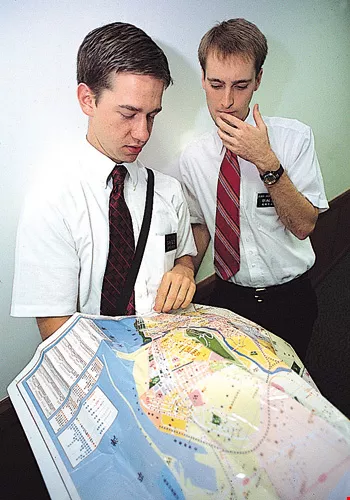
Everybody is supplied with a map and Chinese language teaching materials complete with flash cards. Advances in both equipment and methodology have been an important factor in the accelerated progress of mission work abroad.
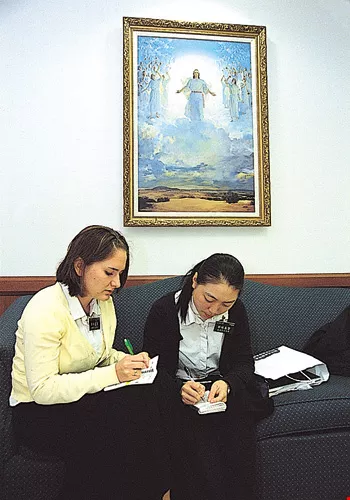
The church is experiencing tremendous growth in both male and female members. Seated inside a NT$230 million church (left), young women missionaries (one foreign, one Taiwanese) are discussing their schedule (below).

Everybody is supplied with a map and Chinese language teaching materials complete with flash cards. Advances in both equipment and methodology have been an important factor in the accelerated progress of mission work abroad.
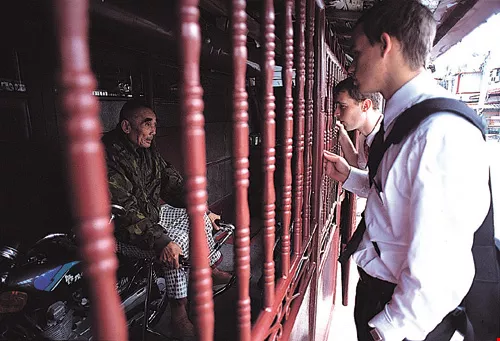
In many ways, including one veteran taking a rookie under his/her wing and the emphasis on discipline, mission work is very much like life in the military. This enables these youngsters to fearlessly face unfamiliar circumstances as they perform their mission work. These photos show Blake Vierra and Nathan Payne Spjute spreading the word in the streets of Hualien.
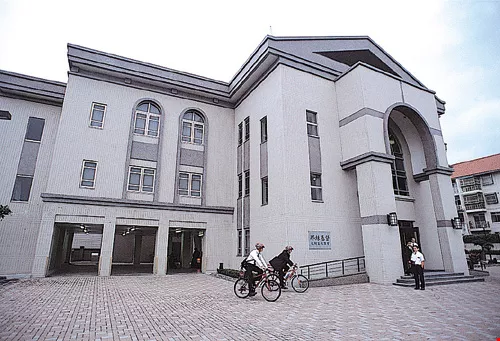
The church is experiencing tremendous growth in both male and female members. Seated inside a NT$230 million church (left), young women missionaries (one foreign, one Taiwanese) are discussing their schedule (below).
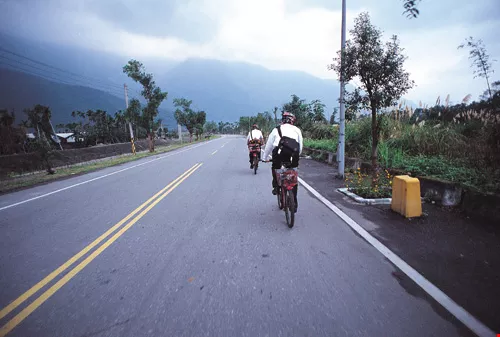
They lower their heads and pump harder as they take on gusts of wind from the north. The two young men seem so tiny alone on the empty highway and against the green mountains in the distance.
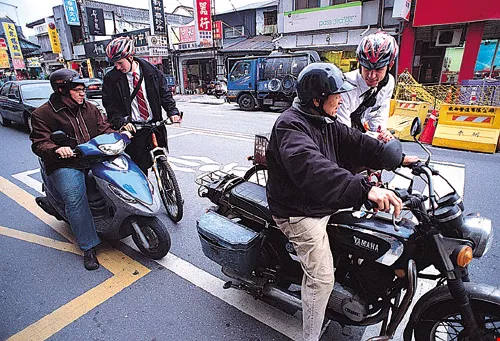
In many ways, including one veteran taking a rookie under his/her wing and the emphasis on discipline, mission work is very much like life in the military. This enables these youngsters to fearlessly face unfamiliar circumstances as they perform their mission work. These photos show Blake Vierra and Nathan Payne Spjute spreading the word in the streets of Hualien.

@List.jpg?w=522&h=410&mode=crop&format=webp&quality=80)


