Crossing Over--Taiwan Studies Near-Death Experiences
Coral Lee / photos Jimmy Lin / tr. by Scott Williams
December 2007


In 2002, two strangers came together at the urging of the Chou Ta-kuan Foundation, an organization that advocates "life education," and established the Taiwan Near-Death Research Institute. The first was an elementary-school principal who had been making the rounds talking about the beautiful afterlife she had seen during her near-death experience (NDE). The second was a psychiatrist who began conducting NDE interviews after a loved one had an NDE.
But while the general public in Taiwan remains largely uninformed about NDEs, researchers in the US and Europe have conducted a number of systematic academic studies into the phenomenon over the last 30 years. These studies have found that NDEs are neither hallucinatory nor psychological phenomena, but common, real experiences that occur without regard to nationality, age, gender, or religious affiliation. While science has so far failed to provide evidence of or an explanation for NDEs, researchers with backgrounds in medicine, psychology, physics, and neurology continue to be interested in them.
People meeting the pretty, exuberant Sophia Hsieh today would never guess that eig. When Yu began to recover from her cancer after a 1999 near-death experience (NDE), she picked up the pace of the volunteer work she'd taken up while ill. She became the executive director of the Chou Ta-kuan Foundation, organizing foundation events all over Taiwan. She also began delivering frequent talks on the changes her NDE had wrought in her life, started reading the international academic literature on NDEs, and established the Taiwan Near-Death Research Institute. "I came back so I could let everyone know that death isn't that frightening," says Hsieh.
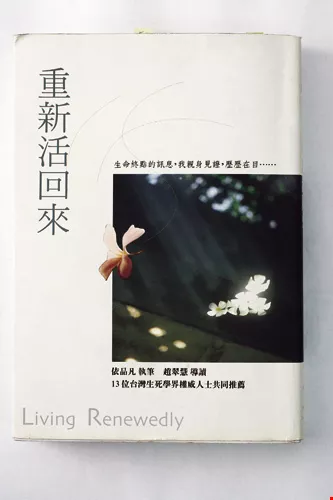
Living Renewedly was the first book to discuss NDEs in Taiwan. It records the experiences of seven Taiwanese alongside commentary from academics and experts in the fields of medicine and religion.
Peeling away the "four elements"
Hsieh is married to the owner of a construction company and is well off. Though she emigrated to Canada, where she runs a Chinese school for Taiwanese children, more than 20 years ago, she has continued to visit Taiwan, where her in-laws have a business, regularly for many years. In her 40s, she picked up a cough that had no obvious cause, and even coughed up blood. She underwent years of treatment, but just couldn't shake it. Then she was diagnosed with late-stage lung cancer. Believing she didn't have much time left, Hsieh left the hospital, but battled on nonetheless, throwing herself into volunteer work. By the summer of 1999, she was on her deathbed. Awakening in the middle of the night one night, she saw her crossed legs bounding ahead of her. Another time, she stumbled to the bathroom door only to see herself already seated on the toilet. Strange as these experiences were, she wasn't afraid.
She was utterly drained when the sun rose the next morning, and had a raging fever to boot. She shouted but her family could barely hear her. Following the instructions of a qigong master, family members tried to soak her feet in warm ginger-infused water, but Hsieh found it unbearably hot. Feeling like each of her vertebrae was falling into her back, she burst into tears. Then her nose began running so vigorously that her family had trouble wiping it all up.
At this point, she found herself able to see through walls. She watched her husband buy something at the convenience store across the street and saw the family's servant crying on the stairs. Hsieh then had another out-of-body experience. Walking towards an incredibly bright screen she could see in the distance, she saw gorgeous multicolored textiles floating in the air around her. Pale yellow was the dominant hue. Indescribably beautiful music surrounded her. "I felt loved and accepted and incredibly blessed in that place," recalls Hsieh, who says that she became deeply intoxicated by the sense of wellbeing. In the midst of this joy, she was struck by the thought that she had to return to tell people about her experience. Taking a deep breath, she fell soundly asleep.
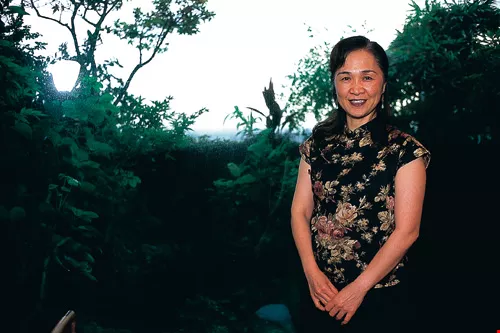
Sophia Hsieh, founder of the Taiwan Near-Death Research Institute, has "died" twice and couldn't care less if people think her odd for giving talks on her NDE.
A turnaround
After awakening, Hsieh couldn't stop telling her friends and family about the joy she had felt and the incurable passion for life she had found. Hsieh had had an out-of-body-experience before, during a 1990 ovarian surgery, but this time she followed up on her experience by reading a variety of perspectives on the mysteries of life and death. By coming to a deeper understanding of life, she garnered new insights into her marital difficulties. She was able to free herself of the pain of her husband's affair with a good friend, and separated from him amicably in 2003. "Flowers eventually whither," she says philosophically. "He'd loved me for 30 years, which was no mean feat. Anyway, I was a party to the crime. And I respect his right to be himself."
Hsieh likes to quote George Ritchie, author of Return from Tomorrow, who says the point of our time on this earth is to learn to love. Hsieh herself came to realize that understanding "pure love" meant learning to love herself and to love others. Loving herself meant accepting and affirming her true self, as well as sometimes letting herself off the hook. Over the years, she has seen too many people make themselves miserable by forcing themselves down dead ends. Loving others meant giving them hope and joy, and allowing them to be themselves.
Hsieh's NDE included an out-of-body experience, abnormal sensory perceptions, an encounter with a bright light, euphoria and a powerful sense of wellbeing, and the sudden thought that she had to return to the living. Research has shown all to be standard elements of an NDE.
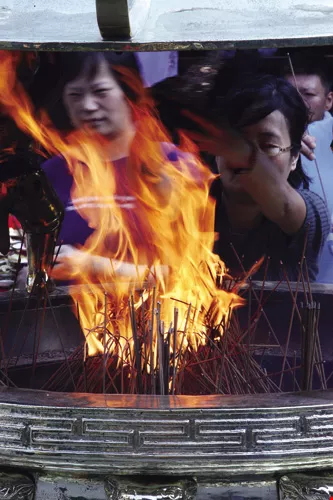
Ideas about such things as New Year's offerings and the transmigration of souls reflect the East's recognition of other planes of existence. This recognition stands in contrasts with attitudes in the West, where the influence of materialism inclines people towards a binary opposition of life and death.
Early NDE research
The term near-death experience was coined in 1975 by Dr. Raymond Moody, an American medical doctor with a PhD in philosophy. In his book Life After Life, also published in 1975, he defined it as the incredible experience people describe having had when an accident or illness has brought them to the brink of death.
Moody at first rejected the notion that consciousness could persist after death. Then, while a graduate student in philosophy, he heard psychiatrist George Ritchie speak about his own NDE. While in the military in 1943, Ritchie had "died" for nine minutes before being revived by a shot of adrenaline directly into his heart. The experience led Ritchie to take up the study of medicine and begin investigating the possibility of an afterlife. Moody was intrigued by the story, but didn't give it a lot of thought.
Moody returned to South Carolina many years later to teach at his alma mater. One day, after a lecture on Plato's notion of an immortal soul, a student told Moody of his own near-death experience: A little more than a year previously, a doctor had declared him dead after an automobile accident. The student had then gone on a bizarre journey before spontaneously reviving. His "death" had completely changed his outlook on life and he wanted to share his experience with his classmates. Moody, recognizing that his student's experience had been cast in the same mold as Ritchie's, reluctantly accepted the reality of the phenomenon and began collecting cases from among his family, friends, and students. He was surprised to discover that their experiences were remarkably similar regardless of their gender, religion, social class, or level of education, or even the cause of their NDE. Moreover, all were emotionally stable, psychologically normal individuals.
In addition, their recollections of what they had seen and heard during their NDEs-what the caregivers inside and outside the intensive care unit had said and done, what the people in the hall had said, even what they were wearing-turned out to be accurate. One person glimpsed a blue sneaker outside a window on a different floor of the hospital, and another encountered a friend who had died while he himself was being revived.
Moody collected information on 150 cases from 1972 to 1975, and published them in Life After Life along with a description of the core characteristics of an NDE. These included the sense of the spirit leaving the body, passage through a dark tunnel, a bright light that calls from the end of the tunnel, an encounter with a deceased loved one or guide, and a rapid review of one's entire life. Life After Life sold millions of copies and introduced the American public at large to the concept of the near-death experience.
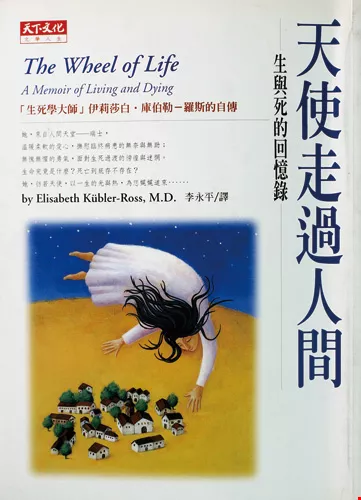
The Wheel of Life-A Memoir of Living and Dying is the autobiography of psychiatrist Elisabeth Kubler-Ross. She reminds that in the face of death, nothing is more important than love.
Interest spreads
Following the book's release, a number of researchers in the medical field initiated long-term studies into NDEs from a variety of perspectives. In 1981, Kenneth Ring, a professor of psychology at the University of Connecticut, established the International Association for Near-Death Studies, which put together a systematic study on the aftereffects of NDEs.
Ring discovered that the changes wrought by NDEs were very similar from person to person and included reorienting their beliefs and values in a much more positive direction and gaining a sense of mission. NDEs also often spark physiological and psychological changes ranging from the development of healing and precognitive abilities to increased intelligence.
Meanwhile, Dr. Melvin Morse's research has shown that NDEs in children still too young to be influenced by culture or the educational system look just like those of adults. Morse's results indirectly refute the notion that adult NDEs are merely "psychological effects" or the product of "too much reading."
Elisabeth Kubler-Ross, a psychiatrist known for her work on death and dying, encountered many NDEs in the more than 20,000 cases she studied over her 30-plus-year career. In The Wheel of Life, she wrote that the afterlife is a reality that people must face, and that the living are like chrysalises that transform into butterflies when they die. In her view, we shouldn't question whether the afterlife exists, but instead figure out how to learn about it. She argues that because we are content to parse our existence into its physical, emotional, and intellectual components, we have difficulty exploring the spiritual and fail to understand the afterlife.
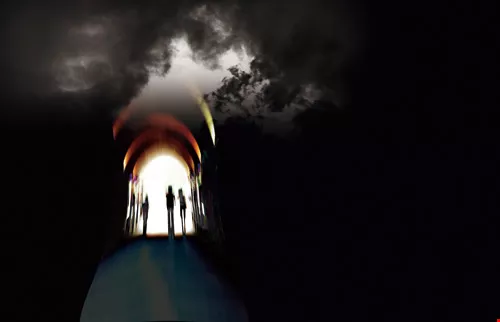
A dark tunnel, a bright light, an encounter with a deceased loved one.... Scholars are intrigued by how similar near-death experiences remain in spite of differences in the age, upbringing, cultural background, and religious beliefs of the people having them.
Just a hallucination?
In spite of the many expert and scholarly affirmations of the reality of NDEs, Western empiricism typically leads mainstream scientists and medical workers to conclude that consciousness ends with death. Their argument runs something like this: The brain is the repository of consciousness. Therefore, brain death must mean the end of consciousness. Therefore, so-called NDEs must be subjective mental phenomena or drug-induced hallucinations.
Kent Lin, a psychiatrist at Kaohsiung's Kao-Suan Psychiatric Hospital and Taiwan's premier NDE researcher, disagrees. "Although drugs dull the consciousness too, they produce fragmentary hallucinations that lack logic and continuity" says Lin. He explains that, unlike drug users, people who undergo NDEs are able to describe them very clearly, and retain vivid memories of them for years afterwards. Drug-induced hallucinations also frequently involve a sense of a splitting of one's awareness. That is, people experiencing such hallucinations often feel they have become two people, each of which is pursuing its own activities. People experiencing NDEs, on the other hand, tend to remain lucid as they observe their dying bodies from outside.
A well-known case in the US involved a drug addict named Henry, who went into severe convulsions after an overdose of intravenous cocaine. Henry experienced hallucinations and an NDE simultaneously. After falling to the floor in the bathroom of his home, he had a vision of six neighbors and friends coming into his bathroom and beating him badly. He then saw a folding door and a ray of light, and heard a sharp noise.
Henry told his interviewer that he knew the door, the light, and the God he saw weren't hallucinations because they were beautiful and serene. Hallucinations, said Henry, were terrifying, miserable, frustrating, and emotionally devastating. Henry walked through the door, but a voice stopped him, telling him that he hadn't yet completed his life's mission. Prevented three times from passing by the light and the voice, he told the voice that he'd do what it said if it could stop the people who were beating him. When he awakened, he tried something new: he picked up the phone and called for help. Nine months later, he quit using drugs.
The mainstream medical community also posits endorphins as a possible explanation for NDEs.
Studies have shown that people release large quantities of endorphins (an opioid produced by the body that is ten times more potent than morphine) during times of extreme crisis to prevent mental and physiological collapse. Marathon runners, for example, are known to experience a euphoria and sense of oneness with nature during their grueling races. Persons participating in religious austerities such as corporal penance often come to take pleasure in their sufferings and can even experience an enlightening joy. Blood tests on people enduring these kinds of extreme duress have shown their endorphin levels to be several times normal. Some scholars therefore postulate that when people are facing life's most stressful event-imminent death-their bodies become flooded with endorphins, triggering the sense of incredible wellbeing described by people who have had NDEs. However, this hypothesis fails to account for the tunnel and bright lights also associated with NDEs.
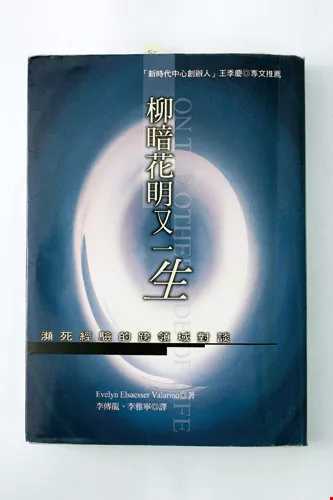
In On the Other Side of Life, NDE historian Evelyn Elsaesser Valarino holds a multidisciplinary dialogue on NDEs with experts from the fields of psychology, biology, physics, and neurology.
Consciousness after brain death?
Are NDEs nothing more than the subjective mental activity of the person having the experience, or do they have an objective existence? Now, after 30 years of debate, we are finally beginning to see some breakthroughs.
A paper published in Resuscitation, a UK journal of emergency medicine, in February 2001 argued that the spirit could in fact exist independent of the brain.
This clinical study of 63 heart-attack victims treated at Southampton Hospital found seven patients who had formed memories while their hearts were stopped and their brain function was severely impaired, including four who met the Grayson Scale criteria for NDEs. The study stated that these subjects were able to form memories, think, and reason, as well as mentally explore their surroundings and hold conversations, during an NDE. This observation led Dr. Samuel Parnia, the study's designer, to propose further study of an important question: Can consciousness persist when there is no respiration, pulse, or brain activity?
An NDE-related study published in The Lancet in late 2001 created an even bigger stir. The Netherlands' Rijnstate Hospital tracked 344 patients it treated for myocardial infarction over a four-year period for eight years after their treatment. Some 62 of these had had NDEs, and the rest served as a control group. The Rijnstate study showed those who had had an NDE also experienced major changes in their lives afterwards. Specifically, they lost interest in material gain and no longer feared death.
The debate over the causes of NDEs has drawn a seemingly endless stream of researchers into the fray, the most significant result of which has been a recognition of the common aftereffects of the experience. These include a newfound appreciation for life among people who had previously been suicidal, an end to drug use among former addicts, a concern for others on the part of the previously self-centered, and a sense of a mission larger than oneself.
Tung Yi-pu's NDE, for example, left her with new spiritual strength and a sense of mission. Though her own life has been hard and without a penny to her name, she has found the means to save many from depression and suicide.
The 50-year-old Tung was abused as a child by the family that adopted her as the future wife of their son. Though she did well in school, they did not give her the opportunity to go on to university. Her marriage was also a difficult one. Her husband gambled, ran up debts, and spent his nights with a mistress, leaving her to raise their four children on her own. It was as if all life's misfortunes had fallen upon her shoulders. But an NDE that occurred during a surgery nine years ago changed her outlook. She came to think of her troubles as a gift. "The things that were wrong with them tested me and made me a better person," she says.
Tung now feels that her mission in life is to help other people discover themselves, whether through the study groups she used to organize or the spiritual workshops she has arranged more recently. Though her formal education was limited and she has no professional training, Tung has managed on her own to become adept at tantra yoga, meditation, counseling, and hypnosis. She has achieved tangible results helping others with all of these techniques.
Life's variety
In the West, the mainstream scientific and medical communities have numerous doubts about NDEs. In the East, in contrast, there are long cultural traditions of inquiry into the intangible, extra-physical elements of life. Qigong, traditional Chinese medicine (TCM), and Zen meditation all provide prominent cases in point. The East therefore is less hesitant about speculating on the causes of NDE phenomena.
"Materialism has had too profound an influence on Western scholarship, which is why you have this kind of wrangling," says Chen Kuo-gen, a professor in the physics department of Soochow University who has also studied TCM and Buddhism in great depth. According to Chen, the West believes that life has a material basis. As a result, the life sciences think in material terms-focusing on macroscopic dissections and microscopic examinations of the genes. The Eastern view of life has never been that tightly constrained. Expressions such as "there's a spirit three feet above your head," "make offerings as if [the ancestors] are present," and "those who walk often at night are sure to meet a ghost," as well as folk customs like grabbing the clothes and calling the name of a child that's been frightened all reflect a belief in spirits and a recognition that other beings can sever the still tenuous grasp a child's spirit has on its body.
Chen believes that life has four levels: the body, energy, information, and the spirit. Spirit, the highest level, sends information (the commands that make life function). It is what Western psychology crudely divides into conscious, subconscious, and unconscious, and what Buddhism calls the eight consciousnesses. Spirit is life's ruler, commanding the mind and the body, and is capable of receiving and transmitting every type of information wave in the universe. In Chen's hierarchy of life, the upper levels are more active, more malleable, and more influential than the lower.
Chen says that most people today think of the spirit as something abstract, and are unaware of its actual existence. People who have undergone NDEs, on the other hand, have been pulled low by some powerful external force, such as an illness or accident, and as a result have experienced the separation of their spirit from their flesh. "When the spirit escapes its fleshy prison, it can contact other spirits and the great energy that fills the universe," argues Chen. "These give it aid and correct its mixed-up instructions." It is therefore perfectly reasonable that such people gain a new perspective on life when they recover from their illness or injury.
Many people's experiece
To better understand the NDE phenomenon in Taiwan, in 2001 Sophia Hsieh had the Chou Ta-kuan Foundation mobilize 36,000 volunteers to conduct interviews throughout Taiwan for one year. Their results led the foundation to estimate that some 120,000 people in Taiwan had had NDEs. While far short of the 13 million Americans (about 7% of the population) a 1994 Gallup poll found to have had an NDE, the Taiwan figure is still a substantial number. The foundation followed up on its survey by establishing the Taiwan Near-Death Research Institute and, in 2003, publishing a collection of Taiwanese research into NDEs entitled Living Renewedly. The book contains the stories of seven persons willing to talk about their NDEs together with scholarly perspectives on the phenomenon.
Those seven people included an accountant, a DJ, a homemaker, a film worker, a student, and a yoga instructor. The basic elements of these Taiwanese NDEs were very similar to those seen abroad. For example, Liao Chu-chien and Yen Mei-yin both had the sense of floating in space, much as Swiss psychologist Carl Jung saw the Earth bathed in deep-blue light far below him during his own NDE. Brought to the brink of death by a car accident, Tsai Ching-wei relived key moments of his life during his NDE. The experience reawakened a sense of affection for other people and helped him bridge the long-standing distance between himself and his family.
Chung Pei-chun, who underwent an NDE as a child, predicted the death of Chiang Kai-shek and her own aunt's suicide. Liao Chu-chien, who works in the US, saw a plane, a bomb, and the twin towers of the World Trade Center long before the 9/11 attack. Chiu Ching-tun suffered from constant headaches prior to the Chi Chi Earthquake, and predicted a strong earthquake and large numbers of refugees. Chiu also predicted a major plunge in the Taiwan Stock Market. These instances of precognition are consistent with Ring's description of post-NDE precognitive abilities.
"The cross-cultural similarities between NDEs have attracted the interest of researchers," says Kent Lin. But there are cultural differences as well. For example, Westerners tend to interpret the light as Jesus or Mary, whereas Taiwanese tend to see Guanyin or another Buddhist figure. Sophia Hsieh, for example, saw and heard something straight out of a Buddhist sutra. Tung Yi-pu heard Buddhist chanting and saw ancient Indian and Nepalese totems. Similarly, Westerners have a relatively unclear image of the border between life and death, whereas Easterners often turn back after seeing a bridge or a river demarking the netherworld.
East and West also differ in their level of scholarly interest in the phenomenon. Where researchers in Europe, the US, and Japan have delved into the subject, Taiwanese scholars have been relatively indifferent. And most local scholars who are interested just dabble independently. In fact, Kent Lin's work with a medical center is the only instance of cooperation. Drawing on the records of Taiwan's major dialysis centers, Lin and his collaborators collected information on nearly 700 people who had had emergency treatment for a rapid drop in blood pressure. They asked them to fill out surveys and discovered 47 NDEs. Though they published the results of their study in 2003, the medical community remained less interested in their work than the media.
NDEs introduce those who've had them to the vastness of the universe and the mysteries of life and death, and demonstrate to them that life goes on after the death of the body. Venerable Huei Kai, who heads up Nan Hua University's Department of Life and Death Studies, says that in addition to eliminating peoples' fear of death, NDEs make them aware that death is the doorway to another life. "We must therefore live sustainably, and begin preparing [for the reality of death] at the earliest possible moment," he says.
Are you seeking relief from life's travails? Perhaps understanding NDEs, which take people to life's utmost limit, will free you from the imagined duality of life and death and set you upon a new path.

@List.jpg?w=522&h=410&mode=crop&format=webp&quality=80)


