Painted Protectors:
The Beauty of Taiwan’s Door Gods
Cathy Teng / photos by Jimmy Lin / tr. by Bob Dougherty
February 2026
When entering a temple in Taiwan, the first thing you’ll notice is a pair of “guards” painted on the door panels to welcome you. For Taiwanese, these door guards are a feature of everyday life, but as a first-time visitor, you may wonder just who they are.

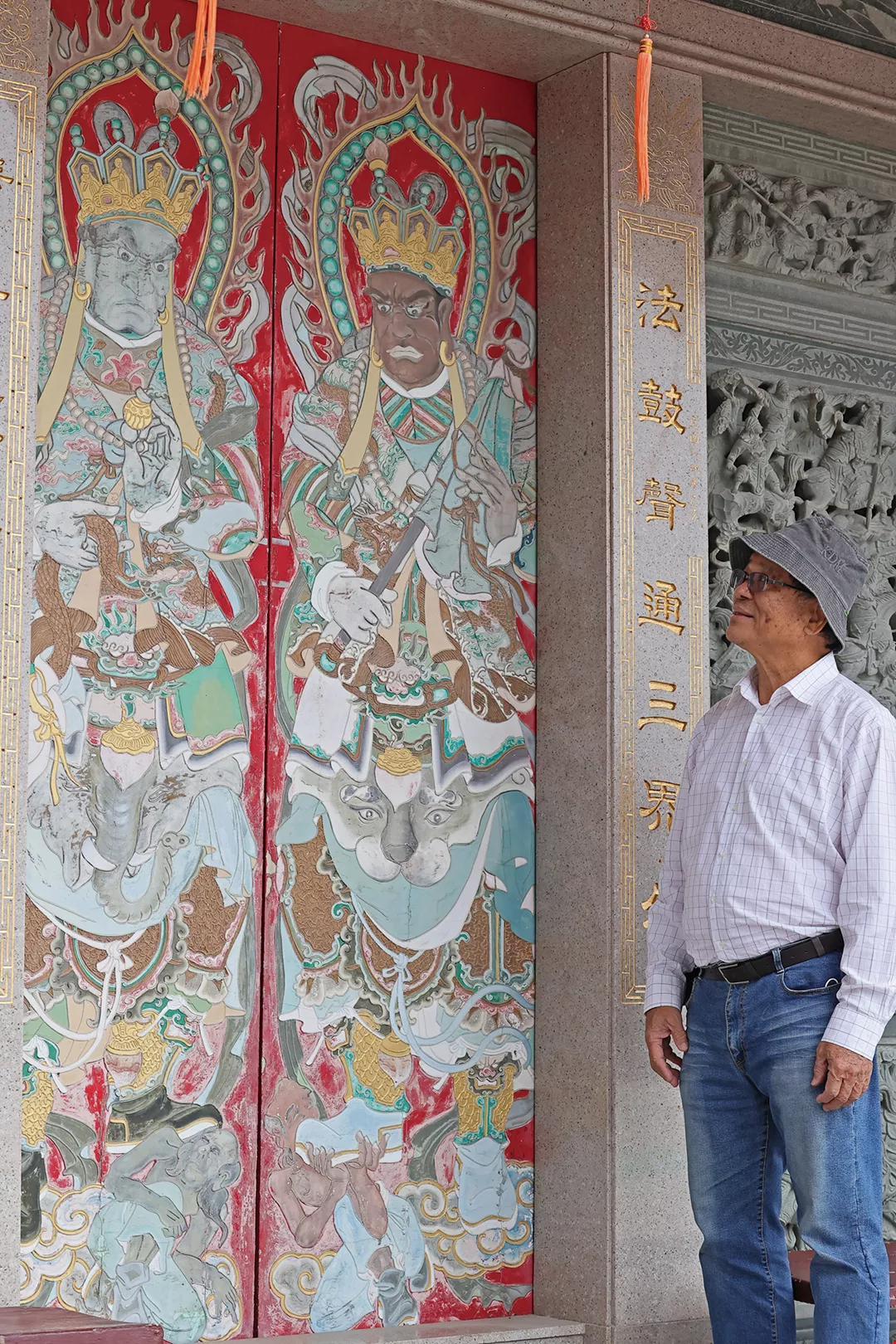
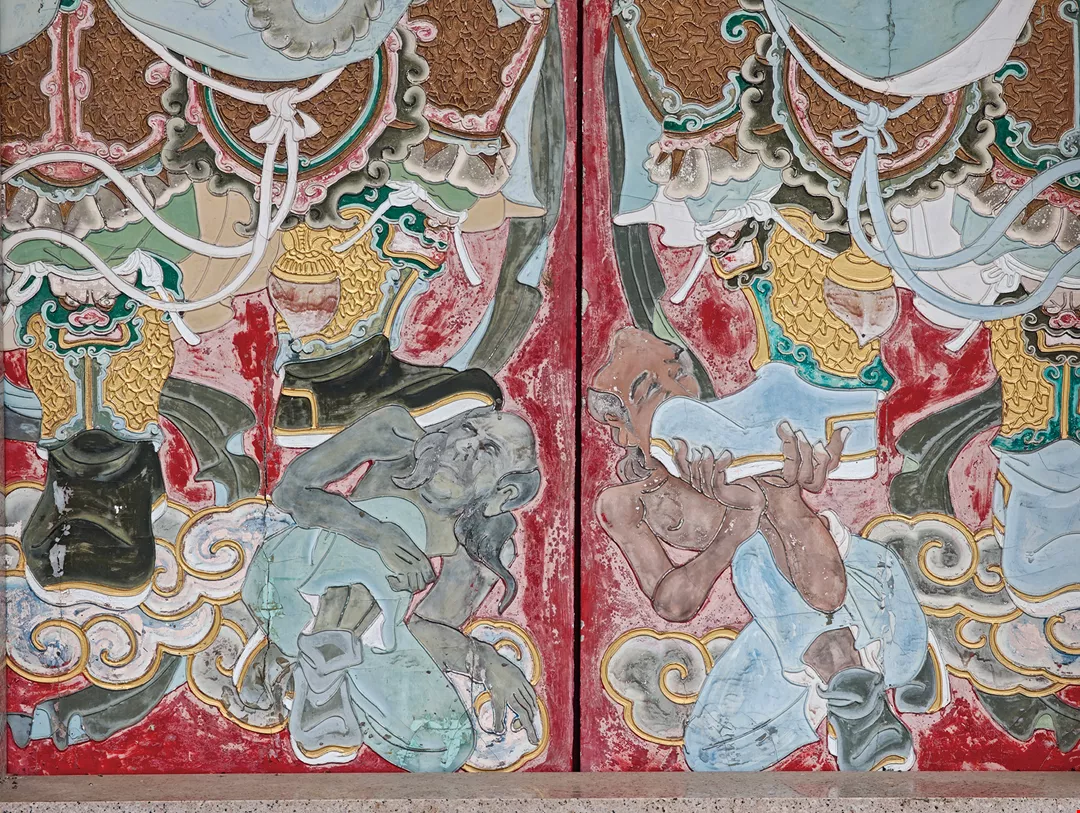
The two guardians Wei Tuo and Sangharama on the central doors of Kaiyuan Temple, Tainan. Painted by Tsai Cao-ju. (photo by Kent Chuang)
Door gods: Guardians of sacred space
The most common door gods in Taiwan are the generals Qin Shubao and Wei Chigong. Legend has it that Tang Dynasty Emperor Taizong was haunted by nightmares, and asked the two generals to guard his door at night. Later, their images were painted on door panels to ward off evil spirits and protect houses.
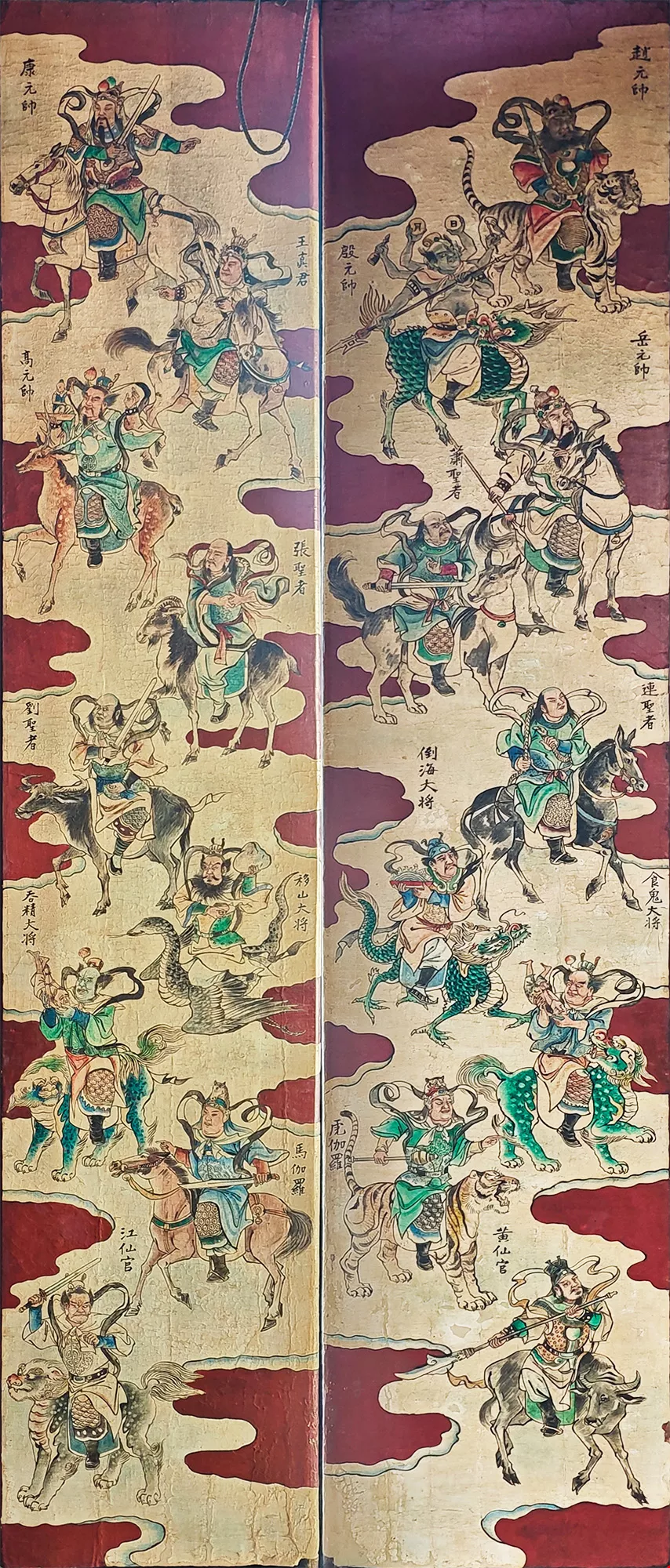
According to legend, the earliest door gods were the generals Shen Tu and Yu Lei, overseers of the ghostly realm in the Classic of Mountains and Seas. In Taoist temples, the Four Great Marshals who protect the Xuantian Emperor often serve as door gods, while Buddhist temples often use the Four Heavenly Kings, Wei Tuo, Sangharama, or the two divine generals Heng and Ha. Although different faiths have their own door guardians, temples in Taiwan blend elements of Buddhism and Taoism, so gods from both religions are worshiped in the same temple and door gods are drawn from both traditions.

.jpg?w=1080&mode=crop&format=webp&quality=80)
Treasure every encounter
Kang Noushi is a cultural historian who has visited ancient building sites for many years, and after recording thousands of door god images from temples throughout Taiwan he compiled a Catalogue of Door God Paintings in Taiwan. When asked about his motivation, Kang says: “If these images aren’t preserved, these door gods will soon disappear in the wind, sun, and rain.”
Door god images are the soul of a temple, and the culmination of a painter’s lifetime of training. While upholding literati traditions, painters develop their own special character and creativity. Kang cites the images of Shen Tu and Yu Lei painted by Hualien County native Chen Qiu-shan for the Ruyi Temple in Nanzhou Township, Pingtung County, noting how the artist employed grotesque images to intimidate, using evil to deter evil. A dramatic image at the Huiji Temple in Zhishanyan, Taipei, depicts the Four Heavenly Kings trampling ghosts underfoot in a uniquely creative work by Kaohsiung native Zhuo Futian.
However, temples contain much open space, and while wood and stone are not easily damaged, painted images are a different matter. Temples undergo major renovations about every 50 years, during which existing images are often painted over and redone, so door gods and other figures have limited lifespans. That makes each encounter precious, and Kang Noushi’s records especially valuable.


Master painters
Door god painting styles differ throughout Taiwan, depending on the lineage of local craftsmen. Northern and southern painting styles are quite different, with numerous renowned masters.
The Kaiyuan Temple in Tainan has images of Wei Tuo, Sangharama, and the Four Heavenly Kings painted by Tsai Cao-ju (1919–2007). The Qin Shubao and Wei Chigong images in the front hall of the Bajijing Guandi Temple in Tainan are the work of Pan Li-shui (1914–1995). Images of the Four Heavenly Kings at Taipei’s Longshan Temple were Chen Shouyi’s (1934–2012) first work in Northern Taiwan, and the Cixian Temple in Shilin has the only work in the northern region by Chen Shouyi’s father, Chen Yufeng (1900–1964).
Guo Shin-lin (1902–1973) was a leading painter in Central Taiwan who put his heart and soul into his paintings at the Longshan Temple in Lukang, Changhua County. In Northern Taiwan, Sanchong native Xu Liancheng (1919–2002) painted door gods for Beitou’s Cihou Temple and Dadaocheng’s Cisheng Temple in his later years in his signature simple and unadorned style.

Competing before the gods
No single artist provides all the paintings in a temple, and a competitive model where artists work as rivals leads to more dynamic results. Kang Noushi explains that in the 1960s and 1970s, when the economy was booming, some temples would invite two artists to work on the same project. That inspired painters to do their best work and burnish their reputations, while also reducing construction time.
The door gods of the Furen Temple in the Daxi District of Taoyuan were painted by rivals Li Deng-sheng and Xu Liancheng. While that project was in progress, Kang Noushi interviewed Li Deng-sheng, who was only 27 years old. He was competing with Xu Liancheng, who was 62 years old, creating a generational clash of titans. Unfortunately, the Furen Temple was renovated in 2014 and their works are no longer visible.
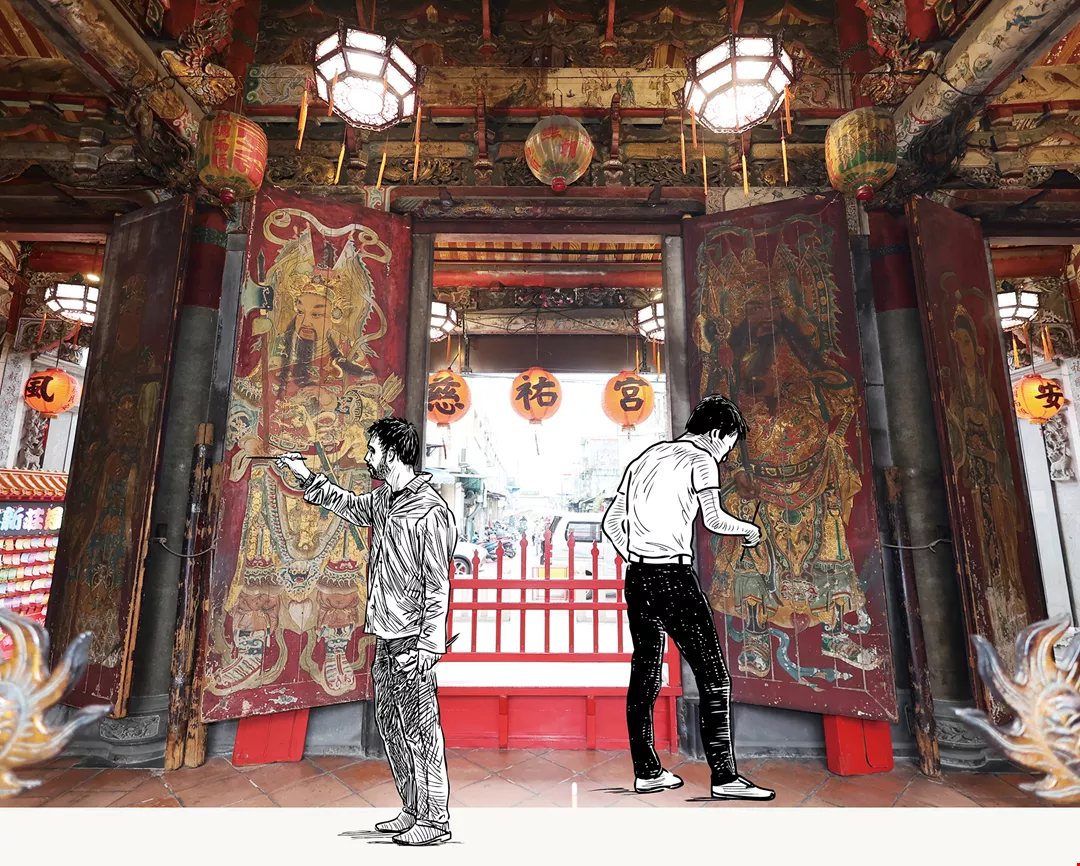
Fortunately, other temples with paintings from rival artists can still be seen today. Kang Noushi guided us on a visit to the Ciyou Temple in Xinzhuang, a temple steeped in tradition that has works by both Chen Shouyi and Huang Chenbang. Upon entering the temple, we immediately saw the door gods Shen Tu and Yu Lei on the central doors of the front hall. Despite the strikingly different styles of line and color, and the weathered texture of the wood, the undying spirit captured by the two painters shines through.
The competitive model allows two artistic visions to meet and resonate with each other on a single door, recreating the moment when the painter’s inspired brushwork achieved something extraordinary that time cannot erase.