A Nostalgic Look at Classic Chinese Films
Hsieh Shu-fen / photos courtesy of the National Film Archive / tr. by Jonathan Barnard
April 1993

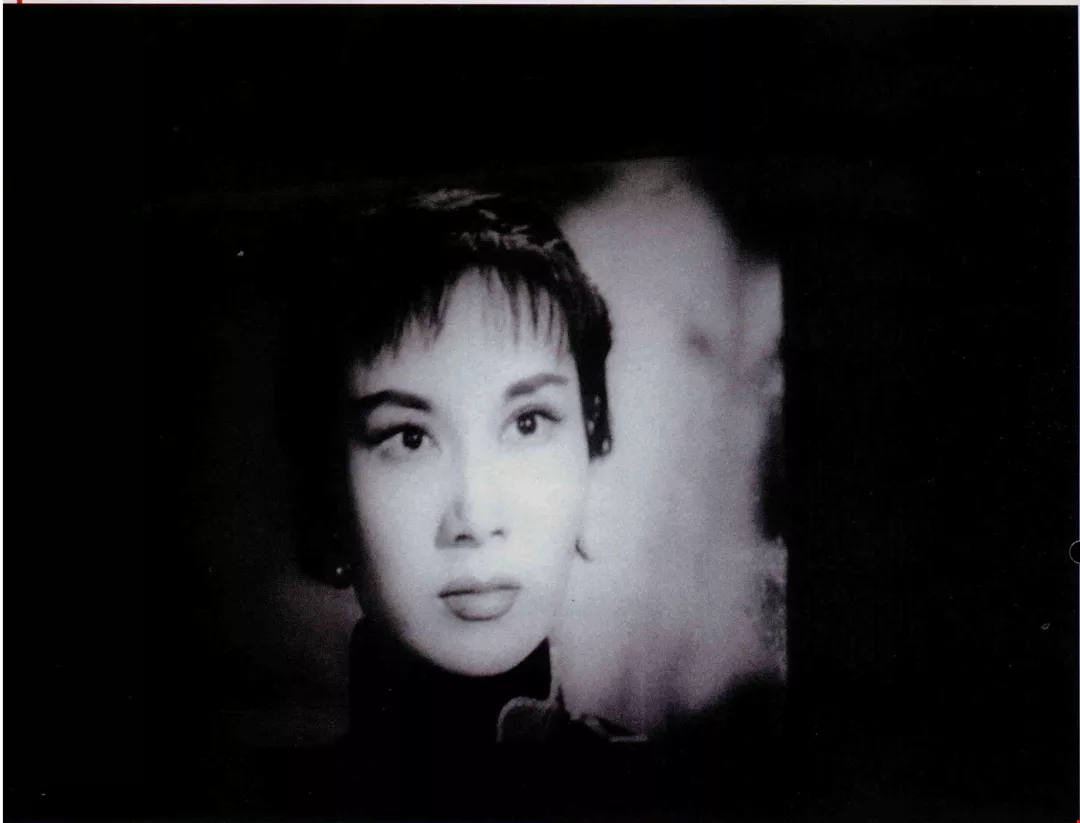
Li Li-hua's performance in Little White Cabbage took the world by storm and is still nostalgically recalled by film fans today. It also made her one of the era's highest paid stars. (photo by Huang Lili)
When the R.O.C. film The Wedding Banquet won top honors at the Berlin Film Festival, another feast for film lovers was opening back home. The films on offer here were black and white: pure and clean, yet warm and sweet.
After a spell of cold and wet weather, the sun finally shows his face. On this fine clear and warm morning, columns of the middle-aged and elderly boldly march through the teenage crowds in Taipei's West Gate district. Their white hair flickers under the winter, which is bright but not burning. Their faces brim over with laughter and their eyes have the romantic sparkle of the young.
Streaming in from all directions, they gather in a large hall, where they settle into their seats. Like children waiting for a magician to unveil a mystery behind a black curtain, they can't suppress their excitement, and they look in every which way and whisper to their neighbors.
Finally the magician makes his appearance. A beam of light takes hold of everyone's attention and sends shadows dancing on the screen in front of them. Slowly the indistinct and rough forms take shape and gain focus, and the audience is absorbed into a world of shadow and light. In a trance they are projected through a deep, dark time tunnel and their grey hair turns black, their shriveled skin youthful and taught, and their cloudy eyes sparkling. Here their bodies' movements are lithe and sharp and their feet have an itch to get up and tango.
Can you really go back in time?
Does youth come a second time?
Were the images in front of their eyes real or imaginary?
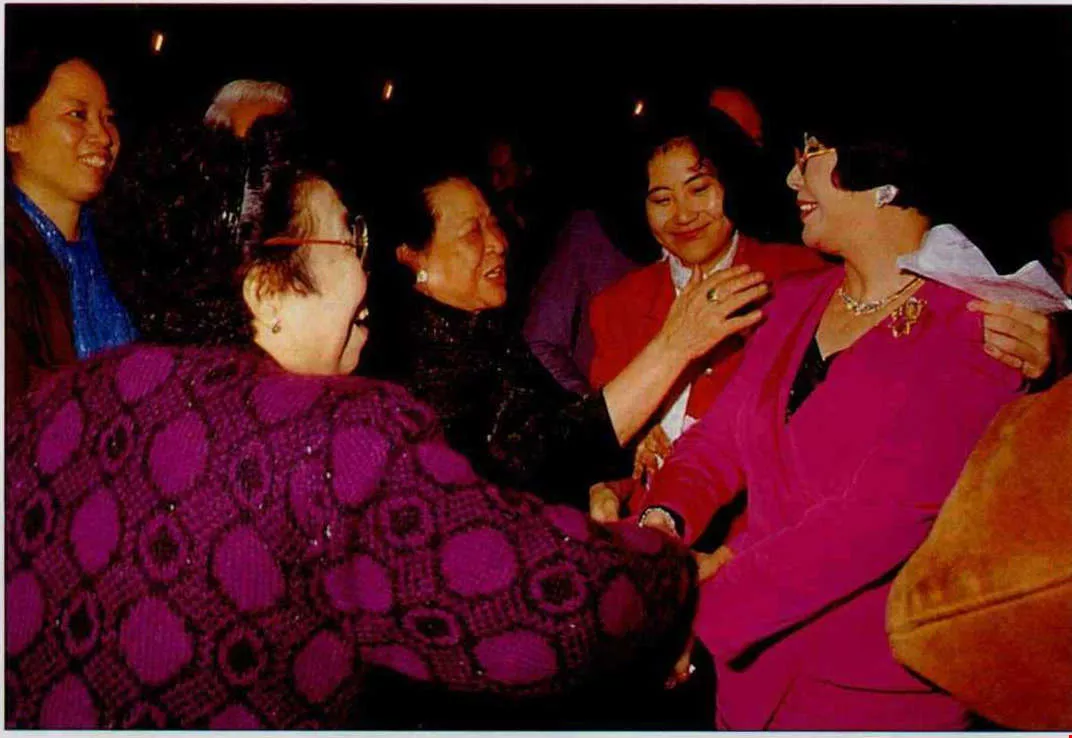
Li Li-hua, the evergreen of the silver screen, hosted the opening ceremonies of "Warmth and Joy--The National Film Touring Exhibition." (photo by Huang Lili)
The Magician's Book:
It's imaginary but it's also real. This "Magic" came from the National Film Archive, and the props are 15 old black and white films. After 30 years the images are being rescreened. It's like they pushed a time switch, unleashing a flood of memories of youth and struggles.
That Mrs. Kuo sitting in the middle with three of her girl friends has gone back to the fifties, to when they just arrived in Taiwan with their husbands. "At the time, how we missed our homes in the mainland!" she says. "But there was no way to go back. The scenery in the movie Gold Phoenix was so reminiscent of my home town that my girlfriends and I saw it seven times--every time staring intently and then crying and hugging."
"When I saw Li Li-hua's Little Cabbage," recalls a 70-year-old gentleman named Sun, "I was still in Korea, only 30 years old. At that time, the international situation wasn't stable. I considered coming to Taiwan, but I couldn't make up my mind. Then I saw her Red Bignonia in the Sea and I was sure: I wanted to go back to a place with Chinese people, get married and start a career. And now I have grandchildren here in Taiwan." At the beginning of Small Cabbage, there is a scene when a small girl turns around and she suddenly becomes a grown women. Today it is the same for Mr. Sun: it's hard to believe that 40 years have passed.
A middle-aged jeweler named Cheng sits alone in the corner, resavoring the flavors of his teenage days, reliving those memories so deeply etched. Once again he enjoys the flirting, the anger and the laughter of Lin Tai, Yu Min, Ke Lan and Yeh Feng.
And there in the front row is Mama Pei, who cane all the way from Kaohsiung. As soon as Hsiao Fang-fang in the The Record of Hardship and Wandering began to sing, "In the world, only Mama is good. A child without a mother is like a blade of grass," she was back at the movies with her classmates in grade school, all sniffles and sobs.
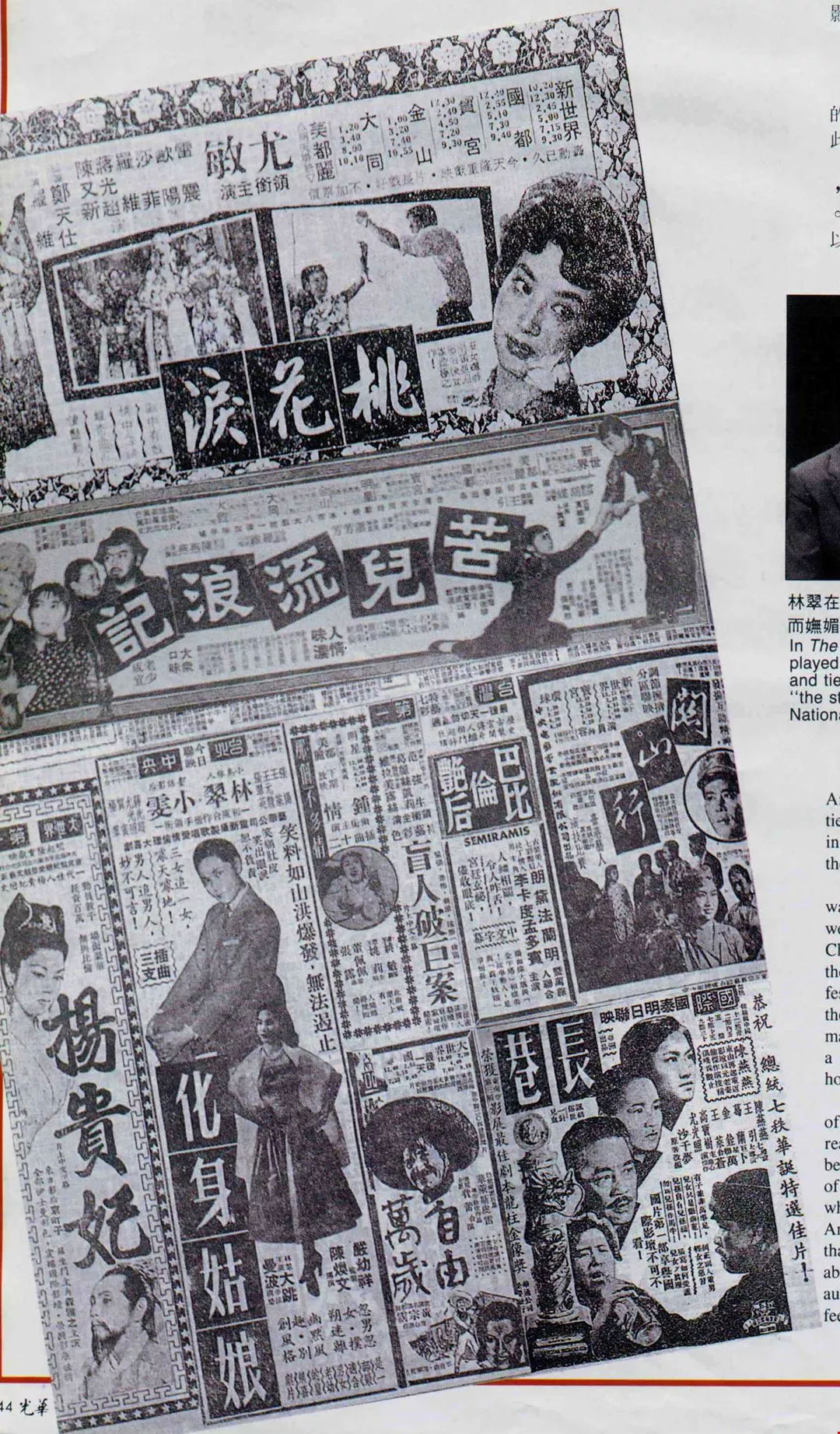
In The Transformation of the Woman. Lin Tsui played a Man. What a figure she cut in a suit and tie! The performance gave her the moniker, "the student lover." (photo courtesy of The National Film Archive)
That age of wandering:
Why are these blurred films with poor sound and less than startling plots so able to unleash this torrent of longing for days gone by?
These 15 films, selected by the National Film Archive, were all Hong Kong films from the fifties and early sixties. At that time, the film industry in Taiwan had yet to rear its head, so the bulk of the Mandarin films were from Hong Kong.
"The fifties was a time when the whole world was frozen in a Cold War stalemate, and here we were fervently opposing the communists in mainland China and Russia," said Ray Jiing, the director of the National Film Archive, which sponsored this festival. "The country had been split apart, and for the many people who fled the turbulence on the mainland for Hong Kong and Taiwan, there was a sense that they would never be able to return home, and this left a bruise on their psyches."
With this kind of atmosphere, most of the movies of the time neither discussed politics nor described real problems. They turned their focus on the beautiful rural scenery of China and the vain world of Shanghai and Hong Kong, There were comedies, which gave people a happy trip to never never land. And there were tear-jerking tragedies, saying all that could be said about the bitter and the sweet, about separation and reunion. These allowed the audience to release all of the sad and melancholic feelings they had suppressed. There at the movies, people were able to release their holds over thoughts of home and forget the exhaustion and wandering of their real lives.
When real life is exhausting and depressing, people need room to weave dreams. Caught up in the nineties, in the midst of all this rapid change, we need our memories to dream old dreams and serve as a record, an eyewitness of that age.
The writer Hsi Sung says that the actors, costumes, sets and props of old movies all have the charm of old calendar photos. Many among them may strike modern audiences as clumsy. And yet, among this clumsiness, one sees the kindness and naivete that generation put its trust in.
In fact, it was a golden age for the Chinese silver screen. The dashing appearances of the stars, the direction and the scripts all had their special places, and today they still charm audiences.
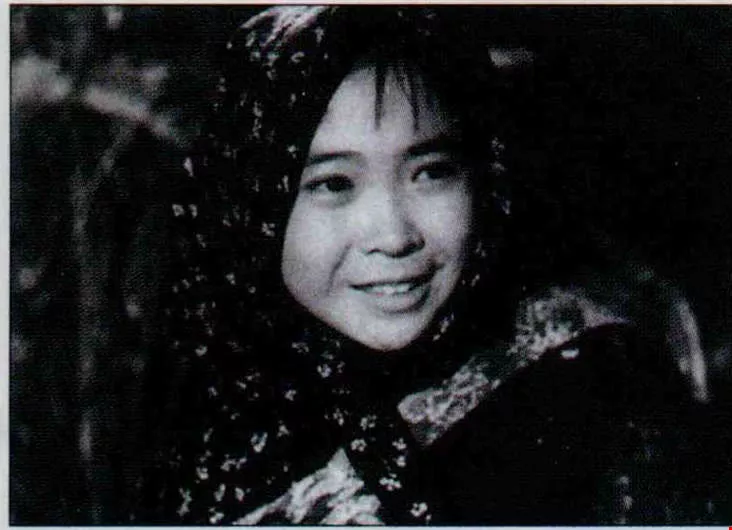
Does this little waif look familiar? It's Hsiao Fang-fang, who's still active in the world of films. Many a tear fell for her rendition of "In the World, Only Mama is good.".
Beauty on parade:
When someone mentions the movies of that age, the well-defined features and bright eyes of the leading ladies come to mind first. Li Li-hua, Lin Tai, Chung Ching, Ke Lan, Yu Min, Yeh Feng, Lin Tsui. . . all were idols worshipped by the fans.
"This was perhaps because of the topics and the types of the movies," says critic Liang Liang. "The dramas of the fifties almost all revolve around love and family morals. Hence they provided a lot of space for actresses. Actors largely stood in the background and helped illuminate the leading ladies."
The stars had their own particular image. "In my first film, the director cast me as a melancholic man of letters with a gentle and scholarly appearance. For promotional purposes, all of the actors of that day needed a nickname. The one they picked for me was 'Melancholic Young Leading Man,'" says Lei Chen, who came to Taiwan for the film festival. After he got this nickname, the gentle and sad characters he usually played made him the dream lover of more than a few girls.
Li Li-hua also came back to Taiwan to participate in the festivities. As beautiful as ever, she stirred up the ardor of the fans once again. With charming poses and exquisite bearing, she has appeared in more than 120 films. Her roles were varied. With an impressive air about her, great looks and excellent acting skills, she was dubbed "The Beauty of a Thousand Faces." Take the star-crossed beauty of Cabbage, or the performer with an appearance as cold as a reptile and inner passion like fire of Red Bignonia in the Snow, or the women struggling between traditional ideas of womanhood and free love in Fire of Love. She got the essence of her characters perfectly.
Lin Tai got hot playing a village girl in Tsui Tsui. With big eyes, thick eyebrows and a wild and lively personality she was named "The Beauty of the Kingdom." "Mambo Maiden" Ke Lan got her moniker on the double whammy of good looks and singing and dancing skills; Chung Ching had the nickname of "Wild Kitten;" Lin Tsui was "student lover;" and Yu Min was the "The Young Beauty of the silver screen."
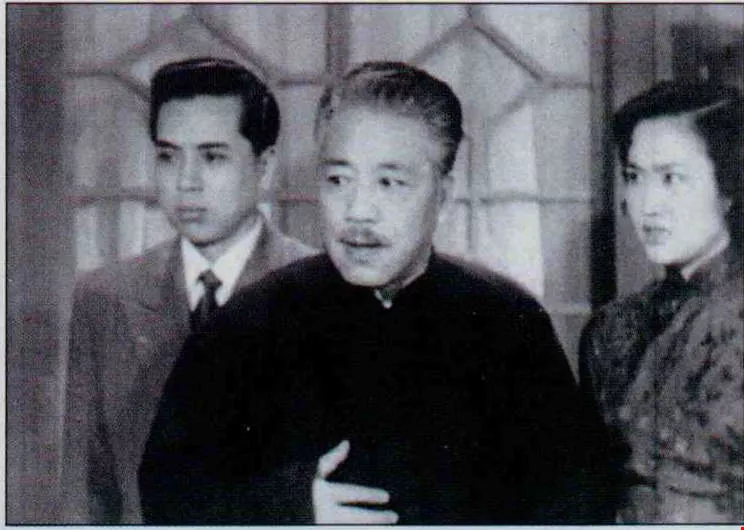
A movie with a message, Long Alley challenged age-old Chinese male chauvinism.
No music, no movie:
"For the hot stars of that age like Li Li-hua, their fee for one film ran as high as HK$75,000," says Tsai Kuo-Jung, the author of Chinese Modern Film, explaining the paramount importance of the women. "Leading men like Wang Yin and Huang Ho would get about HK$10,000. For most pictures the entire production costs would run to about HK$160,000-170,000. The fee for the female lead would make up about 45 percent of that."
He points out that although their status as idols made them the best box office guarantee, the atmosphere created by their huge fees would often lead to cutting other production costs to the bare bone. As a result the quality of movies suffered.
Another characteristic of these films was all the music. It was almost as if you couldn't make a movie without songs. Of the 15 films in this festival, whether set in the countryside during the early days of the Republic of China (Golden Phoenix, Fish Song or Peach Blossom River) or set in the Hong Kong of the day (Express Train, The Singer's Fan and The Women's Transformation), the songs in these musicals all became classics. When the songs hit the screen at the festival, everybody would chime in--sometimes soft and under their breath and sometimes belting it out like a chorus.
"Early movies would advertise themselves as having 'more than ten songs' and tended to use them to replace dialogue," says Liang Liang. "It even got to the point that non-musicals were putting in two or three songs to add some spice."
This phenomenon, on the one hand, reflects that people of that time still thought that going to the movies was a lot like going to see a Chinese Opera, he explained. On the other hand it had something to do with the excellent singing voices of most of the female stars of the day. Chung Ching, Yeh Feng, Ke Lan and such actresses as Chou Hsuan, Tung Pei-pei, and Kung Chiou-hsia were all major Mandarin singing stars. In the films in which they played the starring roles, how could you not let them break into song?
Furthermore, the people of Taiwan and the overseas Chinese communities of Southeast Asia, who made up the principal audience for Mandarin movies, all were mad for song. For marketing considerations, Hong Kong movie companies would of course cater to their pleasure and try to put in as many songs as possible.
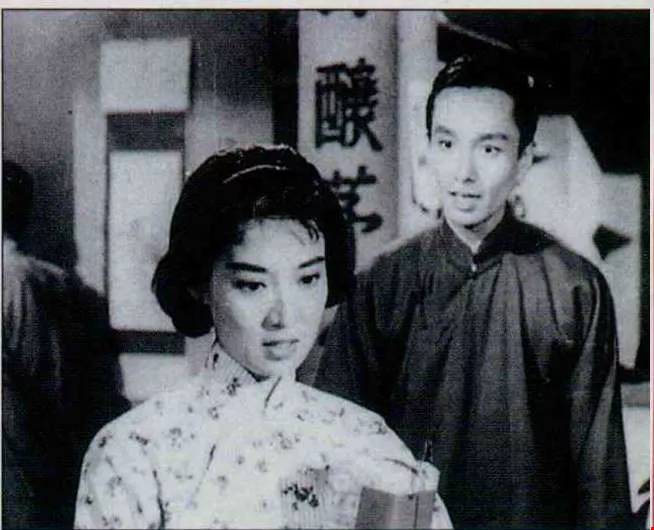
The Tears of the Peach Blossom was a representative of the early films that combined tragedy and comedy, separation and reunion, ambition and tenderness.
Plain old folks helping each other:
The movie industry in Hong Kong from early on started to move in the direction of consolidation and elimination, a trend that resulted in there being only a few powerful studios battling it out. But even though most of the best writers, directors and actors worked for the big studios, a few small and mid-size studios were able to overcome the odds to make films that held their own against those of the big boys. This was particularly the case in the fifties. By the sixties, when Shaw Brothers became the only major studio, there were many fewer of these films.
In this festival, not one of the films was the work of such big studios as Tachunghua, Yunghua, Shaw Brothers or Tianmao. The only six from a relatively large studio came from Hsinhua. The remaining were Asia's Long Alley and Gold Robe, Kuofeng's The Record of Hardship and Wandering, East Asia's The Red Begnonia in the Snow, Yihua's Transformation of a Women, Wanhsiang's The Singer's Fan, and finally All Over Town from Independent, a Taiwan studio. These were productions by independent studios that made few films and had little capital. But their lineups of writers, director and actors had definite standards. Hsinhua's Peach Blossom River, for instance, started the craze for musicals in that era. "While there wasn't as much money in movies back then," Liang Liang avers, "the working attitude and the film topics were more serious."
For example, Gold Robe, starring Ke Lan and Chen Hou, depicts a poor couple who get in an argument over a fashionable overcoat. Finally, the wife falls from the clouds to realize the good points of her husband. All Over Town, Long Alley, and The Record of Hardship and Wandering all describe ordinary folks helping each other live through good times and bad.
"In Modern China 'Art for the people's lives' has been a belief held by artists of all kinds, and this principle was held dear by writers and directors in the fifties," says Ray Jiing. "And so the topics of their films tended to seek after human sentiment, emphasizing traditional ethics and the functions of civilizing the masses." Looking at them today, they may seem to be a bit old fashioned, but in that period of political instability and refugees, the audiences of Hong Kong and Taiwan were in the mood for social order in the movies. And what they got was comfort indeed.
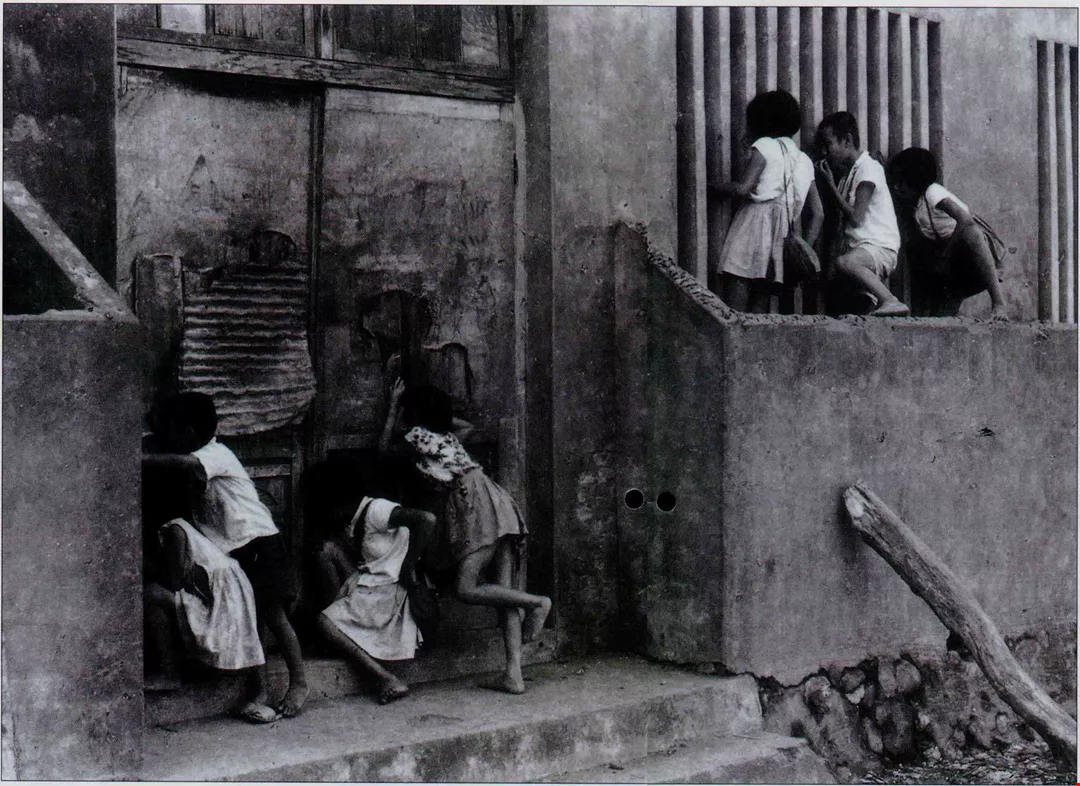
Back when times were hard, seeing a movie was a luxury, an eagerly awaited treat. That's probably why they're still so fresh in the mind. (photo courtesy of Lin Chin-yun)
Sending Rescue Signals:
Besides putting on this festival for nostalgic purposes and for looking at the past to reflect on the present, says Wu Chung Li, the deputy director general of the Government Information Office, "We also wanted to give a message to society about the problem of preserving cultural resources." The movies are an integrated manifestation of the arts and the people's life in miniature.
In reality, the original negatives of the black and white films screened by the National Film Archive at this festival had long been in a state of total decrepitude. Hence, the archive had to find copies, from which they clipped together a new master that was used to make copies for showing in theaters. But because they were 30 to 40 years old and hadn't been stored properly, these 16 millimeter copies had become distorted, mildewed, cracked, torn and blurred. This made the restoration process extremely difficult.
Take Little Cabbage, for instance. "You couldn't even see the characters' noses," says Tung Yueh-chuan, who established Hsinhua Studios with her husband Chang Shan-kun. The National Film Archive took the films to a developing company, which gave them an ultrasonic cleaning, repaired the sections that were ripped and falling apart and then used all sorts of special printing machines and chemical techniques to blow up the negatives one frame at a time. Now the films look pretty much like they did back when they were released. All told, in personnel and materials, it cost about NT$400,000 to have these films preserved for another 50 years.
"There are another 680 films that are still slated for urgent recopying," says Ray Jiing. "They are all extremely old, and their negatives are in a total shambles. Within five or ten years they will have deteriorated too much, and there won't be any way to save them."
In weaving dreams, movies have made history.
[Picture Caption]
p.42
Li Li-hua's performance in Little White Cabbage took the world by storm and is still nostalgically recalled by film fans today. It also made her one of the era's highest paid stars. (photo by Huang Lili)
p.43
Li Li-hua, the evergreen of the silver screen, hosted the opening ceremonies of "Warmth and Joy--The National Film Touring Exhibition." (photo by Huang Lili)
p.44
In The Transformation of the Woman. Lin Tsui played a Man. What a figure she cut in a suit and tie! The performance gave her the moniker, "the student lover." (photo courtesy of The National Film Archive)
p.45
Does this little waif look familiar? It's Hsiao Fang-fang, who's still active in the world of films. Many a tear fell for her rendition of "In the World, Only Mama is good."
p.45
A movie with a message, Long Alley challenged age-old Chinese male chauvinism.
p.45
The Tears of the Peach Blossom was a representative of the early films that combined tragedy and comedy, separation and reunion, ambition and tenderness.
p.46
Back when times were hard, seeing a movie was a luxury, an eagerly awaited treat. That's probably why they're still so fresh in the mind. (photo courtesy of Lin Chin-yun)
p.48
After these reels of film are restored, they'll serve as visual evidence of an era. (Sinorama file photo)
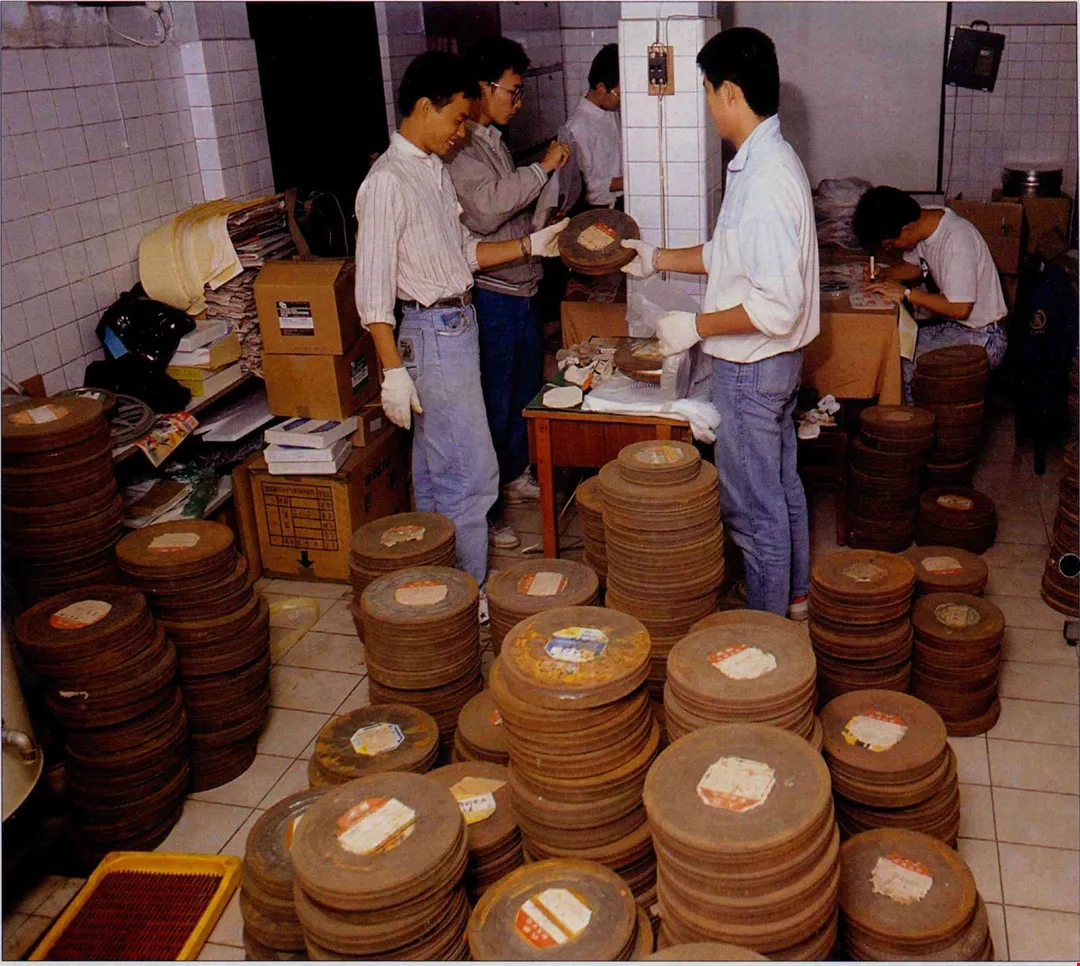
After these reels of film are restored, they'll serve as visual evidence of an era. (Sinorama file photo)


