Eternal Youth, Unbounded Passion--Yu Kwang-chung
Su Hui-chao / photos Chuang Kung-ju / tr. by Jonathan Barnard
January 2010


"What do the hazy contours of a life leave behind? / Apart from sunsets left to the Strait / Apart from a lighthouse left for the wind and waves / Apart from a century that can't be returned to / Left to a history that can't be written / What remains? / The hazy contours of a life
--"A High Window Overlooking the Sea"
What remains?
Turn back the clock to October 2, 2008-five days before Yu Kwang-chung's 80th birthday on October 7, which was also the Double Nine Festival by the Chinese lunar calendar. Members of Taiwan's cultural and literary community gathered to mark the occasion. "When celebrating an important birthday, glory shines throughout the land," reads the invitation. "A Poetic Gathering-Celebrating the 80th Birthday of Yu Kwang-chung." Lee Yong-ping, director of the Taipei City Department of Cultural Affairs, and Perng Ching-hsi, president of the Taipei Chinese Center, International PEN, had sent out the cards.
Among those who have been writing for 60 years, who is still in his prime? Among those writing for 60 years, who still finds an eager market for his work? Among those who have been writing for 60 years, who still stands tall amid the literary landscape and is "kidnapped" time and again to attend literary gatherings, whether in Taipei, Shanghai or Singapore?
The answer to each of the above questions is Yu Kwang-chung. The gathering of Taiwan's literary and artistic community for his birthday celebration was unprecedented and may never be seen again.
Yu's birthday present to himself was the publication of three new works: the poetry collection Goddess of Lotus Root, a collection of essays A Smiling Toast to Heaven, and a translation of Oscar Wilde's play A Woman of No Importance. New editions came out for several of his earlier works: The Untrammeled Traveler, Listen to the Cold Rain, Associations of the Lotus, The White Jade Bitter Gourd, and Look Homeward, Satyr. The academic community paid its respects via Poetry of Divine Blessings: Festschrift in Honor of the Eightieth Birthday of Professor Yu Kwang-chung, edited by Francis K. H. So. Then there were collections of Yu's best poetry and essays edited by Chen Fang-ming, as well as several other books on Yu and special editions of periodicals devoted to him.
The Chinese literary community spent a year in preparation for that day. Apart from the aforementioned publications, an international symposium on Yu's impact on 20th-century poetry was also held on the mainland, and an academic conference was held in Taipei. Meanwhile, National Sun Yat-sen University in Kaohsiung and the Chinese University of Hong Kong put on exhibitions of Yu's handwritten manuscripts and other related artifacts.
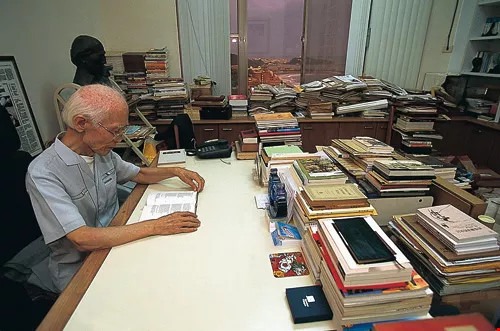
Yu's office faces the sea with its back to the mountains. Everything on his desk is tidy and in its proper place. Here, where Yu pursues both scholarship and literature, a quarter century has passed in the blink of an eye.
After celebrating his birthday early in Taipei, Yu and his wife Fan Wo-tsun flew to Nanjing for the Double Nine Festival. It was a homecoming for Yu, since he attended elementary school, high school and university there. There is an "Yu Kwang-chung" class at his old elementary school, and Nanjing University published Nostalgia in Four Rhymes.
In Chinese communities around the world people are familiar with lines from his poems: "Give me a ladle of Yangtze River water, ah, Yangtze River water." Or "When I was young, nostalgia was a tiny, tiny stamp." In which case, what does remain from the hazy contours of a life? Are 1000-some poems enough to soak up the water of the Taiwan Strait? Are 1000 essays and works of literary criticism enough to construct a lighthouse? Most importantly, Yu, as he heads toward the milestone of 90, is still pressing forward at top form and continues to create.
You all seem to think you've nailed the lid on my coffin and can pass final judgment on my accomplishments. In fact, I want to write until I'm 90. Consequently, the assessments you are making today will be out of date in five years. --Yu, in an interview with Chen Fang-ming
Every day he drives half an hour from his home on Kaohsiung's Heti Road to his office on Xizi Bay. First he always disconnects his phone to avoid disturbances. He still owes Chiu Ko Publishing a book of essays, and he is translating a collection of Keats' poetry that is scheduled to be published in 2010.
For 60 years, he threw himself, body and soul, into literature. His bony frame bears witness to the toll that his accomplishments have taken on his body.
Double Nine is an autumn festival and holds symbolism for warding off evil and natural disasters. That being the case, placing a dogwood branch in a satchel, drinking of chrysanthemum wine and climbing mountains also have symbolic value. Poetry has vast powers too: it can ward off evil, provide a path to transcendence and prevent disasters. The Child of Dogwood says, this is my chrysanthemum wine and this is how I climb a mountain. -"How Long Is Double Nine?"
Yu is the "Child of Dogwood." Fu Mengli chose that as the title of her biography of Yu, which was published in 1999.
Yu Kwang-chung's handwriting is as neat and composed as his person, and periodicals often publish copies of his handwritten poems. The photos opposite show a handwritten copies of his translations of poems by the English poet John Keats.
On the Double Nine Festival in 1929, Yu was born in Nanjing to a family that hailed from Fujian. In 1937, when war broke out between China and Japan, he began his life as a refugee. First he fled with his mother to Shanghai and then he moved to Chongqing to live with his father. After Japan was defeated, he returned to Nanjing via Sichuan. He was accepted to both Peking University and the University of Nanking. After enrolling at Nanking, his uncommon literary talent burst forth like a volcano in his first poem, "Sand Thrown to Float in the Sea": "The stars have disappeared / The sea no longer roars / The stars have fallen asleep. The sea too has fallen asleep." He was then 19, sitting by his second-floor window and gazing toward the soft blue-green of Mt. Zijin in the distance, and the poem flowed from the tip of his pen.
"The callow youth that wrote that poem could never have imagined that 60 years later, when he was 80, he would be still be sitting at a window writing poems-but, instead of mountains, he'd be gazing upon the water of the Taiwan Strait." Yu thus exclaimed on the eve of his 80th birthday as he wrote out that poem that he had written when he was just 19.
In the years that followed, as civil war engulfed the nation, Yu and his mother fled Nanjing for Shanghai, and then continued south to Xiamen, where he transferred to the department of foreign languages at Amoy University. It wasn't long before he moved again, leaving for Hong Kong with his parents and missing school for a year. In 1950 he came to Taiwan and passed an equivalency exam to enter National Taiwan University's Department of Foreign Languages and Literature as a junior. There he became a disciple of Liang Shih-chiu. When he was 22, those restless days of uncertainty had finally come to a peaceful close, and the literary stirrings that he had lost in Hong Kong because of his year away from school came once again to the fore. Yu was "destined to live as a southern poet"-"to develop amid the wet gusts of the subtropics."
Twice Yu went to America. The first time was in 1959 to get a master's in fine arts at the University of Iowa. Then in 1964, he earned a yearlong Fulbright scholarship from the US Department of State, which he spent touring the United States and giving lectures. In Taiwan, he taught successively at National Taiwan Normal University and National Chengchi University. Then in 1974, he accepted a post at the Chinese University of Hong Kong. He remained there for 11 years, and Hong Kong became the city he had lived longest in apart from Taipei. He had never expected that when he returned to Taiwan, he would go south of south and find a job at Kaohsiung's National Sun Yat-sen University, to "Let Spring Start from Kaohsiung."
Now in 2009, after living in Kaohsiung for 24 years: "Taipei has gradually grown distant and strange for me." Yu smells a southerner's scent emanating from his palms, and he has written more about Kaohsiung than anyone. Currently a "chair professor" at National Sun Yat-sen University, he teaches a translation class for graduate students and is one of the university's great treasures. The study he has facing the Taiwan Strait with its back to Mt. Chai will be preserved forever.
And his silver hair and bony frame will forever be visible in the silver medallion of the moon's reflection on sea.
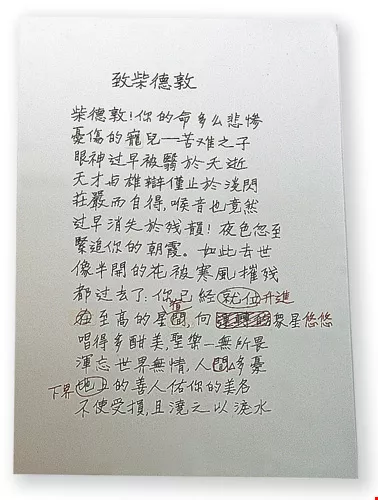
Yu Kwang-chung's handwriting is as neat and composed as his person, and periodicals often publish copies of his handwritten poems. The photos opposite show a handwritten copies of his translations of poems by the English poet John Keats.
The geography of Yu Kuang-chung's literary world is charted via the longitude of poetry and the latitude of essays. His artistic output, created over more than half a century, is extraordinarily rich and substantial. More than merely the astonishing lifetime accomplishments of an individual writer, it has become an important indicator of literary creation in Taiwan. The expansive atmosphere conjured by his pen is a projection of his rich and fertile life, and it also captures the essence of the age. From last century to this century, from his youth to his compassionate old age, he has never experienced a period when his work in at least one of those two genres isn't bearing ample fruit. With regard to the tremendous variety and output of his poetry and essays, he has few rivals-whether among his contemporaries or followers. --Chen Fang-ming, from "Lines of the Left Palm Magnificently Unfolded," the foreword to The Best of 60 Years of Yu Kwang-chung's Essays.
What is the source of literary creation? Yu cites Goethe, who said that all of his poems were rooted in what he saw and experienced. He said he would write about whatever he encountered-for instance, attending the funeral of a friend or being spurned in love. There was no need for these matters to touch his deepest inner desires or to complete some vast philosophical structure; they were simply what he experienced in life. Yu believes that Goethe likely made those comments as a result of getting into a debate with someone. "Nevertheless, that's basically the way it is for me. Creativity comes from life. I write down observations about the vicissitudes of my life...."
But how is it possible to write essays that are so magnificent in their many layers of complexity by "staying close to life" when seeking literary inspiration? How is it possible to create poetry of such refinement and perfection?
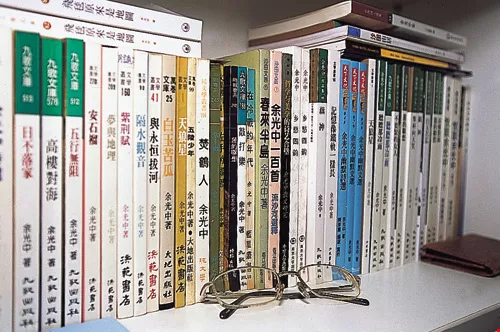
With poetry his longitude and prose his latitude, Yu Kwang-chung's poems, essays, criticism and other works form an impressive literary topography.
Yu has several ways of answering these questions himself. First of all, he defines himself as being one-third scholar and two-thirds writer. The writer part of him reads books willy-nilly as he happens upon them, but the scholar in him adopts an entirely different approach. Take literary history, for instance. He has studied it all, whether he is enamored of the period or not.
Secondly, in their youth people of his generation read many classical Chinese novels and built their foundations in Chinese literature from them. "Although ancient Chinese novels are difficult mixtures of classical literary and vernacular language, novels like The Scholars can be very telegraphic in their use of language, dispensing with the use of basic Chinese particles such as de for long sections. Nonetheless, they are able to convey narrative and emotion." Starting with Chinese classical novels, and then absorbing Western cultural influences, these were the foundation on which Yu would construct his works.
Thirdly, there is the attitude that one takes toward writing.
In the process of his searching and development as a writer, he was exposed to a mixed group of "friends" both classic and modern, Chinese and Western. Some of these friends have become almost "family" and have left a deep imprint on his thinking. Among those that Yu considers "family" are such influential creative talents as Wilde, van Gogh, and the Beatles.
As Yu's "family member" Wilde put it, he needed talent to pass his days, genius to create his writing. Yu has completely the same attitude toward his life and work: using his talents to pass his day, applying his genius to his writing: "You can't be dramatic in the way you lead your life. That would make life too exhausting!" So his lifestyle is very ordinary. He dresses like a bureaucrat and carries around his papers in a beat-up old briefcase. He's moderate in what he eats and drinks.
Everyone says that the writing reflects the person, but that's not necessarily the case.
"Sometimes writing is compensatory-where the writing doesn't reflect who the writer is but rather who he would like to become," Yu explains. When people get to know Yu, they tend to regard him as very Confucian-solemn and serious, not garrulous or humorous. Yet a man of this character writes works that are passionately bold, unrestrained, imposingly vast, and at times imbued with a remarkable sense of humor. These qualities are of course the result of applying his "genius."
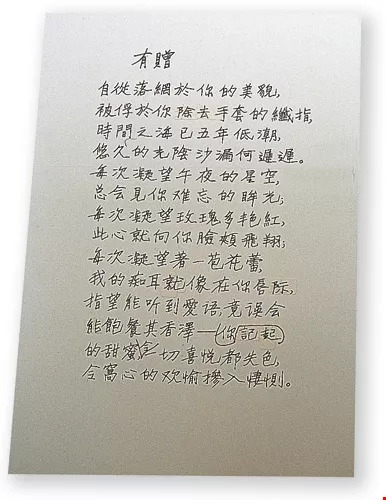
Yu Kwang-chung's handwriting is as neat and composed as his person, and periodicals often publish copies of his handwritten poems. The photos opposite show a handwritten copies of his translations of poems by the English poet John Keats.
Fourthly, there's the issue of a writer's technique.
"What makes Chang Hsiao-feng so unusual is that she is one of the few writers in Taiwan not to be influenced by Eileen Chang," Yu says, darting off into an uncertain direction before revealing his intent: "And I have certainly not been influenced by Eileen Chang!"
In Yu's analysis, the works of Eileen Chang and Qian Zhongshu became classics thanks to Hsia Chih-tsing's stamp of approval. "Hsia's excellent judgment of talent came from putting no stock in the leftists or modernists." Qian Zhongshu's works from the 1930s were created so long ago. In the 1960s Eileen Chang became the model for contemporary writers in Taiwan, and one after another these writers entered the "Chang school."
Yu admires Chang, but he's unwilling to join her school. He has no intention of emulating his contemporaries. His work has achieved its muscularity through his own character and his quest for his own style. Consequently, when turning his gaze backward, he absorbed Liang Shih-chiu and Qian Zhongshu but skipped Eileen Chang and completely ignored the insipid writing of the May Fourth Movement. In looking backward, he set his sights on something more distant. Eventually, he says, "I returned to the eight great writers of the Tang and Song dynasties. I returned to Mencius and The Record of the Grand Historian. I returned to the entire literature of the Chinese people."
"I threw myself into writing essays to try achieve a masculine pen and strong and rugged style," Yu once said. When he made that statement, it was in opposition to the May Fourth Movement. "In all honesty, the [insipid] writing style of Zhu Ziqing and Bing Xin... doesn't do anything for me. It's like a sketch or water colors, it lacks substance. Why can't writing be something strong and masculine? Why can't it create magnificence?"
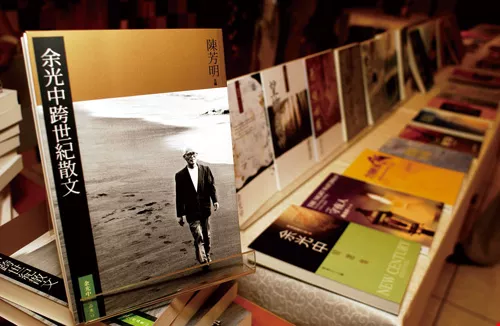
Yu's office faces the sea with its back to the mountains. Everything on his desk is tidy and in its proper place. Here, where Yu pursues both scholarship and literature, a quarter century has passed in the blink of an eye.
Therefore, he has left a few manifestos about art for those who study him:
Here's one: "The kind of essay I'm seeking should have sound, color and light. It should have the sweetness of wood and the boisterous bang of a big drum. It should move freely through the spectrum of a rainbow, and there should be a marvelous light illuminating what's between the lines." (The Left-Handed Muse)
Here's another: "In the furnace of Chinese language I want to forge a magic pill. I'm trying to shrink Chinese language, flatten it, stretch it, sharpen it, take it apart and reassemble it, fold it and stack it up, test its speed, density and flexibility. (Associations of the Lotus)
In 2009 Wang Ding-jun published his memoir The Literary Land, which included important evaluations of Yu. Wang wrote, "Yu Kwang-chung's language takes Western elements (via translation), classical elements (classical Chinese literary language), and local elements (dialect) and smelts them into an alloy with a flexible syntax that is sometimes clipped and sometimes expansive and maintains a galloping style with imagery and rhythm that break new ground rather than uphold tradition."
Yu is equally at home writing both essays and poetry. For his avid readers, Yu-both poet and essayist-represents eternal spring, limitless passion. Without him, their youths would have lacked something vital.

Having written for 60 years but still on top form, Yu gazes upon a literary landscape that he is reluctant to depart and couldn't leave even if he so desired. Yu Kwang-chung's mighty pen is scribing odes to the age.
Can a continent be a nation? / Can an island be a home? / Can a blink of an eye be a youth? / Can a lifetime be forever? --"Jianghu Shang"
Who am I? That's the question that Yu asks time and again.
It's a question he asks repeatedly because he continually moves, and is continually categorized-whether from a geographical or psychological standpoint. For Sixty Years: Selected Poems by Yu Kuang-chung, the editor Chen Fang-ming divided Yu's poems into three periods: Taipei, Hong Kong and Kaohsiung. The impact of the geographic environment on Yu's work is quite apparent. "Every time I change where I live and confront a new topography and environment, it's a test and challenge to my creativity as a writer," he says. "But change is also the currency of creation."
Take, for instance, moving to Kaohsiung. For his first two months there, Yu felt at a loss. Then he gradually settled in and got involved in life there. It gave him inspiration and material for his work. Whether a writer likes a place or not, Yu believes that when you can sit down and write about a place, it means you are settled there. And being settled means that you are interacting with the place and that "in one sense the place has become yours!"
Provence was van Gogh's, Shanghai Eileen Chang's, the Yangtze gorges Du Fu's, Hainan Island Su Dongpo's. What about Yu? Nanjing was once his, Taipei was once his, so were America and Hong Kong. And now? As Yu himself says, Kaohsiung is his. His domain is Qijin's lighthouse and the Taiwan Strait.
"Mainland China is my mother; Taiwan is my wife; Europe is my mistress." But America has no place in his loyalty or affections. "America is a woman I've abandoned"-someone he once loved but no longer has any feeling for or desire to see again. And if Taiwan is his wife, "Taipei is my first wife, Kaohsiung my second."
The complications engendered by moving and these mixed allegiances have time and again caused identity crises for Yu. His own sense of identification is uncertain. Poets say he's an academic, but academics disagree. Traditionalists say he's a modernist, but modernists say he's a traditionalist. He writes about Kaohsiung, and says that's where he's from, yet the city's natives say he's from Taipei. Taiwanese say he's Chinese. And the Chinese say he's a "homesick poet."
"If you start from an ideological standpoint, and focus only on one side of me, intentionally ignoring the other sides, then it's easy to pigeonhole me," Yu says.
Self-explorationIt has been Yu's fate to do battle against fundamentalists and to mix with writers of all ideological stripes. "Probably most people with clear identities are fundamentalists of some sort," he says. "Fundamentalists are happy. Things are simple for them; they have no need to pursue self-discovery."
His life, on the contrary, has been a long difficult journey of self-exploration, a journey on which he couldn't avoid politics. He has constantly challenged himself with political questions. "But that's just creative stimulation."
The relationship of Yu Kwang-chung and Chen Fang-ming became a topic of discussion because they started out as teacher and student and then had a major falling out. For 15 years, Chen, who had gone to America, was on a KMT blacklist and couldn't return to Taiwan.
Literature may have no influence over politics, but politics can certainly influence and distort literature. In 1977 Yu sparked a war of literary theory over Taiwan's Nativist Literature Movement by publishing his essay "The Wolf Nears." He was accused of "opposing nativism" or-to use a more current way of putting it-of "not loving Taiwan" or "selling Taiwan out." Compared with controversial stances that Yu had been taken in theoretical debates about modern poetry, the use of literary versus vernacular language, and abstract painting, Yu's comments made him many enemies-even if he had never equated "nativist" literature with the "proletarian literature" praised by Chairman Mao.
Back then Chen Fang-ming chose to stand amid the ranks of those championing nativism. When he met his former teacher Yu 20 years later, he recalls, "I knew that things could never return to the way they had been, when the master poet and I would read poetry together. Politics, political parties, ideology, and national identification had sowed seeds of impurity in our friendship." There was bitterness when they met again, but "literature must return to being an artistic discipline that is concerned with aesthetic judgments." The impurities in their relationship settled over time, and Chen Fang-ming eventually determined to put it to rest. "When people now ask me who my teachers were, I never hesitate. In literary matters, Yu Kwang-chung is my modernist and also my classicist."
And it's not just Chen Fang-ming. For many second- and third-generation poets in Taiwan, Yu has served as a father figure and model, as someone who has lit the path toward poetry.
And about that battle of literary theory over the "native soil," Yu later would say: "Back then, some people pressed me to make my position clearer, but I thought that would be pointless. The truth isn't necessarily arrived at by arguing more and more. The battle over theory makes it easy for second-rate literary historians to attach labels and divide people into black-and-white camps. But what writer of true accomplishment would rely on wars of literary criticism to find a lasting legacy?"
Belonging only to literatureIn the end he knew who he was, and he no longer needed to fight with himself. But it was another matter when fights came to him. For instance, there was nothing personal in his criticism of the Ministry of Education's policy of reducing the emphasis on classical literature in school textbooks.
When he was 40, he would look upward and ask / Ask the starry sky who he was / Why was he still suffering down here? / Did one of the gods up above / Really have it in for him? / Now, after passing 60 / His mind is no longer consumed by fears and vexations / He long ago stopped quarreling with the constellations / The night has become quiet and gentle / Like a border city during a ceasefire / When his childhood companions are scattered to the ends of the earth / Who, apart from his desk lamp, still casts light upon him / As the story ends --"The Last Half of the Night"
He belongs only to literature. In the city of Changde in Hunan Province, there is a 2.5-kilometer dike along the Yuan River where people have carved poems starting from Qu Yuan from the Warring States period. There are also poems by Luo Fu, and Zheng Chouyu. Yu Kwang-chung has of course not been overlooked.
In that long promenade devoted to Chinese-language poetry, he realizes the promise he made to China in his youth: "China would find glory in his name." When the mainland selected eight contemporary essayists, he was included among the likes of Bing Xin, Ji Xianlin, Jin Kemu, Zhang Zhonghang, Wang Zengqi, and Yu Qiuyu. Chiu Ko Publishing founder Tsai Wen-fu is still convinced that Yu Kwang-chung will one day win the Nobel Prize. At any rate, as Yu himself has said, "Being recognized by one's own people is a writer's greatest honor."

@List.jpg?w=522&h=410&mode=crop&format=webp&quality=80)


