

Throughout April, the Xue Xue Foundation held a special exhibition entitled “Moved Monkey” at Taitung Art Museum to sponsor children’s education. One exhibition space featured the “moved monkeys” produced by some 50 well-known artists, including Lin Hwai-min, Aaron Nieh, and Chien Hsueh-yi; another showcased works from 38 elementary schools in Taitung and Hualien, with seed art teachers leading groups of students in finding inspiration in local colors and painting 1,181 monkeys of their own. With their brilliant colors and bold strokes, each piece is one of a kind, making for a total of 1,181 individual pairings of color and creativity.
This was not just a feast of color for this often overlooked region, it was also another stage in the ongoing search for the colors of Taiwan.
What do we mean by “the colors of Taiwan”? The politically tinged pigments of blue, green, and orange? Perhaps the red, black, and yellow so adored by the Aboriginal peoples? In 2011, the Xue Xue Foundation set up the Xue Xue Colors website, hoping to spark a discussion about just this question with the Taiwanese people.
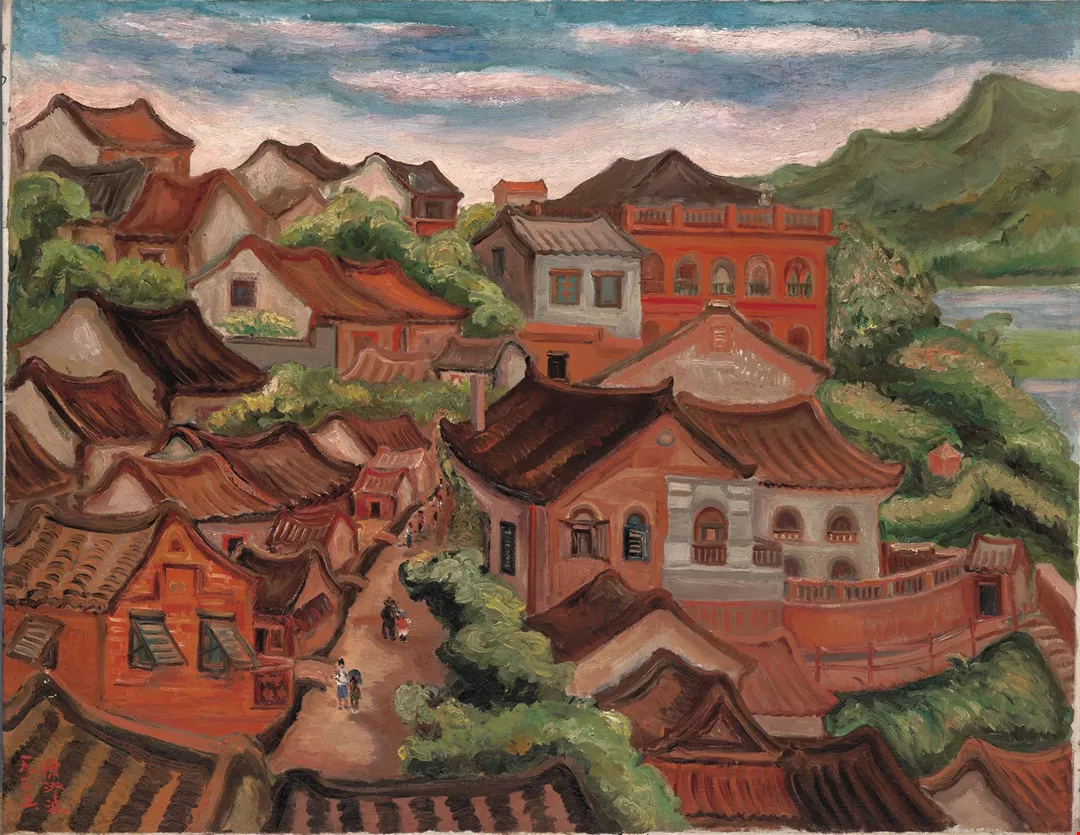
The Xue Xue Colors website hosts a collection of over 8,000 works by 800-plus Taiwanese artists. The color palette shown above presents the color makeup of Chen Cheng-po’s painting Tamsui (left). (courtesy of National Taiwan Museum of Fine Arts)
Seeking the colors of Taiwan
Chromatics—the study of colors—has generally been considered the province of scientists and artists. The Xue Xue Foundation and its chair Hsu Lilin, however, have other ideas. “Everyone has the ability to investigate colors,” says Hsu. A designer by trade, early in her career Hsu helmed Sunrise Department Store’s entry into Taiwan’s fashion circle, and more recently founded the Xue Xue Foundation. She has dedicated herself to fostering the cultural and creative industries, and it is in this role that she has posed the big question of what Taiwan’s colors are.
Color is one of the fundamental elements of design, and design is the key to building a brand. “A city without its own color plan can never really become a ‘design capital,’” says Hsu, and so she created the Xue Xue Colors site, cooperating with national park administrations, domestic galleries, and other organizations with art collections to build a storehouse of distinctively Taiwanese art and photography.
The site’s “Collections” section already boasts over 8,000 works themed around Taiwan, by more than 800 artists. With the permission of the rights holders, color palettes have been produced from each of them.
Xue Xue Colors provides designers and anyone interested in color with a chance to get a close look at these works and to appreciate and analyze them. Users of the site can search by medium, colors, artist, artwork, depository, county/city, theme, and category as they look for chromatic inspiration and develop a keener sensitivity to colors.
Artists’ observations of the colors of nature are presented in their works, and the public can get inspiration for color and aesthetics through appreciating those same works. Designers can also find inspiration for color coordination through the site, incorporating Taiwanese color elements into their creations and introducing them to the wider world.

The Xue Xue Colors website hosts a collection of over 8,000 works by 800-plus Taiwanese artists. The color palette shown above presents the color makeup of Chen Cheng-po’s painting Tamsui (left). (courtesy of Xue Xue Foundation)
Fostering cultural literacy
So why set up Xue Xue Colors?
“Taiwanese education has produced plenty of creators, inventors, entrepreneurs, and researchers, but it doesn’t do anything to make you into an appreciator,” says Hsu. Every creator or brand needs an audience of appreciators who can provide support and facilitate ongoing creation. Recent trends in “flipped” education have attempted to bring all five senses into play in the classroom, getting students interested, helping them become appreciators, and creating the support structure needed by creators.
In terms of training talent, Hsu says she is concerned that Taiwanese society tends to neglect color, which makes it difficult to establish strong brands. Color is at the core of design, and with her design background, Hsu learned early to see design as the key to branding. In the course of their studies, design students learn theories from abroad, overlooking their own culture and so leaving the products they design without cultural roots. Without those roots, is it any wonder consumers feel no attachment to them?
How is Taiwan to engage in exchanges with the world in the 21st century? How can it amaze the world? Only with a strong grounding and literacy in one’s own culture, only by finding what makes Taiwanese culture distinctive, can Taiwan truly make itself seen by the world.
“The colors of Taiwan can only be defined by us as a collective; they can’t be dictated to us by any one person,” Through the Xue Xue Colors website, Hsu says, they are trying to cultivate an appreciation of color among the public while also providing designers with inspiration. The hope is that more people will pay attention to the colors of Taiwanese culture, and to this end, the effort is complemented by “Color Up—A Project for Taiwanese Art and Inspiring Educators.”

The Xue Xue Foundation plays host to “Moved Monkey,” a special exhibition of art by children in northern Taiwan.
Color Up
Although Xue Xue Colors was recommended by the Ministry of Education as an art education tool for elementary and middle schools in 2011, rather than wait for that to make a difference the Xue Xue Foundation began working with the ministry to provide a “Teachers’ Aesthetic Training Workshop” for teachers of arts and humanities subjects. After this workshop, the participant teachers went back to their towns, spreading the seeds of cultural and artistic literacy like dandelion seeds in the wind.
Teachers can use the database at the Xue Xue Colors website (www.xuexuecolors.com) to help their students learn more about Taiwanese artists and their works, while the Xue Xue Colors mobile app enables the children to study the common colors that surround them, collect local colors, and assemble palettes, serving as a source of inspiration for color coordination.
In 2008, the Xue Xue Foundation launched an event to support students, bringing together pieces by Taiwanese contemporary artists themed around color and the Chinese zodiac. In 2013, the foundation invited children to join in with their own observations and discoveries of cultural color.
When the Year of the Monkey rolled around in 2016, famous artist Tsong Pu’s “moved monkey” was used as the plain canvas upon which children could explore color. The different cultural color palettes collected from around Taiwan were used as the sources for the colors on these monkeys, putting on display each region’s own particular “colorscape.” A student from Neihu in Taipei, for example, used “mouse gray,” symbolic of high technology, and “cloud blue,” representing cloud technology, as the base colors for his piece. Another student, from Matsu’s Dongyin Island, drew inspiration from her surroundings, using the earthy brown of traditional buildings, the white of the Dongyong Lighthouse, the dark gray of the tail feathers of the black-tailed gull, the brilliant blue of the bioluminescent “sea sparkle” plankton in the waters around Matsu, and the distinctive purple of the flowers of the locally native tie-dye surprise lily (Lycoris sprengeri). Taken together, such collections could be considered as making up the colors of Taiwan.

In the White Space of the Xue Xue Foundation, Swedish–Chilean artist Anton Alvarez’s How Long Is a Piece of Thread is on display, the brilliant colors creating a stark contrast with the minimalist space.
Art transforming life
The Xue Xue Foundation selected several of the more outstanding works produced by these children to display in an exhibition, and in 2016, some 4,336 pieces will be exhibited in galleries and art museums in Taipei, Yilan, Kaohsiung, and Taitung.
Xue Xue Foundation vice chairman Chang Chi-yi says, “The important thing about this project is that it gives these children a chance to have their works showcased in an art gallery alongside the works of great masters.” When the children get to see their own artwork so carefully displayed in real art galleries, that can be a confidence booster beyond any kind of academic achievement.
Providing art education to underprivileged families has long been a focus of the Xue Xue Foundation, in the belief that introducing children to a variety of aesthetic and artistic elements can inspire their creativity, build their self-assurance, and transform their lives.
After major disruptions to his family life, one child’s self-esteem had taken a hit, leaving him ready to give up on tests, for example, after a single question stumped him. After taking classes with Xue Xue and experiencing the tireless encouragement of the teachers, he not only learned to produce his own art, but even had some of his work put on exhibition at a museum. Seeing his own work on show gave his self-esteem a huge boost. As his confidence rose, so too did his grades, and he even ended up getting involved in student government.
“As long as even one child’s life is changed through this program, then it’s worthwhile for us to keep it going,” says foundation executive secretary Luo Jia-hong.
Color is not just color—it beautifies our environment, makes the world more varied, shapes our character, and more than all that, defines groups and symbolizes their identities. Seeking the colors of Taiwan will be a long journey, and the Xue Xue Foundation has led us on the first few steps. In the future, one hopes, this “color movement” will make ever-bigger waves, splashing the creativity and colors of Taiwan across a global canvas.

“Oh, that one’s really special!” Getting children in Taitung into an art museum to feel the atmosphere for themselves is also part of art education.

Xue Xue Foundation chair Hsu Lilin worries that Taiwan lacks education in cultural literacy. It was this concern that motivated the creation of the Xue Xue Colors website.

A child focuses intently while painting a monkey.

A teacher explains how to use the Xue Xue Colors website’s Practice section.

Art education can spark children’s creativity, making them happier and more confident. Truly, art can change lives.

@List.jpg?w=522&h=410&mode=crop&format=webp&quality=80)
@List.jpg?w=522&h=410&mode=crop&format=webp&quality=80)
@List.jpg?w=522&h=410&mode=crop&format=webp&quality=80)


