Dishing the Dirt on the "Kingdom of Rats": Chang Ta-chun's Chengbang Baolituan
Lin Pao-chun / tr. by Christopher MacDonald
August 2000


Only those who are rats, like me, really understand: such a world is the reflection of a world in which we have lost ourselves.
Chengbang Baolituan (Gangsters in the City-State) is the latest multi-volume work by Chang Ta-chun, one of the enfant terribles of literature in Taiwan. Drawing on his intellect, erudition and impeccable feel for language, Chang conjures up a "genealogy" of the criminal underworld, starting with Jiangnan Ba Daxia (Eight Great Warriors of the Jiangnan Region), set in the early part of the Qing dynasty (1644-1911), through to Qing-Hong Bang (The Qing-Hong Gang) of the early-Republic period and Zhulian Bang (Bamboo Union) of the present day. Throughout the work, Chang quotes from historical sources and covers topics such as traditional medicine, divination, and the development of fighting technique, using language in such a way that the written word takes on incredible new vitality. With its convoluted narrative structure and painstakingly woven blend of fact and fantasy, Chengbang seems uncannily suspended between fiction and reality. The result is a kind of carefully crafted literary hoax, a snare into which the reader is drawn unawares.
It is no slur on Chang to use words such as "snare" and "hoax" in this context. His "genealogy" of the criminal underworld is pure fabrication, and as Chang himself states, the novel is an attempt to overcome the "black hole" of the literary genre pioneered by Louis Cha (widely known by his pen name Jin Yong), master of the historical kung fu romance. For Chang, the bracketing of his work as kung fu literature is a kind of "snare," while modern society (the city-state of the book's title), whether at the political, cultural or economic level, is itself a gigantic hoax, one that leaves its people with "nowhere to run."
Most of us are too caught up in events to discern what's really going on in society. Only those of Chang's ilk, with their "rat's-eye" perspective, can perceive the "hoax." But as rats they are easily blinded by bright light, and can only respond in one of two ways: either they remain cramped up in their holes, or they take to their heels and flee.
Mysterious books
The "snare" is set with the citing of seven books, the details of which (titles, authors, publishers, dates of publication) are meticulously listed by Chang in Volume Three of Chengbang.
These books do not in fact exist outside of Chang's fictional realm, but Chang has the late author of historical novels Gao Yang "endorse" the books with commentary and annotations, and refers to the "possible mystery" surrounding them. Gao was renowned for historical accuracy, and by using his name in this way Chang enhances the apparent authenticity of Chengbang. As we can see, in this respect Chang is drawing on the approach and the appeal of the writers Jin Yong and Gu Long.
Jin Yong's hugely popular kung fu romances, which unfold against a genuine historical backdrop, have long since set the standard for the type. But for Chang Ta-chun Jin Yong represents a "black hole" of kung fu literature, and one of his main motivations for writing Chengbang was the urge to escape the gravitational tug of Jin Yong's work. With his solid grounding in the Chinese classics and ability to draw on historical events, Chang borrows Jin Yong's "faction" (part fact, part fiction) approach to writing, deploying a cast of heroic characters in a grand historical setting. In Chengbang Chang follows the literary route opened up by Jin Yong, but carves out his own track. Jin Yong's stories adhere reliably to the course of historical events, but in Chengbang, history is recreated anew-albeit with a veneer of plausibility. In this respect we can see the influence of the film The Butterfly Murders, directed by Tsui Hark to a script by Lin Zhiming.
Using his device of the seven non-existent books, and drawing on miscellaneous texts from both authentic and unofficial histories, along with novels and folk tales, Chang ingeniously constructs a vast history of the jianghu (the "rivers and lakes"-a romanticized realm populated by roving bands of heroes and outlaws who are subject to no law other than their own, and a euphemism for the criminal underworld) spanning the period from the early Qing dynasty to the present day. Chang, whose academic background is, I feel, his greatest strength, does a marvelous job in counterfeiting history, and the result can very nearly be passed off as the real thing. The details are recorded in those seven books, as if together they formed an alternative version of the Wulin Miji ("Secret Chronicles of the Warrior Caste"). This naturally reminds us of the book The Hongye Letters in the film The Butterfly Murders.
Made in 1979, The Butterfly Murders was an influential kung fu movie which marked the debut of Tsui Hark's sharp new style of direction. Critics noted the adoption of key techniques from western cinema, but less remarked on was the film's striking resemblance to the novels of the quirky kung fu author Gu Long-which contain their own unique history of the jianghu. While we cannot state for sure that Tsui Hark and scriptwriter Lin Zhiming were influenced by Gu Long, the book The Hongye Letters, authored in the film by the character Fang Hongye, clearly set out a Gu Long-type history of the jianghu.
The point is that in both The Butterfly Murders and the Gu Long novels the purported history of the jianghu is a fabrication, designed to direct attention to an alternative world that exists independently of this one. There is no need for historical verification, or for blending of fact and fiction-audience and readers are simply seduced by the force of the plot, action and characters. The jianghu history created for these works has now accrued credibility, and is accepted as if by general consensus.
Chengbang, while also using artifice, deliberately smashes this consensus. Instead the author tries to convince readers of the authenticity of his setting by means of textual citations and historical accuracy, cleverly stringing together a collection of extracts from supposedly genuine texts. It is for this reason that I say the author is playing a "hoax."
But what is Chang's purpose in all this? From his "rat's-eye" perspective he does in fact present a view of one aspect of society, for the jianghu is all around us. Chang then proceeds to deride, satirize and critique the jianghu phenomenon, highlighting it as an issue of real concern.
Shadow over the "Rat Kingdom"
In claiming to be just a "rat," Chang's aim is to point out the existence of a "rat kingdom"-which he peers at through "rat's eyes." Rats have traditionally lived alongside humans, always close at hand, and what Chang dubs the rat kingdom is in fact none other than the jianghu, peopled with figures who themselves are rats.
In kung fu romances the jianghu is a realm of big-hearted, noble-minded xiake (valiant Robin Hood types), a stage for righteous endeavors where debts of gratitude and revenge are pursued and repaid. Although it is often hard to distinguish between the forces of good and evil in the jianghu, what prevails is a spirit of courage and vigor. The rat kingdom, on the other hand, is characterized by wariness and suspicion. In Chengbang, the rat metaphor instantly strips the jianghu of heroic glamour, and points to the dismal fate that awaits many of its denizens. This is something that Chang Ta-chun, with his background in history, is eminently qualified to assert.
Xiake were regarded as a threat to imperial authority throughout China's history, especially when they banded together into armed organizations, and the recorded suppression of such groups dates back at least as far as the Qin dynasty (221-207 BC). In reality the xiake were a far cry from the glamorous characters depicted in kung fu literature, and when they rose to supreme authority (as in the cases of Han Gaodi and Ming Taizu, founders of the Han and Ming dynasties respectively) they soon began exterminating others of their own type.
Xiake were occasionally revered as the shi, or "warriors" of the nation, and as the Song dynasty scholar Su Dongpo wrote in his Yang Shi Lun, ("Treatise on Harnessing the Shi"), they were always at the vanguard in power struggles and hence had to be "harnessed." But once harnessed and drawn into the political fold the xiake could turn out to be even more dangerous than before, and once again they would have to be suppressed. Their fluctuating political fortunes meant that the xiake were essentially tragic figures-as illustrated by the unhappy lot of the Liangshan rebels in Outlaws of the Marsh, a classic work of kung fu literature. In truth the xiake have had a rocky history, living always in the shadow of an uncertain fate.
In this regard, Chengbang brings real historical insight to the subject. Instead of the conventional literary image of xiake as enigmatic characters who perform acts of derring-do then vanish without revealing their names, the novel shows them in their true colors-as men obsessed with fame and gain. Hunger for recognition and personal profit was what drove them. They ran businesses, operated syndicates and got involved in politics. "Black gold" (political and financial corruption) was always a part of their way of life. It was only the most lowly among the xiake that resorted to attacking and plundering homesteads. The xiake of the kung fu novels are, to say the least, romanticized figures. In reality the xiake were greedy for profit and prestige, and despite their sometime status of national shi they in fact belonged to the underworld.
Black Gold
The pursuit of profit and prestige naturally meant the xiake were deeply involved in the economic and political affairs of society. Chang Ta-chun illustrates this with a number of revelations about political conspiracies and gang-related crimes, perpetrated or ordered by present-day "xiake." It is a timely point that Chang makes, and clearly comes in the context of the current debate about "black-gold" politics, and the concerns about underworld manipulation of political power in Taiwan.
Chengbang chronicles more than 300 years of jianghu history, and the author clearly feels there has been a decline in the quality and character of the xiake during that time. Traditional xiake virtues have now deteriorated and all but disappeared. As Chang's history of the jianghu makes plain, contributory factors in this process have included a loss of xiake ideals, lack of cultural sophistication, and degeneration of values.
Thus it is that Chang writes, in Volume One of Chengbang: "Such a world is a reflection of a world in which we have lost ourselves."
"...lost ourselves" as in: "sunk into degeneracy."
p.116
Chengbang Baolituan (Gangsters in the City-State) by Chang Ta-chun, in four volumes.
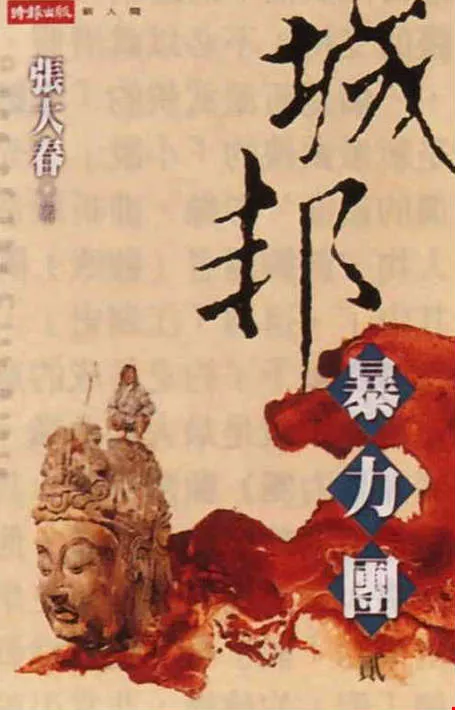
Chengbang Baolituan (Gangsters in the City-State) by Chang Ta-chun, in four volumes.
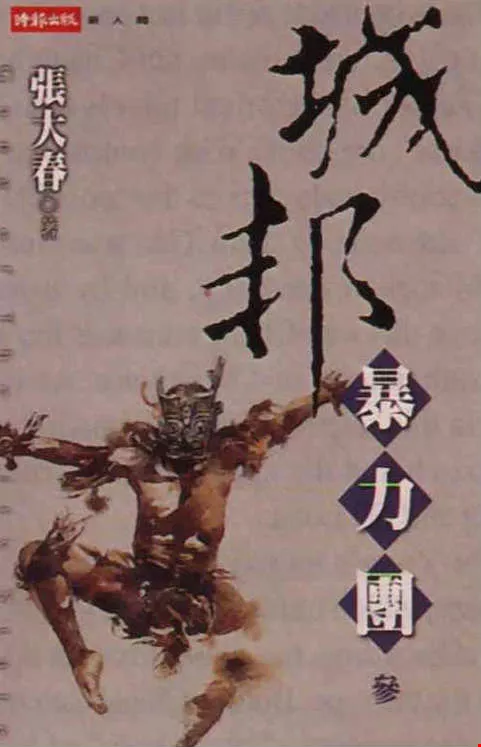
Chengbang Baolituan (Gangsters in the City-State) by Chang Ta-chun, in four volumes.


