Robin Ruizendaal--Dutch Doctor of Puppetry
Kuo Li-chuan / photos courtesy ofLin Liu-Hsin Puppet Theatre Museumtr. by David Mayer
May 2006


Taiwan is a hotbed of puppet theater. So much so, in fact, that when the government recently invited the public to pick an image they thought would best serve as a symbol of Taiwan, puppet theater was the leading choice. It might come as a surprise, then, to learn that metropolitan Taipei's first museum dedicated to the art--Lin Liu-Hsin Puppet Theatre Museum (LLM)--is run by a tall Dutchman named Robin Ruizendaal. In addition to his puppet theater research, Ruizendaal also writes and directs. When curious museum visitors venture a "hello" in English, they're apt to find Ruizendaal chewing betelnut, and when the conversation reverts to Chinese they're always taken aback at his perfect local accent.
A well-known figure in Taiwan's puppet theater community, Ruizendaal has been very busy in the five years since the establishment of the LLM arranging tours for the museum's troupe, which has traveled to Europe, Latin America, Hong Kong and Macao to perform pieces written and directed by Ruizendaal, whose fine eye for detail and restless avant-garde spirit have earned him a place among the leading lights of contemporary Asian puppet theater. Government agencies in Taiwan concerned with the preservation of traditional culture admire him for his hard work. His success has helped Taiwan's puppet theater put down deeper roots at home even as it embarks with a new face upon a larger global stage.
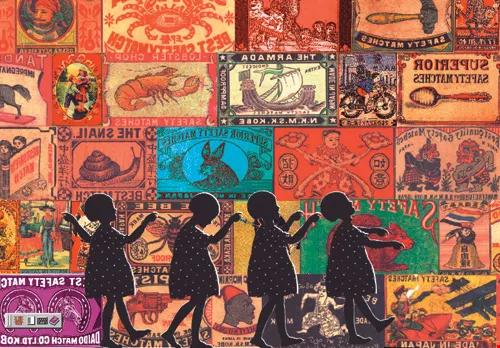
Robin Ruizendaal's children's shadow puppet play The Matchbox Girl is adapted from the Hans Christian Andersen fairy tale, and uses the medium of theater to offer a different interpretation of the meaning of death.
Call of the East
Much of the credit goes to Ruizendaal's maternal grandfather, a great aficionado of Eastern culture who was captain of an ocean freighter, plying trade routes between Indonesia, China and Japan. He lived many years in Indonesia until the independence movement after World War II ran all foreigners out in October 1945, and he moved back to the Netherlands. Ruizendaal was born in 1963 and lived together with his maternal grandparents in The Hague.
"My grandfather traveled all over Asia, and he loved all things Eastern, so we had a lot of calligraphy, paintings and other Eastern art works around home. Lots of my granddad's expat buddies who had been kicked out of Indonesia would get together at our place to eat Indonesian food and talk about the Orient. It piqued my interest in Asian cultures. My grandfather could write a few Chinese characters, which was mysterious and fascinating to me as a kid."
Almost as if he had some sort of karmic connection with Far Eastern culture, Ruizendaal majored in sinology at the University of Leiden after graduating from high school. Little did he realize that learning Chinese would turn out to be such a nightmare.
"Chinese is tough. Classical Chinese is especially difficult for us Westerners. Just looking up everything in a zillion dictionaries is no guarantee that you'll understand the text. And memorizing Chinese characters is so painful. The same character means totally different things in different contexts. The way people think and express themselves is completely different than in the West. Lots of students dropped out every semester, and I thought every week about doing the same." Ruizendaal today tells the tale today in fluent Chinese, quipping that perhaps only his innate stubbornness kept him going when things got tough. "Studying Chinese was really hard, but giving up would have made me feel even worse."
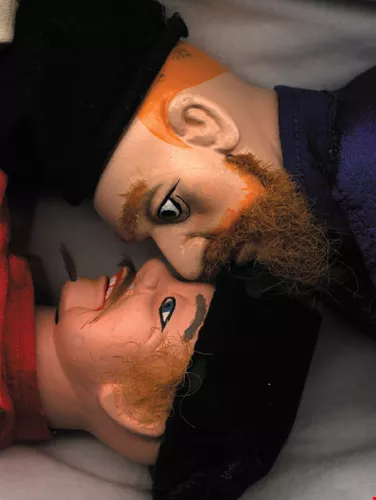
The dialogue in Robin Ruizendaal's first play, Marco Polo, switches back and forth between Taiwanese and Italian while the orchestra plays a melange of nanguan, beiguan, and Italian opera.
Straddling the strait
At Leiden, Ruizendaal studied a wide selection of Chinese classical literature, including the Confucian classics, Yuan drama, and Ming and Qing novels, before going to China in 1986 to study at Xiamen University. There he chose to write his master's thesis on Quanzhou puppet theater.
China was very poor and backward at the time. Everyday life and sanitary conditions were a far cry from anything he had seen before. He slept on a hard bed and ate unappetizing fare at the school cafeteria. Many cultural artifacts and old temples had been badly damaged in the Cultural Revolution, but rural areas were left relatively unscathed. In the Quanzhou area, puppet theater troupes were still doing quite well. After a year of research, Ruizendaal returned to the Netherlands to finish his master's degree.
Ruizendaal returned to Xiamen in 1988 with a five-year plan to master the Minnan tongue of southern Fujian Province, but foreigners were subject to all sorts of restrictions in the closed and secretive China of that time. They were not allowed to live wherever they pleased, so to mix it up with the locals Ruizendaal applied to teach English in middle school and get a work permit that would allow him to live off the university campus. After the June 4th massacre in Tiananmen the following year, he suddenly found himself in a nation on tenterhooks. With scuttlebutt flying about army troops coming to quell student activism at Xiamen University, Ruizendaal went off with his girlfriend, a member of southwest China's Yao ethnic minority, to ride out the storm in the Yunnan capital of Kunming. There he opened a clothing store together with some Chinese friends and stayed in Kunming for a half year before returning to the Netherlands.
In November 1990 the late Taiwanese master glove puppeteer Li Tien-lu led I Wan Jan Puppet Theater on a European performance tour, and Ruizendaal traveled with them as their interpreter in the Netherlands. The natural demeanor and ebullience of the Taiwanese performers made a deep impression on Ruizendaal during his ten days with the troupe. "Living in the Netherlands, I only had a vague impression of Taiwan via magazines like Sinorama and Artist. That was the first chance I'd had to interact up close and personal with performers from Taiwan." He realized for the first time that the culture of puppetry was fully preserved in a free and democratic society across the strait from China.
The next year Ruizendaal was awarded a doctoral fellowship by the Netherlands Organisation for Scientific Research, and his supervising professor at Oxford University in Britain suggested that on his next trip to Taiwan Ruizendaal ought to spend three months researching puppetry in the Kaohsiung-Tainan area. He came to Taiwan in 1993 and has been here ever since.
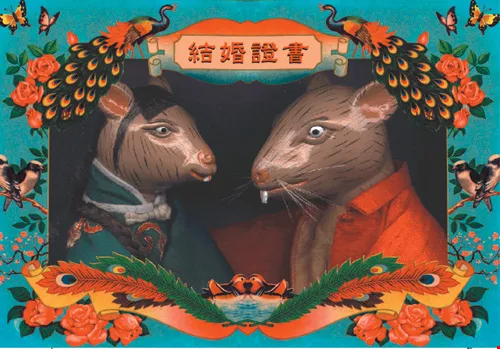
This "Rodent Marriage Certificate" is one of the many gags in The Wedding of the Mice, a children's play in Mandarin written and directed by Robin Ruizendaal.
Heading a puppet theater museum
Ruizendaal has become thoroughly localized in Taiwan, where has learned to speak Taiwanese, acquired a taste for betelnut, and become a big fan of down-home Taipei cuisine. He loves pig's foot noodles, for example, and happily snarfs down the stinky tofu that sends most foreigners away holding their noses. Most important of all, however, is the free and open academic environment that has afforded him unrestricted freedom to carry out his research.
"Chinese theater is not as complex as Western theater in terms of character depth and complexity. The figures are either black or white, good or evil. They don't have transitions in mood or experience uncertainty. Also, Western drama is generally written with a particular type of theater in mind. Western audiences have a more even level of artistic sophistication, and they pay closer attention. In Chinese theater, with the exception of early court performances and indoor stage theater, the audiences at outdoor theater tend to be more working class and rowdier, so the performers have to repeatedly make explicit their status and roles to hold the audience's attention. That's the biggest difference between the two."
Ruizendaal publishes academic papers, speaks on his findings at international conferences, and helps organize Taiwanese puppetry performances in Europe. In 1994 he took a job at the SuHo Memorial Paper Museum, then in 1997 helped the Taiyuan Foundation set up the Preparatory Office of the Taipei Puppet Theater Museum. This latter work led to Ruizendaal's appointment to his present position--a dream job for a puppet theater scholar.
At that time Paul Lin, the head of Taiyuan Foundation, was hoping to donate his collection of over 5,200 puppet theater items to the Taipei City Government to establish a specialty museum. But there was no law on the books to allow for such a move, so the museum was cut from the budget.
Ruizendaal and Lin found a workaround. They simply called on friends to pitch in with time and money, and on private support alone succeeded three years later in establishing the TTT Puppet Centre. To offset basic operating expenses, the center hired itself out to elementary schools, where it taught students about shadow puppetry, including how to make shadow puppets themselves. Ruizendaal performed with the troupe despite never having learned how to manipulate the puppets, and admits with a chuckle that he was pretty bad at it. He continued performing until the following year, when master puppeteer Chen Xihuang joined the troupe, allowing Ruizendaal to concentrate on writing scripts.
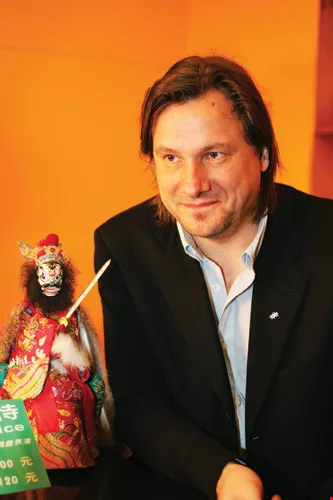
Dutchman Robin Ruizendaal has become a prominent figure in Taiwan's puppet theater community. Since establishment of the Lin Liu-Hsin Puppet Theatre Museum, he has worked actively to take puppet troupes on overseas performance tours, helping Taiwan's puppet theater put down deeper roots here at home while simultaneously embarking upon a larger global stage.
Taiwanese puppets speak English
Ruizendaal observes that the audience for traditional puppet theater in Taiwan has shriveled, and sees innovation as the way to win fans back again. Among other changes, he advocates shorter performances, faster-paced plots, fusion of traditional and Western music, and a switch to colloquial Taiwanese for soliloquies and dialogue. "Lots of the Taiwanese soliloquies and dialogue are delivered in the language of classical literature, but young people today don't speak Taiwanese very well, and they don't understand the classical language at all."
Back when the puppet museum was first established there were only a few puppet troupes in Taipei capable of performing on a regular basis, mostly putting on traditional numbers. Ruizendaal needed to stake out a unique market niche, and wanted to keep in step with the times by creating original works, so he started writing scripts. His first script, Marco Polo, hit the stage in 2001.
It is a "West meets East" love story that adopts the storytelling forms of traditional Taiwanese puppet theater, with a century-old puppetry stage, Minnan theater puppets, and a traditional nanguan orchestra section. Where he departs from tradition is in his bold choice of romantic male lead. Instead of the usual mild-mannered scholar, Ruizendaal goes with 16-year-old Marco Polo, an impetuous Italian lad who continually stirs up trouble in China's imperial palace. Marco meets a gentle, intelligent maidservant from the concubine quarters, sparking off a round of jealous contention between two Italian brothers. The dialogue switches back and forth between Taiwanese and Italian, and the orchestra plays a melange of nanguan, beiguan, and Italian opera.
Without a doubt, the introduction of Western concepts infuses Marco Polo with a higher level of theatrical tension, while the totally new performance elements and post-modern montage give audiences an experience like none they've had before. Still, some question whether Ruizendaal's work doesn't perhaps depart too radically from tradition.
"The best way to scare off audiences is to shout out 'traditional' at the top of your lungs. If you stick slavishly to tradition, you'll just become a cultural specimen." Ruizendaal stresses, "Theater is democratic. The audience decides whether they've seen a good show." Over the past five years Marco Polo has been performed in over 20 countries and has been translated into 12 different languages. It's been to the Royal Festival Hall in London, and to the Cambodian countryside.
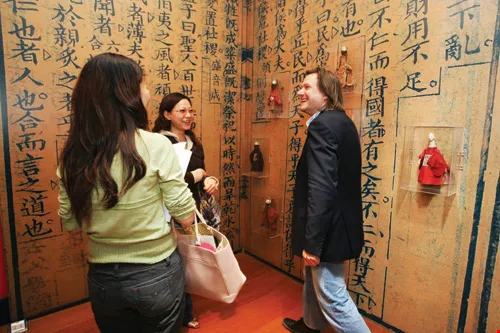
Fluent in Chinese, Robin Ruizendaal enjoys chatting with museum visitors as he shows them the exhibits.
Little Seven and Ah Nan
Ruizendaal's "radicalism" doesn't stop there, either. Death, for example, is a big taboo subject in Eastern societies, but Ruizendaal challenges the taboo in The Matchbox Girl, adapted from the Hans Christian Andersen fairy tale The Little Match Girl. Unlike the unfortunate little girl in the fairy tale, Ruizendaal's heroine, while also saddled with a tragic fate, has at least known a bosom buddy called Ah Nan. The match girl's name is Little Seven.
Little Seven is rented out by her evil, moneygrubbing grandmother to a factory, where she becomes fast friends with Ah Nan, a downtrodden boy working in the factory. Despite suffering hunger and cold, the kids are not lonely, for the matchboxes in the factory are all their friends. Come nightfall, matchboxes, trees, fish and little animals of all descriptions steal into their dreams and dance with the kids. But happiness for Little Seven is an extravagance, after all, as inexorable fate gradually closes in....
Ruizendaal hopes by this children's shadow puppet play to communicate the message that "death is just one way of being apart." No matter how long or short, life must end sooner or later. On a brighter note, the play also urges children to value friendship.
In the play, Ah Nan is injured and ends up in the hospital, from where he writes a letter to Little Seven to let her know he's okay: "I'm in the hospital. It's not serious." But the letter gets wet and the ink runs. By the time the letter reaches Little Seven, it seems to say, "I'm in the hospital. It's serious." She thinks it's a farewell letter, and agonizes. Ruizendaal recalls his surprise at the reaction of the children in the audience when the troupe performed at Taipei Cultural Center--they broke out laughing! With a shrug, he conjectures: "Maybe children don't take death as seriously as adults do."
Frustrated at a the small selection of fairy tales and children's theater in Taiwan as well as a lack of originality in those few works available, Ruizendaal wrote two children's story books: Formosa--A Short Story of an Island and Yintsu's Puppet Friends. To accommodate today's young audiences, who don't have a good command of Taiwanese, he specially wrote a puppet theater work The Wedding of the Mice performed in Mandarin. This year he's doing a project with Taiyuan Publishing to republish his two children's story books, and to produce a children's book and audio CD on puppet theater.
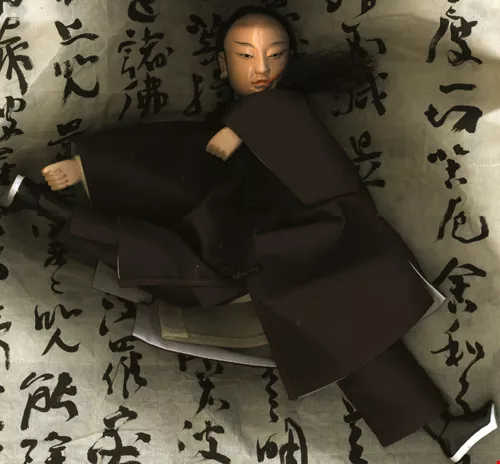
The legendary Liao Tianding, main character in Liao Tianding--Murder in Old Taipei, is a lone wolf living on the fringes, threading his way between the dictates of law and personal loyalties, trading off between the mandates of society and the individual. He is perfect material for a playwright like Ruizendaal, who seeks to create multi-conflicted roles.
Legend of Liao Tianding
Tataocheng, once the most prosperous part of Taipei, is home to many puppet theater and Taiwanese Opera troupes. Crowds flock to Hsiahai City God Temple on holidays to pay their respects to the gods. Back in the Japanese colonial period Tataocheng was the stomping ground of the Taiwanese version of Robin Hood, Liao Tianding, a focus of both legend and controversy. Ruizendaal's work Liao Tianding--Murder in Old Taipei is set in the middle of the night. The body of tea merchant Lin Chin-lai is found hanging in an old house. Everyone in Tataocheng is abuzz over the grisly murder, and the Japanese police suspect Liao Tianding. The police release a suspect, a marquee actor specializing in young female roles at a local Taiwanese Opera troupe, as bait to draw Liao in. Gray areas in human nature come to the fore as the story unfolds in an intricate entanglement of good, evil, and friendship.
Liao Tianding is a lone wolf living on the fringes, threading his way between the dictates of law and personal loyalties, trading off between the mandates of society and the individual, deciding for himself between right and wrong. He is perfect material for a playwright like Ruizendaal, who seeks to create multi-conflicted roles. To tone down the play's whodunnit tension and guide the imaginations of the audience into the sights and sounds of a world gone by, Ruizendaal consciously weaves music from different periods of Taiwan's past into the storyline. The audience listens in, for example, as the opera troupe rehearses a famous love song from Taiwanese Opera. Meanwhile the leading lady, Tung Mei, likes to sing the Taiwanese pop song "How Fleeting is the Spring Flower." And throughout the story one hears various Japanese enka ballads and Taiwanese ballads. The evocative melodies carry the viewer back in time to the golden era of Tataocheng.
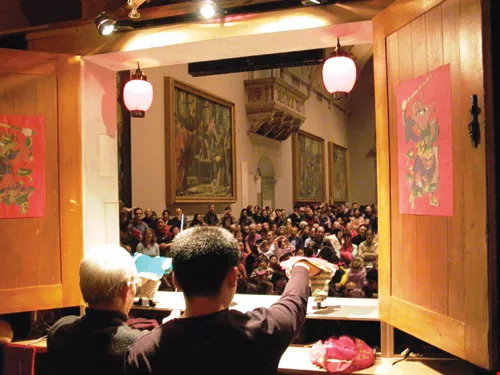
Taiyuan Puppet Theatre is often invited to perform its own original works overseas, and has become part of the international art scene while injecting new life into the artform here in its home base. Shown here is the troupe playing in 1994 in London.
Promoting internationalization
Ruizendaal has already seen ten of his original works performed on stage, all of them by the Lin Liu-Hsin Puppet Theatre Museum's Taiyuan Puppet Theatre Company. Unlike most small non-commercial theater troupes in Taiwan, which tend to operate on the principle that good enough is good enough, Ruizendaal doesn't cut corners. He insists on hiring a professional musician to arrange original scores for each play, and when invited to perform overseas will have the soliloquies and dialogue translated and projected onto a screen so audiences can understand what's going on. He stresses that to promote Taiwanese puppet theater overseas, "packaging" and "professionalism" are extremely important.
"Packaging" means publicity. Some theater troupes in Taiwan put on high caliber performances but do a lackadaisical job of marketing and publicizing themselves. "Foreigners will come to see unfamiliar type of stage performance once just out of curiosity, but what then? You have to put out attractively designed publicity that communicates something to grab people's imaginations, otherwise you're not going to attract many back a second time."
"Professionalism" includes such things as musical arrangements, lighting, use of the stage, and pacing. At the temple fairs where puppet theater is often performed, the crowds are boisterous and the outdoor setting is spacious, so orchestras at these open air events play as loud as they can. But when performing overseas, and especially at cozily appointed little theaters, the wailing suona alone are enough to blow the audience's eardrums. For Taiwanese puppet theater to win fans overseas it is necessary to size up the venue, adjust the musical volume, make skillful use of lighting, shorten performances, and translate the soliloquies and dialogue.
Taiwanese glove puppetry
In addition to his efforts to spread puppet theater, Ruizendaal is also an ace exhibit curator with a number of credits to his name, including exhibits at the Westfries Museum in Hoorn, the Netherlands, the Kwang Hwa Information and Culture Center in Hong Kong, the Ilan International Children's Folklore and Folkgame Festival, and the TTT Puppet Theater.
Six years ago Ruizendaal organized the exhibition From Holland to Formosa--17th-Century Dutch Culture in Taiwan at Fort Santo Domingo in Tanshui, thus linking up his two "homelands."
"Taiwanese history unfolds on many different levels, but history viewed through a nationalistic prism can seem quite boring." The Fort Santo Domingo exhibit therefore emphasized hands-on interaction. Visitors were able to get a feel for the olden days by trying on wooden clogs from the Netherlands, watching stage performances, and romping around in the hold of a replica 17th-century ship.
For Ruizendaal, who was once married to a local and entertains a passion for all things Taiwanese, the verve and warmth of the Taiwanese people and the academic freedom enjoyed here are a continuous source of creative inspiration. As our interview draws to a close, he smokes a pipe and pores over the proposal for a work he's planning to have performed at the International Puppet Theater Festival this May in Istanbul. His devotion to puppet theater has enabled him to enrich and innovate Taiwanese puppet theater by infusing foreign cultural elements and contemporary methods. In the process, the works he has created have brought Taiwan to the attention of international audiences and given those audiences a window on Taiwan puppet theater.

@List.jpg?w=522&h=410&mode=crop&format=webp&quality=80)

@List.jpg?w=522&h=410&mode=crop&format=webp&quality=80)


