A Feast Fit for an Emperor--"China Palace" Brings Chinese Restaurants to the World
Tsai Wen-ting / photos Pu Hua-chih / tr. by Robert Taylor
June 2000


Chinese, French and Italian cooking are three of the world's great cuisines, and the Chinese in particular, whenever they go abroad, are sure to fit several Chinese meals into their trip. With Chinese emigration and the rise of overseas tourism in Taiwan, more and more Chinese restaurants have opened around the world. But among the patrons busily stuffing themselves with Peking duck and sweet-and-sour spare ribs, do any take the time to wonder where these fancy restaurants get their sumptuous palace-style decor, with its carved beams and painted columns, and whether the designers and decorators are Chinese?
Few people are aware that in many Chinese restaurants overseas, almost every item of decor, from the paneled ceilings and intricately carved wooden ornamental windows to the floral-medallion-pattern carpet and the lions outside the door, is the work of Taiwan's China Palace Art and Painting Company, owned and managed by the Sung family, and that most of these items were handmade in Taiwan before being shipped out by the container load. Behind this fact, there is a goodly portion of cultural tenacity and pride, as well as a unique eye for a business opportunity and a remarkable sales achievement.
When one talks of Chinese architecture, what people are probably most familiar with is multi-layered dougong block-and-bracket structures under flying eaves, and vermilion pillars supporting square-paneled "caisson" ceilings painted with dragon-and-phoenix designs in gold, green and a rainbow of other colors-the "palatial" style. This style can be found everywhere, from Taipei's Grand Hotel, National Museum of History, National Palace Museum and Chungshan Hall, to the ceremonial arches and sumptuous restaurants of overseas Chinatowns. And the spread of this Chinese architectural style has carried the business of the China Palace Art and Painting Company, established over 40 years ago, from Taiwan to "everywhere in the world where there are Chinese."
How can the new forms of Buddhist music achieve the goal of guiding people towards the light? Musicologist Lin Ku-fang feels that the key is how well the music conveys the compassionate spirit of Buddhism. (photo by Diago Chiu)
The Chinese palace comes to Taiwan
In 1949 Sung Ying, a graduate of Shandong University's department of economics, came to Taiwan as a refugee with little more than the clothes he stood up in. He took up a teaching post at an administrative school which later formed the core of the law and business college at National Chung Hsing University, and has now become National Taipei University. Sung was very knowledgeable about Chinese traditional painting, calligraphy and Peking opera, and was also a dab hand at playing the erhu (a Chinese traditional fiddle). Although he taught economics, his bookshelves held many works on traditional architecture, Chinese design motifs and caihui-decorative color painting.
In the 1960s, encouraged by a government-sponsored campaign for a renaissance of Chinese culture, many official buildings were built in a style reminiscent of the ornate, solemn palace architecture of northern China, and for occasions such as National Day, Taiwan Retrocession Day and Constitution Day, Chinese-style ceremonial arches would be put up over the entrances to government agencies and across major roads. Sung Ying was very interested in caihui, so he recruited several apprentices and began painting these ceremonial arches. His work also graced such buildings as the pavilions at the rear of the Grand Hotel, the Magnolia Hotel, the National Museum of History, and even the Confucian Temple in Tainan.
In contrast to the southern Chinese style of decoration typical of Taiwanese folk temples, which features bird-and-flower paintings or folk stories, Sung Ying did decorations in the northern style, the main themes being dragons and phoenixes, along with some floral-medallion ruyi scepter symbols, auspicious swastikas and other decorative motifs. The most important-and difficult-element in such decoration is the lifen ("wet powder") technique, which can give the designs an appearance of depth and detail.
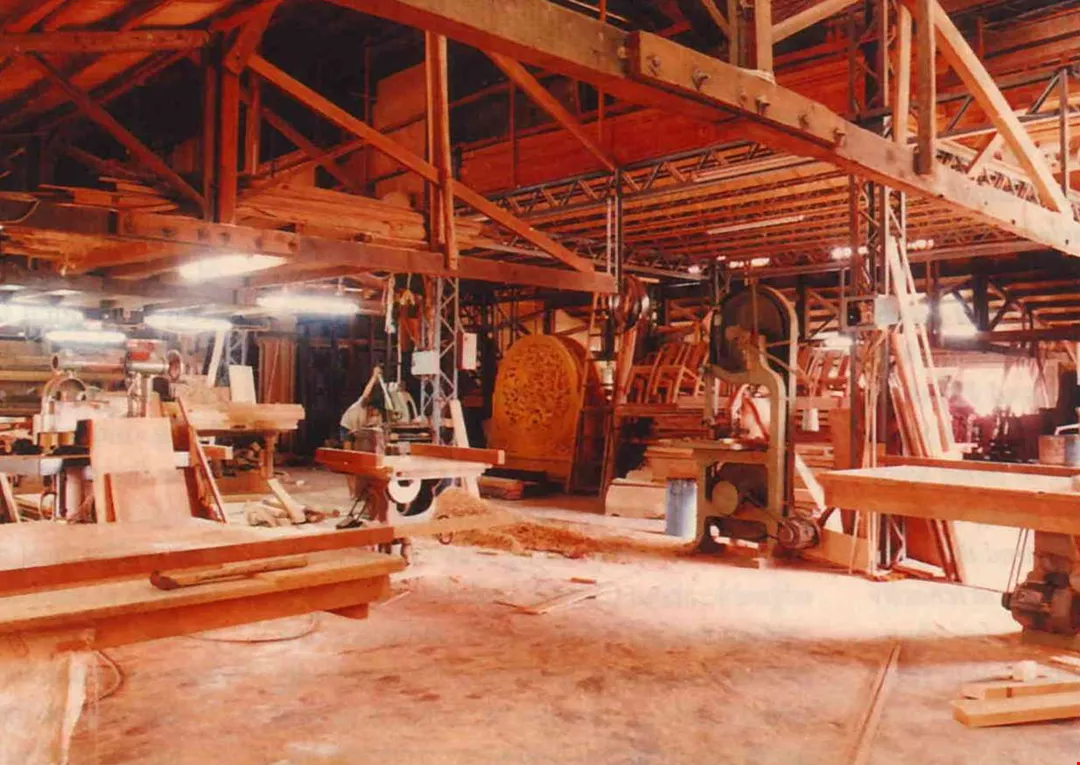
From ceiling panels, partitions and screens to tables, chairs and lamps, the furniture and decor required by overseas Chinese restaurants are all made in China Palace's factory in Taiwan and shipped overseas in containers to be assembled at customers' premises. (courtesy of Peter Sung)
The icing on the cake
Master craftsman Lei Yung-shun joined China Palace as an apprentice at the age of 15 on graduating from junior high school, and has been with the company for 30 years. He explains that the high Chinese caisson ceilings are made up of many individual wooden panels around one-and-a-half feet square. Each panel is first covered with a filler mixed from pig's blood and lime to fill in the cracks and create a smooth surface. Then it is given a coat of base paint, after which a fine stencil is laid over the panel, and a red powder is sprinkled onto the stencil. The powder passes through the tiny holes in the stencil to quickly create the outline of a design motif.
Then it is time to apply the lifen, which is made from a boiled water-based glue to which lime is added to create a thick paste. The paste is put into a rubber tube-made from a bicycle inner tube-with a funnel fitted to one end. According to the thickness of lines desired, different-sized nozzles are attached to the funnel, and then, just like adding piping to a cake, the paste is squeezed out through the nozzle to produce the raised lines of the complex dragon and phoenix motifs. An important step in this painting process is adding fine white lines between the different strong colors-red, yellow, blue, green and gold-to make them appear more harmonious and less gaudy.
Painting such complex designs onto each little ceiling panel takes a great deal of skill, but an even greater test of the craftsmen's ability is painting lines along decorated beams which are one to two meters long. "It's just like doing calligraphy with a writing brush-the line of lifen has to be even and smooth, and you have to finish it in one go. It's all in the wrist action," says Lei Yung-shun. Lei still recalls how, when he was an apprentice, his late boss Sung Ying would often have the apprentices compete to draw lines along wooden boards, moving their wrists smoothly at a constant height above the work, to see who could draw their lines the straightest and the quickest.
Two of Taiwan's "rarest species"-Lin Chun-chi and the "wind box tree" (Cephalanthus naucleoides). Lin is perhaps the only farmer who would rather grow weeds than rice, while this wind box tree is one of only about 100 left growing wild in the wetlands of Taiwan.
Exhibition showcase
In the 1970s, as Taiwan's economy took off, many companies began to take part in major overseas trade fairs. Palace style decoration was undoubtedly an ideal choice to make the Chinese pavilion stand out among the thousands of other exhibition stands. In response to this market China Palace, which had previously mainly concentrated on caihui decoration, expanded into an all-round interior decorating company with four major departments-carpentry, woodcarving, lifen decoration and painting. In the 1970s, Chinese exhibition pavilions designed and constructed by China Palace took the "best design" prizes at two world-class trade fairs.
It never occurred to Sung Ying that designing Chinese pavilions for international trade fairs would take his future market entirely overseas. For the pavilions not only made an impression on foreign exhibitors and visitors, but also on many overseas Chinese-particularly restaurant owners, who on seeing their palatial style were overjoyed to have found just the kind of Chinese style they were seeking for their eateries.
Hence, if in Chinese restaurants in countries throughout Europe, the Middle East and North and South America, or even in Chinatown in Yokohama, Japan, you see palace-style decor with carved beams, painted columns and dragon and phoenix motifs, you might ask the owner whether the interior decor was done by "Mr. Sung"; in most cases, you won't be far wrong. "We've decorated over 300 Chinese restaurants in about 27 countries," says China Palace manager Feng Hsiao-hua, the founder's daughter-in-law, who is in charge of liaison work in Taiwan.
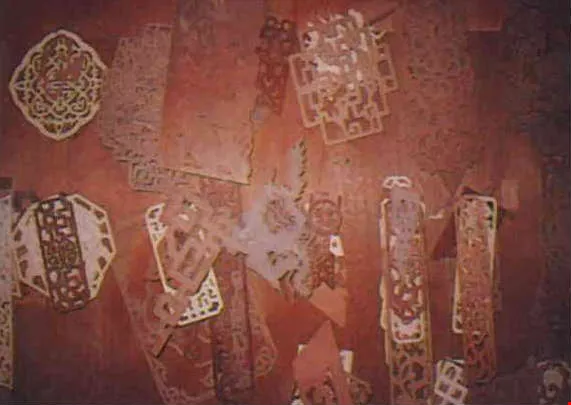
The patterns for all kinds of different auspicious and joyous motifs which cover the walls of the workshop are indicative of the craftsmen's skill.
A strong Chinese flavor
Apart from homesick Chinese, the main clientele for Chinese restaurants are local people. When Westerners eat out, they set great store by the restaurant's ambience, so the Chinese atmosphere in Chinese restaurants overseas is particularly strong. Above the main doorway, one may see vermilion dougong brackets supporting a green tiled roof, and outside the entrance, a pair of snow-white stone lions. Then, on entering the restaurant's waiting area, there may be a dragon-carved imperial throne flanked by a pair of elephants bearing vases on their backs, symbolizing peace, and Qing-dynasty dress for guests to have their photos taken in. Further inside, one may be greeted on both sides by palace-style brass standard lamps, multi-colored vases as tall as a person, and carved wooden seating partitions. At the end of the aisle one glimpses an altar table, on which stand figures of Fu, Lu and Shou, the three star-deities responsible for the blessings of happiness, high office and longevity. Everything one sees or uses-from the carpet underfoot, with its symbolic pattern of five bats around a stylized shou ("longevity") character, the Ming-style chairs and tables, and the blue-and-white porcelain crockery, to the pool in the garden, decorated with strangely shaped stones, and the hexagonal shade pavilions-was made in Taiwan by the Sung family's China Palace company and shipped across the seas in containers.
In China Palace's factory in the Shihlin district of Taipei City, workers in the woodcarving department use mechanical fretsaws to first cut out all kinds of decorative openwork designs in wooden panels, while craftsmen with dozens of carving tools laid out beside them carve out one lifelike magpie after another, completely by hand. The walls of the work area are festooned with hundreds of stencils of auspicious motifs. Meanwhile in the carpentry department, the craftsmen are busy making large items of furniture, such as imitation antique wooden cabinets and seating partitions. After the carpentry and carving is complete, the items are passed to the painting department to be painted. After years of use, the workbenches there are covered with thick layers of paint. Because of rising wage levels in Taiwan, the craftsmen who do the lifen decoration produce simpler designs than in the past, and in response to changing tastes in interior decor they have begun using the same skills to do color decoration on glass.
The items produced here are all made to the dimensions measured out by China Palace's Taiwanese designers on their visits to customers' premises overseas. Large items such as shade pavilions, roofs or moon arch doorways have to be made in several pieces for assembly on site, to reduce their shipping volume. Once the installation of partition walls, mains services and air conditioning are complete at the overseas customer's premises, the items made in Taiwan are packed according to type, and loaded into shipping containers. At the customer's premises, they are unloaded according to the packing list and placed directly at the point where they are to be installed. With the drawings provided, they can be quickly assembled on-site even by local workers.
A strong Chinese flavor
Apart from homesick Chinese, the main clientele for Chinese restaurants are local people. When Westerners eat out, they set great store by the restaurant's ambience, so the Chinese atmosphere in Chinese restaurants overseas is particularly strong. Above the main doorway, one may see vermilion dougong brackets supporting a green tiled roof, and outside the entrance, a pair of snow-white stone lions. Then, on entering the restaurant's waiting area, there may be a dragon-carved imperial throne flanked by a pair of elephants bearing vases on their backs, symbolizing peace, and Qing-dynasty dress for guests to have their photos taken in. Further inside, one may be greeted on both sides by palace-style brass standard lamps, multi-colored vases as tall as a person, and carved wooden seating partitions. At the end of the aisle one glimpses an altar table, on which stand figures of Fu, Lu and Shou, the three star-deities responsible for the blessings of happiness, high office and longevity. Everything one sees or uses-from the carpet underfoot, with its symbolic pattern of five bats around a stylized shou ("longevity") character, the Ming-style chairs and tables, and the blue-and-white porcelain crockery, to the pool in the garden, decorated with strangely shaped stones, and the hexagonal shade pavilions-was made in Taiwan by the Sung family's China Palace company and shipped across the seas in containers.
In China Palace's factory in the Shihlin district of Taipei City, workers in the woodcarving department use mechanical fretsaws to first cut out all kinds of decorative openwork designs in wooden panels, while craftsmen with dozens of carving tools laid out beside them carve out one lifelike magpie after another, completely by hand. The walls of the work area are festooned with hundreds of stencils of auspicious motifs. Meanwhile in the carpentry department, the craftsmen are busy making large items of furniture, such as imitation antique wooden cabinets and seating partitions. After the carpentry and carving is complete, the items are passed to the painting department to be painted. After years of use, the workbenches there are covered with thick layers of paint. Because of rising wage levels in Taiwan, the craftsmen who do the lifen decoration produce simpler designs than in the past, and in response to changing tastes in interior decor they have begun using the same skills to do color decoration on glass.
The items produced here are all made to the dimensions measured out by China Palace's Taiwanese designers on their visits to customers' premises overseas. Large items such as shade pavilions, roofs or moon arch doorways have to be made in several pieces for assembly on site, to reduce their shipping volume. Once the installation of partition walls, mains services and air conditioning are complete at the overseas customer's premises, the items made in Taiwan are packed according to type, and loaded into shipping containers. At the customer's premises, they are unloaded according to the packing list and placed directly at the point where they are to be installed. With the drawings provided, they can be quickly assembled on-site even by local workers.
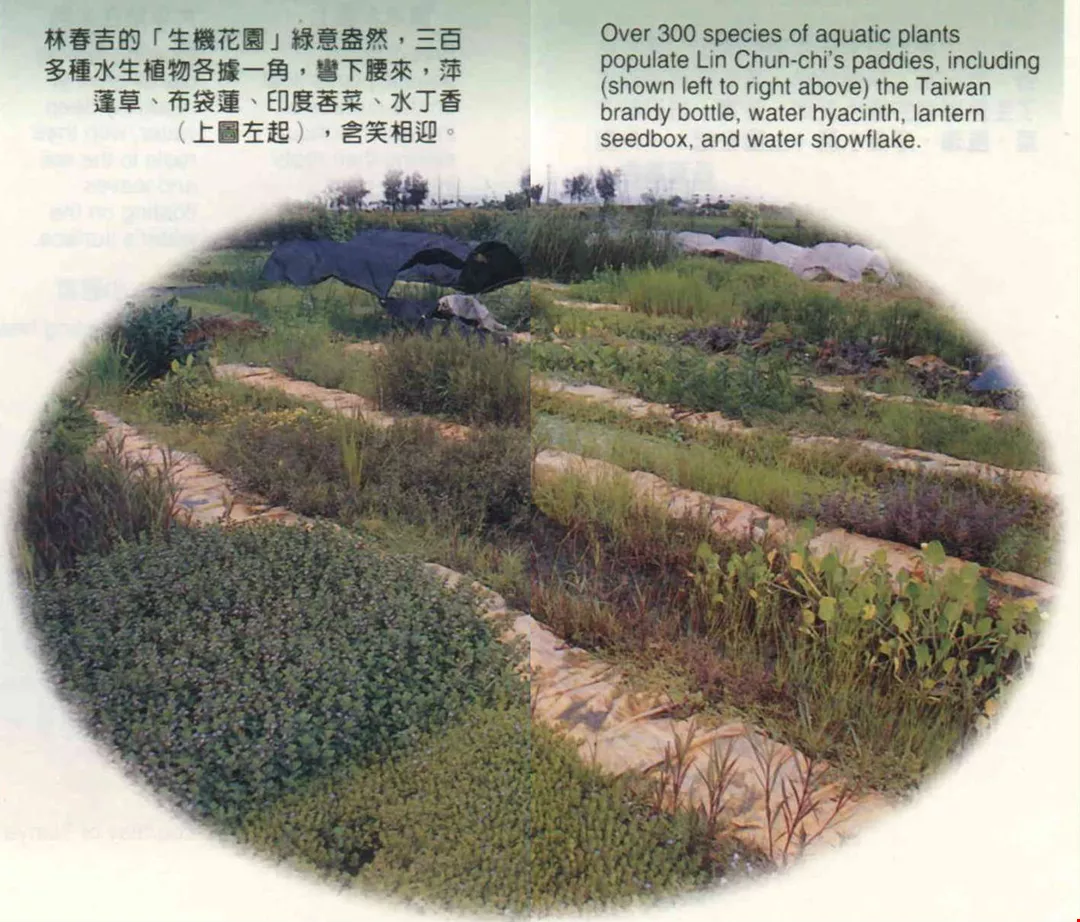
Over 300 species of aquatic plants populate Lin Chun-chi's paddies, including (shown left to right above) the Taiwan brandy bottle, water hyacinth, lantern seedbox, and water snowflake.
A living material
However, when these Chinese products go overseas, the hardest thing for them to adapt to is the climatic conditions at their destination. "That goes especially for things carved out of wood, because wood is a living material," says second-generation proprietor Peter Sung. Timber recently cut from the forest expands when it absorbs moisture and shrinks when it loses moisture, and has to be stored for many years in a cool dry environment before it stabilizes and is ready to be used to make furniture. Nonetheless, even properly seasoned wood is almost sure to split if it is shipped to a cold northerly country and subjected to long periods in the dry heat of centrally heated rooms. Therefore, jointed wooden constructions such as large ornamental window frames, carved screens or moon arches cannot be glued or nailed together, and space has to be left at the joints for expansion and contraction. Peter Sung also recounts how once when the company put up a Chinese ceremonial arch in New York's Chinatown, the ceramic tiles-of a type widely used in Taiwan for centuries-were not up to the cold of the continental winter. In the first year the colored glaze on them flaked off, so Sung had to send staff all the way to New York to replace them.
With rising wage levels in Taiwan, some items such as lifen-painted ceilings and carved wooden accessories with complex designs, or solid-wood furniture, have gradually been replaced by other materials. "If we don't simplify these things, we can't survive," says Peter Sung. For instance, nowadays when one sees a Chinese-style roof with upswept eaves, the red beam high up in the middle is actually made from a tube of compressed paper. The light, cheap paper tube is wrapped in a layer of gauze and covered in red paint. Unless you actually tapped it, you wouldn't know it was paper. The complex dougong brackets only have to support a lightweight fiberglass roof, so there is need to go to the trouble of making them with a mortise-and-tenon construction.
Meanwhile the roof of a six-meter-tall hexagonal pavilion, with its flying eaves, is assembled from six pieces of molded fiberglass, and the pillars which support it are also fiberglass, each with a steel rod through the middle. However, the Chinese-style outward-curved handrail is still made of wood. A pavilion like this, modeled on those in the Net Master's Garden in Suzhou in mainland China, has a traditional appearance but a modern construction.
"Of course everything we make is imitation, but even when we use modern methods we hope the effect is convincing," says Peter Sung. Just as one chef he particularly admires always adds some diced fresh tomato when making prawns in tomato sauce, Sung feels that "what is most important is to use the right details and materials to create the 'feel' that you want." Therefore, even though substitute materials are available for many accessory items, at the points where things will be seen close up or even touched, Sung continues to use many demandingly handcrafted wooden items.
A living material
However, when these Chinese products go overseas, the hardest thing for them to adapt to is the climatic conditions at their destination. "That goes especially for things carved out of wood, because wood is a living material," says second-generation proprietor Peter Sung. Timber recently cut from the forest expands when it absorbs moisture and shrinks when it loses moisture, and has to be stored for many years in a cool dry environment before it stabilizes and is ready to be used to make furniture. Nonetheless, even properly seasoned wood is almost sure to split if it is shipped to a cold northerly country and subjected to long periods in the dry heat of centrally heated rooms. Therefore, jointed wooden constructions such as large ornamental window frames, carved screens or moon arches cannot be glued or nailed together, and space has to be left at the joints for expansion and contraction. Peter Sung also recounts how once when the company put up a Chinese ceremonial arch in New York's Chinatown, the ceramic tiles-of a type widely used in Taiwan for centuries-were not up to the cold of the continental winter. In the first year the colored glaze on them flaked off, so Sung had to send staff all the way to New York to replace them.
With rising wage levels in Taiwan, some items such as lifen-painted ceilings and carved wooden accessories with complex designs, or solid-wood furniture, have gradually been replaced by other materials. "If we don't simplify these things, we can't survive," says Peter Sung. For instance, nowadays when one sees a Chinese-style roof with upswept eaves, the red beam high up in the middle is actually made from a tube of compressed paper. The light, cheap paper tube is wrapped in a layer of gauze and covered in red paint. Unless you actually tapped it, you wouldn't know it was paper. The complex dougong brackets only have to support a lightweight fiberglass roof, so there is need to go to the trouble of making them with a mortise-and-tenon construction.
Meanwhile the roof of a six-meter-tall hexagonal pavilion, with its flying eaves, is assembled from six pieces of molded fiberglass, and the pillars which support it are also fiberglass, each with a steel rod through the middle. However, the Chinese-style outward-curved handrail is still made of wood. A pavilion like this, modeled on those in the Net Master's Garden in Suzhou in mainland China, has a traditional appearance but a modern construction.
"Of course everything we make is imitation, but even when we use modern methods we hope the effect is convincing," says Peter Sung. Just as one chef he particularly admires always adds some diced fresh tomato when making prawns in tomato sauce, Sung feels that "what is most important is to use the right details and materials to create the 'feel' that you want." Therefore, even though substitute materials are available for many accessory items, at the points where things will be seen close up or even touched, Sung continues to use many demandingly handcrafted wooden items.
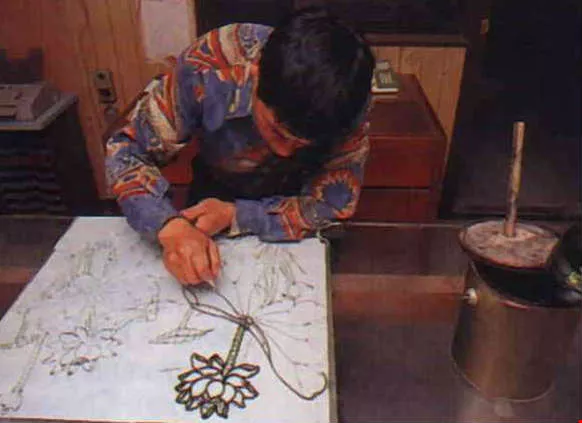
(left to right) Red powder sprinkled onto a stencil creates the outline of a motif on a ceiling panel, onto which colored pastes are then squeezed from rubber tubes to create raised lines. This complicated lifen technique was the core of China Palace's original business.
Palace gives way to garden
Fortunately, Chinese restaurateurs overseas also no longer demand the kind of "all-over-ornate" palatial style of the past, but are tending towards a simpler, more informal Chinese garden style. "When some restaurant owners see the name 'China Palace' on our business cards, they immediately say: 'I don't want the place to look like a temple,'" remarks Peter Sung. He notes that a Chinese ambience can be generated with just a few Chinese elements such as a fan-shaped ornamental window or a bird-and-flower screen, placed in a neutral, elegant space. Thus the company can create a pleasing Chinese restaurant for US$20-30,000. European customers today no longer go for an overblown Chinese style with waitresses in elaborate Chinese dress, or dragon and lion dancers.
A restaurateur who had already had Peter Sung design three restaurants for him, recently opened a large new Chinese restaurant on the seafront at Nice in the south of France. The premises-formerly a supermarket and large car park-were transformed by Sung into a bustling Chinese garden, with cascades splashing over rocks, and shoals of goldfish swimming in a pool crossed by a zig-zag stone bridge leading to a Chinese pavilion where one can lean out over the railing to enjoy the view. This Chinese garden has now become a new local tourist attraction, and the local government has even built a free car park close by to allow visitors to stop and take photographs.
Palace gives way to garden
Fortunately, Chinese restaurateurs overseas also no longer demand the kind of "all-over-ornate" palatial style of the past, but are tending towards a simpler, more informal Chinese garden style. "When some restaurant owners see the name 'China Palace' on our business cards, they immediately say: 'I don't want the place to look like a temple,'" remarks Peter Sung. He notes that a Chinese ambience can be generated with just a few Chinese elements such as a fan-shaped ornamental window or a bird-and-flower screen, placed in a neutral, elegant space. Thus the company can create a pleasing Chinese restaurant for US$20-30,000. European customers today no longer go for an overblown Chinese style with waitresses in elaborate Chinese dress, or dragon and lion dancers.
A restaurateur who had already had Peter Sung design three restaurants for him, recently opened a large new Chinese restaurant on the seafront at Nice in the south of France. The premises-formerly a supermarket and large car park-were transformed by Sung into a bustling Chinese garden, with cascades splashing over rocks, and shoals of goldfish swimming in a pool crossed by a zig-zag stone bridge leading to a Chinese pavilion where one can lean out over the railing to enjoy the view. This Chinese garden has now become a new local tourist attraction, and the local government has even built a free car park close by to allow visitors to stop and take photographs.
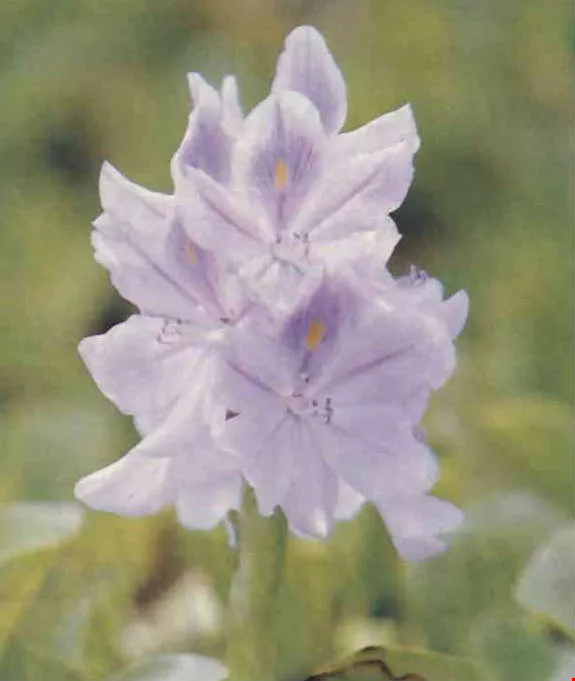
Over 300 species of aquatic plants populate Lin Chun-chi's paddies, including (shown left to right above) the Taiwan brandy bottle, water hyacinth, lantern seedbox, and water snowflake.
Cordon bleu design
Peter Sung has designed around 300 Chinese restaurants, some modern and simple, some grand and ornate. He feels that "a really good restaurant is a 'cordon bleu' establishment where you can see that thought has gone into everything." In a top restaurant, the wine should match the food, the sweet should match the main course, and the choice of tableware shouldn't be slapdash either. By the same token, the decor ought to be of "cordon bleu" quality too. For instance, says Sung, he designed a restaurant for a Cantonese owner in Holland who raises prize goldfish. To go with the owner's goldfish, Sung incorporated a little wooden bridge in the design of the restaurant's entrance, to allow patrons to step across water and enjoy the sight of the fish swimming below. Inside, he put images of goldfish on all the frosted-glass partitions, and in the center he placed an antique-style cabinet filled with the cups the owner had won for his fish. Thus the design of the restaurant fully expressed the owner's individuality.
US president Nixon's visit to the Chinese mainland in 1972 sparked off a worldwide wave of interest in China, and this brought a big upsurge in business for Chinese restaurants overseas. In recent years, the opening of Chinese markets to the outside world has driven fascination with China to even greater heights, and Chinese restaurants are attracting more and more younger customers. In design terms, to attract young people Peter Sung is tending even more to abandon ornate palace-style accessories in favor of bright, fresh white walls and red gingham tablecloths, along with movable screens carved with Chinese characters, and chairs made from black steel tubing in a Ming-dynasty style, to create a Chinese style with a young and modern feel.
Cordon bleu design
Peter Sung has designed around 300 Chinese restaurants, some modern and simple, some grand and ornate. He feels that "a really good restaurant is a 'cordon bleu' establishment where you can see that thought has gone into everything." In a top restaurant, the wine should match the food, the sweet should match the main course, and the choice of tableware shouldn't be slapdash either. By the same token, the decor ought to be of "cordon bleu" quality too. For instance, says Sung, he designed a restaurant for a Cantonese owner in Holland who raises prize goldfish. To go with the owner's goldfish, Sung incorporated a little wooden bridge in the design of the restaurant's entrance, to allow patrons to step across water and enjoy the sight of the fish swimming below. Inside, he put images of goldfish on all the frosted-glass partitions, and in the center he placed an antique-style cabinet filled with the cups the owner had won for his fish. Thus the design of the restaurant fully expressed the owner's individuality.
US president Nixon's visit to the Chinese mainland in 1972 sparked off a worldwide wave of interest in China, and this brought a big upsurge in business for Chinese restaurants overseas. In recent years, the opening of Chinese markets to the outside world has driven fascination with China to even greater heights, and Chinese restaurants are attracting more and more younger customers. In design terms, to attract young people Peter Sung is tending even more to abandon ornate palace-style accessories in favor of bright, fresh white walls and red gingham tablecloths, along with movable screens carved with Chinese characters, and chairs made from black steel tubing in a Ming-dynasty style, to create a Chinese style with a young and modern feel.
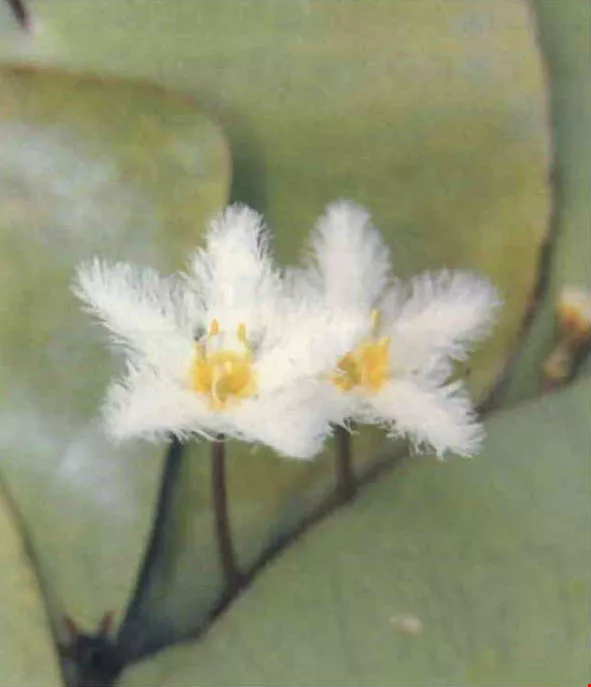
Over 300 species of aquatic plants populate Lin Chun-chi's paddies, including (shown left to right above) the Taiwan brandy bottle, water hyacinth, lantern seedbox, and water snowflake.
Convincing imitations
Of all the Chinese restaurants Peter Sung has designed, a particular favorite of his is the Tse Yang Restaurant in the diplomatic quarter of Paris, close to the Champs Elysees. In that high-class area, frequented by the rich and famous, the impression he wanted to give patrons was that of the home of a wealthy family in southern China. In a design which draws on the spirit of the gardens of Suzhou, just inside the entrance the wall is pierced high up by a carved wooden ornamental window in a rhombus pattern, which lets light shine on the sumptuously painted panels of the high caisson ceiling, to impart a sense of intricate workmanship and opulence. To either side of the aisle in the front of the restaurant, there hang a pair of ten-foot-long, hand-carved bas-relief wooden wall panels, one depicting a hundred birds paying homage to the phoenix, and the other portraying a riverside scene in the Song-dynasty capital Kaifeng on Tomb Sweeping Day.
Inside the restaurant, the walls are all covered with silk brocade, in a phoenix pattern of the same design as a cheongsam worn by the Queen of England at the time. Every detail is apt to make customers gasp in admiration, and this restaurant brought Peter Sung business from many high-class customers, including a Syrian prince. However, the restaurant's swanky atmosphere also attracted the attention of a different kind of "clientele." On a large antique-style cabinet in the waiting area, Sung arranged over 20 pieces of Chinese porcelain. These were imitation antiques which he bought in Taiwan's pottery town of Yingko, but shortly after the restaurant opened they were all stolen by thieves who mistook them for genuine antiques.
Convincing imitations
Of all the Chinese restaurants Peter Sung has designed, a particular favorite of his is the Tse Yang Restaurant in the diplomatic quarter of Paris, close to the Champs Elysees. In that high-class area, frequented by the rich and famous, the impression he wanted to give patrons was that of the home of a wealthy family in southern China. In a design which draws on the spirit of the gardens of Suzhou, just inside the entrance the wall is pierced high up by a carved wooden ornamental window in a rhombus pattern, which lets light shine on the sumptuously painted panels of the high caisson ceiling, to impart a sense of intricate workmanship and opulence. To either side of the aisle in the front of the restaurant, there hang a pair of ten-foot-long, hand-carved bas-relief wooden wall panels, one depicting a hundred birds paying homage to the phoenix, and the other portraying a riverside scene in the Song-dynasty capital Kaifeng on Tomb Sweeping Day.
Inside the restaurant, the walls are all covered with silk brocade, in a phoenix pattern of the same design as a cheongsam worn by the Queen of England at the time. Every detail is apt to make customers gasp in admiration, and this restaurant brought Peter Sung business from many high-class customers, including a Syrian prince. However, the restaurant's swanky atmosphere also attracted the attention of a different kind of "clientele." On a large antique-style cabinet in the waiting area, Sung arranged over 20 pieces of Chinese porcelain. These were imitation antiques which he bought in Taiwan's pottery town of Yingko, but shortly after the restaurant opened they were all stolen by thieves who mistook them for genuine antiques.
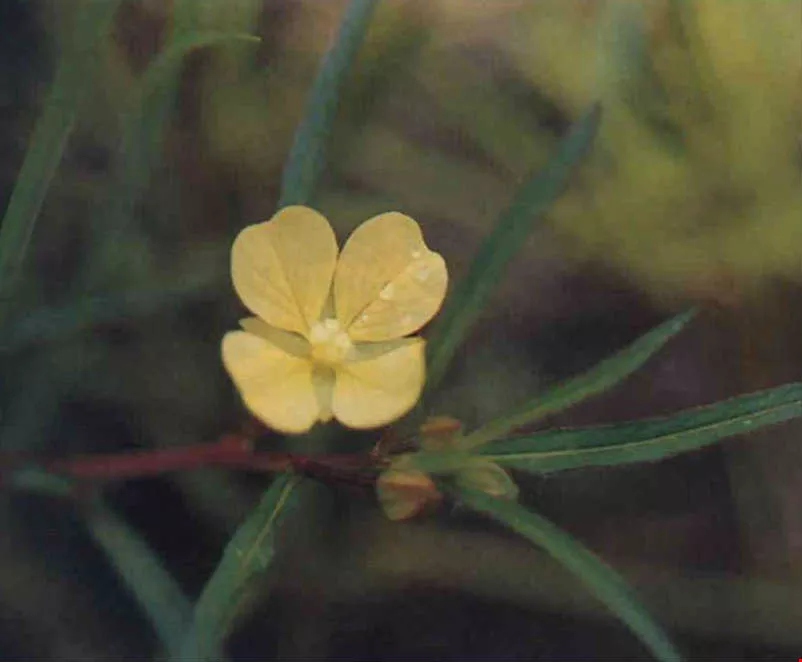
Over 300 species of aquatic plants populate Lin Chun-chi's paddies, including (shown left to right above) the Taiwan brandy bottle, water hyacinth, lantern seedbox, and water snowflake.
European chinoiserie
Peter Sung says he got the inspiration for the silk wall hangings from the Royal Pavilion in Brighton, England. In the 17th and 18th centuries, Europe was swept by a fashion for chinoiserie. This was a "Chinese" style created by Europeans on the basis of their imaginings about faraway China. The Brighton Pavilion, on the south coast of England, is an "oriental" style villa commissioned by the Prince of Wales (later King George IV) and built at the end of the 18th century. Based on the drawings brought back by an artist who accompanied a diplomatic mission to China, the pavilion's designers filled the rustic wall paintings in the banqueting hall with Chinese gentlemen-in-waiting and emperors with strange faces that are neither oriental nor Western. From the ceiling hangs a one-ton crystal chandelier in the form of a gigantic dragon with its tongue lolling out. In other rooms, one finds such things as a porcelain pagoda, lotus-flower lamps, a nodding doll under a large red lampshade, and walls inlaid all over with blue-and-white porcelain. To a Chinese, all these things seem vaguely familiar, yet also bizarre and alien.
Today, as the world grows ever smaller, the Chinese style expressed overseas still has an element of the romance of a declining empire. But the appearance of today's Chinese palaces is no longer so phantasmagorical, and they are no longer reserved for the sole enjoyment of royalty and rich folk. You too can go out of your door, round the corner and into a sumptuously decorated Chinese restaurant, where, under the dim light of a palace lantern, amid wooden screens carved with birds and flowers, you can savor the refined flavors of a Chinese meal served on elegant blue-and-white porcelain tableware, and fulfil your own dream of China.
European chinoiserie
Peter Sung says he got the inspiration for the silk wall hangings from the Royal Pavilion in Brighton, England. In the 17th and 18th centuries, Europe was swept by a fashion for chinoiserie. This was a "Chinese" style created by Europeans on the basis of their imaginings about faraway China. The Brighton Pavilion, on the south coast of England, is an "oriental" style villa commissioned by the Prince of Wales (later King George IV) and built at the end of the 18th century. Based on the drawings brought back by an artist who accompanied a diplomatic mission to China, the pavilion's designers filled the rustic wall paintings in the banqueting hall with Chinese gentlemen-in-waiting and emperors with strange faces that are neither oriental nor Western. From the ceiling hangs a one-ton crystal chandelier in the form of a gigantic dragon with its tongue lolling out. In other rooms, one finds such things as a porcelain pagoda, lotus-flower lamps, a nodding doll under a large red lampshade, and walls inlaid all over with blue-and-white porcelain. To a Chinese, all these things seem vaguely familiar, yet also bizarre and alien.
Today, as the world grows ever smaller, the Chinese style expressed overseas still has an element of the romance of a declining empire. But the appearance of today's Chinese palaces is no longer so phantasmagorical, and they are no longer reserved for the sole enjoyment of royalty and rich folk. You too can go out of your door, round the corner and into a sumptuously decorated Chinese restaurant, where, under the dim light of a palace lantern, amid wooden screens carved with birds and flowers, you can savor the refined flavors of a Chinese meal served on elegant blue-and-white porcelain tableware, and fulfil your own dream of China.
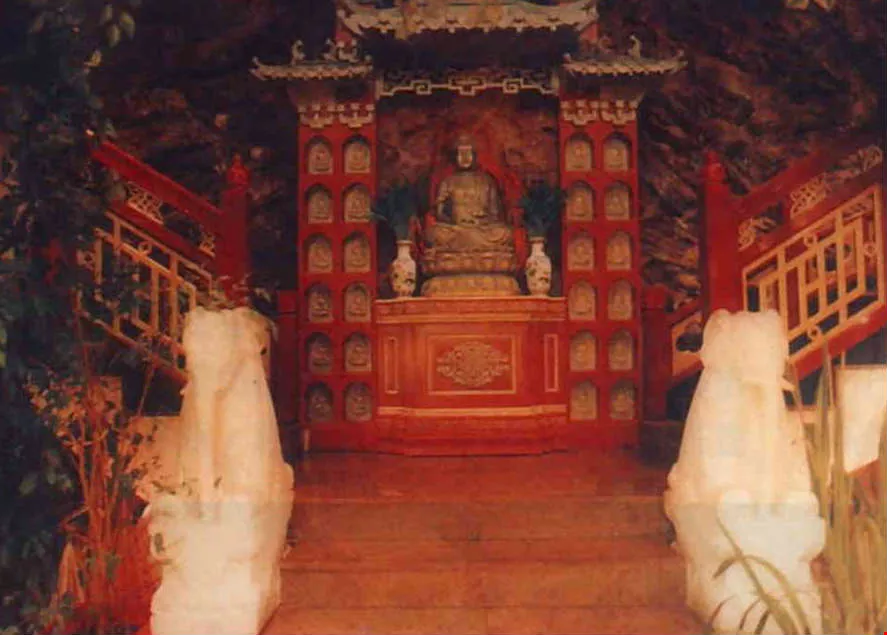
The younger generation's interest in China and things Chinese has prompted overseas Chinese restaurants to begin to shift from carved beams and painted columns to a more casual garden style, or to add some non-Chinese elements to their Chinese decor. In the original stone wall of the La Table de Chine restaurant in Nice, France, Peter Sung created a realistic Buddhist grotto. (courtesy of Peter Sung)
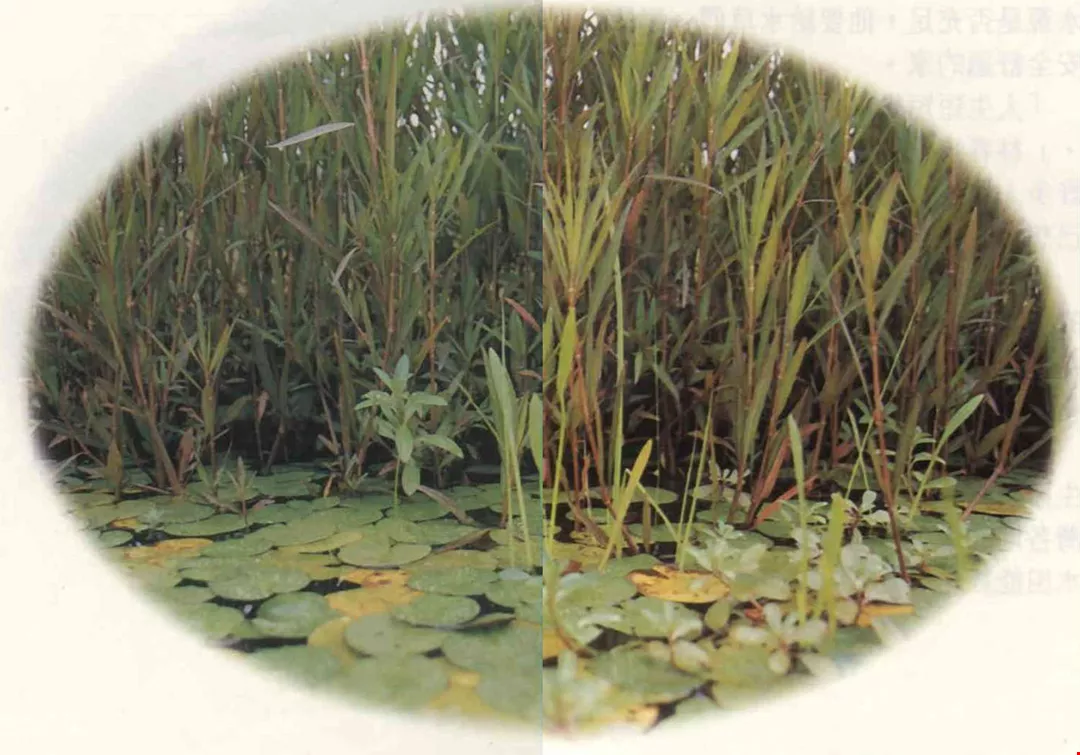
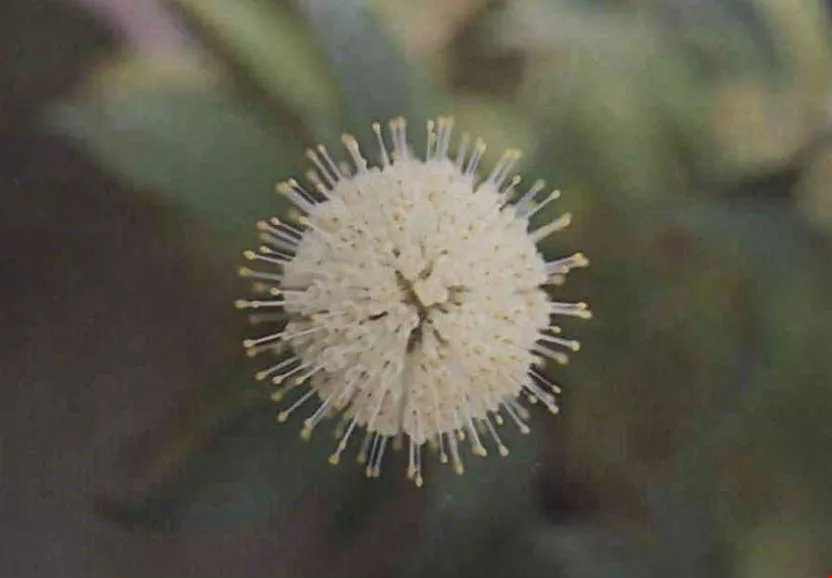
One little pond provides niches for all kinds of plants. Some are submerged or floating, while others are emerged or grow on the banks. Pictured above from left to right are the Gorgon plant, Cuban pondweed, wind box and water fern.

One little pond provides niches for all kinds of plants. Some are submerged or floating, while others are emerged or grow on the banks. Pictured above from left to right are the Gorgon plant, Cuban pondweed, wind box and water fern.
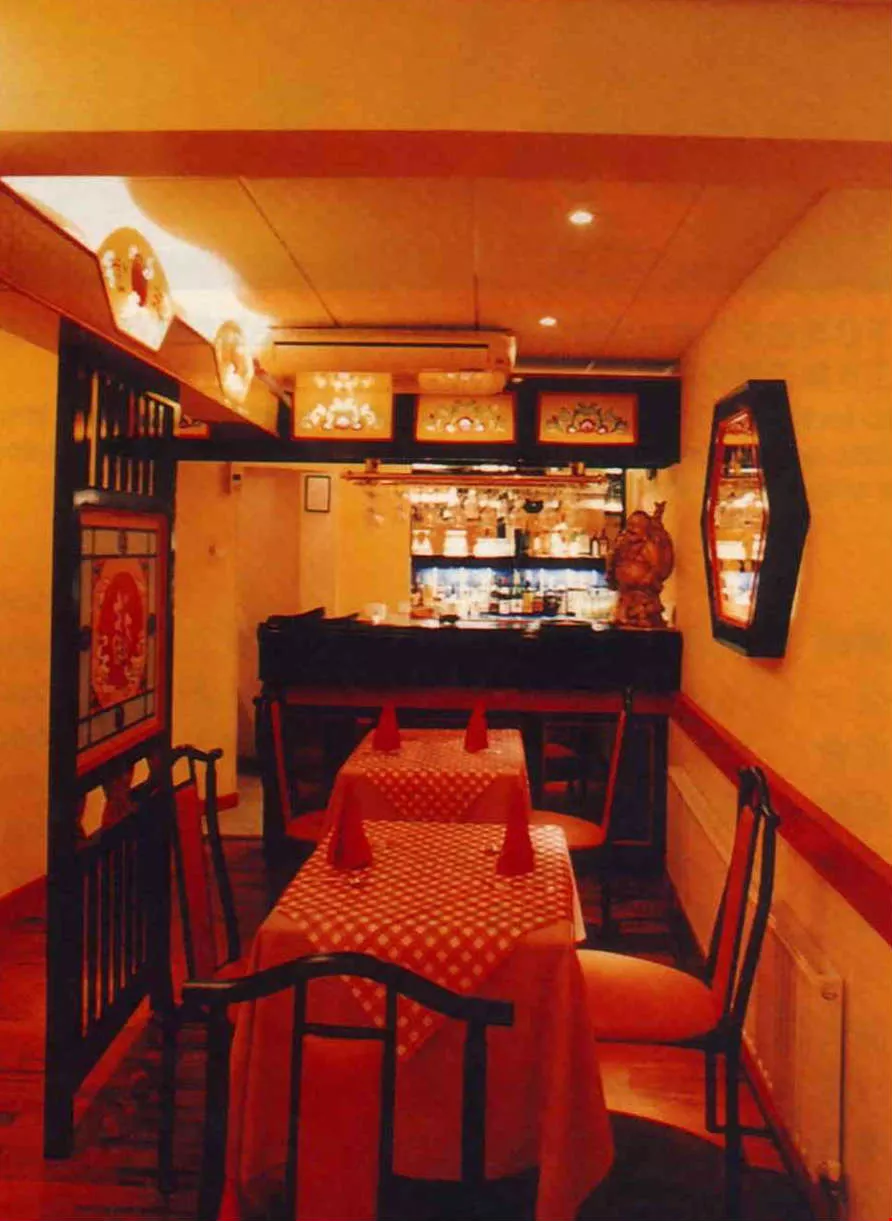
Bright, clean, white walls, a few simple Chinese motifs, red gingham tablecloths, and Ming-style chairs made of steel tubing-this kind of Chinese restaurant is more attractive to young customers. (courtesy of Peter Sung)

One little pond provides niches for all kinds of plants. Some are submerged or floating, while others are emerged or grow on the banks. Pictured above from left to right are the Gorgon plant, Cuban pondweed, wind box and water fern.

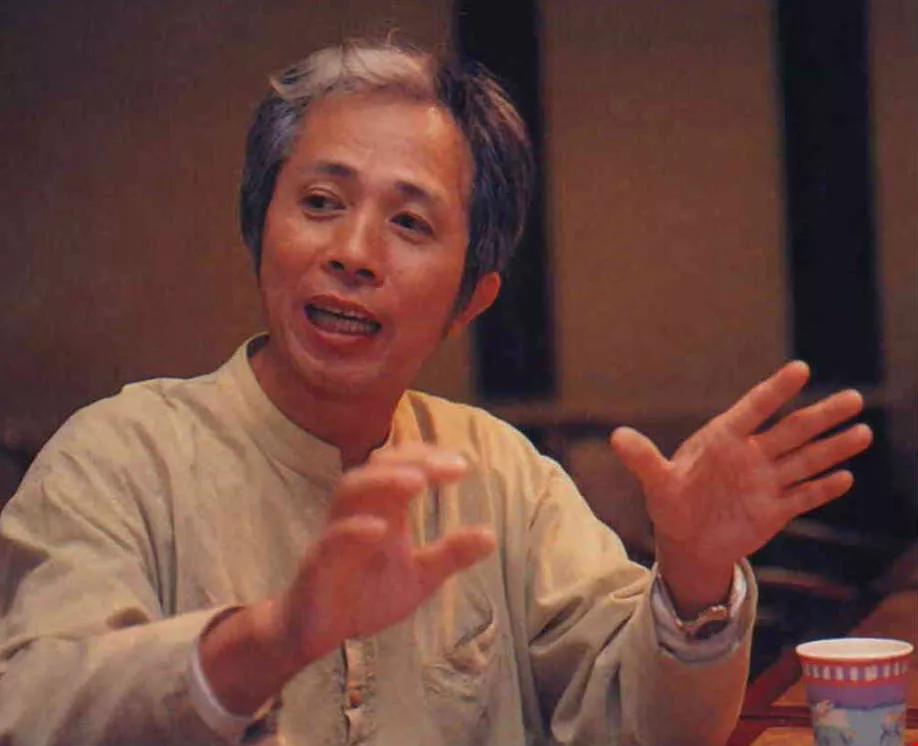
Peter Sung, who took over China Palace from his father, spends most of his time overseas making sales visits and supervising installation. Meanwhile his wife, Feng Hsiao-hua, stays in Taiwan to liaise and manage the factory.
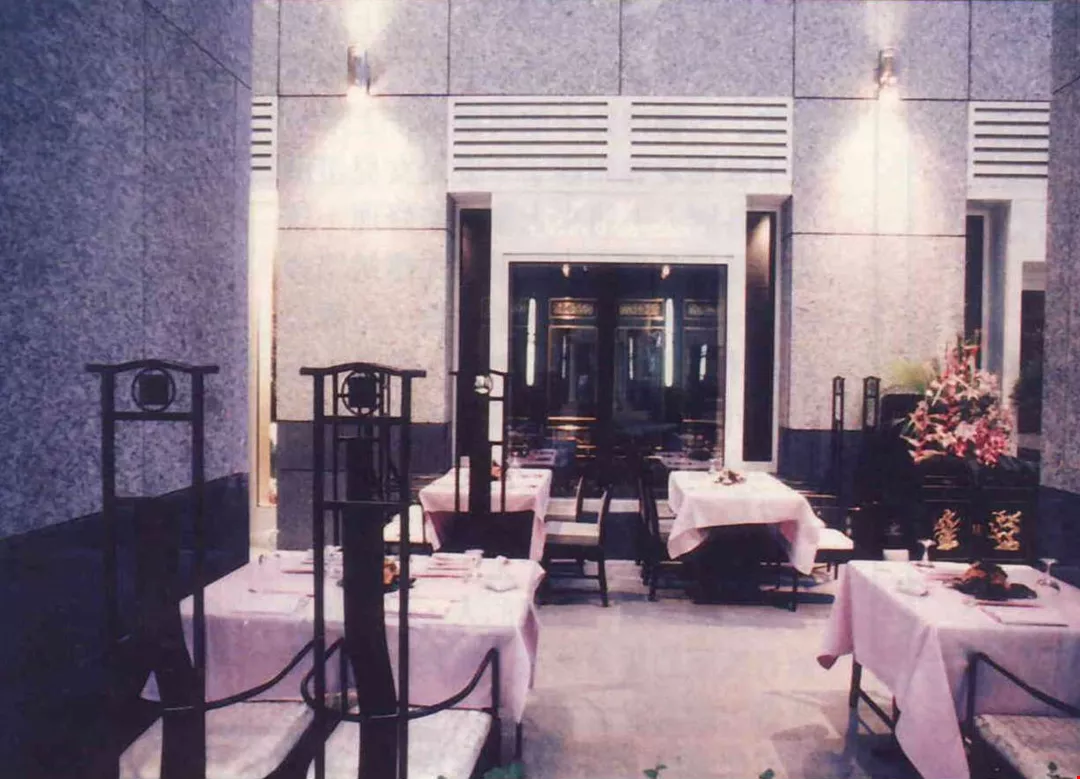
Chinese restaurants designed by Peter Sung and his late father Sung Ying can be found in over 30 countries worldwide, and come in many different styles. The Au Mandarin, on the ground floor of a commercial building in Frankfurt, Germany, has a thoroughly modern feel. (courtesy of Peter Sung)
One little pond provides niches for all kinds of plants. Some are submerged or floating, while others are emerged or grow on the banks. Pictured above from left to right are the Gorgon plant, Cuban pondweed, wind box and water fern.

One little pond provides niches for all kinds of plants. Some are submerged or floating, while others are emerged or grow on the banks. Pictured above from left to right are the Gorgon plant, Cuban pondweed, wind box and water fern.
@List.jpg?w=522&h=410&mode=crop&format=webp&quality=80)


