Taiwan's Comic Renaissance
Wang Wan-chia / photos Chuang Kung-ju / tr. by Geof Aberhart
December 2010


Since July 2010 the Taiwanese comic industry has been buzzing!
First was the news that rising star in Taiwanese comics Ponjea would be working with master mangaka (Japanese comic artist) Riichiro Inagaki on the one-shot Kiba & Kiba, which also marked the first time in its 42-year history that legendary Japanese comic anthology Weekly Shonen Jump has published the work of a non-Japanese artist.
Then came word that the once-popular blockbuster tale of hot-blooded high-schoolers Young Guns was, after a 12-year hiatus, finally going to be wrapped up by author Lin Cheng-te, at last giving long-suffering fans a sense of closure.
At the same time, Lin Lijing, a comic artist living in France, had coordinated a team of 15 Taiwanese comic artists old and new, including creator of Orz Boys Wang Dengyu, to publish an anthology called Taiwan Comix. This anthology was warmly received at the Angouleme International Comics Festival, and has been Taiwan's first serious foray into the European comic-book market.
Up-and-coming comic artist Shen Yingjie-better known by her penname "Akru"- has, meanwhile, been working on her book Wings of Kopule, telling the tale of a 19th-century English botanist who, in investigating a legend of great beauty and sorrow, is brought to Formosa. This fascinating fantasy, weaving together the lives of both Han Chinese and Formosan Aborigines living deep in the Central Mountain Range, is drawn with deft, delicate, and clean strokes and evokes the quiet beauty of the setting while also showing the influence of the author's major in anthropology by detailing the customs and lifestyles of the time. This year, the comic went into its fourth printing.
After the early days of Zhuge Si--lang and Great Auntie and -Smartie, through Ao Youxiang's Oo-long Yuan and the detailed inkwork of Chen Uen, more recently Taiwan's comic market has seemed to have fallen asleep, but as this good news begins to pour in, could Taiwan's long-struggling comic artists finally be enjoying a new time in the sun?
As the first Golden Comic Awards, organized by the Government Information Office, came to a close in July 2010, head of the judging panel Chen Zhi-hua noted that between January and September of 2009, 3,359 different comics were available in the Taiwanese marketplace, with Japanese manga accounting for 95% of that number, followed by 4% from Hong Kong. Of those 3,359 comics, only 35 were Taiwanese. That Taiwanese comics comprised only 1% of the comics available in Taiwan might leave one wondering where Taiwanese comics have gone.
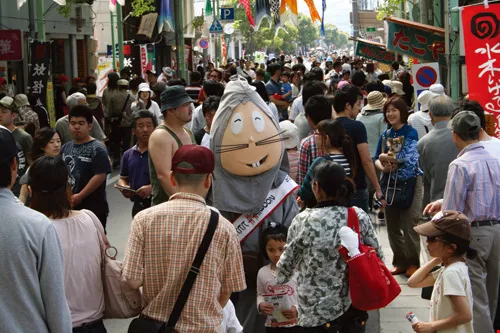
Japan's Sakaiminato City has become a popular tourist destination for manga fans. Below is a statue of the title character from GeGeGe no Kitaro, while on the opposite page Nezumi-Otoko, from the same series, walks the streets as a tourism ambassador, adding color and character.
According to Neil Chen, editor-in-chief at Taiwan's leading comic publisher Tong Li Publishing, the 1990s were a golden decade for local comics. Artists like Chen Uen, Xiao Yan-zhong, Ao You-xiang, and Lin Cheng-te were in the ascendant, and their comics both sold in massive numbers and covered a wide range of styles. One issue could easily sell more than 100,000 copies; now, just breaking 10,000 is considered an accomplishment.
Then there's Cai Zhi-zhong, whose Hundred Schools of Thought has been published in 44 languages and 55 countries, and Chen Uen, whose distinctive inkwork has seen him succeed in Japan with To Shu Ei-yu-den, published in weekly magazine Morning by publisher Ko-dan-sha, and which has been acclaimed by publisher and readers, as well as earning Chen an award from the Japanese Cartoonists Association, making him the first non-Japanese to receive one.
Chen Chung-wei, assistant professor of manga culture and history at Feng Chia University's Center for the Studies of Everyday Life, says that the main factor behind Taiwan's comic boom of the 1990s was the success of licensed comics; with the passage of the new Copyright Act in 1992, Japanese comic publishers began selling licensing rights to Taiwanese publishers in order to stifle the market for pirated comics. These licensing agreements led to comics from anthologies like Weekly Shonen Jump and Weekly Shonen Magazine being repackaged and published in Taiwan in collections like Formosa Youth and New Youth Express. In order to foster "localization" within the books, the Japanese publishers also began to ask their Taiwanese counterparts to include Taiwanese comics, with the books containing between 20 and 50% Taiwanese content. The Taiwanese publishers also began holding "Best Newcomer" awards, as well as signing Taiwanese artists to lucrative contracts and actively fostering local talent. In turn, specialist comic shops and comic rental chain stores began to spring up everywhere, further driving the development of a strong comics culture and pushing Taiwanese comics to their peak.

Zhang Shixin (right) and a self-portrait (left).
Over the past decade, though, the glory days of Taiwanese comics have faded, and today they're almost at rock bottom.
In broader terms, since the turn of the millennium, publishers worldwide have had to contend with a poor economy, rising paper prices, and the impact of the Internet, particularly given the overlap between comic fans and avid Internet users. Online entertainment, including online games, has begun eating into potential readers' collective attention, and the ability to freely share information online has taken a bite out of traditional publishing profits.
This is particularly so with the large number of Chinese websites providing pirated comics for free online reading; when an issue hits Japanese store shelves, by the next day it has already been scanned, translated, and uploaded by avid fans, a process much more efficient than traditional publishing. This has hit retailers and rental stores especially hard, with many going out of business, and the number of comic magazines on sale has dropped from a peak of over 30 to fewer than 10. The visibility of Taiwanese comics is getting lower by the day, and once-popular artists have decided to either try and crack the mainland Chinese market (e.g. Ao You-xiang and Xiao Yan-zhong) or move into the gaming industry (like Chen Uen).
Chen further adds that in the 1990s it seemed like there was no end to the money to be made, and so aside from the big names, there were also a number of poorly made titles published as money grabs, ultimately getting both a poor response from the market and hurting local impressions of and confidence in Taiwanese comics amongst local fans.
At the same time, Japanese comics continued to come in en masse, including triple-A classics like Dragonball, Slam Dunk and Yuyu Hakusho, changing the tastes and expectations of Taiwanese readers. "As soon as a new Taiwanese comic came out, fans would immediately compare it with the latest from Japan, which is absolutely asking much too much from such a young medium," says Chen. As readers' expectations got higher, so did the damage, and ultimately they became so disillusioned they were no longer willing to support local comics.

(right) Selena Lin and Shen Yingjie represented Taiwan at the Festival International de la Bande Dessinee de Chambery in France. On show were over 300 original Taiwanese works, along with 40 scripts, in an effort to have Taiwan's voice heard on the international stage. At left, an image from Shen's Wings of Kopule.
Neil Chen believes that in order to revive Taiwan's comic market, building a comprehensive supply chain and providing a platform for talent will be crucial.
He notes that comics are an easy thing to get pulled into, and even when the economy is at its worst, there will never be a lack of aspiring comic artists. However, passion alone isn't enough to build an industry-there needs to be a tight-knit, professional industry supporting these artists, from editors and writers to assistants and even agents. Such support can smooth the process of taking a comic from inception to reception, and it is just this kind of support that the industry in Taiwan has long most lacked.
Chen Chung-wei points to the detailed division of labor in the Japanese industry as an example: comic editors are trained for four or five years, learning the language of the industry (including storyboarding and the appropriate use of sound effects), how to communicate with mangaka, how to draft proposals for new comics, and many other things. A successful editor must not only be able to determine trends in the market and in readers' preferences, but also be able to make scenario and plot suggestions when needed, helping the mangaka avoid falling into their own blind spots or getting too ambitious with their scripts and being unable to finish them.
Yang Chung-wei, publicist-general for Sharp Point Press, says that today, the majority of Taiwanese comic artists have been left to go it alone, unable to afford assistants and taking on sole responsibility for writing, drawing, making sure everything proceeds to deadline, and all sorts of other miscellaneous things, making it hard to concentrate on the books themselves.
In Japan, as soon there are signs a comic is going to hit the big time, even if it's just a serial in the print media, all kinds of aspiring coattail-riders from the animation, merchandising, ringtone, and other industries will immediately come knocking, looking for cooperation or licensing. Such sideline opportunities can bring in far more revenue than simple publishing, and the market will quickly help the mangaka in question reap profits. However, the case is much different in Taiwan, which lacks a similarly linked side industry.
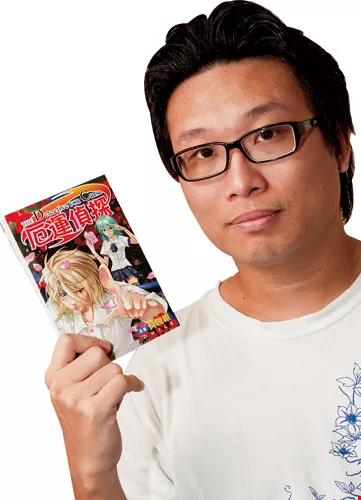
Mangaka Huang Chun-wei and his book The Detective for Curse, and a self-portrait by the artist (right). On the left is an image from a his new series Ominous Star.
On the other hand, Neil Chen believes that the serial comic, as a platform, can reintroduce readers to Taiwanese comics, and is the best way forward from here. Not only will having the latest installments available each and every week help keep readers interested, artists can use the feedback from each issue to make adjustments to their original plans, while by sharing the same publication with well-known artists, new artists can have their works exposed to more readers, and market mechanisms will lead to old, largely unread series being replaced by new ones.
Look at Japan's most competitive magazine, Shonen Jump: that magazine uses reader ratings as their main measure for whether to cut or extend a given series. Each volume of Weekly Shonen Jump runs for 20 issues, and if a title ranks near the bottom for multiple volumes, it is virtually inevitable that it will get the chop.
On the other hand, sometimes a title is so popular it almost never drops in its ratings, such as was the case with manga legend Akira To-ri-yama's Dragonball. Even when the artist actually wanted to wrap the story up, the massive popularity of the title meant that its cancellation could even have impacted the stock price of publisher Shueisha, hence Dragonball ended up running for a full 11 years, from 1984 to 1995. Another title, One Piece, which tells of the adventures of a group of pirates, has been published for 13 years to date; not only has it remained one of the most popular titles in Jump throughout, the last few issues have even sold over 3 million copies on their first printings, setting a new Japanese record and becoming part of the collective heritage of comic fans around the world.
Many publishers in Taiwan have thought similarly about using magazines to foster new talent, and several have put out a few issues, but ultimately their runs have been short and they haven't found a market, ending up disappearing without a trace.
According to data covering 2000 to 2010, a total of 28 new comic magazines came out, including Go Comic Creativity, the brainchild of Lai You-xian, artist and president of the Taipei Comic Artists Labor Union; Comic Lottery Monthly, edited by artist Ren Zheng-hua; and Challenger Monthly, which started life in print and moved online. Of these, 16 have been discontinued, each running between one and three years, and with no title having made it past five years. And so you can see that even for the most spirited challengers, that Taiwanese comic publishing industry is still a serious test.
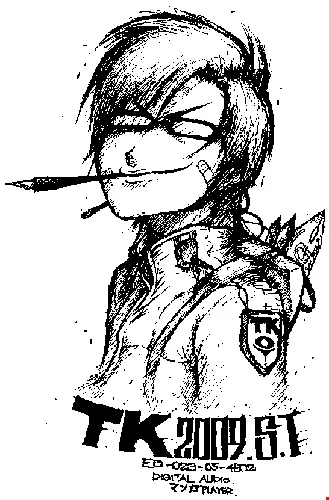
Zhang Shixin (right) and a self-portrait (left).
But even in these cold, dark days, there are still passionate publishers using their particular skills and strategies to publish dazzling works from time to time.
Primarily child-oriented comic publisher Ching Win Publishing has had a hit with Zhou Xianzong's Ori-gami Warrior, which has been in publication since 1996 and has sold millions of copies throughout Asia. In 2006, Korea's Dong Woo Animation worked with Korean television network SBS and others to make a US$6-million animated adaptation of Ori-gami Warrior. The series has already screened in South Korea, Singapore, and Hong Kong, but only secured an interested Taiwanese broadcaster as recently as November 2010.
Meanwhile Sharp Point Press, a specialist in shojo (a Japanese genre of comics catering to teenage girls), has found period-piece artist Selena Lin, who has already published more than 10 titles, including String of Blossoms, Burning Moon, and An Imperfect Woman, which have found popularity in Europe and the US for their "oriental impressionist" style. Her works have been licensed in France, Germany, Spain, and several countries in Southeast Asia, as well as being invited to take part in the Leipzig Book Fair in Germany. Lin, along with Shen Ying-jie, has been invited to represent Taiwan at 2010's Festival International de la Bande Des-sinee de Chambery, France's second biggest comics show.
Tong Li Publishing, a long-time promoter of local comics, has published over 100 new artists in their compilations Dragon Boy and Star Girl, and they too have faced the problem of a lack of experienced writers. They chose to tackle the problem a different way, commissioning artist Cai Hong-zhi to adapt popular online writer Yu Wo's novel Half Prince, not only receiving a warm welcome, but also quickly reaching the top ranks of Tong Li's publications, even outselling well-known Japanese comics Kek-kai-shi, Ya-ki-tate!! Ja-pan, and Fairy Tail.
Local problems aside, Taiwan's comic industry also faces a formidable challenge from its Asian neighbors.
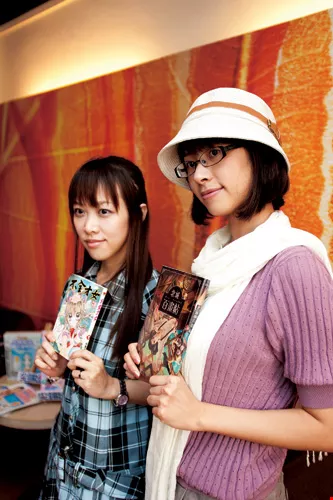
(right) Selena Lin and Shen Yingjie represented Taiwan at the Festival International de la Bande Dessinee de Chambery in France. On show were over 300 original Taiwanese works, along with 40 scripts, in an effort to have Taiwan's voice heard on the international stage. At left, an image from Shen's Wings of Kopule.
Japan, with a 300-million-strong market for its comics and a long comic tradition, has an industry that generates more than US$6 billion a year, and which has won over young people around the world, earning Japan the title "king of comics." According to a New York Post report, the graphic novel market in the United States generates about US$330 million a year, and of that, Japanese comics account for US$250 million!
The highly refined techniques aside, Japan has further cultivated talent through academic programs, the largest of which is the Faculty of Manga established at Kyoto Seika University in 2001. Turning this five-decade-old entertainment industry into a formal line of research has not only given aspiring mangaka an academic option, it has also helped train writers and editors through its Department of Manga Production. Mangaka Keiko Takamiya was invited to serve as the faculty's dean, bringing with her practical experience as well as theoretical ideas, and so helping speed up the development and growth of this cultural asset.
And then there are so-called "comic towns," many of which can be found across Japan; one such place is Osaka, home of "God of Manga" -Osamu Te-zuka, the artist behind Astro Boy and Blackjack. A museum dedicated to Te-zuka was opened in the city in 1994, and has thus far had an average of 800 "pilgrims" come through its doors every day. Walking in, your eyes are met with images of the handprints and signatures of Te-zuka's iconic characters in an imitation of Hollywood's Walk of Fame.
Many other governments, including those of China, South Korea, and Malaysia, have begun to support the growth of their animation industries, combining massive manpower with big budgets in shows of tremendous ambition.
In China, for example, since 2004 not only has the Ministry of Culture been investing NT$900 million annually into the local animation industry and relevant academic programs, the city of Hang-zhou has been declared China's "cartoon capital," attracting a high level of creative talent, including inviting popular Taiwanese artists like Cai Zhi-zhong and Zhu De-yong to take up artist-in-residence positions and offering detached studios beside the famous West Lake to help keep the creative juices flowing.
On top of this, the Hang-zhou Municipal Government announced last year that it would invest about NT$1.3 billion in building a museum to Zhu De-yong, a Chinese animation museum, artists' studios, and tourist facilities, all in the Lake -Baima area, establishing a "creativity park" spanning almost 15 square kilometers.
The South Korean government is also investing heavily in the comic and animation industry, committing NT$22 billion to supporting animation and comic publishing, as well as offering tax breaks and giving young cartoonists exemptions from military service to pursue their careers.
In the face of such ambitious actions, what does the Taiwanese market have to offer, and how should Taiwan respond?

Artist Lin Minxuan walked away from 2010's inaugural Golden Comic Awards with two awards. Here we see Lin and a standee for her title Oh! My God, as well as a self-portrait by Lin (at left).
"Taiwan's still in with a shot," says Yang Chung-wei, who has himself attended Chinese animation shows on several occasions. Right now, the Chinese animation industry faces issues of a lack of creativity, a monotony of themes, and a lack of brand awareness; Yang cites several major animation shows in China, where pirated copies of Japanese cartoons abound, and some places even proudly state that they sell pirated versions, going head-to-head with legitimate licensees.
As such, Yang believes that Taiwan, with a more established civil culture and its greatest asset-its talent-can produce works that are higher quality, in terms of both production and content. However, he estimates that China could well catch up in as little as five years.
Putting on his academic cap, Chen Chung-wei says that there has long been a lack of serious research into Taiwan's comics, and the relevant data is slipping away rapidly, so he has promoted the idea of "comic culture academies" similar to the programs offered at Japanese colleges, to promote the viewing of comics as a legitimate form of cultural expression and the understanding of comics as cultural assets.
At the same time, the rise of globalization and of digital publishing means that future publishers will have to investigate the many digital platforms and look for opportunities to get into overseas markets. Domestic publishers can no longer rely solely on serving as agents and licensees, but rather must develop local content to remain competitive.
The Chinese Comic Publishers Association, composed of 70 publishers and distributors and Taiwan's largest comic-industry organization, called for this year to be "the first year of Taiwan's comic renaissance," actively promoting domestic and foreign trade shows and publishing deals, as well as working to raise the visibility of Taiwanese comics in local bookstores in order to help encourage a resurrection for the local industry.
Neil Chen, editor-in-chief at Tong Li Publishing for two and a half years, is optimistic. He believes that whether times are good or bad, the low barrier to entry for comics-which can "touch the world with just a pen and paper"-means there will always be opportunities. Chen also emphasizes the importance of training editors and improving the quality of writing to help stem the loss of confidence in Taiwanese comics amongst local fans. Such things may seem like only small improvements, but over time they will be beneficial to rallying the troops in the industry.
"The worst of times can also be the best of times," he says. As Taiwan's comics begin to thaw after a long cold snap, and the industry begins to look ahead to a renaissance, ambition and action are coming together to usher in a new golden age for Taiwanese comics.
1.Lin Minxuan
Lin Minxuan was the big winner at the inaugural Golden Comic Awards, walking away with the Best Shojo Comic and Best Comic- Grand Prize gongs for her book Chicken Cutlet Princess. Against a senior-high backdrop-a fixture in the shojo genre of -manga-Lin tells the tale of a group of students who form a school club to buy and enjoy chicken cutlets from local night markets, as well as making their own, a scenario that lends itself well to her slapstick style.
Lin drew inspiration from her own experiences seeing publishing company colleagues coming together for occasional group-buys of chicken cutlets for afternoon tea and how this would liven up the otherwise dour faces of her workaday workmates. The judging panel praised Lin for her ability to smoothly integrate Taiwanese cuisine into the story, giving it a more local flavor, and for her subversion of the usual tropes of shojo manga.
2.Zhang Shixin
Better known by his penname, T.K., Zhang Shixin got his start as a winner of Tong Li Publishing's Newcomer of the Year award. His debut title, Skanda, is based on an ancient Indian myth of battles between the gods, but in this incarnation the scene of the battle is Taiwan. As such, its backdrops include areas such as Yi-zhong Street and the National Museum of Natural Science in Ta-ichung, and Chang-hua's famous Big Buddha, making the story feel closer to home for Taiwanese readers.
3.Huang Chun-wei
Twice nominated for the Graphic Novel Awards-the predecessor to the Golden Comic Awards-Huang Chun-wei has worked as an assistant to a number of mangaka, as well as having vast experience with drawing and teaching. Many readers have remarked that his art has a more refined style and that it more than stands up to the level of Japanese artists. His title The Detective for Curse involves detective-mystery subject matter, something rarely seen in Taiwanese books.
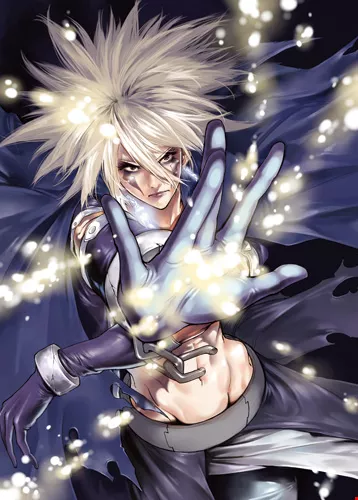
Mangaka Huang Chun-wei and his book The Detective for Curse, and a self-portrait by the artist (right). On the left is an image from a his new series Ominous Star.

Artist Lin Minxuan walked away from 2010's inaugural Golden Comic Awards with two awards. Here we see Lin and a standee for her title Oh! My God, as well as a self-portrait by Lin (at left).
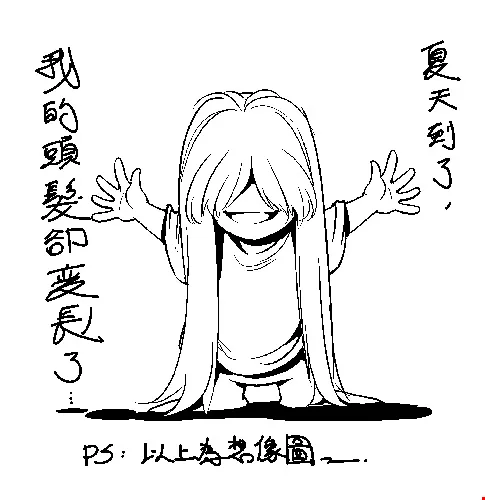
Mangaka Huang Chun-wei and his book The Detective for Curse, and a self-portrait by the artist (right). On the left is an image from a his new series Ominous Star.
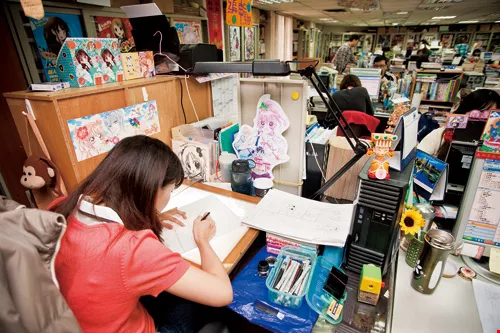
Lin Minxuan, hard at work in the editors' office. She says that this is the only kind of environment that can drive her to finish comics on time.
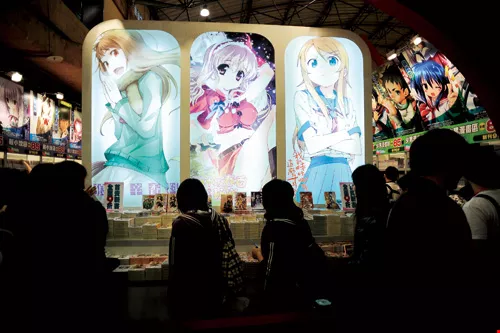
No matter what troubles the -publishing industry may face, Taiwan will always have a cadre of diehard comic fans. At left, a scene from the 2010 Comic Exhibition in Taipei, which over six days attracted a record 540,000 visitors. Below, an image from Lin Minxu's Oh! My God.
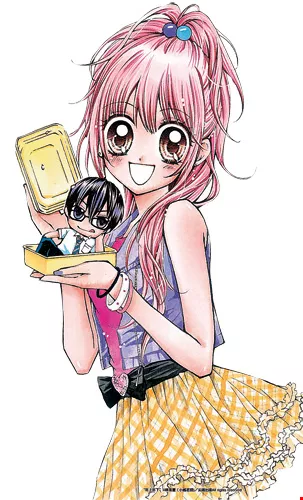
No matter what troubles the -publishing industry may face, Taiwan will always have a cadre of diehard comic fans. At left, a scene from the 2010 Comic Exhibition in Taipei, which over six days attracted a record 540,000 visitors. Below, an image from Lin Minxu's Oh! My God.

Japan's Sakaiminato City has become a popular tourist destination for manga fans. Below is a statue of the title character from GeGeGe no Kitaro, while on the opposite page Nezumi-Otoko, from the same series, walks the streets as a tourism ambassador, adding color and character.


