

Taiwan has been described as "a reader's paradise, a publisher's inferno." Over the last 20 years, as the economy has grown, the publishing industry has also experienced rapid expansion, with the number of publishers increasing from the hundreds to the
thousands. Taiwan, with a population of only 23 million, comes out with more than 40,000 new titles a year, which puts the island second in the world in new titles per capita. Even given the economic downturn of the last couple of years, bestsellers have still been moving out of bookstores by the hundreds of thousands of copies, and there are chain bookstores everywhere. If reading is an indicator of a society's level of culture, what do these statistics, which suggest great vitality, really tell us?
In this age of chaos, only books can really make one feel on firm ground.
When the United States launched its attack on Iraq, books on relevant subjects went from a few scattered selections to whole shelves. You can now find a biography of Saddam Hussein placed in the most prominent display cases in bookstores. Those readers who don't care to follow the barbarity and vapidity of ever-changing news events, and who don't care to become prisoners of the hidden values of the mainstream media, can find books that will give them an understanding of the origins of the war at the historical, cultural, religious, and ethnic levels.
Meanwhile, many people in the Chinese-speaking world were undoubtedly shocked by the suicide of Hong Kong superstar Leslie Cheung. Besides commemorating him, why not also take a look at books that advise one on how to deal with tragedy, depression, and the transitory nature of life. Besides helping you to cope with Cheung's tragic ending, you can also learn what to look for to see whether any of your friends or family are in similar difficulties. And if you want to understand more about the meaning of death, you can read from among the many philosophical works on this subject.
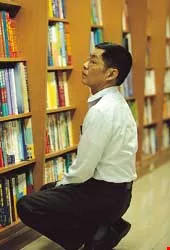
Choosing a suitable posture and location for reading enhances the pleasure of your knowledge feast.
Number two in the world
Whatever kind of book you may want, for whatever logical or emotional reason, all you have to do is go to a bookstore, and you can rapidly find something that meets your needs. Books can take us far from home, or be the best companions on inner spiritual journeys. Readers living in Taiwan should definitely feel fortunate, because on the global publishing map, Taiwan ranks number two in the world in publication of new books per capita, trailing only the UK.
Generally speaking, the more prosperous the economy and the more advanced the civilization in a given country, the more books that country will produce. France and Italy each come out with about 50,000 titles a year, Japan 60,000, and the US, with a population over 250 million, 80,000. In the UK, with a population two-plus times that of Taiwan, the number of new books published in a year is an amazing 120,000, putting that country at the top of the global list for publishing volume.
The number of new books is an indicator of the level of culture of a society, but given the size of Taiwan's market, is the publication of 40,000 new books each year a cultural miracle, or a social disaster? There are different interpretations. But how is it that even in an economic downturn, when the publishing industry is in turmoil, the number of new books is rising, not falling?
According to the International Standard Book Number Center of the National Library, in 1996, Taiwan published 38,000 new books, in 2001 the figure surpassed 40,000, and last year it reached 43,000.
"Each year 40,000 new books fill the bookstores till they burst, eat up resources, and make it impossible to tell the wheat from the chaff. Readers can't even begin to read them all, and society cannot absorb them. It's a four-way losing proposition: for the industry, readers, society, and the forests," writes Chen Ying-ching, deputy editor-in-chief of the Owl Publishing House and an advocate of the "disaster theory," on his personal epaper Reference News for the Publishing Industry.
"From this year's Taipei International Book Fair, you can see that publishers are under tremendous pressure to get rid of stock. Everyone was trying to clear out their warehouses, which somewhat distorted the meaning of the book fair," says Chang Huei-fen, editor-in-chief of the Big Tree Culture Enterprise Company, which specializes in nature books.
Compared with the past, the economy is highly developed, and there is much greater freedom of speech. Moreover, costs for publishing are very low, so there are few barriers to entry. "There definitely are too many new books. Anybody can publish a book these days," says Lynn Chen, chief editor at the China Times Publishing Company. "But an excess of books leads to mutually destructive competition, and books that do not sell right away are immediately taken off the shelves. The shelf life of some books is even shorter than a monthly magazine."
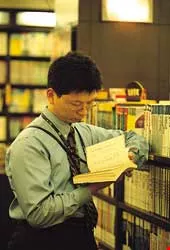
Choosing a suitable posture and location for reading enhances the pleasure of your knowledge feast.
Too many books spoil the market
An excess of new books has definitely had a "squeezing out" effect. "In the past, new books at least had a chance to be seen. They would be put on display in bookstores for two or three weeks, and only then, if they didn't sell, would they be returned to the publisher. But these days it's gotten so bad that a book won't even get exposure on the market. Supply and demand are out of harmony and the market is saturated," opines Yin Ti, director of Elite Books Publishing Company, in his book Yin Ti 2002. This is why China Times Publishing, which produced more than 250 new titles last year, plans to cut output by 10% this year.
But is it really a smart move to reduce the publication of new books just because society cannot digest, nor bookstores find space for, them all?
"The problem is not publishing volume, but redundancy," says Jack Lin, associate manager of the Sales Department at Commonwealth Publishing Company. For example, if you go to the travel section, you can't even count the number of books introducing Tokyo, whereas readers generally buy only one.
Many people agree that as Taiwan's publishing industry takes an increasingly global perspective, the number of new books will only increase. Thus, publishers must consider how each title will be able to find the readers interested in reading it. But where are the readers? What do they like? And how big is their appetite for reading?
In remarks celebrating Publishing Day at the end of March, Yang Jung-chuan, director of the Publisher's Association of the ROC, stated that "mainland fever" has created a structural shift in the reading population. An estimated 500,000 Taiwanese businesspeople have gone to mainland China. If each one of these persons, who are part of the social group that does the most reading, only spent NT$5,000 a year on books, then the loss to the publishing industry would be NT$2.5 billion.
In July of 2001, Net and Books magazine released the results of a survey on reading habits in Taiwan's main urban areas. The survey discovered that in the three metropolises of Taipei, Kaohsiung, and Taichung, 37.7% of respondents said that they had not read a book within the previous month. Among readers, the average time spent on reading each day was 1.9 hours, still less than the 2.8 hours spent watching TV. The survey points out that the main reason given for the reduction in reading time is, "I am too busy" (64%).
But if the reading population is really falling, how can the market support 40,000 new titles per year? Thus some people do not agree with the theory that the reading population is in decline.
"The number of educated people in the country is continually increasing, and you can see from the fact that overall revenues in the publishing industry have not significantly declined that the number of people who buy books is by no means falling," concludes Whale Lin, senior web consultant at Yuan-Liou Publishing, who often exchanges views with his colleagues online. It is not that readers have disappeared, but rather they are being carved up among more niche publishers. Taking novels, for example, in the past there were fewer types, but now we have martial arts novels, detective novels, mysteries, science fiction....
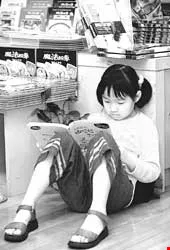
Choosing a suitable posture and location for reading enhances the pleasure of your knowledge feast.
The diversified literary garden
It's interesting that even as serious writers constantly complain that the number of people who read literature is falling, and it has even been said that "literature is dead," the Net and Books survey shows that literature is still the number- one choice for urban readers (16%), followed by recreation (15%), investment and money management (13%), self-help and biographies (10%), and books related to computers or the information industry (9.6%).
"Literature still touches people most closely," says Commonwealth's Jack Lin. "Many people read it, and many people are writing it. It's just that there are a lot more books competing for the same audience, so each book sells fewer copies."
When you go into a bookstore, in fact, the bestseller display still includes plenty of well-known writers of fiction, old and new, foreign and domestic, and literature still occupies a large amount of overall shelf space.
During the 1980s, the glory days for literature in Taiwan, fans concentrated their affections on a small number of writers, but with changing times, the favored writers of the past have fallen into disfavor, and have been displaced by new arrivals on the scene.
However, one of Kingstone Books' list of the ten most important news items of the previous year related to the publishing industry was: "A re-shuffle in publishing, main players change direction, new stars appear." The identities and directions of the new players in the reshuffled game appear to confirm literature's unassailable position.
For instance, the Sino Cultural Enterprise Company, established last year by Kuo Chun-hsin (who was previously at Owl), embraces publishers like ECUS, La Gauche, Walkers, and Monkey under its flag. Chen Yu-hang has left Rye Field and launched a new campaign at iFront Publishing, the poet Chiao Tung has founded Fish and Fish Publishing Company, the writer Lo Chih-cheng has established Reading Planet, and Chu An-ming has taken over at Ink Publishing.

Choosing a suitable posture and location for reading enhances the pleasure of your knowledge feast.
Keeping the faith
These publishers, who have brought rich literary characters and backgrounds to their new professions, have all made literature the main focus of their publishing lists. For example, Fish and Fish is coming out with a "Literary Garden" series, producing a battery of highbrow works by noted authors all at once. The first work from iFront is by the mainland writer Wang Anyi, and iFront is also about to issue a series entitled "Literature of the Century" under the supervision of Cheng Shu-sen, who has a PhD in Comparative Literature from the University of California, the first work of which will be a collection of writings by Virginia Woolf.
One can't help but worry a bit about the boldness of these literati during an economic downturn. Lo Chih-cheng, every inch the poet in appearance, emphasized at the press conference marking his company's founding: "I am going into publishing because I hope, in this barbaric age of cultural regression, to find a group of local book-lovers who will feel that they are not alone, that they have kindred spirits." He also quoted the words of senior publisher Hao Ming-yi: "Publishing is a cumulative enterprise. Certain kinds of books have long publishing lives, and naturally will accumulate a certain group of readers." Lo says the fact that collected volumes of the poems of Hsia Yu still sell 10,000 copies a year in bookstores has been very instructive for him, persuading him that good books will always attract readers. He believes that the relationship between publishers and readers can transcend the usual company-consumer relationship, to be more like a cultural group with common ideals and preferences.
The publication of literature has a long history in Taiwan, and now more territory than ever is being covered, making for a mature reading market. "A mature market is good for readers," avers iFront's Chen Yu-hang, "because they have a lot of choices." Diversification has changed the definition of literature. Now you not only have poetry and novels, but also "sports literature" and "travel literature." The world is so big, and there are so many books, that today it is virtually impossible to find a category in which no one is writing.
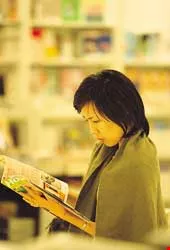
Choosing a suitable posture and location for reading enhances the pleasure of your knowledge feast.
Playing the lottery
However, increasing openness in society, widespread education, and diversification of reading material all mean more intense competition as well. Companies have no choice but to keep putting out new material, with the result being that many books have become "commodities" that are here today and gone tomorrow.
Because the economy has been on the skids these last two years, bookstores have been returning books like mad, yet new books keep coming out in growing numbers. Some describe this situation as being like the lottery, because as every lottery player knows, the more tickets you buy, the better your chances of hitting the jackpot. So publishers put their heads down and plow ahead, hoping that they can get a phenomenal bestseller like Harry Potter or The Lord of the Rings and thereby secure their fortunes in a single blow.
Taiwan's situation of having a large number of small publishing houses means that local companies have to keep cranking out books to remind readers that they exist. Under the circumstances, publishing naturally has tended toward vulgarity and short-term returns, so that now nobodies from the Internet or pop culture celebrities, with only mediocre writing abilities and little of substance to say, are considered "writers."
While publishers do not necessarily agree that putting out new books is "gambling," they all know inside that however much you work to publicize and talk up a book, you can never deliberately make a bestseller, you can only come across one.
"Getting a best-selling book is like the sacrifice of 10,000 soldiers for the glory of one general," says Whale Lin of Yuan-Liou Publishing. You cannot predict bestsellers, or manufacture them, and no one dares to say that his or her book will be a hit. In any given year, it is likely that fewer than ten books will sell 200,000 copies or more.
"A book like Harry Potter, which broke all the publishing records in history, comes along only maybe once in a century," states Jack Lin of Commonwealth Publishing. Last October, Commonwealth invested a great deal of effort in promoting A Biography of Yang Chen-ning. They even invited Yang, a Nobel Prize winner in physics, to return to Taiwan to celebrate his 80th birthday, and this made the headlines in the newspapers. But still sales were much less than expected, at only 15,000 copies. It is difficult for books like this, which are idealistic in orientation, to get on the bestseller lists.
On the other hand, look at the recent phenomenon Execution. Besides the fact that it addresses a major problem in our society today--government and corporations merely describing their goals but failing to act--it was also heavily promoted by the Taiwan publishers. For example, they went on television to talk up the book, held four lectures, and invited scholars and businesspeople to discuss it at seminars. The bottom line: In three months the book sold 100,000 copies.
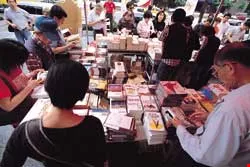
Under a shining sun, street bookstalls draw a crowd.
Thinking in the long term
So bestsellers are few and far between, while no-sellers flood the warehouses. Commenting on the "bad karma" generated by the relentless outpouring of books from the publishing industry, Yin Ti points out that having only bestsellers or no-sellers would be as abnormal as a society having only very rich people and extremely poor people. Thus, there are a few publishing companies that take a more long-term perspective and aim for "long-sellers."
At the Taipei International Book Fair in February of 2003, the organizers invited the directors of small independent publishers from Europe, the US, and Japan to talk about their experiences. The publishers emphasized that small size is not a problem, because small firms have more room to choose the kinds of books they like and at which they are especially good. The real keys to success are creativity, specific expertise, and quality.
In Taiwan, there are quite a few of these "small but beautiful" publishers, of which one of the best examples is Big Tree Culture Enterprise. Most of Big Tree's books are "long-sellers."
Founded in 1993, in ten years of existence Big Tree has only produced 50 or so books, about four to six per year. In comparison with large firms, which put out several hundred new books per annum, they really do seem to be a bit slow. Big Tree chief editor Chang Huei-fen states that Big Tree's priorities are very clear: to serve as a bridge between people and nature. From project planning, to finding writers, to research and taking photographs, to layout and editing, it can take more than one year to complete a book. A book they published on Taiwan's crustaceans includes more than 1000 photographs, all of which were edited by computer, which cost an enormous amount of money and effort.
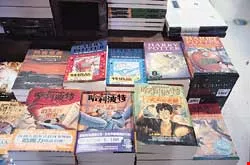
How do you make a bestseller? There is no golden rule to follow. But everybody agrees that books like those in the Harry Potter series, which has swept the world, are the exception.
Small but successful
Because Big Tree is demanding when it comes to paper quality and print quality, their books average about NT$600, or about twice the cost of ordinary books. Although readers often complain that their books are too expensive, Big Tree persuades readers to spend a little extra money because their books can be used over a long period of time and are of higher quality. And they have been successful in this approach. For example, since coming on the market in 1994 The Trees of Taiwan has sold 70,000 copies. And the work 365 Days of Taiwan Wildflowers, released in 1997, has sold 40,000 copies, despite the fact that it costs NT$1300 for the two-volume set.
Based on market response, the lesson from Big Tree is: Stick to what you know best. Chang Huei-fen says that originally Big Tree put out roughly equal numbers of translated books and locally focused books. But they later found: "Translated books got lost in the sauce once they hit the market, because there are too many similar books and the market can't digest them all; it is difficult to set yours apart from the others. So in fact translated books were our weak link." This is why last year Big Tree changed tack, and now concentrates on producing books about Taiwan, written by and for Taiwanese.
Besides books with a local focus, in this hectic modern world, self-help and psychology books that bring calm and peace of mind are also an area with considerable potential for development. "Don't be obsessed with the fact that others are so large, small companies are built up one brick at a time," says Doris Wang, chief editor at Psygarden Publishing Company. A small company like theirs is not in a position to manage bestsellers, with their current editorial staff of seven, they can maintain high quality by coming out with about only two books a month.

Readers can't possibly digest books at the rate at which they are published, while bookstores have to keep running clearance sales to make room for new arrivals
Culture and commodity
Looking at operating revenues in the publishing industry, "the larger the contribution old books make to annual revenues, the more stable a publishing company is," explains Whale Lin. Considered as commodities, books also face the problem of depreciation. Imagine two types of books. One sells 100,000 copies the first year, 10,000 the second year and 1000 the third. The other kind sells 10,000 copies the first year, 8000 the next, and 7000 the one after that. Which of these two kinds of books would company owners like to have more of? The latter, of course. Because if the rate of depreciation each year is so low, there will be correspondingly less sales pressure on the company.
But how can you ensure that depreciation rates do not get too high? That's up to the editorial staff and the quality of the books. Generally speaking, textbooks have the lowest depreciation. Each year new students replace the old, so there are always new readers, and as long as teachers continue to use the same books, then sales will continue in a steady stream over time. In contrast, bestsellers often have an extremely high depreciation rate, especially those that focus on current events, scandals, and pop culture. They might sell more than a hundred thousand copies right off the bat, but once the news or personalities on which they are based fade, they might not sell even a thousand.
Lynn Chen of China Times Publishing argues that publishers should aim for sustainability: "You cannot wait for one superstar to come along, but must endeavor to manage one or two stars in every area." In the upcoming year, China Times hopes that the ratio of operational revenues from old vs. new books can regain the level of the past, at 60:40.

Taiwan's publishing industry is characterized by a large number of small houses, so competition is intense.
Balanced reading
The volume of new books produced around the world in a single year is comparable to the total produced in the first several millennia of human culture. One cannot help but sigh, "So many books, so little time."
In an article, Hao Ming-yi of Locus Publishing wrote that we know of about 150,000-180,000 Chinese books published over the 2000 years from the Western Han Dynasty to the late Qing Dynasty. About 100,000 books were published in the four decades of the Republican era in mainland China (1912-1949). Today, the Chinese-language world comes out with at least 130,000 new titles a year. The number of new books facing a Chinese reader in one year now far exceeds the total accumulated over several decades in the past.
"If reading is food for the brain," argues Hao, then our reading habits have, like our eating habits, moved through stages from, "will we find anything at all to consume?" to "will be able to consume a little more than in the past?" to "what is the healthiest balance to consume?"
He argues that a balanced reading diet must include the "four book groups." The first type of reading satisfies the craving for knowledge. This is the "staple food" category, and includes textbooks, money management, business, psychology, inspiration, computers, languages, and the like. The second kind of book satisfies the craving for thinking, and is like a nutritious side dish that provides a protein supplement. This category includes profound literature, philosophy, history, and science. The third group covers reference material, such as dictionaries, encyclopedias, and maps. It is like fruit and vegetables that help digestion. The fourth type of reading addresses the need for recreation--the equivalent of desserts or snack foods--and includes comic books, pop culture, travel books, and light novels.
Hao suggests that everyone should think carefully about whether their reading habits take into account all their reading needs. Nonetheless, whether in terms of titles published or reading habits, in Taiwan informational and recreational reading account for an excessive amount of supply and demand. Demand among readers for, and the supply of books in, the categories of thought and reference occupy a clearly lesser proportion. Hao describes the current publishing situation as "gastritis." There are too many new books coming out, causing indigestion for readers and bookstores. He sees Taiwan's publishing industry as being like a ten-year old child. If the three key players--readers, publishers, and booksellers--can work together and produce a new approach to publishing and reading, then perhaps the publishing environment could enter a virtuous cycle.
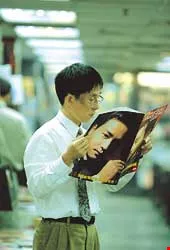
Choosing a suitable posture and location for reading enhances the pleasure of your knowledge feast.
Making friends with books
If you were to go to a desert island, and could only bring five books, which five would you take?
The aesthetics scholar Chiang Hsun often discussed this question with his friends when he was in college, and even today he frequently thinks about it. People like Chiang can recall clearly the era of "banned books," when they had an especially strong interest in going to the second-hand-book shops on Kuling Street to try to find old copies of works that had later been banned. Today, drowning in a sea of books, readers can perhaps ask themselves: "If I were not free to choose my reading, what books, in the end, would I be willing to read forever?" After all, amidst chaos it is difficult to find one's reading course; only amidst calm can one find the books one likes, and from there read broader and deeper.

The economic downturn means that bookstores are returning more unsold books to publishers. But why isn't the number of new books falling?


@List.jpg?w=522&h=410&mode=crop&format=webp&quality=80)


