Gao Xingjian's Third Crazy Dream: The Inception of Snow in August
Sun Sung-tang / photos courtesy of the Council for Cultural Affairs / tr. by James Decker
September 2002


Gao Xingjian, the first person of Chinese ancestry to ever win the Nobel Prize in Literature, has said that he has had three "crazy wishes" in his life. His first crazy wish was to win the Nobel Prize, which came true two years ago. His second crazy wish was to paint a mural on the wall of a large church, which he has been commissioned to do and is presently bringing to completion. And his third crazy wish was to have Snow in August staged, a project which has now been launched with the strong backing of the ROC Council for Cultural Affairs, with casting of the players and sourcing of other talents already under way.
For the purpose of producing this work, Gao Xingjian will come to Taiwan for the third time this year on September 14, and will stay here a full three months, in order to personally direct and polish the presentation, the formal staging of which is scheduled for the end of this year.
Just what manner of theatrical work is Snow in August, that it could charge Gao Xingjian with such fervent aspiration and make CCA chairwoman Tchen Yu-chiou willing to give her unstinting support, even to the extent of personally taking on the task of producer? How will Taiwan's theater world be shaken, or otherwise influenced, by the unique "second-round creation" process of making the play into a revolutionary new theatrical form, which has attracted the keen attention of arts promoters the world over? And when the production goes on world tour, what sort of legacy will it leave this world's people? Starting with this issue of Sinorama, we will be presenting a series of background reports on the Snow in August production in the attempt to shed light on this theatrical work which has been called hybrid, iconoclastic, and epochal.
"The Snow in August production has fulfilled my fond dream of writing and directing an opera. But at the same time this dream is being realized, worries have set in." In such words Gao Xingjian, winner of the Nobel Prize in Literature, revealed his sense of trepidation at a press conference held after he came to Taiwan in April to start the preparatory work for production of his newly written theatrical work, to be staged at the end of this year.
He frankly admits to feeling great pressure "because Snow in August isn't a patchwork of Chinese traditional opera and Western opera, but a new kind of theatrical form born of their fusion with each other." He wants, in his own words, to complete an "out-of-the ordinary" theatrical work.
What sort of "fusion" does the forthcoming Snow in August production represent? As Gao Xingjian explains, the arts world has already made numerous explorations into creating various fusions of Eastern and Western theater. Some attempts have directly spliced together Peking opera and Western opera in the same presentation, while others have taken Peking opera music and transformed it into symphonic music. In his view, such amalgamations don't go far enough. "What Snow in August aspires toward most definitely isn't a patchwork of Peking opera and Western opera, but rather a new theatrical form born of their fusion, commingling drama, a lot of music, and dance, with the performers singing as they dance."
As for the manner of singing, he is still in the process of refining it. However, he has discussed the matter with songwriter Hsu Shu-ya, and the two appear to be of similar mind. Hsu Shu-ya is willing, moreover, to put aside all present work and devote herself exclusively to writing both the symphonic and choral music scores for Snow in August. Gao has further commented that the music for Snow in August is even more critical than his direction of the play.

The cast of Snow in August was confirmed as long ago as late September last year, and includes many familiar Taiwanese stars such as Wu Hsing-kuo, Chin Shih-chieh, Tsao Fu-yung, Tang Wen-hua and Feng Yi-kang.
As fleeting as August snow
Although the operatic libretto for Snow in August has yet to be finalized, the already published play suffices to indicate the general story line: It takes as its subject Huineng, the sixth patriarch of Chan (Zen) Buddhism, aiming to convey "exultation in nothingness."
In this modernistic new musical, Gao Xingjian merges Chinese traditional speaking and singing arts with modern Western theater of the absurd to dramatize how, in the Tang Dynasty, the most famous of Chan koans (paradoxical statements or questions which, when profoundly meditated upon, may bring the Chan practitioner sudden enlightenment) became the basis on which power was transmitted from the fifth patriarch, Hungren, to the sixth patriarch, Huineng.
As Gao himself asks: What is this thing "Chan"? Is it a state of "no coming, no going, no left no right, no up no down, where amidst nothingness there truly exists somethingness, somethingness itself being nothing"?
Or could this thing "Chan" possibly be the convoluted twists and turns of a woman's heart? Or the "opposite shore" yearned for by fools? Or the words of an innocent-hearted bloke?
In the production, the author has designed an array of characters rich in meaning, including for example: the Buddhist nun Wujinzang (literally, "inexhaustible repository"), the Chan master Shenxiu (rival of Huineng), the monk Huiming, Mad Monk, Song Girl, Writer, Chan Master Is, Chan Master Isn't, Chan Master This, Chan Master That, Commoner, etc.-in all a 30-odd-member cast, who will give a theatrical performance designed to stimulate its audience to reflect deeply on life, based on the legend surrounding the famous passage penned by Huineng: "The Bodhi [Buddha Nature] is not like the tree, / The mirror bright is nowhere shining; / As there is nothing from the first, / Where can the dust itself collect?" (translation by D.T. Suzuki, in Essays in Zen Buddhism)
Chan, under the pen of Gao Xingjian, is as a snowfall on a blistering-hot August day. Chan is like snow, so evanescent. Has it ever really occurred among human beings? Or when it comes, is it at the wrong time, and does it, amidst the vicissitudes of worldly happenings-now hot, now cold-just vaporize in a flash?
The name Snow in August itself is pregnant with opportunity for Chan insight. A lot of people naturally wonder why is it that Gao, who himself adheres to no religious faith, has nevertheless created a theatrical work full of Chan-related meanings. In reality, whether it be through the medium of the novel, theater or painting, multitalented Gao Xingjian's capacity for exploring the human spirit seems inexhaustible. As he once said, "The older one gets, the greater one's sense of closeness to religion, although I'm not a believer in any religion."
Gao Xingjian believes that the religious spirit is a yearning for liberation, and that not only writers and artists but everyone needs spiritual liberation. But when religion is transformed into a kind of political power, it becomes quite frightening.
Four acquaintances of Gao Xingjian, appreciative of the merit of his work, have played an important part in the story of Snow in August's creative unfolding.
Prior to Gao's winning the Nobel Prize in Literature, his novels had already been published in Taiwan, and he had already held several painting exhibitions. In this connection he often came to Taiwan and, in the process, got to know quite a few people in the Taiwan arts world. Among them, National Taiwan University professor Hu Yao-heng was highly appreciative of Gao's works, and introduced them to movie director Li Hsing and theater critic Kung Min. Consequently, the four became close friends.
At the time, Gao Xingjian's Snow in August playbook had yet to be published. Through Hu Yao-heng's introduction, Li Hsing put up the capital for it to be published by his own publishing company. In order to help readers understand Gao's play, Hu Yao-heng spent a long time writing a 60,000-character commentary, itself constituting a major work.
In addition to these three confederates, former CCA chairman Kuo Wei-fan is another Gao Xingjian "soul brother." Early on, not long after travel between Taiwan and the mainland was opened up, Kuo planned to introduce to Taiwan several avant-garde small-theater plays by Gao, such as Bus Stop and Signal Alarm, which he had directed on the mainland and which had been quite enthusiastically received by audiences there. Later, Kuo Wei-fan was promoted to the post of minister of education. Kung Min and Li Hsing, seeing this as a wonderful opportunity, accompanied Gao Xingjian to pay a visit to Minister Kuo, in hopes of persuading him to help arrange a staging of Gao's work.
Minister Kuo gave his immediate assent, promising to secure the cooperation of the National Kuo-Kuang Chinese Opera Company for a performance of the work in conjunction with the tenth anniversary of the National Music Hall and National Theater. At the time, Gao Xingjian proposed to use the playbook for Nocturnal Wanderer. However, Li Yen, the director of the two facilities, was of the opinion that their tenth anniversary ought to be a joyous occasion, for which reason the appearance of the Chinese character ming (≠?) in the title of the play-meaning "nocturnal," "dark" or "Hades"-was not appropriate, and he hoped that the name of the play could be changed. With that, the plans for a cooperative undertaking were temporarily put aside.
Not long after returning to France, Gao Xingjian wrote a letter to Kung Min, who at the time was serving as Kuo-Kuang Chinese Opera Company's artistic director. In it, he proposed to change the play, and explained that he would specially write a new play for the express purpose of cooperation with Kuo-Kuang in celebrating the tenth anniversary of the National Theater and Music Hall. This new play was Snow in August. Kung Min was the first person in Taiwan to read it. Highly admiring of Gao's ability to write such a fine play in such a short time, Kung began doing his utmost to get the work staged.
As stated by Kung Min, Gao Xingjian's greatest motivation for writing Snow in August was that at present the whole world, in speaking of "Zen," is under the impression that it is a product of Japanese culture, no one realizing that it-as Chan-has in fact been part of Chinese culture since ancient times, with a history of over a thousand years, and has had an impact upon the whole of East Asia. In view of this, Gao wanted to come forward and say a few words in defense of Chinese Chan, restoring its original identity in the eyes of the world. Believing theater to be the most powerful vehicle for moving hearts to recognition of reality, Gao decided upon using it as his vehicle for telling a story of Chan.
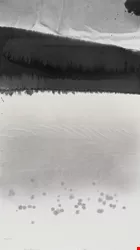
(right) Gao Xingjian's inkwash painting Diansa (Splattering) is highly acclaimed in artistic circles. It reflects the same spiritual depth as his novel Soul Mountain and his play Snow in August.
Crazy dream come true
With the aim of successfully bringing Snow in August to the stage, at the time of Kuo-Kuang Chinese Opera Company's participation in the 1997 Avignon Arts Festival, Kung Min took the occasion to take Ko Chi-liang, the opera company's director and principal of the Kuo-Kuang Chinese Opera School (now part of National Taiwan Junior College of the Performing Arts) to visit with Gao Xingjian. They stayed on in France for two weeks, the three of them discussing Snow in August at length, and Kung Min offering many suggestions to Gao. On this occasion, Gao said he wanted to create an "incomparable" theatrical work, a work which foreigners too could view with pleasure.
However, as fate would have it, Kung Min and Ko Chi-liang shortly thereafter left their original positions, and plans for a production of Snow in August came to a standstill, a situation which lasted until 2000, when Gao Xingjian was awarded the Nobel Prize in Literature. With the sensation which this event caused in Chinese cultural circles, interest in his writings instantly skyrocketed. When, in the following year, he came to the Taipei International Book Fair to give talks on Soul Mountain, One Man's Bible, Snow in August and other works, he also met with new CCA chairwoman Tchen Yu-chiou, who at the time had served in that position for over half a year.
Upon hearing Gao's plans for staging Snow in August, Tchen-herself an artist of repute-almost instantly recognized the project's artistic merit. Feeling that Taiwan ought to rise to the challenge of doing what is right, and that it possesses the wherewithal-and has the need-to give birth to this theatrical work, Tchen made up her mind on the spot to give it her full backing.
Thus, after many twists and turns, the threads of fate have finally, thank heaven, come together. Gao Xingjian's third crazy dream has now become the shared dream of Gao and Taiwan's arts community. But just how will this never-before-seen type of theater take form through the experimentation of the artistic workers involved? No one has the answer to that question at present. All we can do for the time being is to urge our readers to patiently await the next installment of Sinorama's ongoing account.

(right) Gao Xingjian's inkwash painting Diansa (Splattering) is highly acclaimed in artistic circles. It reflects the same spiritual depth as his novel Soul Mountain and his play Snow in August.


