Chang Li-hua's Aesthetic World
Tsai Wen-ting / photos Jimmy Lin / tr. by Scott Gregory
December 2004


Usually in education, humanities and the arts are viewed as an "extra," but this is not the case with Chang Li-hua. In fact, to her it is the other way around. She often takes over the class periods of other teachers, using the extra time to teach the arts as if they were main subjects. Chang believes, "The arts will stay with you your whole life, of course they are a main subject!"
In her 26 years of teaching, she has guided students in photography, filmmaking, weaving, dyeing, and participation in public art projects, bringing beauty to the everyday world.
The bell rings, and the students open up their "art supply kits" and trace the pictures in their textbooks-unfortunately, that's what many remember from elementary school art class, and this kind of pre-packaged education is still taking place in some elementary schools.
Taipei Municipal Teacher's College conducted a survey this year and found that parents and teachers are destroying the creativity of children. Once students enter junior high, the pressure is on for them to place into good high schools. Periods for arts and crafts, music, or home economics classes often get taken over for cram sessions, and might as well not exist. The education that students in special art and music classes get is often strict drilling of theory and skills in the aim of producing professional artists. Education in the arts is either all or nothing for most students.
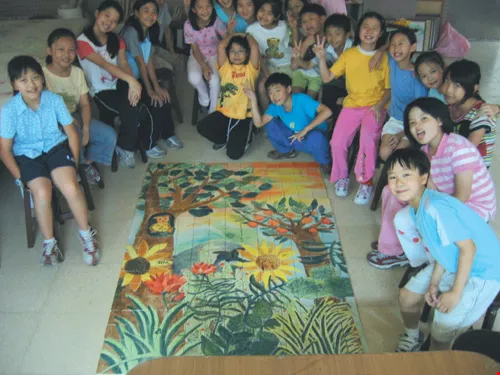
Collective, public art.
An imprint on the neighborhood
However, National Chengchi University Experimental Elementary School in Taipei's Wenshan District is different. Before even entering, you can already see the imagination and creativity of the students.
In the sidewalk in front of the school, there are tiles imprinted with the shapes of guava, parasol, and cassia tree leaves. It was the idea of the fourth and fifth grade students to use leaves from these trees common to the neighborhood. The students from lower grades made colorful decorations on tiles for a wall, and the project has brightened up the neighborhood.
Chang says, "We hope that children can use the process of making art to establish a connection with themselves, their families, their school, their neighborhood, even the whole world. That's the spirit of public art projects!"
Under Chang's direction, every inch of the schoolgrounds has unlimited artistic potential: Piles of chairs make a stage into an art installation space. The school itself becomes a giant drawing board.
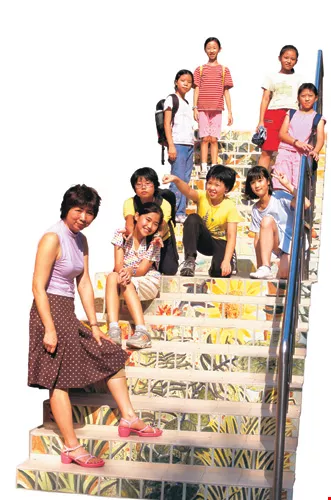
Aesthetics should permeate everyday life. Chang Li-hua's students at National Chengchi University Experimental Elementary School get in touch with their surroundings at school and at the same time create childhood memories. The photo shows a piece of public art that the children created by decorating the stairs at the school's back gate.
Creating, participating
Looking through Chang's lesson plans, you see that the curriculum includes pottery, drawing, photography, drama, documentary filmmaking-many disparate subjects. The old-fashioned, simplistic pairing of "art" and "music" does not hold here.
For example, when the subject of Matisse came up in art appreciation class, she organized an "art enjoyment party," letting the kids paint their faces in bold Fauvist colors, tape pieces of cut paper to their blank T-shirts, and dance around.
In her "Honey, I Made the Masterpieces Interesting!" class, the students pick a work, Chinese or Western, that they like and not only explain it but act it out. Whether Bu Nian Tu, the Song Dynasty portrayal of Tang emperor Taizong meeting emissaries from Turpan, or da Vinci's Mona Lisa, or Van Gogh's The Potato Eaters, they are all turned into imaginative skits.
In one script, Mona Lisa is a poor woman living with mother and sister in an old house. One day she hears a whistle outside her door. She looks out and sees a handsome man heading toward her with a bouquet of flowers and can't help but give a little smile-as seen in the painting. But, it turns out that he has come for the sister!
"I really like it when students work in teams, and collaborate with each other. Today's kids are smart, but they are too sure of themselves and look down on others," Chang says. She hopes that kids can learn to cooperate from an early age.
In the nine-year integrated curriculum, her art classes have been designed with three major areas in mind: Appreciation, discovery, and practice. She hopes that students will gain an informed sense of appreciation, an ability to analyze and sketch, and the inclination to put their creativity into motion.
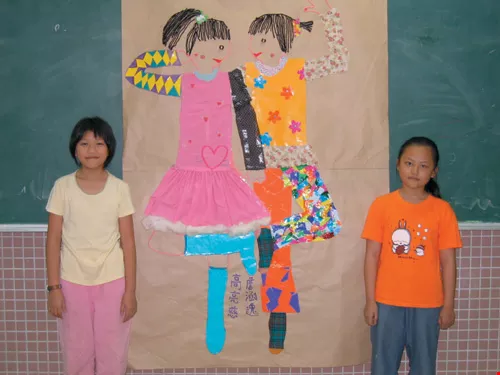
A class about colors turns everyone into a fashion designer.
Senses of aesthetics
"Aesthetics don't come through vision alone, but also through touch, hearing, taste and smell-they are literally 'sensed,'" Chang says. This is why she has students draw the taste of bitter melon and lemon, or close their eyes and touch their classmates' faces. They draw while listening to music, and feel wind blow through their hair and clothes in drama class.
Of Chang Li-hua's classes, the most amazing is photography. The students have keen eyes and active imaginations, so single works and narrative series alike are real eye-openers.
With the start of a new semester, the fourth-grade students learn to appreciate photography. The teacher throws out question after question, and students jump at the chance to give their opinions. Whether on composition or mood, the students are always forthcoming with their views.
Fifth-grader Hsiao Yuen-chiao used backlighting to photograph the silhouette of coconut trees in Hualien. While Liao Huan-hsuan's mother was making lemon vinegar, he took advantage of the scene to snap a vivid photo that looked very much like an oil painting. Their artistic sensibilities are awakened even by leaves or rays of light.
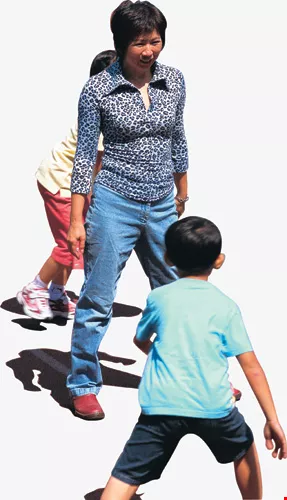
In Chang Li-hua's art classes, every child is a star and every lesson becomes part of life. In the interaction of teacher and student, memories are made.
Bringing it back home
"The fourth and fifth graders have entered a stage where they seek realism. Some have high expectations but low skills, and are always struggling with how to draw in perspective. Some even come to dread drawing class. Photography class lets them use their visual sense and imaginations, but a machine does the handiwork. That compensates perfectly for this age group's problems with expressing themselves visually," Chang explains. Works by National Chengchi University Experimental Elementary School students are even admired by professional photographers. Not only have they been exhibited in WanFang Hospital's Chuantang Gallery, but were also specially requested for display in an exhibition of professional photographers' works last year.
To Chang, a 26-year teaching veteran, all subjects have the same purpose-developing students' independent thinking skills and ability to solve problems. "That is the biggest goal. If they get that, they'll be able to deal with anything in the future," she says. That's why she stresses application in all aspects of her teaching.
For example, she teaches the students chiaroscuro technique and how to vary color brightness and linear composition to impart a feeling of depth, and then the students dye fabric and wear their "works" home. She has them decorate an area of their homes, photograph it, and comment on how different it became. They also find out how dull the closets in their rooms are, saying to themselves, "If only the builders had taken Ms. Chang's class...!"
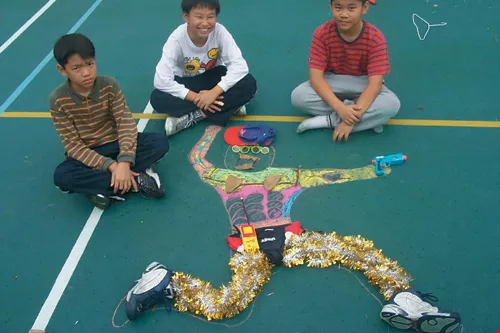
With the earth as a canvas, this work combines natural and ready-made materials.
Chef's granddaughter
Chang Li-hua feels that life is a canvas for aesthetic values, and that those values in life are a person's strongest influences.
Chang was born in Ilan in 1954. Her grandmother was a chef for Taiwanese-style outdoor banquets, and she'd carve fruit and vegetables and arrange the dishes while her grandmother worked. Her mother, who attended a finishing school during the Japanese occupation, could sew more than just suitcoats and dresses-she also made finely embroidered napkins and seat covers with such loving care that no one could tell the inside from the outside. "Though my grandmother and my mother weren't artists themselves, they brought an air of beauty to my everyday world," she remembers.
Creative theater is one of Chang's most popular classes. Under her guidance, students stretch and warm up, and then everyone is a star of the show. For a minute they are aliens, using sounds and expressions to show their emotions. Then a drum sounds, and the students contort their bodies into the letters of the alphabet. Or, two students use a chair as a prop, striking poses and turning it into a sedan chair. They extend their limbs, unleashing their creativity.
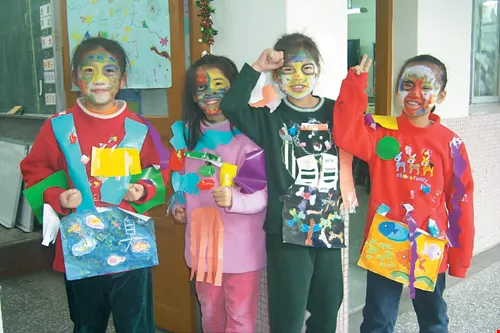
Decorated clothes and painted faces-it's an "art enjoyment party"!
Lifetime student
Chang has impressive credentials: A graduate of National Taiwan Normal University's Department of Fine Arts, her ability in theater comes from her studies with the dancer Ku Ming-shen. She has also studied ceramics with modern ceramics master Chiu Huan-tang, and metallurgy with Chou Li-lun and Li Hsiao-yuen. In order to lead the students through documentary-making, she made great efforts to first learn to edit film. "I love to have fun, and I'll keep learning my whole life!" she says with a smile.
Chang, who will retire next year, is presently on a board of advisors to the Ministry of Education concerning visual arts education for elementary school students. Though it is difficult to quantify such knowledge, she hopes that students will be able to name at least five Taiwanese artists and two foreign artists, and have an active interest in exhibitions and performances. She thinks they should be able to express themselves in three different media and be able to decorate their living spaces. She hopes they'll happily hum to themselves on the way home. This is Chang Li-hua's idea of an aesthetic world.
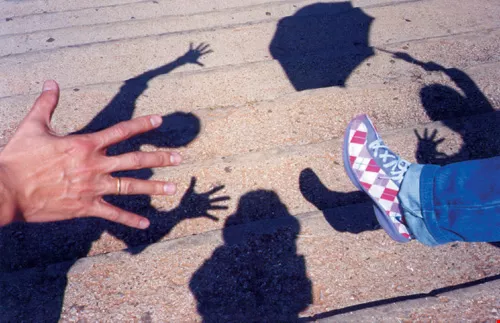
Student Li Ching-wei's photograph, "Long Shadow."

@List.jpg?w=522&h=410&mode=crop&format=webp&quality=80)


