Cai Guo-Qiang, Enfant Terrible of Conceptual Art
Yang Ling-yuan / photos courtesy of Cai Studio / tr. by Jonathan Barnard
February 2010


What does a visit to Taroko Gorge bring to mind? A few will worry about falling rock, and most will gasp in awe over the magnificent scenery. Yet one person's train of thought moved beyond what was there immediately before him, leading him to imagine a primordial scene of explosive fury and primal chaos. He wondered what it would have been like when the trees and rocks were shattered and the birds and bugs took to flight in fear.
He not only thought about it, but used his own two hands to bring it into being: First he took a broom to sweep gunpowder into images on paper. Then he draped a flame-retardant cloth over it. On top of that, he piled large amounts of explosives, bark, rock and finally another layer of paper. When this "sandwich" exploded, it yielded starkly differing results: The upper layer conveyed a heroic cliff-chiseling spirit, whereas the lower sheet of paper showed the delicate beauty of Swallows Cave (a tourist attraction at the gorge). The audience watching the creation of this gunpowder drawing gasped in delight.
Chinese ancients discovered gunpowder while searching for an elixir of immortality. Now, some two millennia later, Cai Guo-Qiang has playfully perfected this alchemy to once again prove that gunpowder can be used in a joyous, imaginative and beautiful manner-an altogether deeper and more enlightened way of conquering the world.
Upon entering the Taipei Fine Arts Museum, one comes head on with a high-impact scene. There are eight cars presented as if in a revolving sequence of frozen frames: at first motionless on the ground, then taking to the air, back rising, flipping more than 10 meters high, and then following through on the way down to land rightside up at the original spot. The airborne cars are spiked like porcupines with shafts of neon lights. The spectacle engendered is truly a weird one. The public can see this huge installation from all three stories of the exhibition hall, and they can go from floor to floor to gain different perspectives on the frozen images of the flipping car.
The installation-named Inopportune: Stage One-evokes the image of a car bomb being detonated. Although one doesn't see blood and shattered glass, the meticulous rendering of its aesthetic of violence may ultimately be even more terrifying. Cai thought that the installation provided an "opportune" way of denouncing terrorism after 911. And in keeping with the principle of contemporary art that a work should reflect its locale, he chose New York as the site of the installation's unveiling. Yet "it was too fantastical and thus inopportune." Cai installed the fixed work in the lobby of the Taipei Fine Arts Museum both to highlight the interplay between stillness and motion, and also to allow audiences to witness a silent explosion.
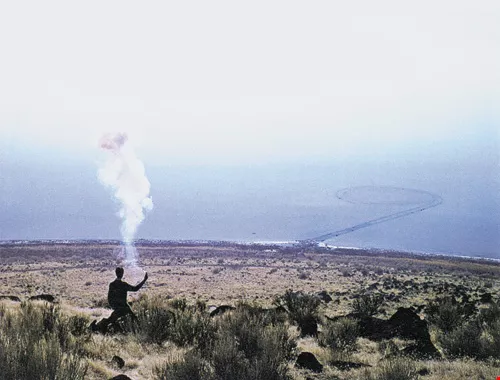
Exploding fireworks in outdoor spaces is an example of Cai Guo-Qiang's "Earth Art." The first of these works shown here, The Century with Mushroom Clouds, was an explosion event that Cai held at a former test site for atomic bombs in the United States. It quickly made a name for Cai in that country. The second, Red Flag, was created about Poland's democracy movement. The third and fourth are titled Black Rainbow and Dragon Sight-Sees Vienna.
As long ago as the early 1980s, when Cai was studying stage design at the Shanghai Theatre Academy, he was exploring different avenues for conveying the possibilities of art. "I thought about shooting firecrackers at a canvas, burning one hole after another until finally the whole canvas burned!" Although he felt that he was onto some wholly original method of artistic demonstration, he thought that simply burning the canvas would lack sufficient cultural content and a connection to the history of art. Then he used gunpowder to create Overlord Chu and Self Portrait-works in which he substituted the traditional colors of ink wash with the colors of gunpowder-combining explosive fieriness with the spiritual qualities of traditional Chinese literati ink wash paintings. These later evolved into his gunpowder drawings.
"I am a rational person, but I'm also full of contradictions, so I'm inclined to search for a controllable medium that also eludes control." That's how Cai put it at a press conference at the exhibition's opening.
Whether for his large-scale explosion art or his two-dimensional gunpowder drawings, Cai always sketches out his plans in tremendous detail in order to gain some control over the gunpowder. But once he lights the fuses, the flames' advance along the fire lines, and the rapid variations in wind and air currents, always move beyond the control of the artist. The only thing that he can exercise control over at that point is when to reenter the scene and extinguish the fire.
Take a look at Cai Guo-Qiang's canisters of gunpowder. He has some dozen kinds of eye-dazzling gunpowder-from the black of traditional gunpowder, to smokeless brown gunpowder, to realgar yellow gunpowder. The colors black, brown and yellow are in fact the primary colors of gunpowder drawings. To allow the gunpowder and the canvas to merge in more splendid ways, when creating his canvases Cai, much like a Chinese herbalist deftly putting together a prescription, has time and again experimented with the strength of the gunpowder and the speed at which it burns. He has moved from roughly demonstrating the power of gunpowder explosions to tackling the challenge of creating fine lines that can represent the human body.
Yet his creative process repeatedly meets with unforeseen circumstances. Take, for instance, Day and Night, a gunpowder drawing in this exhibit in Taipei. To create it, he projected silhouettes of a dancer to use as outlines, which he filled with gunpowder. Some patches of gunpowder didn't ignite, whereas other lines were obscured by tape and remained white, forming decorative belts on the human body.
"The more you want to control the results, the more things don't turn out the way you plan!" That's because gunpowder is unpredictable, serendipitous and spontaneous. These are qualities that give Cai's gunpowder drawings a life of their own.
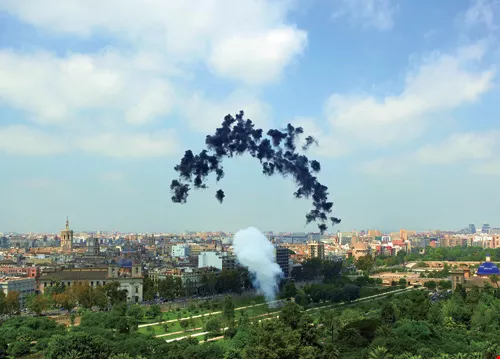
Exploding fireworks in outdoor spaces is an example of Cai Guo-Qiang's "Earth Art." The first of these works shown here, The Century with Mushroom Clouds, was an explosion event that Cai held at a former test site for atomic bombs in the United States. It quickly made a name for Cai in that country. The second, Red Flag, was created about Poland's democracy movement. The third and fourth are titled Black Rainbow and Dragon Sight-Sees Vienna.
Aside from Taroko Gorge and Day and Night, Cai also created the installation Strait for this retrospective of his work at the Taipei Fine Arts Museum.
This nine-ton slab of granite placed in a small and narrow space gives people a sense of the solemnity of a giant stone. But when you look carefully, you can also see the deep feeling that Cai Guo-Qiang has for Taiwan.
Some 400 years ago the Han Chinese pioneers in Taiwan, who hailed either from Quanzhou or Zhangzhou in Fujian, would always place large stones in the holds of their boats as ballast. After landing, these stones would be used to build foundations or stairwells. Some were brought outside to pave roads or build bridges, silently extending their mission of protecting their owners.
The stone slab used for Strait was likewise taken from Cai's hometown of Quanzhou. Its right edge is a representation of the West Coast of Taiwan from Fuguijiao to Eluanbi, and the left edge is the Chinese coast from the mouth of the Min River to Dongshan Island. Its special quality is that "the two coasts are empty, and the strait itself has substance." Master stone workers carved fine ripples onto the giant stone, constantly splashing water on it to make sure the waves were realistic so as to convey what the pioneers must have felt as they made this dangerous sea journey: their determination and longing, as well as their regrets at leaving home.
Cai was born in Quanzhou, and his works often feature traditional Chinese elements, such as junks, lanterns, kites, fengshui and traditional Chinese medicine. And he speaks Mandarin with an accent not unlike natives of Taiwan's Lugang. Consequently, with regard to Taiwan, Cai has always held certain hard-to-explain feelings. When he was a student, he even thought of stealing his way onto the island.
"When I meet Taiwanese, it's like we're good friends right away," says Cai in Cai Guo-Qiang: What I'm Thinking, which was adapted from conversations between Cai and critic Yang Zhao. Because he and his Taiwanese friends alike enjoy a legacy of Minnan (Southern Fujianese) culture, and because they have alike been deeply influenced by Japanese and American culture, Cai can talk to them about the modern and the traditional, and about expansive topics such as how Oriental culture can be extended to have a broader global appeal. "To a certain extent, I regard Taiwan as my cultural home."

A portion of Cai's new work Taroko Gorge. Blending a powerful cliff-chiseling spirit with the refined aesthetic of traditional Chinese landscapes by literati, it creates an alternative beauty that transcends traditional artistic categories.
Cai's rise to prominence took place not in China but in Japan.
When he was 29, Cai took his beautiful wife Wu Honghong to Japan to try to make a name for himself there. He went from being a nobody to becoming the first Chinese national to win the Japan Cultural Design Prize. But just as the Japanese cultural community was passionately discussing the "Cai Guo-Qiang phenomenon," he applied for a visa to live in New York, where he would once again be a stranger.
In recollecting his rise to prominence in Japan, Cai says, "I had no way of opening the door. It just so happened that when I arrived at the door, it opened and I skated in."
During that period, Japan was concerned about whether it could find a path forward apart from westernization. Meanwhile, Cai was on the one hand using traditional Chinese gunpowder as an artistic medium and on the other excelling at rigorously calculated explosion art with a modern feel. A theme of much of his work was transcending east-west conflict, and his "Project for Extraterrestrials" took an even broader perspective. Consequently, he quickly found his way into the hearts of the Japanese.
In 1989 Cai commenced his "Project for Extraterrestrials" series, which involved large-scale explosion art. The project went on for 10 years, during which period he finished a total of 32 of these works. The series served as a watershed in Cai's career as he moved from explosion paintings toward adopting three-dimensional space as his canvas.
He was living in cramped quarters in Japan, and he was thirsty for conversation with boundless and universal life. And he had a concept that was quite simple and pure: Since the universe was formed in a big bang, through explosions he could integrate his work with the movements of the universe. In the evening, large-scale explosions cast light skyward, announcing the existence of earthlings to other life forms. With the smoke that forms afterwards, the work disappears from the human field of vision, but it still flies out into space at the speed of light, surviving for a long time in the universe.
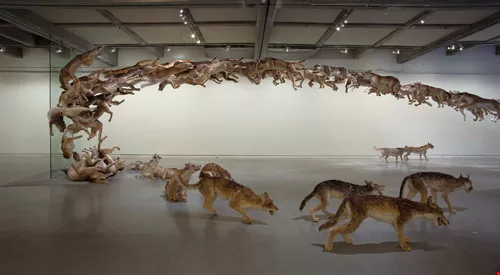
Left: Head On. Facing page: Inopportune: Stage One. A "spatial artist," Cai likes to place wildly unusual props and create explosive imagery in what had been empty space. He then goes on to use the spatial characteristics of different exhibition spaces to create new meaning.
Aside from the Project for Extraterrestrials, Cai's experiences in Iwaki were also part of his legend in Japan.
When he had just arrived in Tokyo, Cai kept running into obstacles and felt frustrated. Eventually he adopted Mao Zedong's policy of "encircling the cities from the villages" and moved out to smaller towns to try his luck.
The result was that his explosive art in the beautiful coastal town of Iwaki attracted people's attention and also a group of volunteers. These typical Japanese villagers, who had never considered themselves connected to art in any way, expended money and effort in creating these explosion events. They also brought up a sunken wooden fishing boat, which they refashioned as the installation Reflection: A Gift from Iwaki, and they built the "San Jo- Tower," which is connected to the idea of prayer. Together Cai and the villagers revisited the town's past and created special experiences belonging to it.
In the years that followed, wherever Reflection was exhibited around the world, volunteers from Iwaki would make the journey to help with the installation. The process of their participation was recorded and became one of the most moving aspects of the work. They demonstrated the "collective action" that is a special quality of contemporary art.
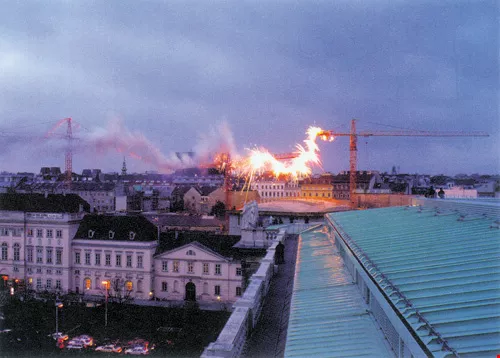
Exploding fireworks in outdoor spaces is an example of Cai Guo-Qiang's "Earth Art." The first of these works shown here, The Century with Mushroom Clouds, was an explosion event that Cai held at a former test site for atomic bombs in the United States. It quickly made a name for Cai in that country. The second, Red Flag, was created about Poland's democracy movement. The third and fourth are titled Black Rainbow and Dragon Sight-Sees Vienna.
The exhibition at the Taipei Fine Arts Museum-"Cai Guo-Qiang: Hanging Out at the Museum" takes its Chinese name (literally "Cai Guo-Qiang soaks at the museum") from Cai's installation Cultural Melting Bath-a well-known work that he created after moving to the United States.
To the right of the museum's lobby, there's a courtyard regarded as having the best fengshui and airflow at the museum. Some dozen pines in containers have been placed there, as well as 18 rocks from Taihu Lake and a therapeutic bath steeped with Chinese goldenthread, ginseng and other Chinese medicinal herbs. Different groups of curious visitors put on swimming suits and come here to take a soak-becoming part of Cai's Cultural Melting Bath.
"New York itself is one big cultural melting pot," says Cai in describing his first impressions of the Big Apple. The installation has been exhibited in various places around the world, and Cai always asks Chinese herbalists for different prescriptions. The Taihu rocks are also repositioned depending on the fengshui of the exhibition space. And so that visitors can have the greatest physical, psychological and spiritual enjoyment, the bath is always placed at the most advantageous position according to the principles of fengshui.
Bearing testimony to his internal contradictions, Cai, despite being a firm believer in rationality and the dialectical materialism of Marxist-Leninist thought, also puts stock in fengshui and "the invisible world." Cai inherited his superstitious side from his paternal grandmother, who hired a female shaman to take care of him, cure his minor ailments and answer his questions. Later, when going abroad to pursue his studies and participate in exhibitions, he would always carry talismans with him.
For a solo show in the United States, he chose the theme of fenghsui: How is Your Feng Shui: Year 2000 Project for Manhattan. Moreover he brought 99 stone lions from his hometown of Quanzhou to the exhibition space in Manhattan.
His lions weren't just on display for exhibition; he also wanted to sell them to members of the public "whose homes had fengshui problems." He visited 400 homes of exhibition visitors who had applied for his advice. He would assess the homes' fengshui and place the lions in spots where it wasn't good.
As it turned out, rather humorously, most of these wealthy people had employed the services of professional architects and interior designers, and consequently the fengshui of their homes was fine. But they wanted to buy lions anyway. For instance, if a woman was worried that her husband was having an affair, she would buy a lion to put by his chair to keep him in line. It was win-win for her and Cai.
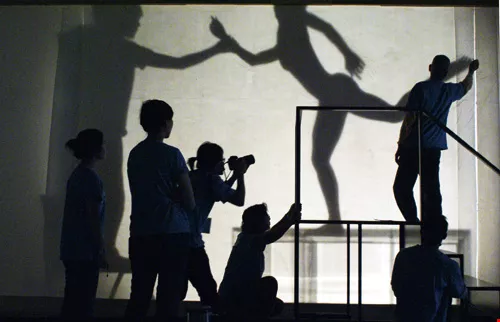
For Day and Night, Cai made a blueprint of silhouettes of a dancer taken over a 12-hour period, using it and gunpowder to convey the delicate lines of a female body as well as various different species of plants and flowers. It was a moving one-time experiment that merged the two-dimensional medium of drawing with performance art.
After gradually getting on his feet in America and then gaining international recognition, Cai went a step farther and decided he wanted to connect his art to conceptions of Western democracy.
For instance, on New York's East River between Manhattan and Queens, he once ignited shells fitted with computer chips to create a rainbow of fireworks for 15 seconds. That explosion event-Transient Rainbow-offered a sense of the skies clearing after the storm of terrorism brought on by 9-11 and showed praise for life. Cai went on to create a black rainbow in the clear skies above the Institut Valencia d'Art Modern in Spain to convey his concerns about terrorism making democracies weaker and less stable.
Head On, which likewise conveys the fragility of human life, is the installation that earned Cai the greatest accolades: It shows 99 wolves baring their teeth, charging in an arc toward a glass wall and then smashing against it. Despite painfully flipping over after hitting the wall, they throw themselves at it one after another to demonstrate the will of the pack.
This installation, first exhibited in Berlin in 2006, is a metaphor for how mankind finds itself in one historical tragedy after another due to its blind sense of obedience. He reminds people that, even though the Berlin Wall has been torn down, "The invisible walls are harder to raze." That glass wall represents the wide gulf in mental outlook of the East and West German people. Because the image of Head On is so shocking, it has become an important part of the collective consciousness regarding the Berlin Wall.

"I always have some fun ideas I'm considering and hoping to bring into being." Cai's endless stream of creativity isn't limited to engendering weird and fantastic visual scenes. For instance, his installation Venice's Rent Collection Courtyard, which won a 48th Venice Biennale International Award, involves the transformation of an earlier work and yet is still very much connected to the present day.
The original Rent Collection Courtyard is a work that was created by members of the Sichuan Fine Arts Institute in 1965. Back then China was afflicted by famine, and the people were seething with discontent. Consequently, the Chinese communists mobilized the artistic community to sing the praises of regime. Whatever the government's actual intent, the teachers and students at the institute created this work, which describes "landlords in prerevolutionary society bullying tenant farmers." They took a very sincere and conscientious approach. They read Chairman Mao's books, listened carefully to peasants' complaints and created 114 vividly lifelike sculptures, successfully evoking citizens' gratitude and faith in the Communist regime.
In 1999 Cai, who was participating in the Venice Biennale, decided to focus on this work, and he invited various people from the Sichuan Fine Arts Institute to participate, including Long Xuli, who was teacher at the institute back when the work was created. On site in Venice they constructed 73 life-sized statues, letting the audience see the sculptures, the sculptors, and the entire creative process-"exhibiting a classic socialist work of art and prompting thoughts about the true face of artists in the real world."
No efforts were made to preserve these figures. The first figures completed were already cracking from drying out before the clay had been completely applied to the figures that were started later. At the end of the exhibition the statues were broken into small bits and thrown away on site. The next time that work is exhibited, Cai will once again rely on current students at the institute to recreate the sculptures. And it is only because of Cai Guo-Qiang's creativity and conceptualist genius that these realistic sculptures are able to enter the free and unruly world of contemporary art and breathe new life and meaning into the original work of socialist realism.
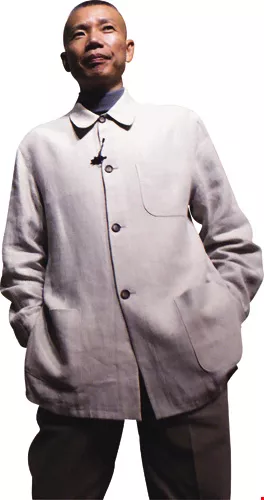
Cai Guo-Qiang in front of his new work Day and Night. Described as one of the art world's 100 most influential people by the British magazine ArtReview, Cai embraces all subjects and creative forms. He calls himself "an uncategorizable artist."
Starting out with gunpowder drawings, then becoming famous from explosion events, and drawing major attention for his installations, Cai Guo-Qiang has in recent years been most in the news for returning to China to put on fireworks displays at festivals and sporting events. Most notably, for the opening ceremony of the 2008 Beijing Olympics, he created a fireworks display showing 29 giant footsteps in the sky above Beijing. The steps moved from Yongding Gate to the "Bird's Nest" Beijing National Stadium. It was the most exquisite image in the history of the Olympics or, for that matter, in the history of all international festivals and sporting events.
Because of the limitations of live broadcasting, the version shown to international audiences around the world was actually rendered on a computer from dress-rehearsal footage, but that doesn't detract from the uniqueness of Cai's artistic creation.
Since his early "Project for Extraterrestrials" series, which used large overhead footprints to symbolize extraterrestrials' movements in the sky above earth, Cai's explosion events have caused concern: What if the burning remnants of fireworks set off in a city caused a fire after descending? Consequently, Cai spent two years developing fireworks that leave no remnants before allowing his "wild idea" to reach fruition.
His works of art may vary widely, but just as Cai's calmest expression can never obscure a wise smile, even his most serious works hold a thread of humor, and often an innocent, childlike playfulness. "I look like an artist on the outside, but I have a playful spirit on the inside."
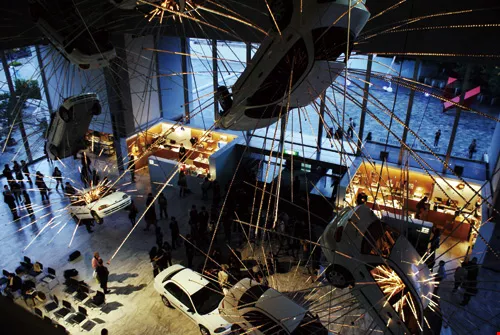
Left: Head On. Facing page: Inopportune: Stage One. A "spatial artist," Cai likes to place wildly unusual props and create explosive imagery in what had been empty space. He then goes on to use the spatial characteristics of different exhibition spaces to create new meaning.
He describes himself as an "undercover artist" and exclaims: "Art can be messy." By this, he doesn't mean that an artist can recklessly do whatever he wants, but rather that an artist should carefully plan, as well as seek and exhaust resources, attempting to create historical echoes and to communicate with the masses.
"There is a common core to all my creative works-namely change, free and untrammeled change." He has tried the possibilities of various forms of creativity, and he has bridged nations and disciplines and worked with various different kinds of people-all in an "effort to breathe new life" into art, so that his work doesn't get caught up in a single kind of style.
Cai stresses that there's something a bit "masturbatory" in the relationship between himself and his art. The main thing is to excite yourself, to get to the tipping point, to push things to the limit. Nevertheless, with any kind of creation sincerity is key-one must draw on issues that one truly has personal experience of, and that one truly is anxiously reflecting on.
For three years running, Cai has been named by the British magazine ArtReview as one of the world's most 100 influential artists. Although his artistic direction has already moved from the "explosive" and "challenging" work of his youth to something more gentle and restrained, he has maintained a pure heart that is forever seeking change, and he continues to play with the sparks of his own art.
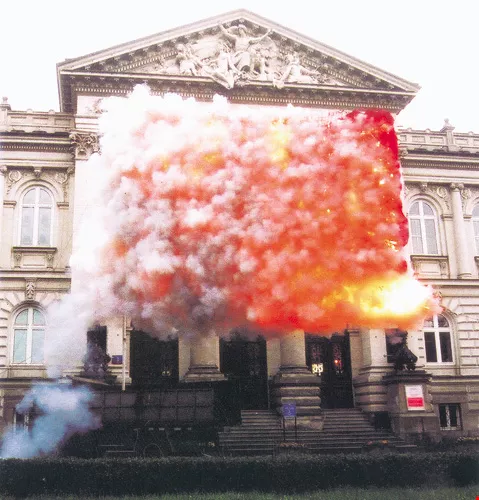
Exploding fireworks in outdoor spaces is an example of Cai Guo-Qiang's "Earth Art." The first of these works shown here, The Century with Mushroom Clouds, was an explosion event that Cai held at a former test site for atomic bombs in the United States. It quickly made a name for Cai in that country. The second, Red Flag, was created about Poland's democracy movement. The third and fourth are titled Black Rainbow and Dragon Sight-Sees Vienna.

@List.jpg?w=522&h=410&mode=crop&format=webp&quality=80)


