An Online Cinderella Story for the Strawberry Generation
Lin Hsin-ching / photos courtesy of Liao Xiaowen / tr. by Scott Gregory
June 2009


To most fresh university graduates, the age 25 seems like a time where one is still struggling to find a path in the workplace. Most of them hold low-level positions in administration or sales with a monthly salary of just over NT$20,000.
However, among these youth who are new to the workplace, there are those who no longer depend on their parents for financial support and have become the boss. Liao Xiaowen, who sells fashionable shoes, is an example. Five years ago, the 20-something Liao began her own shoe lines amai and la Una on the Internet. With her self-taught creativity and business sense, she was a success, selling at least 5,000 pairs a month and taking in over NT$6 million.
Walking along Changxing Road in Taipei County's Luzhou City, you see mostly new buildings. This newly developed residential district is the base for Web-based shoe brands amai and la Una. In an alleyway just around two or three hundred meters long, it has three spaces that serve as offices and storehouses. In this space of around 1,500 square meters are stacked nearly 100,000 pairs of shoes.
"From the design to the soles to the boxes to the decorations and even the makeup mirror we give away when you order two pairs or more and the beach bags we plan to bring out this summer, we've designed and outsourced them all ourselves," Liao says confidently. "Everyone who buys a pair ends up a loyal customer."

Liao Xiaowen, 25, is a top seller of women's shoes on the Yahoo! Kimo shopping website. Her amai and la Una brands take in as much as NT$6 million a month, and flats with bows like those she is holding in her hands are the most popular models.
25-year-old boss
This young woman, who is perfectly made up and is wearing the latest fashions with pink flats, looks like any one of the hip young women you'd see in Taipei's Eastern district. But make no mistake, her amai brand is the second most popular shoe seller on Taiwan's Yahoo! Kimo shopping site. It sells at least 5,000 pairs a month and takes in more than NT$6 million.
The 24-year-old Liao, whose father is a parking-lot attendant, comes from a working-class background. At age 19, she placed into Chinese Culture University's Department of Advertising. She chose to attend part-time so she could work and pay the high tuition.
At first, Liao was a switchboard operator for a public relations firm, but she felt stifled by the formal workplace atmosphere. When she learned about the newly popular online auctions, she started bringing her boyfriend down to Wufenpu, Taipei's wholesale apparel district, to buy things to sell online. "You could earn money and also always have new clothes to wear," she says with a laugh.
However, after selling online for a while, Liao discovered that most people selling women's clothes online were buying at Wufenpu the same as she was. "Other people were selling the same clothes, and I could often only get buyers by offering very low prices. Though business wasn't bad, I felt like I was just helping Wufenpu sell clothes," she says.

A chance to create a brand
It was only by accident that she ended up in shoes. She had a loyal customer whose husband ran a shoe factory in mainland China. They became friends after doing so much business together, and her customer asked if she wanted to try her hand at selling shoes as well. Liao, who'd always wanted to start her own brand, leapt at the chance.
In order to learn about materials and the manufacturing process for shoes, as well as such basic industry knowledge as what sort of toe spring, instep, and heel height fit which type of foot, she spent two months at the factory in mainland China. She also researched the styles of women's shoes then sold online.
"Five years ago, the styles popular online were mostly 'mature' styles with high heels, pointy toes, and deep colors. There was a need for younger styles like flats that go for a cuter look. I saw an opportunity there," she says.
She named her brand "amai" after the Japanese word for "sweet," and set her target price range at NT$980-1,480 (including shipping) to be affordable to younger women. At first, she only put out a few unpatterned, light-colored round-toed flats. They were an unexpected success. One style, a "sailor" sandal (red-and-white stripes with canvas wedge heels and a strap in the back) sold 3,000 pairs in just three months.
"The success amazed me and my boyfriend, but from it I became confident in my taste," she says.

Simple is cute, too
Though she'd never studied design before, Liao was a sharp judge of the market. She says that women's shoes are for the most part more or less the same. To attract buyers, you just have to put a little more care into the shoes than the others do.
For example, the no-slip soles on most shoes usually just feature stripes or circular patterns. But amai's soles have deeply-carved cherry-blossom patterns. They also come in a shoebox with the same pattern-when they get them, customers can't help but exclaim, "So cute!"
Liao says that many people think young women will be attracted to flashy or highly decorated things. But as someone of the same age group, she thinks that styles that show a sweetness through simplicity are more appealing.
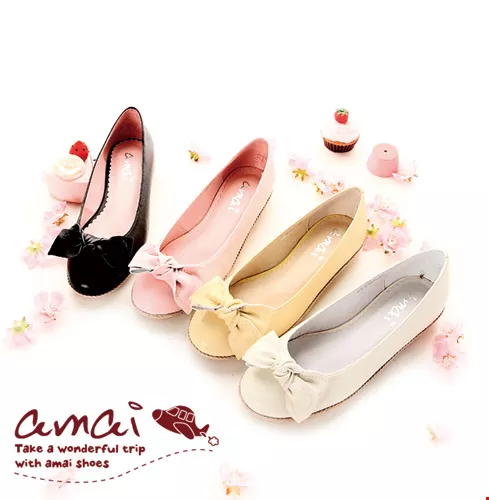
In the five years amai's been in business, the best-selling style has been a pair of doll flats. Since it was introduced in 2007, the round-toed shoe with a simple silk bow on the top has sold more than 10,000 pairs through word-of-mouth and blog posts alone, and not a dime has been spent in advertising.
Liao says that the secret of this pair's success is the silk bow. It looks like it was taken from a fancy gift box, and gives people a feeling of happy expectations. Also, it is of medium size and just big enough to cover the toe. It is cute but with a touch of class. It also contrasts the slimness of the feet and ankles. This is why the model is so popular. It's been sold in more than a dozen colors, patterns, and fabrics for the consumer to choose from, and every one is a hot item.
"In spring of this year we thickened the latex cushion on this model to make it softer on the foot, so even if you stand a lot and sit a lot you won't get sore calves," she says.
Two brands, two styles-with her girlish amai range and slightly more mature la Una heels (middle picture), Liao Xiaowen has captured the hearts of her many loyal customers.
Top-quality service
To most people, the problem with buying shoes online is you can't try them on first. It's hard to tell if those beautiful shoes in the picture will be comfortable on your feet.
To overcome this mental barrier, amai's website not only explains to consumers how to measure the length and width of their feet but also provides the experiences of wearers with every type of feet. For example, for the hot-selling model with the bow described above, the website says that Ms. H, who has wide, fleshy feet and usually wears either a 36 or a 37, takes a 36 in this shoe.
"With this information, we can help customers who are interested in buying estimate which size is best for them," Liao says.
So what happens if, even after reading all the descriptions, the shoe you buy isn't a good fit? It's okay, because amai allows you to exchange one time free of charge. You also get the seven-day "trial period" mandated by consumer protection laws in which you can just return them.
Additionally, Liao generously includes gifts for buyers such as comfort strips to protect against chafing from new shoes. For high winter boots, she provides a set of inserts to keep them from losing their shape. For a while, customers buying two pairs or more would receive valuable gifts like a free lollipop-shaped make-up mirror or a gift certificate for stila brand cosmetics. They all make young women feel they're getting more for their money.
In addition to amai, which is targeted at women in their early twenties, Liao, who has around 10 employees, also has a brand called la Una that is focused on working women around 30 years of age who wear high heels. Though many envy her bright career, she puts in 12-hour days. She also dropped out of college in her sophomore year to concentrate on her business.
Does she have any regrets? This young entrepreneur, who is clear and rational when it comes to business, shakes her head. Five years ago was the point when Internet auctions started to take off in Taiwan. She got in early, so she was able to corner the "cute" women's shoe market. Had she waited until after she'd graduated, the competition would have been too much and she wouldn't have been this successful. There will always be chances to return to campus later, but a chance for success in business has to be grasped before it's gone.
"A lot of people think those of us born in the 1980s are the 'strawberry generation,' easily bruised and lacking perseverance, and that we can't make it in business. I want to let those older people know that not all young people these days are like that," she says, full of determination.

Two brands, two styles-with her girlish amai range and slightly more mature la Una heels (middle picture), Liao Xiaowen has captured the hearts of her many loyal customers.

Liao's online shop has instructions on how to measure the width and length of your foot properly. By following the instructions, customers can avoid buying the wrong size.

(top) In addition to cute designs, amai products feature shoeboxes with prints of cherry blossom or bows. (bottom) Liao Xiaowen has three offices-cum-warehouses with a total floor area of around 1,500 square meters. Inside are stacks of nearly 100,000 pairs of shoes.

Two brands, two styles-with her girlish amai range and slightly more mature la Una heels (middle picture), Liao Xiaowen has captured the hearts of her many loyal customers.

(top) In addition to cute designs, amai products feature shoeboxes with prints of cherry blossom or bows. (bottom) Liao Xiaowen has three offices-cum-warehouses with a total floor area of around 1,500 square meters. Inside are stacks of nearly 100,000 pairs of shoes.

Liao's online shop has instructions on how to measure the width and length of your foot properly. By following the instructions, customers can avoid buying the wrong size.

Targeted toward women in their early twenties, the amai brand features many flat, round-toed, "cute" designs like those popular in Japan. The goal is to make them so customers will slip them on and exclaim, "So cute!"

Liao's other brand, la Una, is a more "mature" line of high heels targeted at young career women of around 30 years of age.

Targeted toward women in their early twenties, the amai brand features many flat, round-toed, "cute" designs like those popular in Japan. The goal is to make them so customers will slip them on and exclaim, "So cute!"


Two brands, two styles-with her girlish amai range and slightly more mature la Una heels (middle picture), Liao Xiaowen has captured the hearts of her many loyal customers.

@List.jpg?w=522&h=410&mode=crop&format=webp&quality=80)


