Dances with DeerSon of the Mountain Forests--Liu Szu-i
Kuo Li-chuan / photos Chuang Kung-ju / tr. by Anthony W. Sariti
October 2005


Taiwan is an island brimming with the primordial forces of life and the brilliance of human culture. The ubiquitous mountain peaks, the deep river valleys, the growth of natural vegetation that increases with the elevation, the many varieties of birds that flit back and forth in the mountain forests building their nests and multiplying, the wild animals that search for food and wander the landscape--all this gives pause to marvel at the wonderful kaleidoscope of creation as one strolls along the mountain trails.
But the number of people who can turn an inspiration from nature into a life's direction is few. Sambar deer photographer Liu Szu-i is one of those few who have inherited and carry on the pioneering spirit of our ancestors. He possess the free and unfettered romantic sensibility of a modern Wandervogel, leaving the world behind and immersing himself in the mountain forests, recording with his lens the world of the Sambar deer and through images showing man and nature coming together and going forward side by side.
Liu Szu-i, a lecturer for the Society of Wilderness, introduces the Sambar in its many guises to his audience with slides--the full-grown stag with its towering antlers; the gentle, intelligent doe; the solitary figure of a stag with broken antlers as he wanders the dark and desolate valleys; the timid yet curious fawn standing outside the tent as it gazes in.... It is the Sambar stag's fierce pride and self-assurance that most elicits the admiration and wonder of audiences from the concrete jungle, and with the photographer's lively commentary they are transported to the primeval forests on imaginary wings.
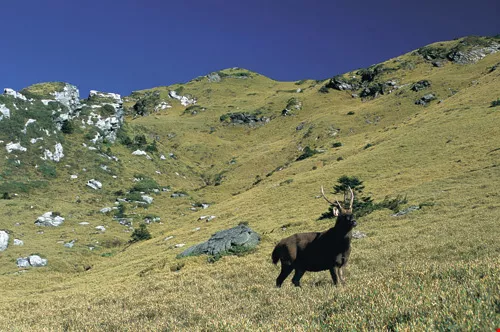
Five years ago Liu Szu-i made an arduous winter trip into the mountains only to discover the Sambar had gone down the mountain to pass the winter. After waiting two days in vain, he yelled out into the valley the names of the Sambar deer he knew. That evening "Middle Yellow," with whom he had a longtime close connection, appeared in front of his tent to his utter amazement.
First contact
"At the age of 13, I opened the book Baiyue Quanji (The 100 Mountains of Taiwan), and it was as if a connection were created for the first time between the mountain forests and me." Born in 1968, Liu Szu-i was brought to his passion for mountains by the book's flyleaf, and the richly colored mountain vistas led to a secret ambition--to one day go into those mountains. When he got to senior high school he took his first step by joining a mountain climbing club. With a few like-minded schoolmates, and relying on the "courage of a new-born calf" and an indescribable enthusiasm, he set off into the embrace of the mountains with simple equipment on his back, a contour map and a copy of Baiyue Quanji in his hands.
Initially, Liu photographed mountains in the hope that the beautiful scenery would attract more classmates to go mountain climbing. To capture the real impact of the broad mountainous expanses, Liu Szu-i worked hard at a summer job following his first year in senior high school and bought himself a Nikon FM2 camera. In his second year he began to climb the "one hundred mountains" and use his camera to record what he saw. During the summer after his freshman year at Tunghai University, where he studied in the Department of Science and Engineering Liu tutored at three different homes and added a 500cm Hasselblad camera to his collection together with an 80mm standard lens, a film clip, and a light meter, but he had no money left for a tripod.
"In those days each time I took the Hasselblad into the mountains and shot a sunrise or sunset, which required a long exposure," Liu says, "I had to get to the scene a half hour earlier to pile up stones to make a tripod." This predicament was not solved until six months later when Liu, after an austerity campaign, scraped together enough money to finally buy his tripod.
"As far as I was concerned, my idea in buying more photographic equipment and improving my technique was simply to use the camera lens to reveal the beauty of Taiwan's mountains and the deep emotions that they evoked in me," says Liu. But when Tunghai began cutting the acacia forest, a subtle change came over his feelings about mountains.
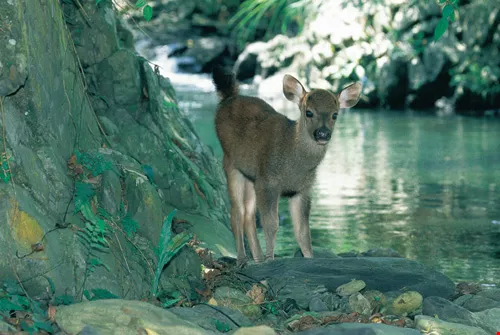
A Sambar fawn barely two months old.
Only mountains
During the second semester of Liu's sophomore year at Tunghai University, the university received a subsidy from the Ministry of Education to help build classrooms. The original site chosen for the expansion was opposed by the teaching staff, however, and so to make use of this budget allocation the university authorities made a decision to clearcut the nearby acacia forest and build the classrooms there.
As soon as the news was announced there was furious opposition among faculty and students, and Liu Szu-i, too, was deeply affected: "If we couldn't preserve a piece of forest on the campus of a university that had as its motto, 'Seek truth, be honest and sincere, do one's best,' one day we would lose the entire green carpet of the central mountain chain." Liu gave some serious thought to the matter: What criteria do we use to decide whether a particular tree should be saved? How should we evaluate the worth of a forest? And mountains? Mountains don't become great because of human admiration and praise, and they don't become insignificant as a result of man's neglect. Mountains are mountains. Such thinking had a deep impact on his later views on photography.
Liu Szu-i, who at that time had already climbed more than fifty of the one hundred mountains of Taiwan, felt an emotional connection to the majestic moun-tainscape of Mt. Nanhu, the deep winter snows, the old yet vigorous juniper trees and the rich flowers and fauna. And also there were the comfortable mountain lodges located on ridges in just the right spots for the camera lens, making the job of the photographer even more convenient. Although many before him had photographed Mt. Nanhu, Liu decided in 1992 to make Mt. Nanhu the object of a long-term photographic journey.
Nevertheless, Liu's photos of Mt. Nanhu reveal a feeling of loneliness. Liu Szu-i had been born into the family of a civil servant, the last of five children. Despite hopeful expectations of the family, Liu disliked schoolwork from childhood, and the outstanding grades earned by his four sisters only made him look worse. Mountains, for him, became a refuge. To cover the costs of buying materials and getting film developed, he even worked as a mountain guide and bearer.
"All I wanted to do was to hole up in the mountains and take pictures. My life's goal was one day to be able to publish a collection of photographs." In five years he climbed Mt. Nanhu more than 30 times, logging more than 600 days there.
Recalling those simple, carefree days when the mountain was his home, when for him the mountain seemed to loom before him as an incomparable, huge dark cave, always there to absorb, to embrace his emotional ups and downs. "But I was always me, and the mountain was always the mountain." Liu says. "I never actually became a part of the mountain."
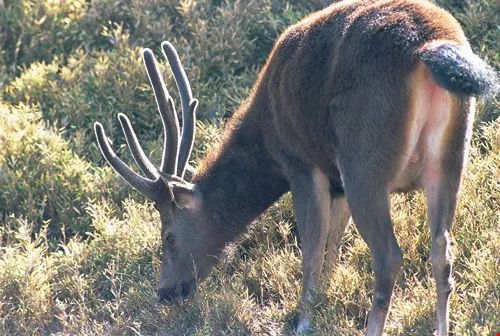
In April and May each year the Sambar stag grows the velvet antler buds to their full length. Shooting these antler buds with back lighting clearly reveals the short bristly hair or "velvet" that covers them.
Encounter with the Sambar
In 1977, just when he was considering whether or not to change his photographic subject to animals, an elder classmate at his university received from the national parks system a natural photography project and invited Liu to participate in photographing Taiwan's Sambar deer. Although in the end this project for various reasons was abandoned, Liu had decided to give it a try. It was only that having gone through six winters and summers on Mt. Nanhu taking pictures, although quite confident of his familiarity with this wide expanse of mountain forest and having seen the robust mountain goats scale the cliffs on many occasions--even keeping pace with the mountain boar that scrambled all over the place--he had yet to see a wild Sambar deer in the forest mists.
"The elevation at which I did my mountain photography was in fact close to that of the Sambar deer's habitat, but I had never seen one. At most I had seen some still-steaming, fresh droppings on arrow bamboo leaves," says Liu Szu-i with a smile that reveals his prominent dimples. The naturally timid and cautious Sambar deer is universally recognized by mountain photographers as one of the most difficult to get a lens on.
Because academics in Taiwan had produced only a tiny number of survey reports on the Sambar deer, Liu Szu-i turned to ranchers that raised the deer and to old hunters who had hunted it to get an understanding of the animal's living habits. On the basis of what he learned, it turned out that it would be easiest to find traces of the animal along riverbanks, so he spent three days exploring the most likely trails along the southern branch of the Choshui River.
"Photographing mountainscapes got me used to picking out spots to shoot photos at dusk and in the early morning, but photographing Sambar is not the same as photographing mountains," he says, "The Sambar doesn't just sit there waiting for you, and you have no idea when he will show up, so I had to change my approach. I had to hunker down in an area where a Sambar might come along and just wait for him to appear."
A few days later there was a small typhoon, and Liu climbed up to a small peak and looked around, hoping to catch the movement of a brown spot that would indicate a Sambar deer. But the sun set without his seeing a thing. Soon after he departed he discovered he had left his light meter behind. Quite annoyed he started back to the peak to recover it when suddenly he heard an unusual splashing noise reverberating in the quiet valley. Searching for the source of the sound, he suddenly saw a mature Sambar stag with a full rack of antlers rolling around in a muddy pool that had formed as a result of the typhoon.
On first seeing the wild Sambar, Liu held his breath and just stared at the stag as it nonchalantly stood up in the pool, its body covered in glistening drops of water The stag, after shaking itself off, proudly raised its head and looked about. When it moved it lifted its front legs high in the air before bringing them back down. As it raised its legs and pranced forward, it was like a martial figure in a Chinese opera striding the stage, for this grassy plain was, in fact, the Sambar's very own stage.
Because the distance was too great, it would very difficult to capture this proud stalwart on film, but since he had followed the Sambar trails, Liu knew where the animal's movement would take him. Without wasting a second to think about it, Liu shouldered his camera and tripod and set off at a run for a trail crossing to wait for the Sambar to come by. Roughly five minutes later the Sambar in fact showed up on a grassy slope about 70 or 80 meters away, leisurely grazing. This was the first day Liu had seen a wild Sambar, and on this one day he saw eleven of them.
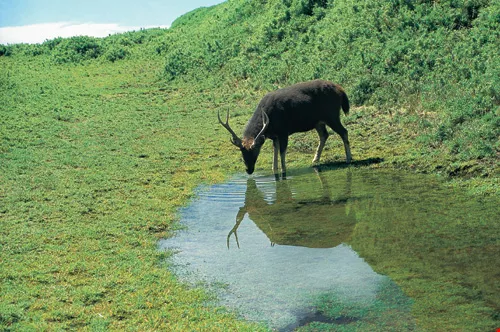
A mature stag deer normally appears tame but as rutting season arrives in July each year its beautiful antlers become weapons in truly ferocious battles for territory and a mate.
Letting go
In the very beginning, to avoid startling the Sambar, a certain distance had to be maintained. "Because the distance was so great," he says, "I had to use a telephoto lens, but those are hard to keep steady and debris in the air can ruin the picture quality." Although he crossed land and water in search of a good shot, Liu was unable to get a photo he was pleased with, which made him begin thinking about giving up. It was then that Carlos Castaneda's Journey to Ixtlan opened his eyes to a new dawn.
Carlos Castaneda was a graduate researcher in anthropology when, to study the medicinal plants of the Mexican Yaqui Indians, he got to know a shaman whom he called "Don Juan" and became his apprentice. The shaman Don Juan told Castaneda of a three-step procedure to follow: first become a hunter, next become a warrior and finally become a wise man.
In the book, Don Juan elucidates the meaning of "hunter": "A good hunter knows one thing above all--he knows the routines of his prey. That's what makes him a good hunter." To capture an animal you must first understand it, surmise its movement by using its way of thinking, to a certain extent you must become the animal. Don Juan emphasized, "Once you worry you cling to anything out of desperation; and once you cling you are bound to get exhausted or to exhaust whoever or whatever you are clinging to."
The perceptive words of the book opened up an entirely new spiritual vista for the very much discouraged Liu Szu-i. "A good hunter can hunt down his prey but he doesn't rely on luck, he relies on power; and if you want to get power, you must first achieve self-perfection." Liu Szu-i thus began to change himself, to change his pattern of co-existence with nature; not only did his impulsive nature gradually become gentle, he no longer moved or carried himself like a human being, he calmed himself down and began to feel the Sambar's movements, his own movements being quiet and non-threatening so the deer would know he had no harmful intentions. And then his encounters with the Sambar began to steadily increase.
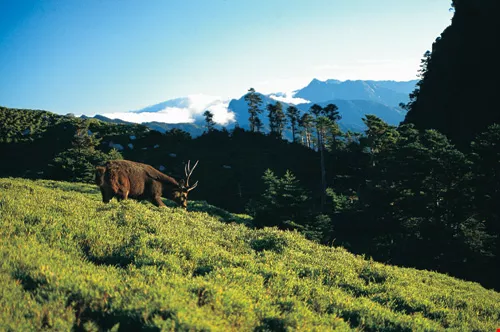
Liu Szu-i stresses that hunting pressures in a particular area are reflected in the Sambar's attitude toward people. If this peaceful grass-eating deer shows no fear of man whatsoever, this proves the area is a paradise for the animal.
"Cool Guy"
Liu Szu-i gave names to the Sambar he frequently came in contact with that were based on individual characteristics and habits. The stags that he knew rather well were "Big Yellow," "Middle Yellow," "Small Yellow," and "Broken Antler." One doe was called "Missy." "Big Yellow" was the biggest of all the Sambar and was a target for other stags to challenge. He could usually be seen standing alone on a mountain peak, radiating a kingly majesty as he surveyed his realm, making a wonderful photographic model. "Middle Yellow" was also called "Cool Guy" and was the deer Liu was most in tune with.
During the winter five years ago, Liu made the arduous trek into the mountains to photograph the Sambar deer in their newly grown black-brown winter coats. But, perhaps because the weather was too cold, the Sambar had all come down the mountain to pass the winter! Liu waited in the mountains two days without seeing any sign of the Sambar. Just when, very discouraged, he was preparing to leave, a feeling came over him and he called out the names of the Sambar one by one and shouted into the valley: "I've come a long way to see you and you pay no attention to me. If you don't come out, I'm going home!" After night fell he suddenly heard a familiar sound outside his tent. When he opened the flap there was Middle Yellow standing right in front of him.
During the following few days, the weather was clear but still quite cold, Middle Yellow was taking shelter from the cold in the arrow bamboo forest. Whenever Liu wanted to take a photograph he went out to the forest and called for Middle Yellow to come to the ridge to make it easier for him to take a shot. Not until Liu left camp did Middle Yellow start to slowly make his way to the valley.
Another time when Liu made a connection with Middle Yellow occurred in August 2001. At the time Liu had already been shooting for eight days and was preparing to leave the mountain. He went down to a pond preparing to get some water to wash his pots with when he saw Middle Yellow standing some four meters away, quietly staring at him. Suddenly he came rushing over but about one meter away he abruptly came to a complete stop, his front hooves kicking up mud and water that splashed Liu all over.
"He gave me quite a fright," Liu recalls, "but then he unexpectedly leaned his head to one side and looked at me with a totally innocent face." Liu then filled his pot in the pond and flung water at Middle Yellow, whose face was now completely wet, but he quietly continued to stare at Liu. Liu splashed water on Middle Yellow three times before he turned around and bounded away. He stood about three or four meters from Liu and again leaned his head to one side, staring as before.
"That was the first and only time I felt that the Sambar and I were playing together," he says. "We were so close, we almost shared our thoughts." But as Liu has gone into the mountains over the last four years, he has not seen Middle Yellow. What ever happened to Middle Yellow? Liu is still concerned about him to this day.
People are always asking Liu Szu-i whether, when he is photographing, he ever gets the impulse to reach out and touch the Sambar.
"I once did have this idea but quickly dismissed it," Liu says. "Man is certainly a step higher than the Sambar on the food chain. The Sambar's fear of human beings is in the natural order of things. What I have been able to do is to show good intentions, let the animals feel I don't present a danger to them so they allow me to share the same space. It's not that they won't let me touch them, I have no desire to do this. To make such a beautiful creature submit itself to man's touch like a domesticated animal would really be a crime."
Although the government strictly prohibits hunting Sambar, one frequently hears about poaching incidents. Rumor has it that there is a "Sambar graveyard" in Nantou's Tanta forest, where once four Sambar skins, 17 lower jaws and 71 leg bones were discovered in a hunting hut of less that 80 square feet!
"The presence of hunters in a particular area is reflected in the behavior of the Sambar towards people. If the Sambar flee as soon as they see someone, this proves that there is a lot of poaching going on in the area. Conversely, if the Sambar show absolutely no fear of people, then it is certain there is no hunting going on," says Liu.
Because a pair of wild antler buds or a wild Sambar penis (both used in traditional Chinese medicine) can fetch as much as NT$200,000, the lure of high profits makes it difficult to stop poaching.
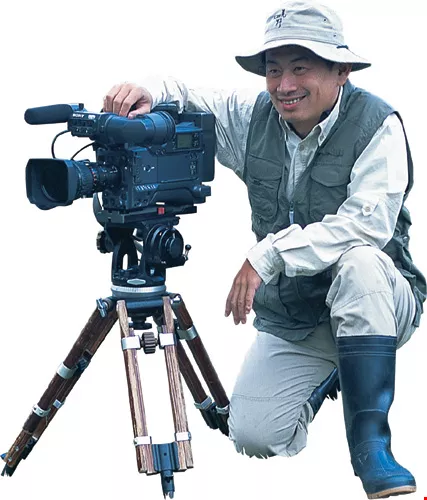
Liu Szu-i, this modern son of the mountain forest, who switched from photographing mountains to photographing the Taiwan Sambar deer and is now the producer of the documentary "Hidden in the Mountains and Valleys--an Ecological Documentary on the Taiwan Sambar," fearlessly abandoned the pleasures of modern technology and accepted the call of the wild to "dance with deer."
Deer in the spotlight
To leave behind a precious, natural photographic record of Taiwan's Sambar deer, Liu Szu-i agreed to take on the primary responsibility for a project entitled, "Hidden in the Mountains and Valleys--an Ecological Documentary on the Taiwan Sambar," a joint undertaking of the Bureau of Forestry, Council of Agriculture and the Society of Wilderness. His task was to make a documentary and publish a book, slated to be finished by December 2005.
Long years of taking photos in the high mountains had led to a rare and special relationship between Liu Szu-i and the wild Sambar deer that lived there. There had been several different herds of Sambar over the years that had gotten to know him well and accept him, that would allow him to approach just a few meters away. Thus beginning in July 2003 Liu and his colleagues actually spent more than 300 days in the high mountains photographing Sambar. Not only did filming in the mountains present a food supply problem, the wide fluctuation of nighttime and daytime temperatures often caused the electric motors and batteries the cameras had to use to malfunction. Sometimes someone would be sent on a special trip down the mountain with equipment for maintenance or repair. A round trip took more than four days at a minimum and was quite enervating.
"The Taiwan Sambar" is already in the editing stage. Because the average film editor hasn't got the foggiest notion of the living habits of the Sambar deer and doesn't know where to start, Liu Szu-i had to learn "nonlinear editing" himself, and after the first cut he will turn the film over to a professional for final editing.
Leafing through Silence of the Quiet Mountain, published in 2000 by Liu, we see a once perplexed Liu Szu-i, who had devoted countless years of his youth putting into photographs his love of Mt. Nanhu, his awe of the mountain snows and his worship of Mt. Chilai, who now, in the comforting embrace of the mountains, looked into his inner being. And after his change to photographing the Sambar with whom he had such an intimate relationship, he once again entered a new frontier, putting his inner being aside and accepting the call of the wild, dancing with the Sambar and finally, being taken up in the bosom of the mountains he loves.
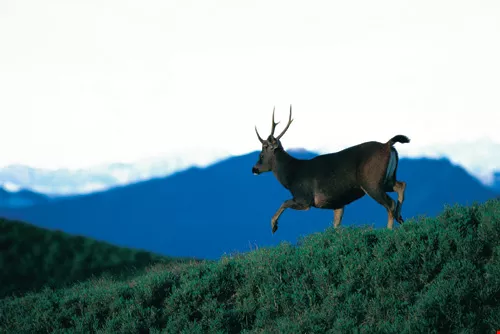
The Taiwan Sambar deer is the biggest herbivore native to the island. The Sambar stag grows a pair of antlers that grow thicker and longer each year, reaching a maximum length of 50 cm.
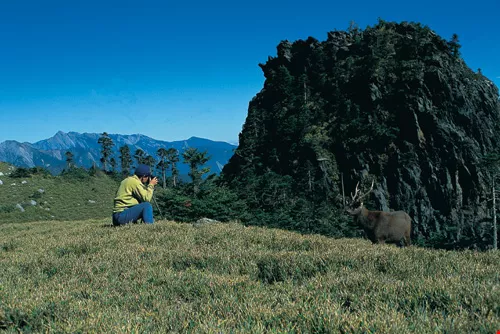
After switching from mountain photography to photographing the Samba herds and having close interaction with the deer eight years ago, Liu Szu-i went through a change in his personal relationship with nature and truly entered the embrace of the mountains.
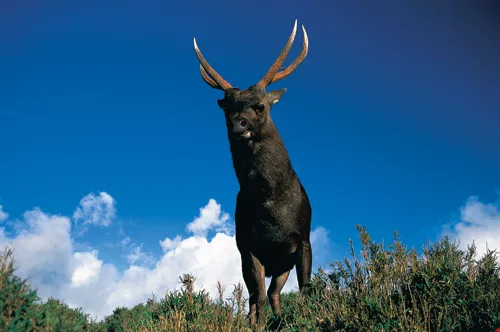
The deer Liu Szu-i named "Middle Yellow" he also called "Cool Guy." He was the deer with which Liu had the closest relationship, to the point where he allowed Liu to take photos with a close-up lens.

@List.jpg?w=522&h=410&mode=crop&format=webp&quality=80)

@List.jpg?w=522&h=410&mode=crop&format=webp&quality=80)


