Happily Retired: Madame Wei-wei's Beautiful New Life
Chang Meng-jui / photos Hsueh Chi-kuang / tr. by Ken Kraynak
March 2007


Madame Wei-wei has had her own column for over 30 years, but her girlhood dream was to travel, easel in hand, to the far corners of the world. She never could have imagined that only after many years of providing her readers with fine essays would she finally be able to fulfill her dream. At the end of 2006 she not only released a new book, but also had her first art exhibition--after studying painting for a full ten years. Happily retired, she remains eager to share with her readers the joy of her "beautiful new life."
Born Yueh Tzu-chun, Madame Wei-wei's early professional life spanned various branches of the media, including television and newspapers. Good at telling the story of womanhood, describing how women love and hate, their difficulties and helplessness, she is also eager to share her own insights into life, something she encourages other women to do as well. She frequently advises women, "Don't give up easily, don't close the door on the world, and live your own life." She's widely admired as a "lucky lady" possessed of beauty, virtue and intelligence.
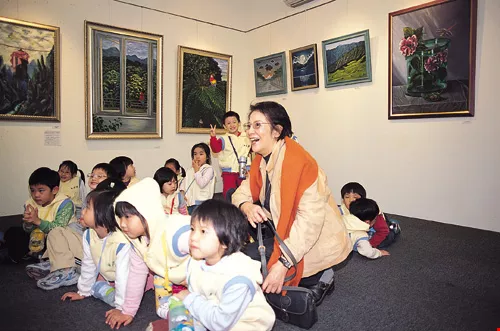
Formerly the director of the Mandarin Daily News, Madame Wei-wei has long been dedicated to children's education. Here she accompanies a group of children at her art exhibition.
Painting in the light
When she turned 65 in 1997, Mme. Wei-wei decided to retire as director of the Mandarin Daily News. According to the newspaper's regulations she could have continued in the same position until the age of 75, but she didn't want to cling to her job until the very end. In her view, sooner or later everybody must face retirement, regardless of whether one looks forward to it or not. But not all those who look forward to retirement find it to be as relaxing and happy as they were hoping it would be; and some of those who were dreading retirement unexpectedly discover a happy new life. The key lies in how well one has prepared.
Several years before her retirement, Mme. Wei-wei began to quietly plan the next stage of her life: a retirement enriched by such activities as painting, reading, traveling, getting together with old friends, and attending art exhibitions and performances. On the second day of her retirement she promptly began to study painting with Hsi Sung, whom she had already known for some 30 years.
Painting quickly became her passion, and she would spend at least ten hours a day painting. She later went to the United States and studied painting at community college, and she enjoyed her experience as an older foreign student. Mme. Wei-wei says that the greatest joy of painting is the creative freedom one has to transform natural scenery and people at will.
For example, her painting A Tribute to Frida Kahlo features a woman's outfit draped with a shawl, suspended by a clothes hanger over a gaping chasm, as a way of paying her regards to the modern Mexican painter whose tragic life was depicted in the film Frida. Hsi Sung says that great women painters have always been extremely rare, so Frida Kahlo's artwork, which gives vivid expression to a woman's passion, makes a strong and distinct impression. It's no wonder, then, that when Mme. Wei-wei threw herself into painting, Kahlo became her favorite painter, an admiration which perhaps reveals another side to Mme. Wei-wei's mild character.
Another of her paintings, Three Dogs and a Cat, features three dogs and a cat standing on different levels of a stone stairway under a clear blue sky. They all stare out at the viewer with an intense gaze. When Hsi Sung first saw this painting he found it to be very surreal. Mme. Wei-wei explains, "This painting is a remembrance of the time when I was living in the Huayuan Hsincheng housing complex in the Hsintien area of Taipei. If I happened to turn around as I went down the steps on my way to work in the morning, I would see our cat and dogs following from behind, sending me off with their concerned expressions. Some of them were given to us by friends, others were adopted as strays, but they all became a part of the family, and we had a strong feeling of affinity for each other."
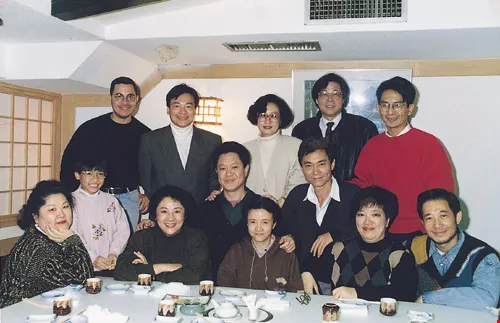
In this rare 1982 photo Madame Wei-wei is seen together with noted figures of the arts with whom she had been friends for many years. In the front row, from left to right, are Fan Man-nung, Wei Shao-ming (daughter of Cheng Shu-min), Mme. Wei-wei, Chiang Hsun, Wang Hsin, Hsi Sung, Ma I-kung, and Huang Yung-hung. In the back row are Lo Lun-so, Wei Tuan, Cheng Shu-min, Wu Ching-chi, and Lin Hwai-min.
No way home
Being able to follow one's inclinations and find inner peace in the remaining years of one's life is indeed a great joy. Mme. Wei-wei's present happiness, however, only came to her after she went through all sorts of severe ordeals.
Mme. Wei-wei was born in 1932 in China's Anhui Province into a small family which included only her parents and younger sister, the noted literary critic Yueh Heng-chun. Since her mother always longed for a son, she raised the young Mme. Wei-wei like a boy. Her hair was cut short, and when she began to attend school the other girls didn't want to sit with her. She always played with the boys, and could do everything they could do, such as scaling walls, climbing trees, as well as fighting.
Recalling her early life, Mme. Wei-wei says that since her mother died young, her father became the strongest influence on her outlook. Her father graduated from the National Hangzhou Art College, but due to the turmoil of war he never painted a single picture. Yet he was very much in the avant-garde as a person. When he took his daughters out for a walk he would only talk of sunspots, and never discussed anything trivial. In those times high school girls were supposed to keep their chests wrapped in a cloth. Her father didn't agree and even went to the school and asked the principal why a girl's breasts should be wrapped up when it would be better to let them develop naturally, causing much embarrassment to his two daughters. "Perhaps my character is like my father's: expansive and unrestrained," she reminisces with a smile.
One's destiny, however, is unpredictable, and the unexpected invariably happens when one is least prepared. In 1949, when the chaos of the civil war made it impossible to continue studying, General Sun Liren set up the Young Women's Brigade, which was being sent to Taiwan for training. Mme. Wei-wei and her sister thought it would be fun to go to Taiwan for a few months, after which they could return home. So without their father's knowledge they passed the entrance exams and came to Taiwan. Before long, mainland China fell to the Communist forces, making it impossible to return home. When the trainees heard the news they wept bitterly in the classroom, and from this time onwards they had no choice but to make this distant land their new home. Leaving her home behind during her adolescence has served to mold Mme. Wei-wei's independent character.
Perhaps due to her father's influence, Mme. Wei-wei always enjoyed reading, and was not a bad painter, but there wasn't much reading material available at that time in the training facility of the Young Women's Brigade, which was located in Ahouliao, a remote part of Pingtung County. At that time there were no bookstores, so the books the trainees brought with them from home got passed around until they were falling apart. They even vied with each other to read the Chingchung Bulletin, a periodical published by the military. Because of the lack of leisure activities, the brigade would organize journalism competitions known as "wall newspaper contests." Since she was good at both writing and art, Mme. Wei-wei never missed a chance to participate, and of the three groups competing, her team regularly took first prize.
After she completed her training, Mme. Wei-wei was recruited by the China Youth Corps to be a military training instructor, but she had little interest in supervising students, for whom she had much empathy. One time she really raised some eyebrows at the school when she led the female students in a demonstration against the discipline director in order to protest mandatory military training for young women. She was thoroughly unhappy in her role as a military instructor, so when she met her future husband, Professor Chou Cheng, she immediately decided to get married and be done with the whole business.
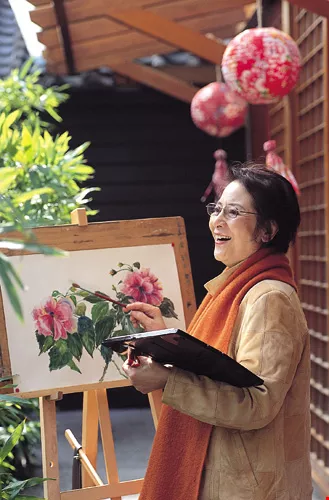
Enjoying the splendid sunset of her life without the slightest inhibition, Madame Wei-wei is content with her lot and has found a comfortable rhythm for her life, a custom-made lifestyle which she has slowly refined during her ten years of retirement.
Seize the opportunity
After marriage she remained unemployed for some years, until one day she saw in the newspaper that the National Taiwan University Hospital was looking for an art designer. Although she had no prior recommendations, she took some of her work and went to find the director, Kao Tien-cheng, and she got hired. She worked at NTUH for ten years, during which time, to supplement her income, she would submit articles to various newspapers, though they were usually rejected. Then she wrote a piece titled "The Comedy of a Humble Family" which, to her surprise, was published by the United Daily News. From then on she continued to write an episode every week without interruption.
Ten months later the newspaper's editor-in-chief, Shih Hsi-chuan, called her to ask if she would be willing to write a special column for the new "family edition." At that time she didn't even know what a special column was, let alone how to write one, but she agreed anyway. Shih had chosen the name of the column: "Madame Wei-wei." Although they had never met before, this editor got her started in her career as a columnist, and also changed her life.
In the midst of raising her three children, Mme. Wei-wei would compose her column in a cramped space, usually writing on a small wooden stool which she would move next to the bed. When her children would come over now and then and snatch her pen, she would simply take it back and keep on writing without even getting distracted. During these years she never missed a deadline for submitting an article, no matter how busy she was or how much work pressure she was under.
The "Madame Wei-wei" column was well received, and brought a certain amount of celebrity. Some time later, when writer and media personality Cheng Shu-min started the Today program on the Chinese Television System, she invited Mme. Wei-wei to discuss art and literature. Her appearances on the show are a shared memory for Taiwanese over 35. This marked the beginning of 30 years of association with such noted writers and artists as Hsi Sung, Fan Man-nung, Lin Hwai-min, Wu Ching-chi, Chiang Hsun, Ma I-kung, and Huang Yung-hung. Many will also remember her in her role as counselor on interpersonal relationships, in which she offered advice on how to maintain harmonious relationships between mother-in-law and daughter-in-law, husband and wife, and parents and children.
She confesses she never imagined that "Madame Wei-wei" would follow her like a shadow and become her life-long pseudonym. Many people don't even know her original name, and if they saw it they might not even know how it is pronounced, as one of the characters in it is very rare.

The bitterness of life
These experiences certainly brought their share of challenges and rewards, but pale in comparison to the heart-wrenching grief Mme. Wei-wei felt in response to the early death of her eldest son, Chou Kai.
Twenty years ago, Chou Kai was working as a stage lighting technician on the set of Contemporary Legend Theater's The Kingdom of Desire. Exhausted after working all night to keep the production on schedule, he fell off a 24-foot-high scaffolding while adjusting the lights, suffering a major brain contusion. After 18 days in intensive care he died on his 26th birthday.
Optimistic by nature, Mme. Wei-wei never mentioned the tragedy in her column, and it would have been very difficult for her regular readers to have any inkling of the fact that she had just lost her son. Yet this was by far the most painful experience she has had to endure in life. She sank into a deep melancholy, and all she could do was sleep, unwilling to even open her eyes all day long. It felt like being in a very deep and very long dream. She didn't maintain a bedside vigil at the hospital during her son's final days, nor did she attend the funeral. Mme. Wei-wei says that she used lethargic sleep to try to escape from reality, hoping that when she finally awoke from the dream everything would be back to normal.
The pain of losing her son at that time was compounded by accusations that if she hadn't been so preoccupied with getting decked out and advancing her career, her son wouldn't have had an accident. It was also suggested that if someone were to write a novel based on her personal tragedy, it would certainly be a big hit. Her friends were enraged when they heard about this, and even suggested that she should sue for libel. But Mme. Wei-wei responded by simply saying, "What, are they talking about me?"
This experience led Mme. Wei-wei to begin to reflect on human nature, asking herself how people could be so cruel to a grieving mother. She admits that her son's sudden and tragic death even led her to contemplate suicide at one time, feeling that she could no longer carry on. "But I still had two children and a family; if I had gone what would they have done? I had to continue living, but how could I just keep on crying all day? So I would go out by myself and drive through the mountains, crying and venting my grief as I sped along the winding roads. Before returning home I would wipe away my tears and force myself to put on a happy face."
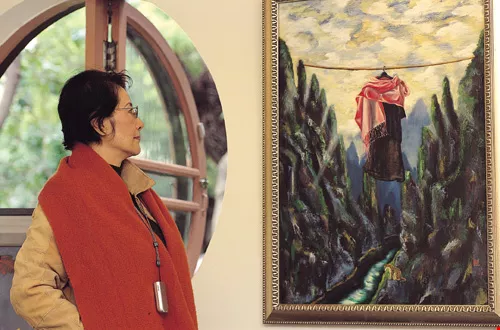
Madame Wei-wei painted A Tribute to Frida Kahlo as a way of paying her regards to the modern female Mexican painter whose tragic life was depicted in the film Frida. This is her favorite painting.
A son's great filial piety
Still, as soon as Mme. Wei-wei would find herself in a calm mood, images of her beloved son would whirl around in her mind. She would dream about him now and then, especially when traveling abroad. Chou Kai was 180 centimeters tall, well built, and wore a full beard, making him look just like a handsome foreigner. She even had the strange feeling that he was possibly living in a foreign place whose name she didn't know.
One time she was in the lounge area at the Los Angeles airport when she suddenly noticed a man who bore an uncanny resemblance to Chou Kai. Leaving her carry-on luggage behind, she immediately jumped up and started to follow him closely from behind. The faster he walked the closer she followed. Tears pouring down her face, she kept telling herself, "Chou Kai, if it's really you, turn around and let your mother see! Don't walk so fast! Mother can't keep up with you!" Finally the man passed through customs without turning around. Mme. Wei-wei found a corner, leaned against a cold wall and wept bitterly.
Another time, while on her way back to Taiwan, she was so exhausted by the journey that she fell fast asleep as soon as she got on board the plane. In the middle of the flight some very strong turbulence caused the plane to shake so violently that the luggage began to spill into the aisle. Chaos broke out when some of the startled passengers began to scream. When Mme. Wei-wei woke up she saw in the monitor a man who looked just like Chou Kai. Sure that this was her beloved son standing right in front of her, she remained oblivious to all that was happening around her. She just kept gazing at the screen sobbing, "Chou Kai, have you come to meet your mother? I'm here! I'm here! Do you see me? Let's go together!"
Looking back on the event, Mme. Wei-wei reflects, "Really, I wasn't afraid at all. When I imagined that my son--who I hadn't seen in three years--had come to meet me, I suddenly felt an inexplicable sense of joy."
It was only a long time after her son's death that Mme. Wei-wei's state of mind slowly stabilized. As she reflects on that period, she confesses that the pain of losing a son never ends; it only settles down. During those years, Mme. Wei-wei slowly came to realize through her reading that the inevitability of both birth and death is something that everybody must admit. "Some say that a son dying before his parents shows a lack of filial piety. But I believe that if a son sacrifices himself to help his mother overcome the fear of death, that is great filial piety."
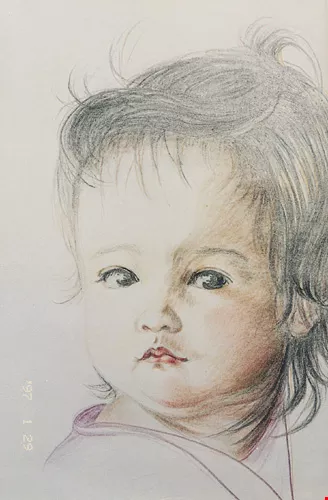
Years ago Madame Wei-wei succeeded in capturing in a sketch her granddaughter's spirit. Today her granddaughter is a slim and graceful young woman.
From the mountains to the coast
Owing to this kind of insight, Mme. Wei-wei's later creative work frequently touches on the theme of courageously facing the sorrow of life, death and separation. In Love for Life, a talking book she published before her retirement, for example, she frequently discusses how to cope with unbearable grief. The sudden death of her dear son 20 years ago has proven to be a priceless lesson to Mme. Wei-wei. Through it she has come to realize that the value and meaning of life aren't simply a matter of how long a person lives. Even though her son only lived 26 years, he was able to do many of the things that he enjoyed, and lived a really outstanding life. "Looking at it from this perspective takes some of the edge off of my grief."
Three years ago Professor Chou Cheng, Mme. Wei-wei's husband for most of her life, died following an illness in his hometown in Shandong Province. Her son and daughter now live in mainland China and the United States. She wasn't up to maintaining by herself the old family house at the Huayuan Hsincheng housing complex in Hsintien, where she lived for 30 years and which holds so many memories for her. Thus she made up her mind, sold it and moved to Tanshui on the other side of Taipei, looking for new energy in her life.
Intent on letting go of the past, when she moved she gave away most of her furniture. Apart from the dining table and some chairs, what most stands out in her living room is the easel set up in the middle of the room and the four walls covered with her paintings. She has every day free to sit in front of her easel and paint to her heart's content. Not encumbered with entangling concerns, Mme. Wei-wei has found a comfortable rhythm for her life, a custom-made lifestyle which she has slowly refined during her ten years of retirement.
She believes that while retirement is certainly a time for career women to step out and do what they've always wanted to do, housewives should also take the opportunity to make the most of their second spring in life.
During her several decades of writing a column, Mme. Wei-wei has come across too many unhappy housewives. No professional post, no salary, no colleagues, no promotions, and, of course, no retirement and pension. They give their youth to their family and children, but once their children grow up and their nice home becomes an empty nest, the old couple are left behind to look after each other. If, by chance, they don't get along very well, it can be a rather depressing situation. So a woman has to make a retirement plan for herself which doesn't require her to leave home. Especially since women have a longer average life expectancy than men, it's important to begin planning for the future as soon as possible.
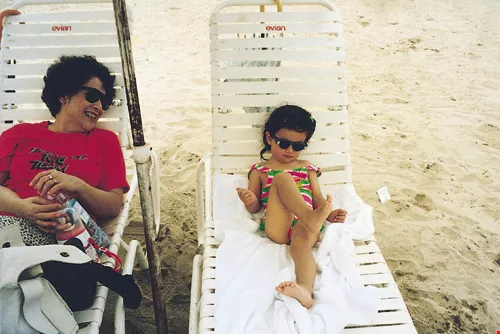
Madame Wei-wei's son-in-law is an American PhD, and she has been a grandmother for over ten years. She is very fond of her lovely granddaughter, who has inherited the attractive features of both her parents.
Enjoying the final solo dance
Mme. Wei-wei asserts that one's character governs one's fate and determines one's life. The same goes for retirement. As long as one remains optimistic, curious and eager to learn, retirement is just a matter of moving to a different dance stage. No matter how old you are, you can still be lively and upbeat. Isolators are a high-risk group, because retirement deprives them of their most important link with the outside world, as well as the meaning and focus of their lives. Lots of people retire, only to sit at home feeling depressed. Before long they fall ill and linger on until they die, a senseless waste of the resplendent twilight of life.
"Retiring from one's job is normal, but shrinking away from life is not." She's weathered the storms of life, including the loss of her son during her middle years and her husband in her old age. Yet she thoroughly cherishes the inner freedom and peace she has found, and is deeply grateful.
"The Dance of Life:" "Retirement is switching to a new dance on a different stage, / But the dance continues all the same. / Retirement may be a solo dance without spectators / Or reaffirming applause, / But there is freedom, / No fixed style, as you please. / So enjoy this solo dance, / Give the dance of life all you can, the best form you have, / Until you can dance no more."
Mme. Wei-wei is very fond of this poem written by a friend who wants to remind retirees and those who are preparing for retirement that even though the dance of life has moved to a new stage, the curtain has not yet dropped. This is the time to get up and dance gracefully and joyfully, and make the closing scene of one's life beautiful and free of regret.
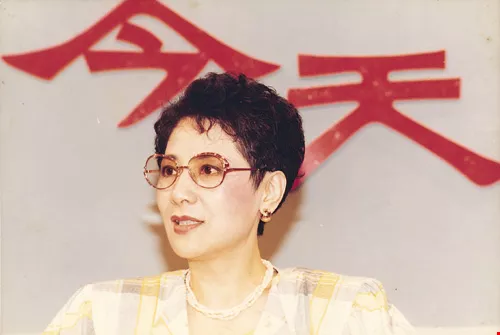
In 1972 Madame Wei-wei began to host the Today program, which was broadcast in the morning on the Chinese Television System. On the show she addressed a variety of problems faced by women, which led to her becoming one of the most influential woman writers in Taiwan.
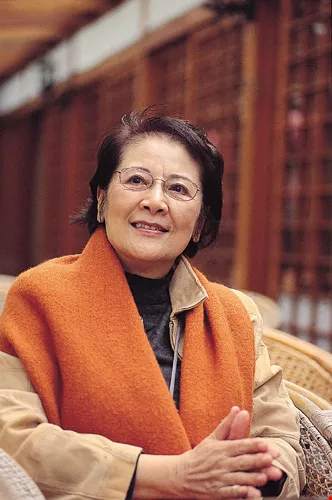
A columnist and woman of many talents, Madame Wei-wei also stands out for her deep concern for people. Not content to rest on her laurels, after retirement she began to paint again. She asserts that dreams are not only for young people, and encourages retirees to make their dreams come true.

@List.jpg?w=522&h=410&mode=crop&format=webp&quality=80)


