A Rare Taiwan Raptor Graces the Big Screen:
Inside the Documentary Fly! Mountain Hawk-Eagle
Chen Chun-fang / photos Kent Chuang
May 2026


Fly! Mountain Hawk-Eagle focuses its lens on Taiwan’s most mysterious and elusive apex avian predator, unveiling the rarely seen behaviors and ecology of the Mountain Hawk-Eagle. (courtesy of Cai Chang International)
Deep within Taiwan’s precipitous mountain forests soars a massive silhouette—the Mountain Hawk-Eagle. Known as the legendary king of the sky, this endangered raptor is a sacred ancestral symbol for the Paiwan and Rukai Indigenous peoples and Taiwan’s most mysterious bird of prey. After 12 years of dedicated filming, renowned documentary director Liang Chieh-te presents his latest masterpiece, Fly! Mountain Hawk-Eagle. The film guides viewers into misty, high-altitude forests to witness a touching journey of connection, conservation, and cultural understanding between humans and this majestic bird.
While the Mountain Hawk-Eagle is not endemic to Taiwan and can be found across East Asia and Japan, its presence on the island carries a profoundly different significance due to the feather adornment culture of the Paiwan and Rukai Indigenous peoples. This unique cultural intertwining makes the story of the Mountain Hawk-Eagle in Taiwan truly one of a kind.

The documentary Fly! Mountain Hawk-Eagle not only captures extraordinary, fleeting moments of the raptor in action, but also, against the backdrop of breathtaking natural scenes, underscores the sobering reality of the specie’s gradual disappearance. (courtesy of Cai Chang International)

Through the groundbreaking research of scholar Sun Yuan-hsun—affectionately known as the “Taichi Eagle King”—the film offers an authentic look at the grueling hardships of tracking the eagles and illuminates the unwavering perseverance and ideals behind conservation efforts. (courtesy of Cai Chang International)
Bridging the divide between sky and cliff
“I could never have completed this film on my own!” Director Liang stated emotionally at the film’s premiere. He noted that besides his own filming,contributions included valuable footage from a number of friends, poignant narration by acclaimed director Wu Nien-jen, and an original score by Golden Horse-winning composer Lim Giong. Liang also expressed his thanks to various organizations for their support, which was essential to bringing this documentary before the public.
The film follows the arduous and often perilous fieldwork of Sun Yuan-hsun, a leading scholar affectionately known as the “Taichi Eagle King.” Viewers are given a firsthand look at the immense challenges of ecological research and the unwavering dedication behind conservation efforts. Carrying tens of kilograms of equipment, the research team regularly hikes for over five hours each way along the rugged Southern Cross-Island Highway. Despite facing severe weather and treacherous terrain, the researchers never back down in their quest to uncover the behavioral and ecological secrets of the Mountain Hawk-Eagle.
Liang noted that capturing the perfect shot required extraordinary patience. For instance, a sequence lasting only a few seconds on screen was the result of the crew staking out Wulai’s Fushan Indigenous community for five grueling months. Because Mountain Hawk-Eagles inhabit sheer cliffs deep in the mountains, even a lucky sighting is usually just a fleeting glimpse. Through the collective efforts of many people, the film documents rare behaviors such as courtship, chick-rearing, and hunting, offering breathtaking footage that warrants multiple viewings on the big screen.
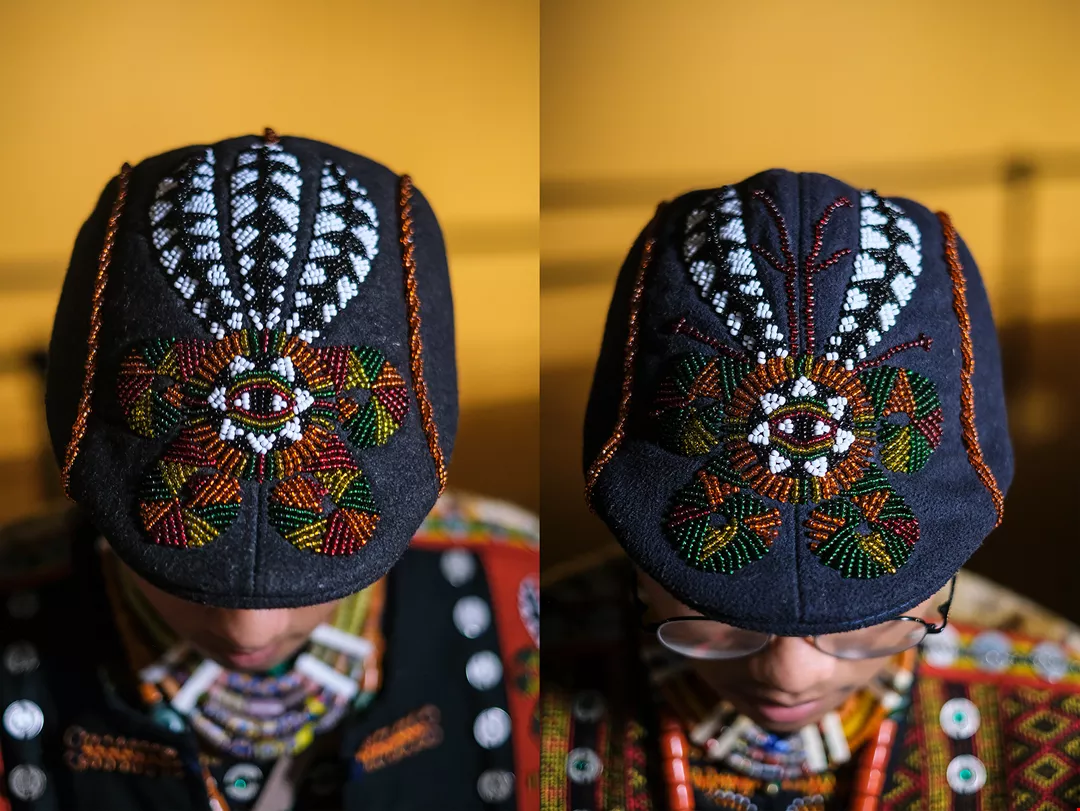
In Paiwan Indigenous culture, Mountain Hawk-Eagle feathers are a symbol of status. Only the eldest son of a chief’s family is entitled to wear an adornment of three feathers (left), while other family members are restricted to two (right).

Ljuzem Djubelang Djakudjakuc (second from left), a traditional leader of the Paiwan tribe, attended the film’s premiere in full ceremonial dress with members of her family, proudly wearing exquisite simulated feathers on her headpiece.
Crafting simulated feathers to sustain ancient traditions
Through his lens, Liang delves deeply into the use of Mountain Hawk-Eagle feathers and the complex cultural and ecological issues intertwined with this practice. In some Indigenous cultures, these feathers carry profound traditional significance, serving as a powerful symbol of status and identity. Historically, only the tribal chief was permitted to wear the feathers, which later evolved into an indicator marking the chief’s broader clan. In the early days, feathers were primarily gathered after being naturally molted in the wild. However, as lifestyles modernized, some tribal members began purchasing feathers. “Where there is demand, there is trade, which can inevitably lead to hunting,” generating indirect pressure on the survival of the Mountain Hawk-Eagle.
A turning point emerged through the tireless outreach efforts within Indigenous communities of Sun Yuan-hsun and his wife, Wu Hsing-ju, as well as the work of master craftsman Zhong Jin-nan, a pioneer of simulated feathers.
Acting as missionary-like advocates for forest conservation, they continuously promoted the viability of substituting real feathers with simulated ones. After years of meticulous trial and error, Zhong perfected a delicate painting technique to create simulated feathers so remarkably realistic that even experts struggle to tell them apart from the genuine article.
Zhong shares his core philosophy: “Respect tribal traditions, and respect the opinions of the leaders.” He fully understands that for certain Indigenous people, Mountain Hawk-Eagle feathers are an irreplaceable marker of identity. Therefore, he leverages his craftsmanship as a bridge of communication to help resolve this ecological dilemma. Many traditional leaders, who initially voiced strong opposition, are now willing to wear simulated feathers at major life events such as weddings and sacred ceremonies. Zhong finds their active endorsement of his work to be deeply moving.

Craftsman Zhong Jin-nan (right) has brought new hope to Mountain Hawk-Eagle conservation by passing along his simulated feather painting techniques. In this photo, he shares a joyful moment with one of his very first students, Ljuzem Djubelang Djakudjakuc (left), and director Liang Chieh-te (center).
A transcendent promise between a tribal leader and her grandfather
At the film’s premiere, Ljuzem Djubelang Djakudjakuc, a traditional leader from the Paiwan tribe in Pingtung, attended in full ceremonial regalia including a headpiece that was, in fact, made using a set of simulated feathers. As a pioneer in promoting this alternative within her community, Ljuzem openly admitted that the journey has been fraught with difficulties. Her steadfast commitment to pressing forward, however, has been deeply rooted in a promise she made to her grandfather.
Years ago, when Sun Yuan-hsun first visited various Indigenous villages to gauge interest in simulated feathers, Ljuzem’s grandfather offered a profoundly wise perspective. He argued that Paiwan leadership is rooted in bloodlines, not in external objects validating an inherent right. He told Ljuzem: “If the day comes when the technique for making simulated feathers is ready, you must help them if you can.” Honoring these words, Ljuzem became a student in Zhong Jin-nan’s inaugural simulated feather workshop in her community, stepping up to be among the first to embrace the change.

“We have constantly been searching for an equilibrium between cultural preservation and ecological conservation. With time, collective effort, and mutual respect and support, I believe things will only get better,” Ljuzem Djubelang Djakudjakuc noted hopefully at the premiere.
Fly! Mountain Hawk-Eagle officially hits theaters nationwide on May 15. As Chou Wen-ling, CEO of the sponsoring Wistron Foundation, eloquently stated at the premiere: “This film has been completed at the most opportune time and is the finest gift we could offer this land, because it allows us to see the beautiful possibilities of greater inclusion and mutual respect.”
Further reading:
“A Path to Survival: Conserving the Chinese Crested Tern”
與學者孫元勳(右二)、工藝師鍾金男(右一)、緯創人文基金會執行長周文玲(左三)、部落傳統領袖沈文伶(右三)與她家人.jpg?w=1080&mode=crop&format=webp&quality=80)
Director Liang Chieh-te (fifth from left) is joined at the premiere of Fly! Mountain Hawk-Eagle by scholar Sun Yuan-hsun (second from right), craftsman Zhong Jin-nan (far right), Wistron Foundation CEO Chou Wen-ling (third from left), traditional Paiwan leader Ljuzem Djubelang Djakudjakuc (third from right), and members of her family (first, second, and fourth from left). (courtesy of Cai Chang International)

Fly! Mountain Hawk-Eagle features incredibly rare footage of the eagles rearing their young, documenting the fledglings as they learn to fly. The film urges the public to join forces in protecting this magnificent species so it may soar for generations to come. (courtesy of Cai Chang International)


