Apex Lin--Bringing Design in Taiwan to New Heights
Kuo Li-chuan / photos courtesy of Apex Lin / tr. by Jonathan Barnard
July 2009


Creativity is one of the core ele-ments of competitiveness in the 21st century, the age of the aesthetic economy. In the face of global competition, one of the keys to victory for economic entities as small as an individual or as large as a nation is whether they can use creativity and design to convey their special qualities.
In 2002 Taiwan adopted the fostering of "creative and cultural industries" as a goal of government policy. In 2004 Taiwan established the national-level Taiwan Design Center, which aims to move industry in a "designed in Taiwan" direction. And this year the government has adopted a plan to invest more than NT$21.2 billion in six "flagship industries," including television, film, and digital content. The plan aims to promote Taiwan's transformation into a center for creative industries in Asia.
Academia and private associations as early as the early 1990s had created posters that displayed the essence of "Taiwan culture," and they garnered international attention. At the 2006 Frankfurt Book Fair and the 2007 Bangkok International Book Fair visitors could see a "Natural Taiwan" composed of leaves, a "Cultural Taiwan" created from tribal totems, and a "Literary Taiwan" featuring a lush bouquet of flowers fashioned from book pages. These visual images that represented Taiwan left a deep impression on the international publishing industry.
The driving force behind this series of "Taiwan images" was Apex Lin, "a luminary of Taiwan design," who in 2007 was the first person to win a National Award for Arts in the fine arts division for work in "design."
Lin was born in 1957 in Pingtung County's Donggang. His father Lin Qingyun was one of Taiwan's most important photographers of his generation. Although he worked as an escrow agent, he couldn't conceal his artistic sensibilities, and he took a liberal approach to his children's education.
Lin's father loved to listen to melodious classical music, which back then was extremely unusual for the fishing village of Donggang. It often attracted curious Taiwanese and foreign researchers stationed at the nearby Fisheries Research Institute to stop by and listen. His father and friends often organized meetings where people talked about art, and Apex's second older brother Lin Wenyan even organized a design association called the Hayfield Wind Workshop. It was in such an environment that the young Apex's artistic vision grew.
Corporate identity systems
In addition to the influence that his family exerted, Apex attended college just as the folk song movement led by Li Shuangze and others was sweeping Taiwan's campuses, inspiring students to write and sing their own songs. Then, in rapid succession, Taiwan was shaken by the Zhongli Incident in 1977, the severing of formal diplomatic relations between the United States and the ROC in 1978, the Formosa Incident and the Bootleg Alcohol Incident in 1979, and the PCB Poisoning Incident in 1980. Lin, who has always been very civic-minded and likes to keep up with social trends, thought deeply about these events, which were reshaping the social environment.
"Whether via the campus folk songs movement, which stressed finding one's own voice, or via passionate discussions about the nation's status prompted by the United States severing formal relations with the ROC, Taiwan was actively searching for its own voices, standpoints and positions," recalls Lin. "All of that had a big impact on me."
In 1976 Lin entered the design program in the fine arts department of National Taiwan Normal University, where he studied under Professor Wang Jianzhu. Lin helped Wang conduct surveys of folk resources and carry out research into handicrafts. These helped Lin gain knowledge about Taiwan's rich cultural resources. In his junior year, Lin planned and designed a kindergarten, which led to an interest in corporate identity. He subsequently read DECOMAS-Design Coordination as a Management Strategy, by Motoo Nakanishi, "the father of corporate identity." The book greatly inspired Lin, who enlisted his Japanese-educated father's help to write Nakanishi about various questions he had.
In 1985 Lin used his spare time while he was performing his military service to write Corporate Identity Systems, which advocated taking a company's intangibles-such as its corporate culture, its guiding philosophy, and the unique character of its products-and giving them concrete manifestations via the planning and design of corporate identity systems.
Back then Taiwan was in the midst of an economic transformation and was just beginning to open its market in earnest. Government agencies as well as state-owned and private businesses needed to build their images. When the book came out, it immediately attracted widespread attention. Lin became a columnist and also established a design firm with his college classmate Gao Sisheng and others. In rapid succession, the company worked with Taiwan Sugar, Chunghwa Telecom, BES Engineering, PTS, and FTV. The firm helped those companies with their overall image planning, as well as with promoting their corporate identity and brand images. Instantly, it seemed that CI had become a magic pill that would enable businesses to remake themselves and start afresh.
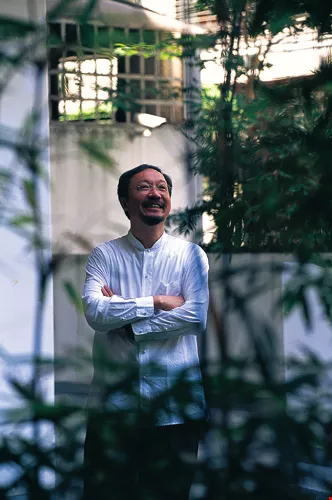
A creative professional and an expert on CI (corporate identity), Apex Lin has formally issued a call for Taiwan to create posters. Striving to turn Taiwan into an island of design, he has actively worked with platforms of international exchange so that the entire world can see Taiwan's creative accomplishments.
Idea craftsmen
"Design," which has by now become a widely studied discipline, is translated in Chinese as sheji (設計), which can also mean "to plan." In Japanese it is translated by the Chinese characters "意匠" which literally mean "thought craft." Lin stresses that the Chinese character for "thought" (意) combines the characters for "sound" and "mind." The Analytical Dictionary of Characters, a classic published over two millennia ago, describes the character thus: "The mind examines speech to know meaning." Therefore, designers must first precisely figure out what others (consumers/clients) are saying they want. Then, "thinking carefully before putting pen to paper," they must come up with their own creative ideas. Finally, there is the stage of craftsmanship, when designers choose the most suitable tool and use a pure and mature technique to finish the job.
He cites a famous line by the Qing Dynasty painter Zheng Banqiao-"eliminate the superfluous to show the essence of autumn trees, and seek to be a trailblazer like February flowers"-to describe the two main directions that designers take in their work: design conception and planning. Design conception emphasizes concepts and ways of thinking, as well as grasping the core elements of something's nature, whereas planning involves strong step-by-step implementation to end up with an image that truly has an impact on people.
Taking a broader perspective, Lin says, "Design is nourished from culture and art. It takes commercial design, with its market orientation, and turns it into a creative enterprise with aesthetic content and cultural meaning." Consequently, he believes that designers should have three special characteristics: sensitivity to current events, sharpness in thinking, and boldness in execution.
"Working in design is like passing something through a sieve," says Lin, who has directed nearly 100 corporate identity efforts. "First you take a broad perspective to consider every possibility. Then you find the core elements and choose what works." He cites the CI work he did for Chunghwa Telecom in 1992. Two handsets-one colored and one blank-are nestled together to convey the idea that when people use the phone to communicate they convey the meaning of their hearts and souls. The image was thus an extension of the company's corporate mission of "communicating people's sentiments and connecting with the world's heart."
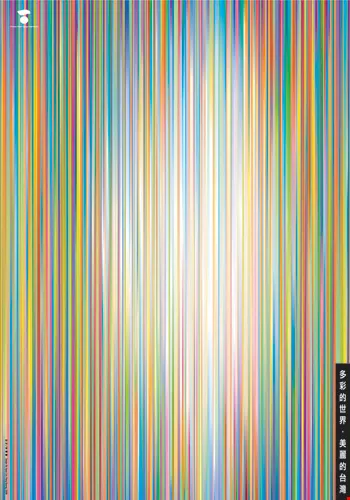
In "Colorful World, Beautiful Taiwan" (2005), stripes of gorgeous neon-like colors demonstrate Taiwan's accomplishments in the realm of computers and technology, as well as the achievements of its cultural and creative industries.
Taiwan's image in posters
Another field in which Lin has acquired international expertise is poster design.
During summer vacation in 1989, Hou Xiaoxian's City of Sadness won the Golden Lion at the Venice Film Festival. While the nation rejoiced, Lin regretted that whereas Taiwan had enjoyed some success in the realm of culture, it had done nothing to promote a national image. In comparison, the nearby countries of Japan and Korea had long been taking active steps to show their local color and the unique elements of their culture to the world. But with reduced sovereignty in the international realm, internal divisions regarding national identity, and a lack of discussion about related cultural theories, Taiwan had continued to have a hazy place within international society.
In order to build up and promote the nation's image, Lin brought together his college classmates Qiu Yongfu, Gao Sisheng, Ye Guosong, and You Ming-long to establish the Taiwan Image Poster Association (now the Taiwan Poster Design Association) in 1991, which-in the spirit of "passionately loving Taiwan, emphasizing the native soil, and caring about design"-issued a clarion call for Taiwan to create posters.
The following year Shenzhen held the "1992 Print 2-D Designed in China" exhibition. Lin wanted to take advantage of the opportunity to show the many special sides of Taiwan via posters. With his encouragement, quite a few designers participated. Subsequently, the association held a poster competition on a different topic every year, including environmental protection, color, protection of children, communication, and fighting drug abuse. These competitions explored issues in Taiwan and the pulse of society here.
With their clearly identifiable style and slogans, these creative Taiwan Image posters became representations of Taiwan's international identity, and various big cities in mainland China modeled their own poster competitions on the Taiwan Image competitions.
Island image, national totems
In his own creative works, Lin uses an epic descriptive style to convey his cultural theories about Taiwan. For instance, "Drifting Taiwan" (1993) presents a series of horizontally arrayed Taiwans floating like clouds across a map of the world. "A Colorful World, a Lost Taiwan!" (1996) shows Taiwan enmeshed in a color blindness chart. Although the island of Taiwan is discernable to most, too many people can lose sight of it in the field of colors, meaning that they can lose sight of its plight and status. Then there is "Colorful World, Beautiful Taiwan" (2005), which featured stripes of gorgeous neon-like colors to demonstrate Taiwan's accomplishments in the realm of science and technology and let the world's people see the value and beauty of Taiwan.
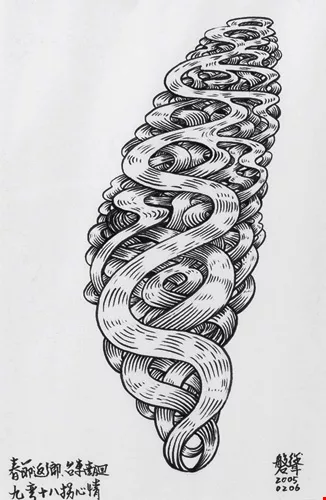
What's more, Lin's "My Homeland Taiwan" series, featuring detailed line drawings, presents various visual images in the shape of the island. These have become among Lin's most representative works of personal artistic creativity. This creative journey began with a pot of devil's ivy.
During winter vacation in 2004, Lin returned to his old home in Pingtung, and happened to see some devil's ivy that his father had planted. It got him thinking about his father, who had just passed away the year before. With emotion welling up inside him, he picked up the brush at his side and a sheet of ordinary A4 paper and drew an image of the island of Taiwan as an expanse of devil's ivy leaves. That was the start of a series he is still working on: "Seeing the Homeland of the Spirit."
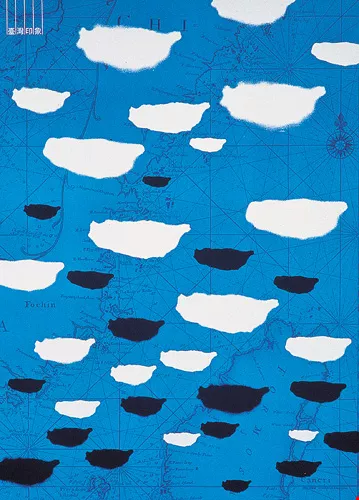
Lin uses poster exhibitions to convey his thoughts on Taiwanese culture. His "Drifting Taiwan" (1993) shows a series of horizontally arrayed Taiwans floating like clouds across a map of the world to convey Taiwan's rootlessness and homelessness in the international realm.
The homeland of heart and soul
"Although I had long been drawing works featuring images of Taiwan, I didn't have strong motivation for doing so or a clear conception of what I was doing," he says. "But when I was drawing devil's ivy, my thoughts came more clearly into focus with each brush stroke." He used the simplest of tools (a calligraphic brush) as well as the simplest of techniques (line drawing) to record all that he had heard, thought and felt. The works range in size from a postcard, to A4 paper, to a door panel.
"Just as monks arise early to recite scripture day after day, so have I worked on these day after day." Lin thus describes why he has chosen to meticulously apply layer after layer of dots and lines with a calligraphic brush.
"The size of each dot and the pressure applied when making it reflect the rise and fall of emotions at that very moment. Works of art provide a window onto the inner state of their creator, which is sometimes easy going and peaceful and sometimes restless and wandering." His wife and daughters have emmigrated to the United States, and in their absence he has covered his bedroom door with a sheet of paper. Every morning he works on it for an hour. Although it remains unfinished after three months of work, he still has unflagging enthusiasm for the task.
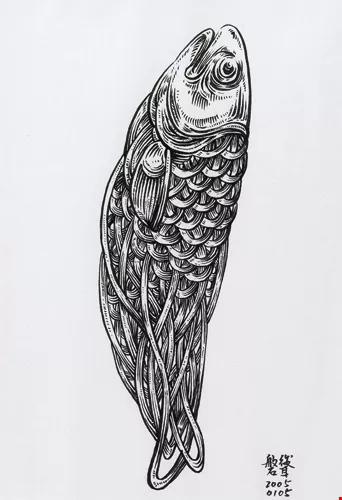
To him, the island of Taiwan is like a vessel for holding creative material, filled with what he experiences every day. "You can engage in quiet observation in every aspect of your life. Often, without thinking about it, I observe the existence of a Taiwan style in common surroundings." Through his artistic rendering, Taiwan is clouds; it is mountain ridges, swimming fish, frangi pani, vines.... Each of his works holds deep feelings for and great expectations about his native land.
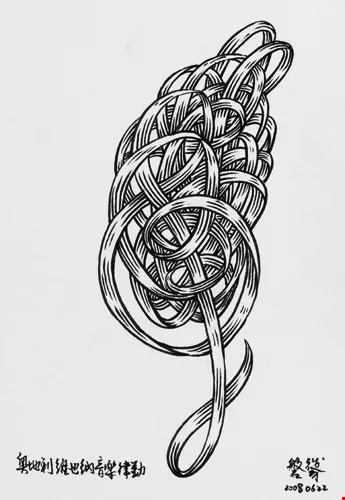
Since 2007, whenever he has gone on a business trip, whether in Taiwan or abroad, he has turned his observations and thoughts into a visual image of Taiwan, which he draws on a postcard and sends to himself. Serving to document their time and space, these postcards have featured the easy-going, happy lines of Rome, and the musical rhythms of Vienna. He plans on accumulating them for ten years in order to finish his "Letters Home to Taiwan" series. The next installment in this series, a piece created in watermarks, is expected to be unveiled in 2010.
Lin often quotes a common saying: "You can't choose your natural homeland, but you can choose your spiritual homeland." Via these various images of the island of Formosa, he hopes to invite people to try to consider and observe Taiwan from different points of view. He wants to convey to society at large: "I've seen Taiwan! Have you?"
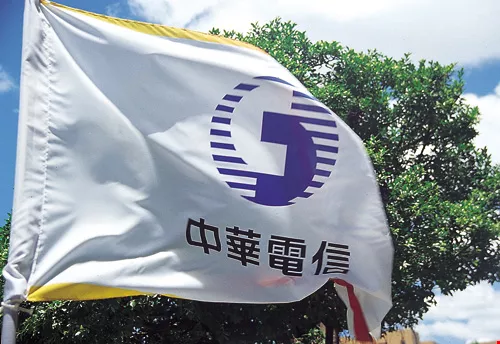
Corporate identity design requires both creativity and functionality. The photo shows the fruits of CI work that Lin did for Chunghwa Telecom. Two handsets-one colored and one left blank-are nestled together to convey the idea that when people use the phone to communicate they convey the meaning of their hearts and souls.
A platform for Asian design
Apart from bolstering Taiwan's image and promoting international exchange, Lin has constantly taken as his personal mission the elevation of Taiwan design onto the international stage.
In 1994, Lin, along with two designers he greatly admires from Japan and Korea, formed the Asian Corporate Identity Association in Beijing. The association has promoted corporate identity development on the mainland, and has earned him much praise and many friendships in the mainland Chinese design community. From 2001-2003 he was selected to serve as the vice president of the executive board of the International Council of Graphic Design Associations. This is the first time that this important international organization, which lists its members based on their national origin, has appointed someone from Taiwan to their executive board.
With Lin's ceaseless efforts, Taiwan has become a bright new star in the international design firmament. It has successfully won the bid to hold the 2011 International Design Association Congress, for which more than 2000 major designers and design professionals from 50 nations will come to Taiwan. This is the largest design gathering in Taiwan's and Asia's history, and it is also the first time that the International Design Association has integrated the three realms of print media design, industrial design and interior design into one conference. It represents an important milestone in the history of global design.
Lin pulls out the self-inking brush that he carries with him at all times. He draws a circle on a blank sheet of paper, and, after denoting the globe's north and south poles, marks the location of Taiwan. "Because Taiwan's plight is special, it is forced to act in the diplomatic realm as if it had one hand tied behind its back," he notes. "In fact, it's no use for Taiwan to argue about 'territorial' matters in international society. Instead, Taiwan ought to employ the soft power of culture to create a 'magnetic field' that draws the world to it." And international competitions are a shortcut to building a "magnetic field" of soft power.
Artistic seeds bear fruit
In 2005 Lin became head of National Taiwan Normal University's Department of Fine Arts and Graduate Institute of Fine Arts. By breaking through longstanding prejudices in academic circles that "devalue commercial applications of art while valuing art for art's sake," the appointment marked a major turning point in the history of fine arts in Taiwan. After Lin assumed the post, he not only encouraged students to break down the old barriers between pure art and applied art, but went a step farther to lead designers out of the ivory tower and toward a wider market and greater audience.
Apex Lin combines the enthusiastic cordiality of a southern Taiwan native with the perfectionism of a Virgo, and has shown great diligence in fulfilling his social missions. Demonstrating that form and content are as complementary in art as red petals and green leaves are in a flowering plant, he has thus rewritten the history of Taiwan design, offering a new image of Taiwan to the people of the world. This does indeed represent the apex of design.
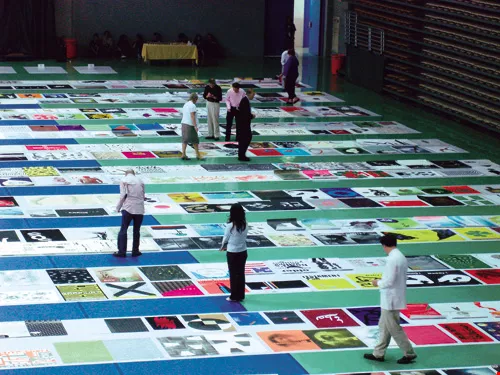
Hosting major international competitions is a shortcut to garnering international attention. From 2005-2007 the Taiwan International Poster Design Awards attracted more than 2000 entrants from more than 30 nations, amply demonstrating the soft power of Taiwan's culture.
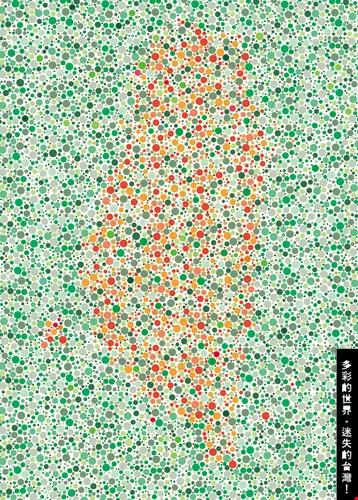
When China conducted missile tests off Taiwan in 1996, Lin designed "A Colorful World, a Lost Taiwan!" He hoped that a color blindness chart would get the people of Taiwan to reflect on the nation's status and their own plight.


@List.jpg?w=522&h=410&mode=crop&format=webp&quality=80)


