

For nearly 30 years, Kaohsiung's Mt. Zion has been the site of marvels and controversy.
The members of the Protestant New Testament Church have worked hard to build their Mt. Zion homestead and have fought ferociously to protect it. When they clashed violently with military police in the 1980s prior to the lifting of martial law, local and international media portrayed them as brave believers fighting for their cause. When loosening Taiwan's educational regulations to make learning more enjoyable for students became a cause celebre a decade ago, the members of the church collectively withdrew their children from the public school system. They took their kids back to their "Garden of Eden" on their "Holy Mountain" to provide them with a "God-based" education and instruct them in living a "God-based" life, and once again found themselves in the spotlight.
Since the lifting of martial law, Taiwan's Mt. Zion has been transformed from the site of a bloody "holy war" into a beautiful retreat. Its decade-long experiment with "God-based" homeschooling is flourishing, as well. The church is also growing rapidly. To date, it has spread its educational and organic farming models to 18 overseas branches, enlarging its little utopia by sharing resources and connecting people.
Mt. Zion rises 1,000 meters above Kaohsiung County's Chiahsien Township. Following the twists and turns of Provincial Highway 21, you eventually arrive in a place like that described in Jin-dynasty poet Tao Yuanming's "Peach Blossom Spring." As Tao put it, "There are fertile fields, pretty lakes, bamboo and mulberry trees, crisscrossing footpaths, the sounds of clucking chickens and barking dogs, men and women farming in clothing just like outsiders wear...." But Tao was penning a fantasy. Once his fisherman-protagonist left the confines of his utopia, he was unable to return. Mt. Zion, in contrast, is a real community in southern Taiwan settled by more than 300 devotees of the New Testament Church.
While the mountains still sleep, residents of Mt. Zion gather in the temple at the summit. It is 5 a.m. and everyone is here: elderly grandparents, the middle-aged, young couples pushing baby carriages, and even teens. They sit very upright, praying, reading the Bible, and listening to their pastor's sermon.
At the end of the meeting, more than 100 teens and young adults move to a broad hall to sing and dance. "For the seed shall be prosperous; the vine shall give her fruit, and the ground shall give her increase, and the heavens shall give their dew; and I will cause the remnant of this people to possess all these things...." Their song rings out against a backdrop of green mountains and early morning light, marking the start of another day.

A Chinese class using texts developed within the community gets underway in a corner of the dining hall. The teacher seems to be having no trouble teaching while rocking a baby.
Fully provided for
The 100-hectare Mt. Zion site is a small community whose members are fully provided with food, clothing, residences, work, education, and entertainment. Residents take up their tasks at eight every morning: the agricultural crew measures out feed for the animals, harrows and waters the fields, and produces organic fertilizers; the fermenting and packing crews attend to their work in the processing plant; the young people responsible for soil and water conservation and for sprucing up the gardens set out in a small truck; the shop at the community's entrance begins serving groups of visitors; the publishing group goes to work in the office revising textbooks, making posters, and designing packaging for the farm's produce; the smell of cooking food and soy milk begins to waft from the kitchens....
The children, meanwhile, split into six groups divided by age and begin class with their respective teachers. In the morning, they study Chinese, English, math, science, spirituality and music. In the afternoon, they join the work crews, laboring beside and learning from the "aunts and uncles" doing the farming, gardening, building, cooking, and what have you. Every three or four months, the kids rotate to a new crew.
No one receives a salary on Mt. Zion. Instead, the community operates like a large family. Members manage the income collectively, and together provide for each individual's needs. Families have their own homes, while singles, school-age children, and the elderly each have dormitories. The community's elderly also have personal caretakers, and the school-age kids are watched over by "aunties and uncles."
This self-sufficient agrarian lifestyle, which some see as a "return to nature," has drawn many church members to live on the mountain. But the work is hard. Organic faming and animal husbandry are labor intensive, and there are many dependents on the mountain. As a result, the community is always pressed for manpower.
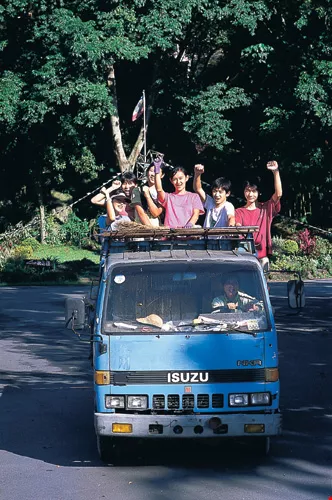
With breakfast finished, it's time to go to work! The children of Mt. Zion learn a variety of skills, including planting, tending gardens, raising livestock, and soil and water conservation.
Undefeatable Pocashi
Take the rabbit colony at the top of the mountain, for example. Two women take care of the 22,000-square-foot site by themselves, caring for the 2,000 rabbits that provide the community's meat. The women manage four breeding seasons every year, as well as handling numerous daily tasks that include inspection of the colony, cleaning up food left over from the previous day, checking up on newborn bunnies and their mothers, and feeding the rabbits. They lead a group including teens and members of the ostrich workgroup out to cut hay for an hour in the afternoons, then come back to measure out the feed for the rabbits' second and third meals of the day.
"When rabbits pick up a contagious disease, huge numbers of them die," says Luo Chia-hui, one of the rabbit caretakers. She says that whereas most commercial rabbitries try to prevent this by injecting their rabbits with antibiotics, she and her partner rely on hygiene and good fodder to keep their rabbits healthy. Mt. Zion has also developed a food supplement called Pocashi, containing dozens of microorganisms that greatly increase the rabbits' resistance to disease.
It's not only the rabbitry that's short on labor. Just two young women take care of the 90 ostriches in the ostrich pen. And the seven or eight kids on the gardening team are responsible for keeping all the grass, trees, and gardens in the community trimmed, weeded, and looking nice. The community doesn't use herbicides, so weeding is a real chore. Visitors frequently see the kids squatting down in roadside flowerbeds, pulling up weeds and putting them in plastic bags.
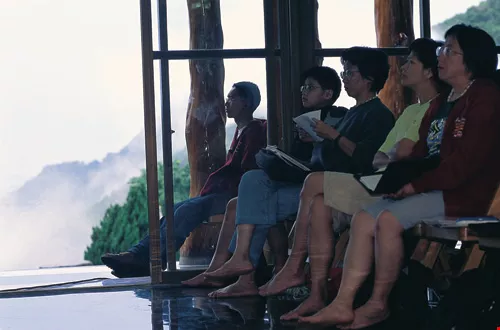
Far from civilization, hearts yearning for God soar through the morning light and mountain mists.
Mind and body
People who live in the city have a hard time imagining rebellious teens spending hours cleaning up chicken waste without any complaints. But these kids are comfortable working with their hands and their heads, and take on tasks in the kitchen, the gardens, the woodshop and even the webpages.
"We don't just build our own houses. We also repair roads and maintain our own flood control systems," says Li Ming-wei, a 30-year resident who has in recent years been responsible for guiding visitors around. He points out that Mt. Zion is bounded on the east by the Nantzuhsien River, and on the north and west by mountains. Given this and the deep valley that lies to the south, the community has an excellent geomantic location. But because it is also situated on top of a fault line, the construction team has had to do a great deal of soil and water conservation work. Then Typhoon Herb came through in 1996 and destroyed the majority of their earth retaining walls. They spent six months rebuilding them with everyone in the community pitching in. The work called to mind the rebuilding of the walls of Jerusalem by Nehemiah in Babylonian times. Their new retaining wall is a tiered structure 60 meters tall and 120 meters wide. Viewed from the vantage of Highway 21, it makes quite a sight.
Caring for the Earth
Though the community's 100 hectares is a lot of land, most of it is slopeland. Consequently, their cash crops are largely provided by fruit trees, including more than 10,000 tea-oil camellia (Camellia oleifera) and more than 1,000 plum trees. The community also manufactures a range of well regarded organic products on site, including bottled tea oil, tea-oil toothpaste, tea-oil facial lotion, and tea-oil dish soap.
Mt. Zion also produces organic fertilizers, including a spray made from fermented kitchen waste and another fertilizer made from worm castings. They produce the latter by suspending their rabbit cages above mounds of earthworm-rich soil. When the rabbits' feces falls to the ground, it becomes a feast for the worms. "Worm castings are nine times more potent than ordinary organic fertilizer," says Li Ming-wei. But, he adds, they cost too much to make in the world outside Mt. Zion's boundaries.
The Mt. Zion community is doing well these days. Its gardens are tidy and its animals are flourishing. Such a picture of prosperity was hard to envision 40 years ago.
In 1963, God led the community's founder, Elijah Hong (born Hong San-chi and later known to his followers as "Grandfather"), to Mt. Zion, which was then nothing but a precipitous, uninhabited wilderness. Certain that God had led him to this holy mountain for some purpose, Hong sold off his family's property and moved here with two other men who were, like him, dissatisfied with traditional churches. They built grass huts, grew ginger, and raised sheep, living a hard life while they waited for God to raise up a new spiritual leader.
Unable to make ends meet on the mountain, Hong went back to Tainan to run a pharmacy in 1965, using the proceeds to keep the homestead project afloat. While there, he chanced to meet the founder of the New Testament Church, Kong Duen-yee. Already very ill, Kong had come to Taiwan to spread her version of the gospel. She spoke persuasively on Christ's blood, water, and spirit, and believed that she had been chosen by God to revive the churches of the world. Hong became her follower and took on the mission of spreading the church's teaching in Taiwan. When Kong passed away shortly thereafter, Hong took on the roles of apostle and prophet as well.
Grueling work
While Hong was spreading the gospel and building his church, three families moved up onto Mt. Zion to begin bringing it under cultivation. Li Ming-wei, who became one of Grandfather's followers as a young man, says that when he first went up the mountain in 1972, there was hardly anything there-just a few grass huts, a vegetable garden, and no electricity. A shopping trip meant hiking for eight hours along winding mountain paths and stony riverbeds to Chiahsien. After spending the night in town, they'd have to shoulder their loads of rice and other goods, and lug them back up the mountain.
Hong described the difficult early years in One Man, One Mountain. Running cabling for a cable car in 1976 was particularly tough. How were they to get two kilometers of cable weighing more than 400 kilograms up the mountain? "God instructed us to have 12 young men carry it on their shoulders, each wrapping dozens of turns of cable around their necks. They spaced themselves out evenly, and marched at the same pace," recalls Hong in the book. In spite of the difficulty of walking in this kind of line, he writes that with God's guidance and the church members' faith they were able to complete their incredible task.
Leaving tragedy behind
"Leading this kind of self-sufficient life, God is revealed to us in the environment," says Li. He explains that customs and civilization don't determine or interfere with life in the mountains. Instead, they live in accordance with God's laws, which allows the bounty of God's country to be revealed to the people of the world. Li says that the passage of time is making this ever more apparent. Many members held onto this belief even when the Nationalist government barred them from the mountain in 1980-86. Unable to live on Mt. Zion, they went abroad looking for another "Holy Land" far from the distractions of civilization.
But why did the New Testament Church run afoul of the government? Most people attribute the church's troubles to its founder Kong's leftist leanings and the "people's commune" look of the group's homestead. They believe these unsettled the government, which feared Mt. Zion might be providing cover for a subversive Communist group. The authorities therefore moved to disband the homestead. The church took to the streets, protesting the government's actions for seven years and winning sympathy from abroad.
Church members finally returned to Mt. Zion to rebuild their homestead in 1986. With the end of martial law in 1987, the homestead began welcoming visitors to the mountain, slowly turning into a tourist destination and shedding its veil of secrecy.
Strolling in Mt. Zion's tranquil gardens, you often run across posters proclaiming: "The crimes of the Nationalist Party's imperial Chiang family will never be forgiven," and "Floods and earthquakes are coming!" But when you see the elderly residents talking to young people beside the gardens, watch barelegged children playing in the road, and hear snippets of song wafting out of the buildings, you can't help but feel you've stumbled onto a little utopia.
Following their own path
Picking a few young people out at random, I asked about their reasons for being here. Their answers gushed out whether they'd moved here with their parents or on their own. They spoke about how they had come to work and study for God, or about what they'd learned opening up new farmland at "holy sites" in places such as Africa, Australia, and Sarawak. Twenty years into the rebuilding of Mt. Zion, some church members have left after finding themselves unable to adapt to the hard labor or restrictive lifestyle on the mountain. Even so, they continue to believe that one honors God by "giving up one's autonomy to work for the group."
As Hsu Tsun-jo, the 26-year-old mother of a four-month-old, puts it, she had grown up in the church but had never felt God. Ten years ago, she ignored her parents' protests and moved to Mt. Zion. Her two older sisters soon followed. Now she is happily married and lives a spiritually fulfilling, worry-free life. Unlike her old classmates out in the world, with their debts and marital problems, she is satisfied with life and grateful.
According to those on the mountain, life really can be very simple. The bright smiles and measured pace of Mt. Zion's residents are food for thought for those of us out in the hustle-bustle of the world.

@List.jpg?w=522&h=410&mode=crop&format=webp&quality=80)

@List.jpg?w=522&h=410&mode=crop&format=webp&quality=80)


