Tseng Chao-hsu's New Home
Theresa Wang / photos Wang Chen-hua,Chien Yun-ping / tr. by Peter Eberly
June 1986


The new 252-sq.-ft. apartment is located on the third floor of a high-rise in a busy part of Taipei. From the outside, the apartment looks just like any other, but open the door and the vase of flowers in the wall niche, the vase-shaped door opening onto the corridor, and the sense of receding spaces, all reveal a layout far different from those we are accustomed to. Set off by the rays of the afternoon sun, the living room, with its spirit table, Ming-style furniture, and Chinese character scrolls, provides a dignified yet comfortable setting for the conversation.
Can the humane, ethical spirit of the traditional Chinese quadrangular residence be recaptured in a modern high-rise apartment? A pair of professors have recently tried--Tseng Chao-hsu, the owner, teaches Chinese at National Kaohsiung Teachers' College, and Wang Chen-hua, the designer, is a professor of architecture at Chung-yuan Christian University. The two got together at our request last month in the living room of Professor Tseng's "modern Chinese home" for what turned out to be a seven-hour talk. The following summarizes some of the highlights of their remarks. A more technical discussion will appear in Professor Wang's forthcoming book. Also present was Liu Ch'ien-mei, instructor in aesthetics at Soochow University.
Tseng: When they heard my new home was "Chinese-style," some of my friends got the idea it was all "carved beams and painted rafters." But once they stepped inside they found it was not at all what they had expected--it was too simple!
Wang: Many people do associate Chinese- style architecture with the ornate and elaborate, but actually that's just for palaces and temples; the residential style is much simpler. You know, the Ch'ien-Lung emperor (r. 1736-1796) was said to have been so taken by the plain yet elegant taste he encountered in his excursions among the people that he had an entire Soochowstyle street constructed in the Summer Palace. My design seeks to capture just that flavor.
Tseng: Some older folks who have lived in traditional Chinese houses have come here and told me how this and that ought to be thus and so. Later I thought: It really is very difficult to recreate in a modern urban setting the calm, tasteful effect of receding spaces that you find in the traditional Chinese house, so perhaps some elements of traditional architecture simply cannot be carried over into a modern apartment.
The lesson is surely that we must grasp the spirit that lies behind the forms of the past and then infuse that spirit into the present. That is the way to carry on tradition.
Wang: This apartment does use many elements of traditional architecture: from room dividers, corridor posts, and round and vase-shaped doors down to the round-backed wooden chairs and the spirit table. What I want to emphasize is that this design is a real continuation of tradition and not just a case of "adding a few Chinese touches." But the continuation is as much a matter of spirit as it is of things you can see with your eyes.
Let's take the spirit table as an example. The ancestors' altar was the spiritual center of the traditional Chinese home, but in today's apartments it is usually hidden off to one side, now in the dining room, now in the kitchen, sometimes even under the staircase. I asked Tseng Chao-hsu if he wanted to leave this spiritual space in the living room, and he said he did.
The problem then was where. In traditional architecture the altar must be placed by the main wall facing the sunlight, but that's where we've got the furniture. So we had to break a taboo by putting it under a roof beam.
My reasoning went like this: In the old days, when buildings were made of wood, the beam was the weakest part of the house, so the altar was placed away from it for protection. But with today's reinforced concrete, the beam is precisely the safest place in the apartment, so putting the altar there is not inappropriate at all.
Tseng: I thought that was the most suitable place, too. And since my parents accepted the idea, it was decided.
Wang: That's why I say this design is a continuation in spirit of the traditional style. Let me explain a bit more clearly.
First comes spatial organization. For the past 30 years, apartments here have adopted Western designs, merely changing a few details here and there. We have never really fundamentally rearranged the space according to our own needs and lifestyle.
Now Chinese architecture is rich in rhythm and depth. So my concept was to put the dining room at the center of the apartment, like a kind of courtyard, and surround it with the other rooms, all linked together by the corridor. Really, this kind of spatial rhythm is hard to express in words or to capture with a camera; you almost have to live here and experience it in person.
Tseng: After more than five months here now, our impression is that the atmosphere of each room is quite different. The living room is rather formal, the dining room more relaxed, and the bedrooms and study the most warm and intimate. When students come here to talk, if they look like they're in good spirits we sit down in the living room, but if they say they've got something personal to talk about, we go into the study where we can have a heart-to-heart talk.
Wang: The second point I want to bring up is the concept of hierarchy in traditional architecture. I mean, in a traditional residence, the grandparents lived behind the main hall and the other family members had rooms along the halls to the left and right according to age and family rank. I think the concept of respect embodied in this principle is very important.
Liu: Actually, apartments today display a kind of hierarchy, too. Only it's not according to room location; it's according to size. The biggest bedroom goes to the breadwinner, while the older folks wind up in a smaller one.
Tseng: It's really too bad modern society takes economics as its standard of values instead of age or character.
Liu: That makes the think of the problem of "three generations living under one roof." I think one of the reasons we hear so much about daughters-in-law screaming to move out is often simply because the master bedroom and the grandparents' bedroom are too close, which puts every-one's nerves on edge. I think this so-called "ethic" of room size and location can have a positive effect on family relations. And it can serve as an unspoken lesson in respect for one's elders for the younger generation, too.
Wang: Most apartments today have one master bedroom (usually with a bath) and two single bedrooms. That's the Western style. But I've always encouraged designing two master bedrooms, which I think can solve a lot of problems.
Tseng: Two master bedrooms alone aren't enough, perhaps. I think it's best to leave a little distance between the rooms, too, to act as a kind of a buffer space.
Wang: Both stability and flexibility are needed. By stability I mean clearly defined, self-sufficient areas. The grandparents' room here for example is big enough to drink tea, watch TV, or entertain guests in, and it's the only bedroom with its own bathroom.
But these clearly defined areas can't be sealed off boxes, either; they've got to be flexible and interconnected. Look at the screen divider between the dining room and the living room here. It can be arranged in five different ways, each with a different effect. And the grandparents' room has a separate entrance to the living room via the balcony so they don't have to walk through the corridor. Each of these features helps somewhat to reduce family frictions.
Tseng: Every room in the apartment has more than one door, except our son's bedroom. And he's already climbed out of his window onto the balcony quite a few times now.
Wang: What the question really comes down to is the relationship between space and behavior. Architects used to believe in the power of space to influence behavior. But nowadays most of them look at architecture as just another commercial service, and they're all wrapped up in "visual form". I think there's a danger here. If architects don't really understand lifestyles and behavior patterns, it's all too easy to produce a purely aesthetic space that's not suited for living in.
I incline toward the theory that space can influence behavior, although I know it's not easy to achieve. But at least we can hope to create an interesting environment.
That's what I tried to do here. To take the dining room as an example, in most apartments that's the darkest room and the weakest link. I wanted to make the one here as bright and lively as I could. So I used an arched ceiling and "True Lite" lighting, and the result is something of a courtyard effect. Some people who have seen it have even said there should be a bench and a block of wood here instead of a dining table so they could sit in the shade and sip tea.
Tseng: You know, my wife sometimes spreads out pillows there and we sit down and chat. Really, no matter how busy or tired you are, you should set aside at least 20 minutes a day for a sincere talk with your mate. This, in fact, is what traditional culture is all about: we don't all have to be "experts," but we have to live sincerely; only then can we feel settled down in society. If we're not settled down at home, it's hard to be well-intentioned when we go outside.
Wang: The home should play a more positive role in today's society. Faced with the pressures of modern urban life, we need a place of our own to maintain our ideals and our interests in. Some of the decorative features of this apartment--the fancy rafters, the screen divider, the vase-shaped door--are there to provide us with food for reflection, to help remind us of a higher, more refined world.
The discussion thus far has shown that traditional Chinese architecture, whether in spatial organization or in decorative imagery, can be dignified, lively, and rich in interest and taste. Actually, most people today don't reject traditional architecture at all. But while they may think it's all right for nostalgia, picture-taking, and musing over the past, most people don't seem to believe that the traditional Chinese house can be lived in comfortably or adapted to modern living. From this point the conversation turned to a discussion of the notion some people have that "The times are different so tradition can't be used."
Wang: When I first started planning a Chinese-style design, a lot of my friends objected. They said, "Don't go to so much trouble. Just make it comfortable." Why do we seem to think tradition doesn't suit the times? Is there a conflict between tradition and the modern? Just what is "modern"?
That's a big question, of course. My own definition would go like this: "Modern" means using the simplest methods to achieve the most sensible and substantive results. From this viewpoint, traditional Chinese architecture has a lot of very modern features.
Speaking of this particular apartment, there are a couple of points I'd like to stress. First, there's not a whole lot of creativity here; everything can be found in traditional architecture. And second, the work was all paid for out of Chao-hsu's savings and royalties, and he's not a particularly well-to-do man. In other words, the job was completed under today's economic constraints.
At any rate, we've offered a possibility. We firmly believe that the spirit and layout of traditional architecture can be adapted to the modern high-rise apartment and can satisfy the needs of the modern Chinese. Should I have the chance, besides single-unit designs like this one, I'd like to move on to exteriors, to apartment buildings, and to residential areas and their relation to urban transportation and the natural landscape. In this way, the rich potential of Chinese architecture could be brought out even more fully.
The ancestors' altar was the spiritual center of the traditional Chinese home, but in today's apartments it is usually hidden off to one side, now in the dining room, now in the kitchen, sometimes even under the staircase.
One of the reasons we hear so much about daughters-in-law screaming to move out is often simply because the master bedroom and the grandparents' bedroom are too close, putting everyone's nerves on edge.
If architects don't really understand lifestyles and behavior patterns, it's all too easy to produce a purely aesthetic space that's not suited for living in.
While they may think it's all right for nostalgia, picture-taking, and musing over the past, most people don't seem to believe that the traditional Chinese house can be lived in comfortably or adapted to modern living.
"Modern" means using the simplest methods to achieve the most sensible and substantive results.
[Picture Caption]
Can a Western-style high-rise be home to a traditional Chinese living space? This is an experiment in "possibilities."
(Above) The apartment's original layout. (Below) The redesigned blueprint.
These are the "conductors" of the experiment--the owner, Tseng Chao-hsu (r.), and the designer, Wang Chen-hua(l.).
The divider between the living room and the dining room can be moved about freely to create different effects.
This picture reveals the relationship between the foyer, living room, dining room, corridor, and bedrooms.
Chinese calligraphy, bonsais, and a round-backed armchair add to the living room's refined atmosphere.
Taking part in the living room chat are (from left) Liu Ch'ien-mei, Tseng Chao-hsu, and Wang Chen-hua.
The corridor between the dining room and the bedroom acts as a buffer space. The posts and bench produce a little corner for lingering.
The ancestors' altar by the main wall is situated at the center of the living room's spiritual space, lending the room dignity and stability.
The grandparents' bedroom is large and has an attached bathroom, making it a self-sufficient area.
The dining room has a relaxed, outdoor atmosphere, like the courtyard in a traditional Chinese house.
The study, with its bamboo curtain, carved rafters, and dressing table cum sleeper, is the most warm and peaceful spot in the apartment.
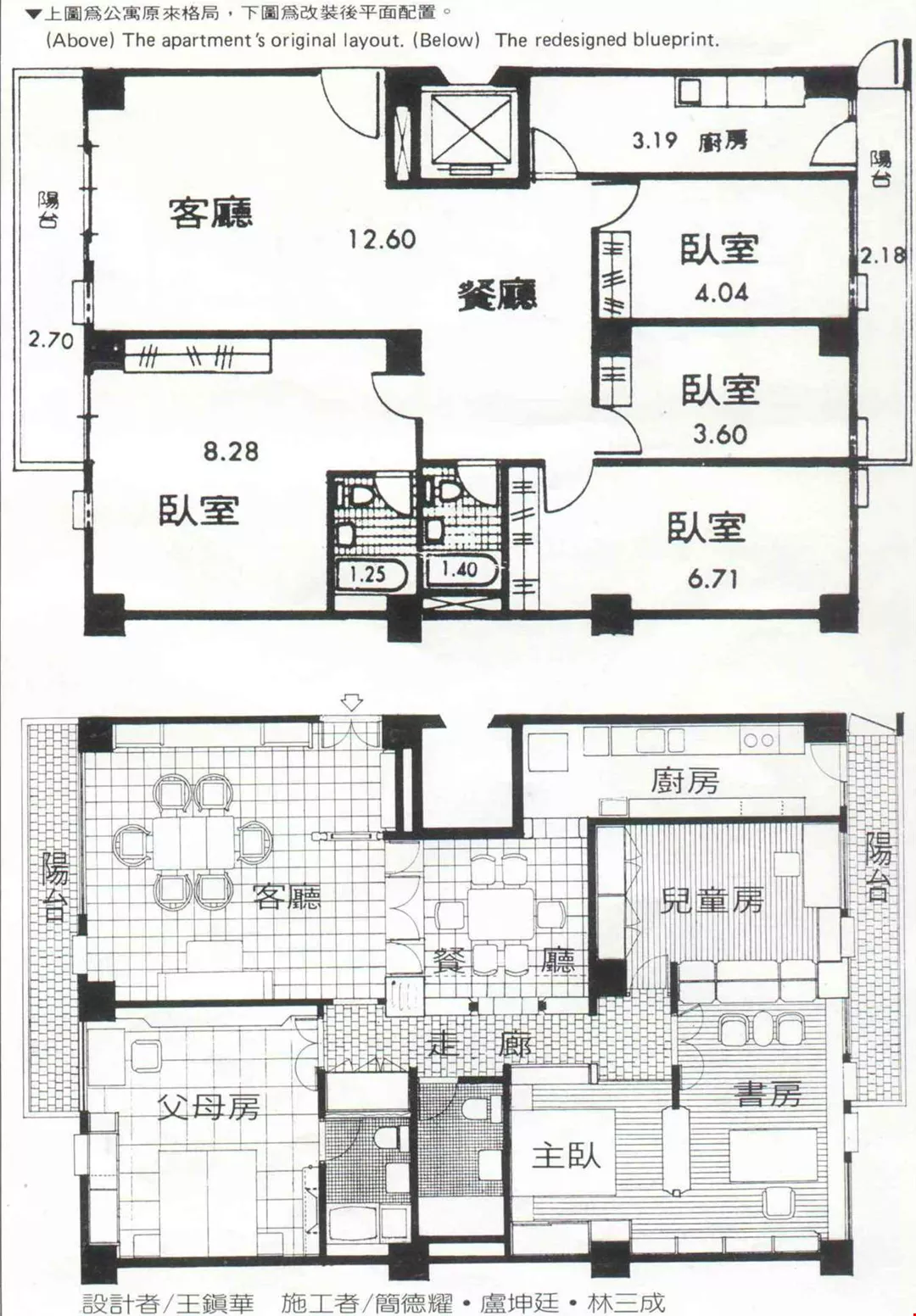
(Above) The apartment's original layout. (Below) The redesigned blueprint.

These are the "conductors" of the experiment--the owner, Tseng Chao-hsu (r.), and the designer, Wang Chen-hua(l.).
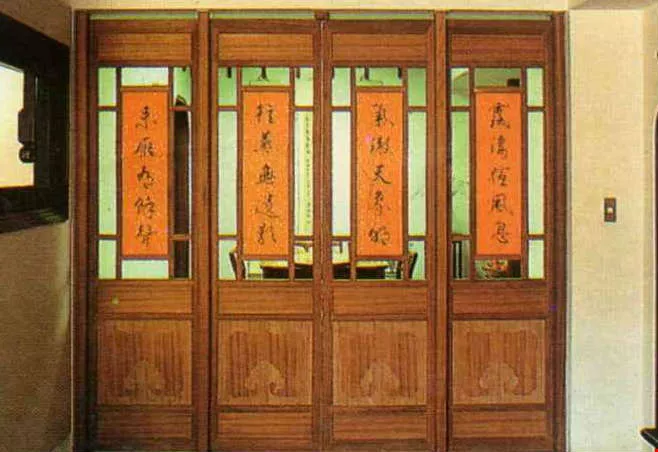
The divider between the living room and the dining room can be moved about freely to create different effects.
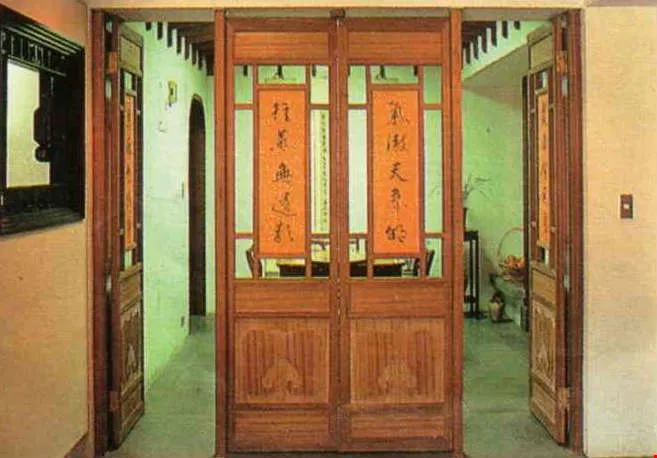
The divider between the living room and the dining room can be moved about freely to create different effects.
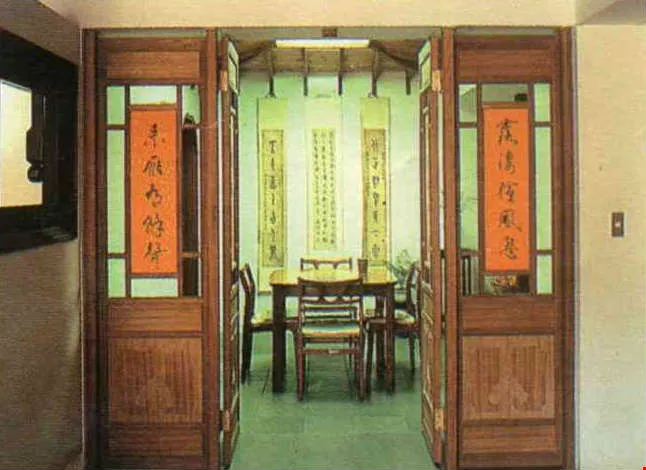
The divider between the living room and the dining room can be moved about freely to create different effects.

This picture reveals the relationship between the foyer, living room, dining room, corridor, and bedrooms.
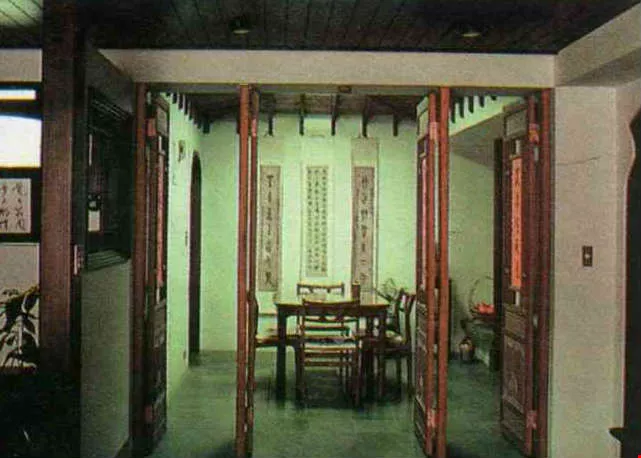
This picture reveals the relationship between the foyer, living room, dining room, corridor, and bedrooms.
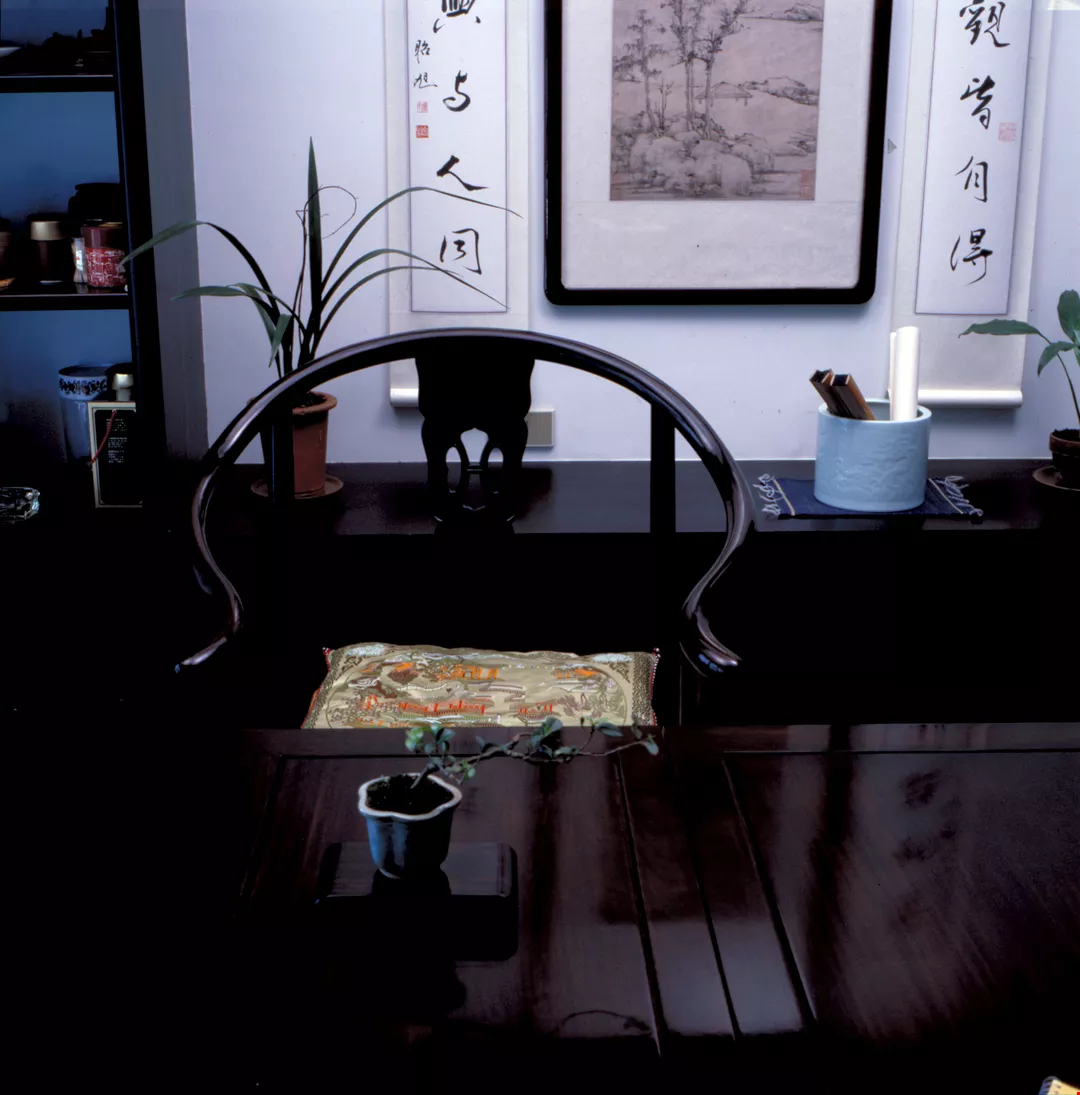
Chinese calligraphy, bonsais, and a round-backed armchair add to the living room's refined atmosphere.
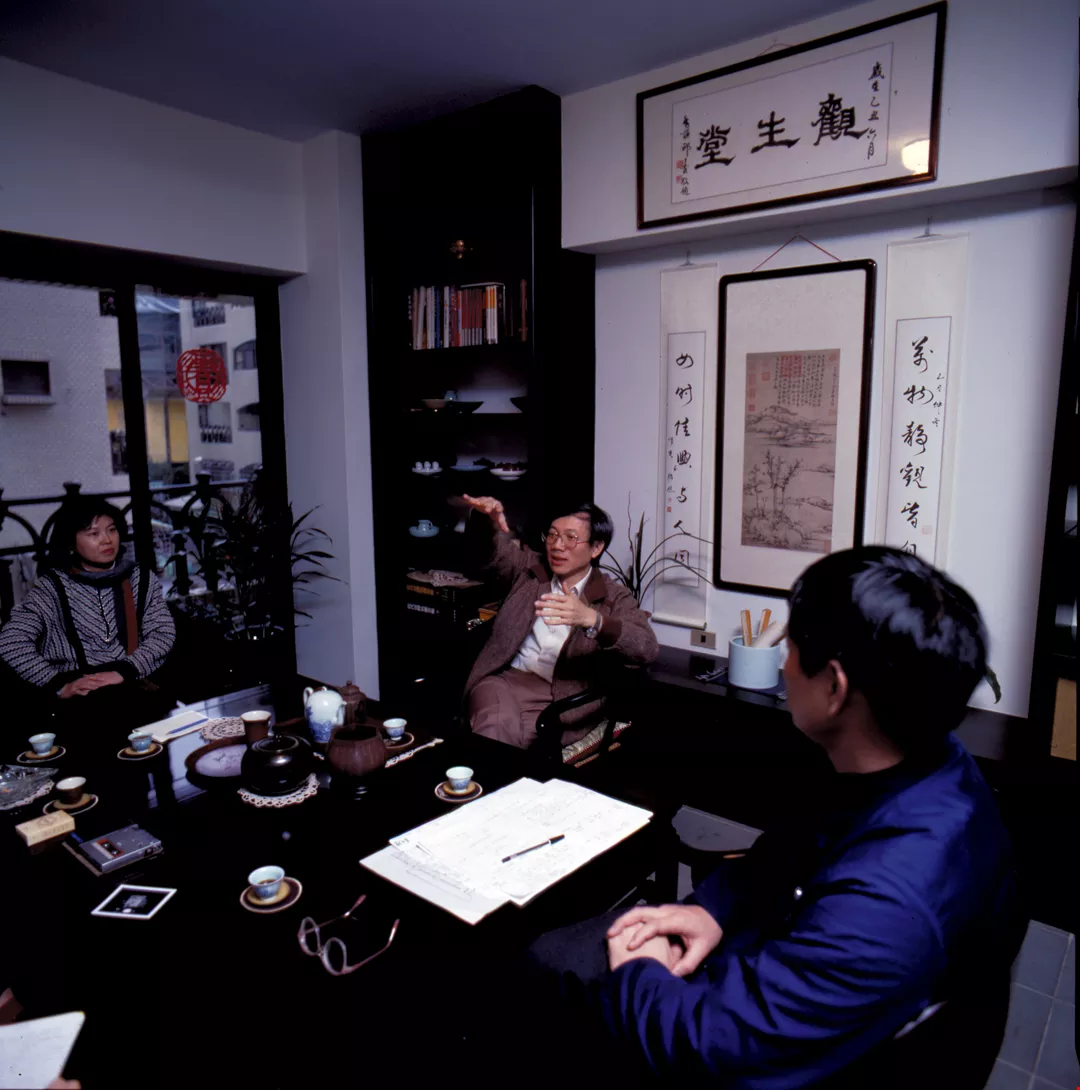
Taking part in the living room chat are (from left) Liu Ch'ien-mei, Tseng Chao-hsu, and Wang Chen-hua.
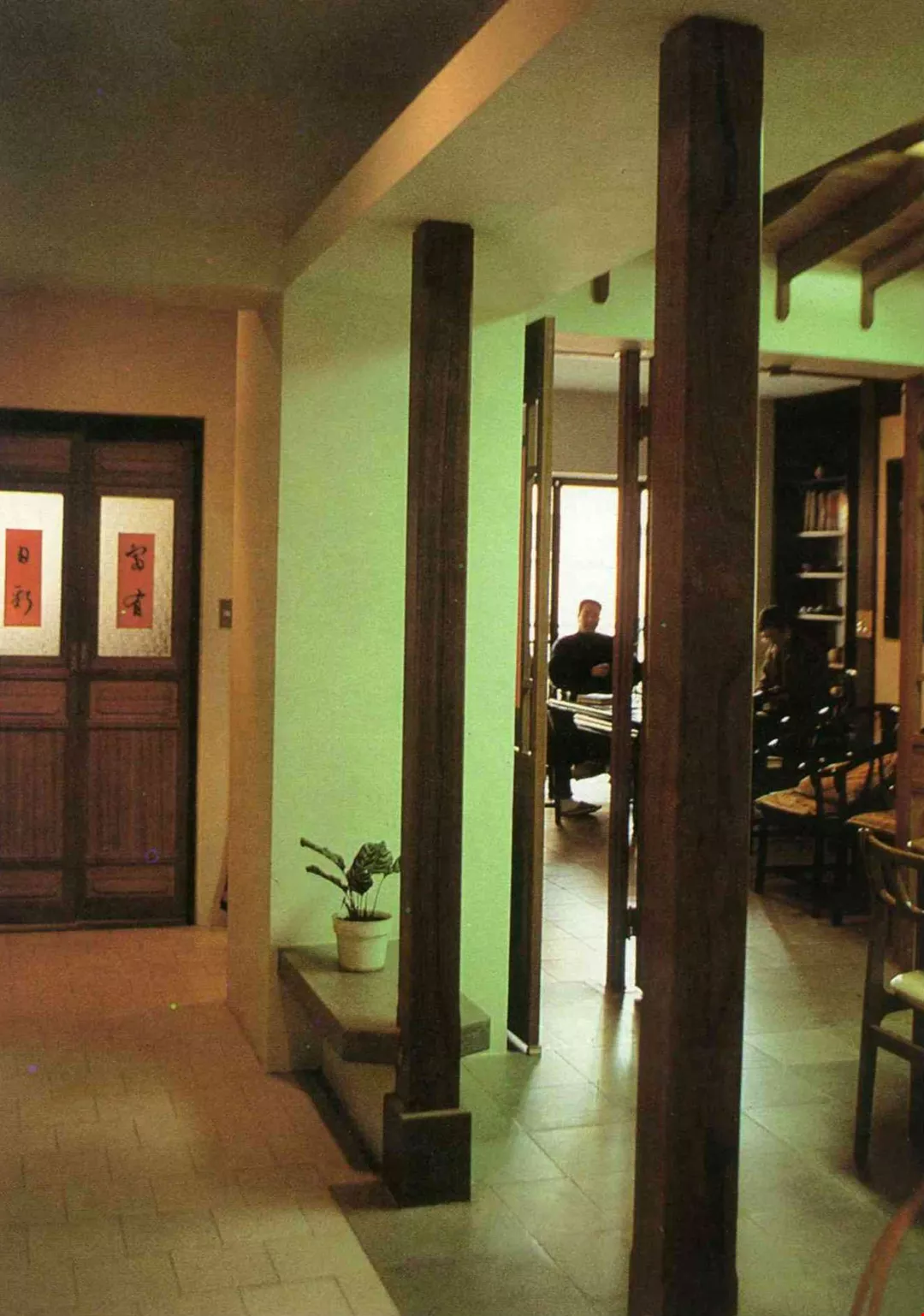
The corridor between the dining room and the bedroom acts as a buffer space. The posts and bench produce a little corner for lingering.
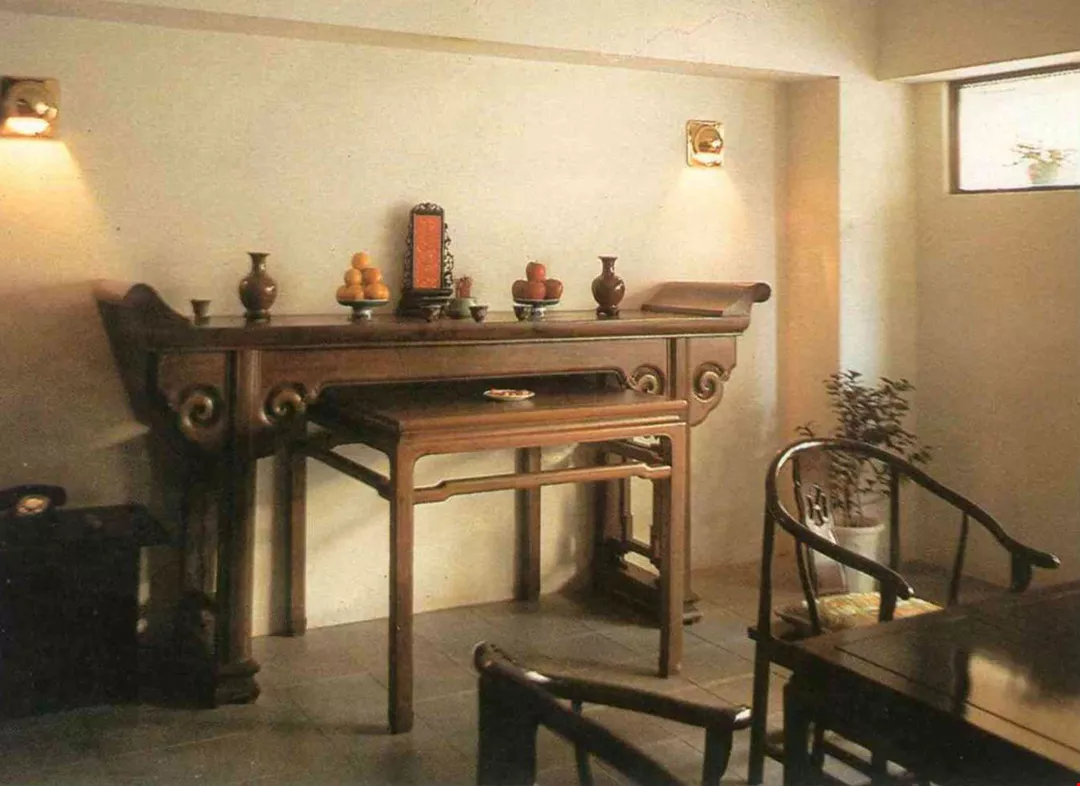
The ancestors' altar by the main wall is situated at the center of the living room's spiritual space, lending the room dignity and stability.
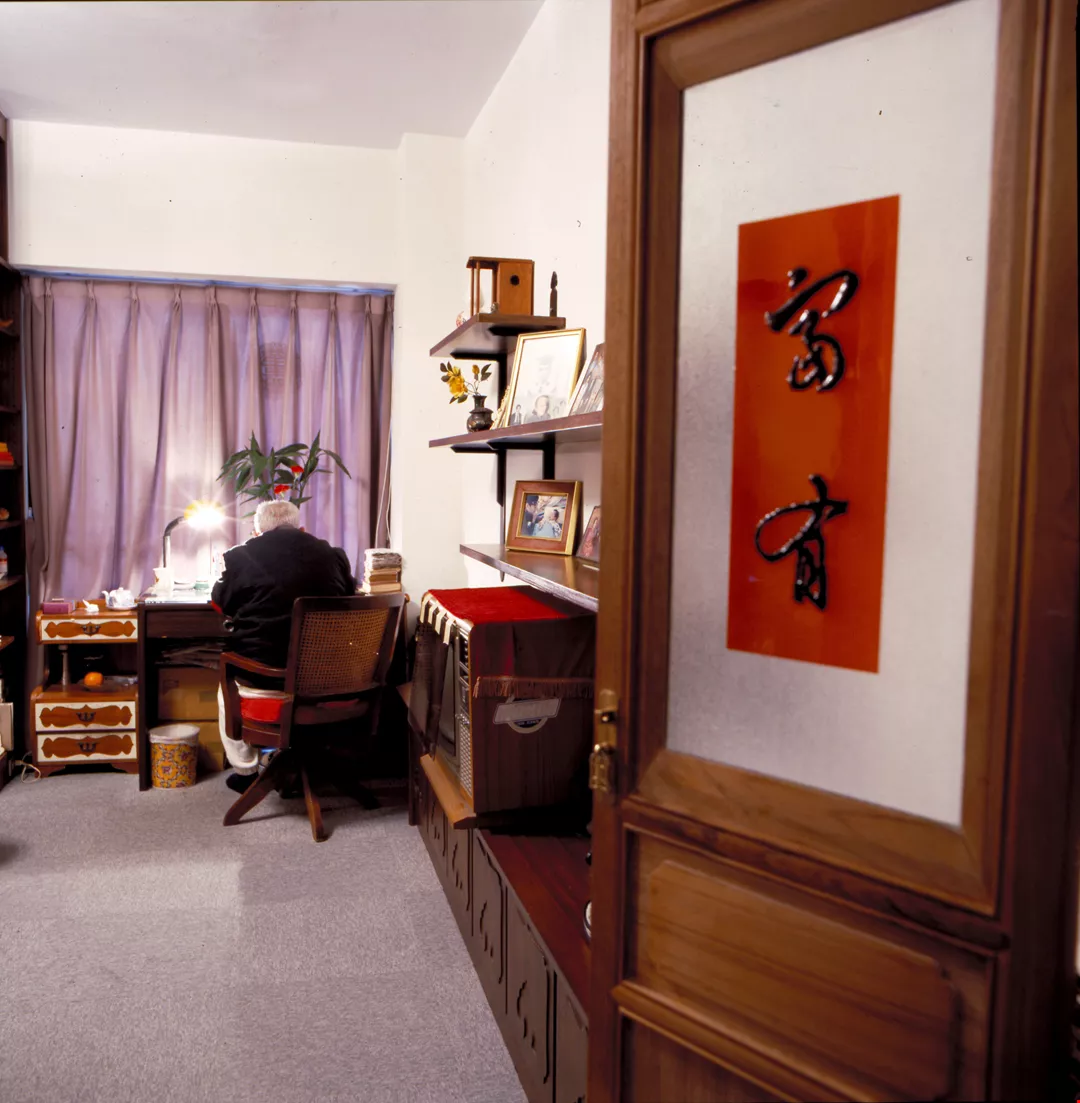
The grandparents' bedroom is large and has an attached bathroom, making it a self-sufficient area.
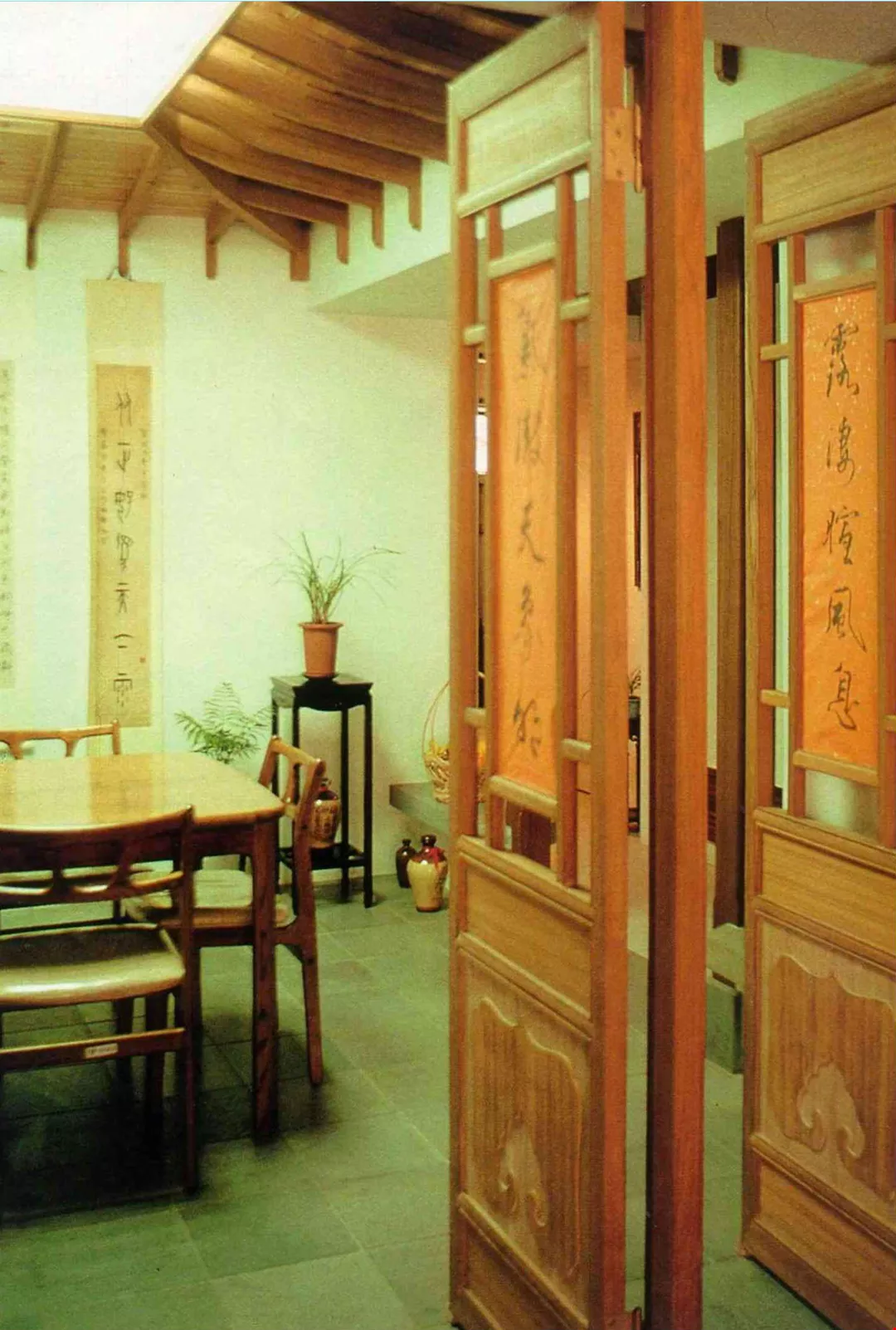
The dining room has a relaxed, outdoor atmosphere, like the courtyard in a traditional Chinese house.
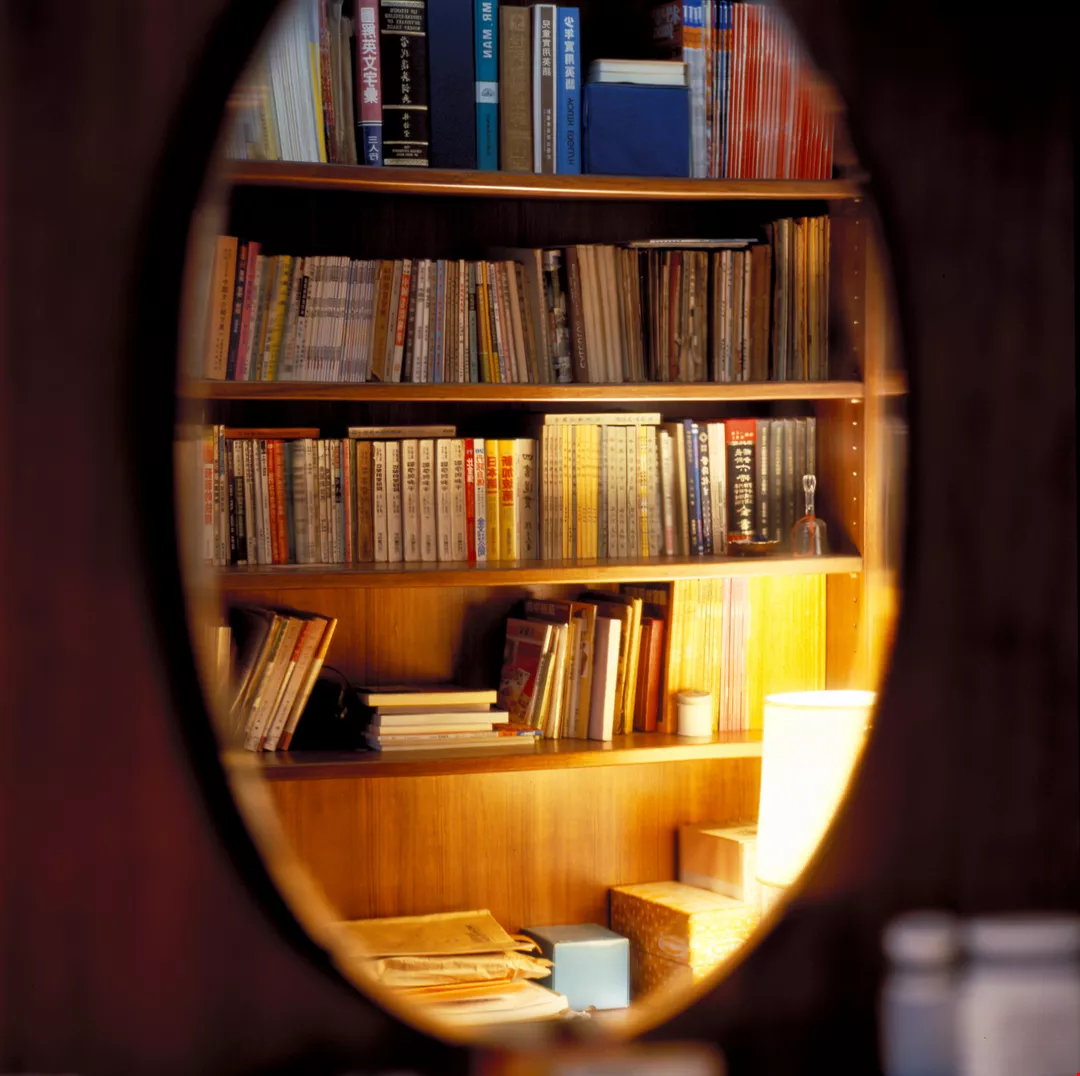
is the most warm and peaceful spot in the apartment.
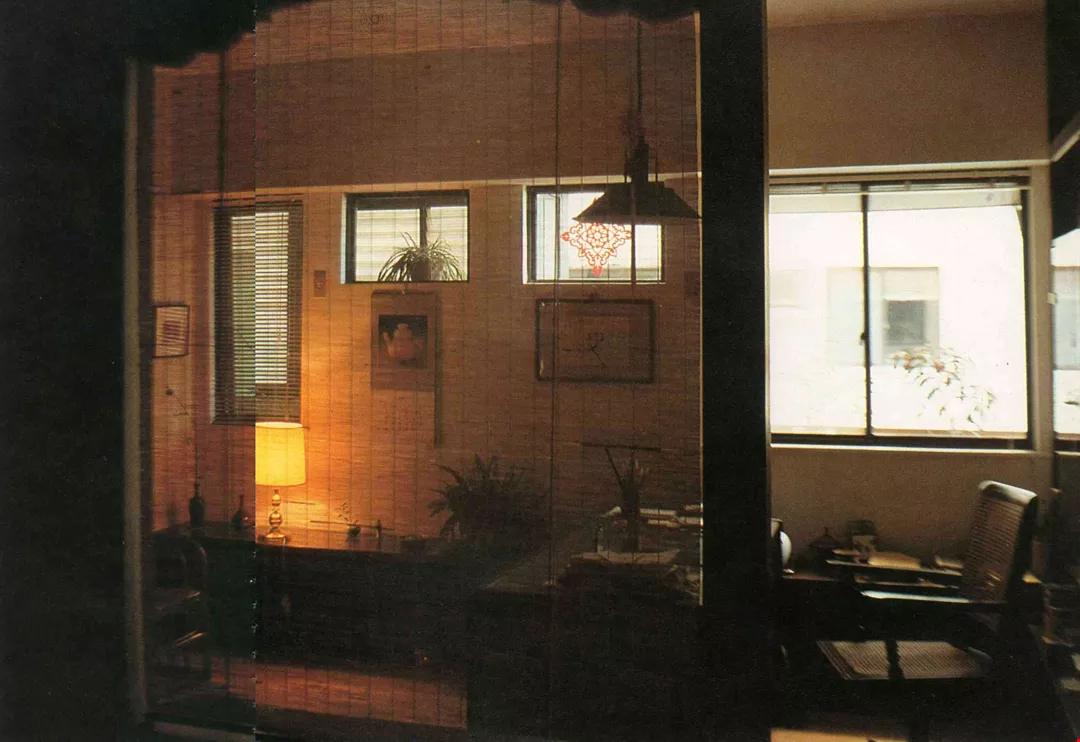
The study, with its bamboo curtain, carved rafters, and dressing table cum sleeper, is the most warm and peaceful spot in the apartment.


