Building Bridges: Ho Chi Minh City's Taipei School
Chang Chiung-fang / photos Chuang Kung-ju / tr. by Scott Williams
March 2016


As Taiwanese businesses have increased their investment in Southeast Asia, the educational needs of Taiwanese children living overseas have grown. The Ministry of Foreign Affairs, the Ministry of Economic Affairs, and the Overseas Community Affairs Council worked together to address this need in Vietnam by establishing the Taipei School in Ho Chi Minh City in 1997. The HCMC campus is only the fifth overseas Taipei School; the other four are in Malaysia (Penang and Kuala Lumpur) and Indonesia (Jakarta and Surabaya).
In the 18 years since it was established, the HCMC school has seen both its enrollment and the average age of its students rise in step with the number of Taiwanese businesspeople in Vietnam. In fact, the school has a current enrollment of nearly 1,000 students, and now operates preschool, elementary, middle-school and high-school divisions. Unfortunately for Taiwanese businesspeople working in northern Vietnam, the school down south is simply too far away to satisfy their own children’s educational needs.
Taiwanese businesspeople have poured into Southeast Asia seeking to make money to raise their children, but have frequently struggled to provide for the educational needs of those children while doing so. Developing their children’s skills and their sense of cultural identity have been areas of particular concern. To explore the challenges of operating a school overseas, Taiwan Panorama looked at the experience of the Taipei School in Ho Chi Minh City.
It’s Sunday afternoon in Hanoi, and Taiwanese husband and wife Huang Kaijian and Cai Peizhen are attending the FeiFantastic Education Center’s monthly Mandarin story hour with their six-year-old and two-year-old children.
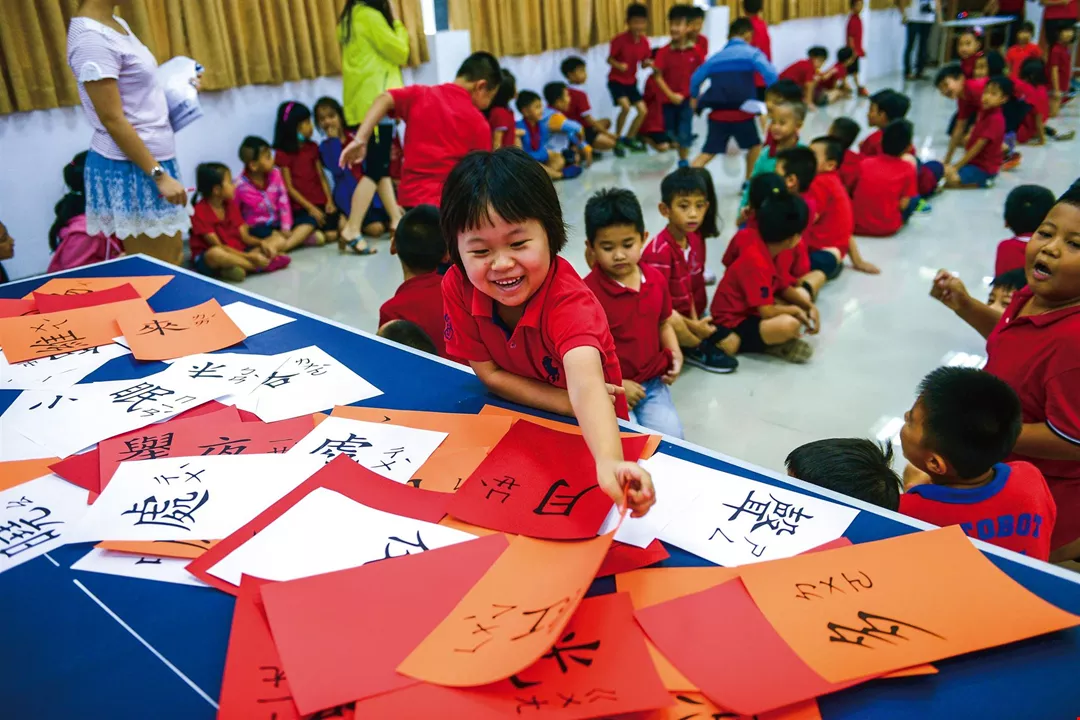
Grade-school students have a ball playing a word game based on Tang-Dynasty poems.
Educational problems
Huang, who is in his 40s, works for Singapore Airlines in Hanoi, while his wife shuttles their children back and forth between Taiwan and Vietnam. With their six-year-old, Huang Yuting, soon to begin elementary school, the couple faces a difficult choice: should they enroll him in the international school in Hanoi, put him into the Taipei School in Ho Chi Minh City, or just take him back to Taiwan to be educated there?
Their dilemma is shared by many Taiwanese working in northern Vietnam.
Lin Chung-tsung, head of the the Council of Taiwanese Chambers of Commerce in Ban Ninh, says that the Taiwanese businesses in northern Vietnam sprawl across ten provinces. He says there used to be minimal contact among them, but 2014’s anti-Chinese riots prompted them to form a Northern Vietnam group to stay in better touch with one another and share news.
When Lin surveyed Taiwanese professionals in northern Vietnam, he found that only two had married and had children with Vietnamese women; most had left their wives and children in Taiwan. Meanwhile, Foxconn has chosen to staff its Bac Ninh facility, the largest Taiwanese operation in the area, with large numbers of mainland Chinese supervisors (whose children are ineligible to study at the Taipei School).
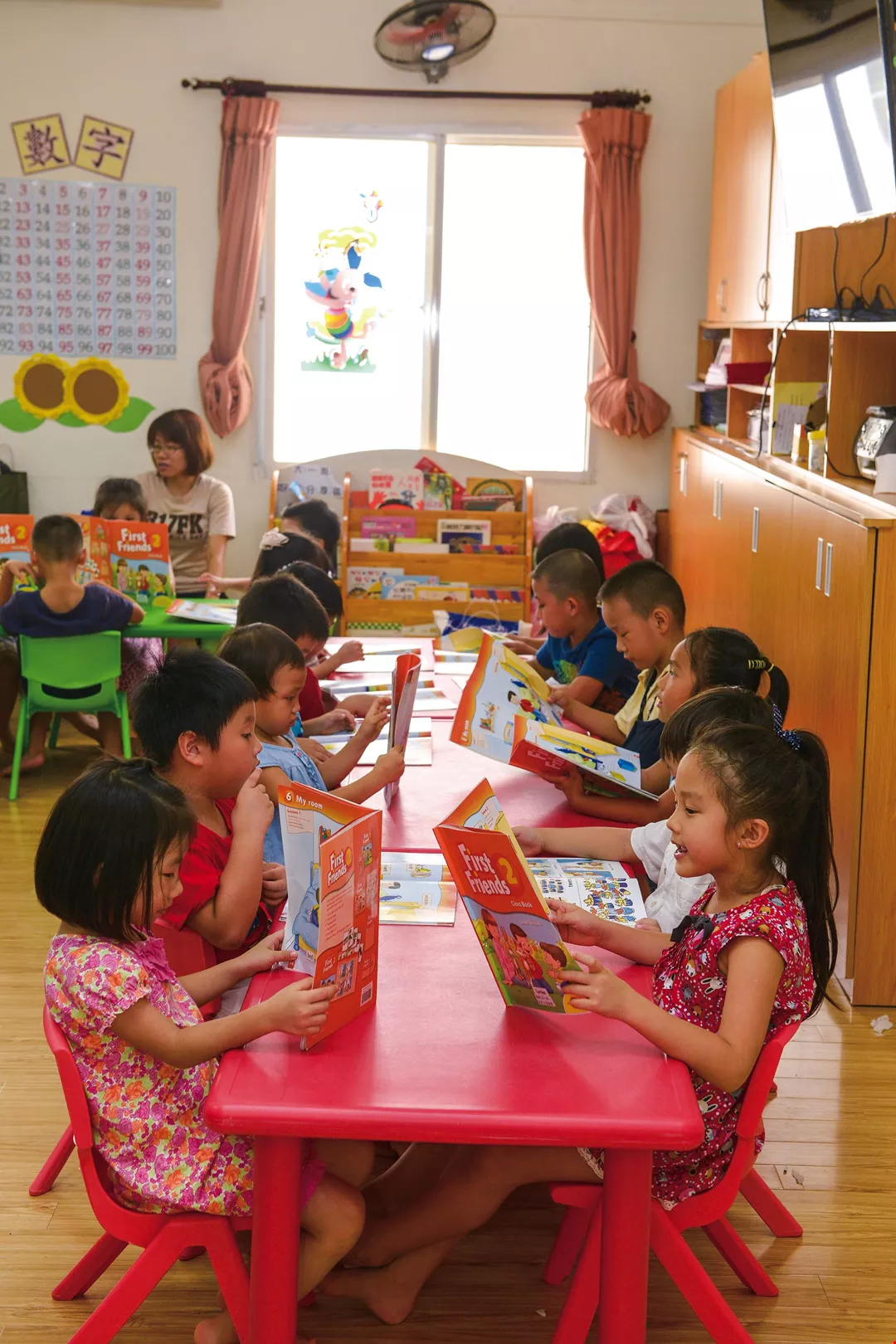
The more than 100 children in the Taipei School’s kindergarten come from nine different countries. They are a veritable mini UN!
The Taipei School HCMC
David Liang, head of the Taipei Economic and Cultural Office (TECO) in Ho Chi Minh City, says that there are more than 4,000 Taiwanese businesses and 50,000 Taiwanese personnel in Vietnam. With 90% of them in southern Vietnam, it is no surprise that the country’s only Taipei School is in southern Vietnam’s largest city, Ho Chi Minh City.
The school had just 66 students in its first term, but has since grown to more than 980, ranging in age from three to 18 years old. “Over the last few years, a large number of Taiwanese professionals have transferred to Vietnam from Dongguan in mainland China,” says school principal Pan Tao-jen. Pan notes that the Ho Chi Minh City Taipei School is the only one of the five overseas Taipei Schools that is still growing its enrollment. He adds that while 82.2% of the student body is Taiwanese, the remainder come from a variety of other countries, including the United States, Korea, Japan, Singapore, Canada and Malaysia.
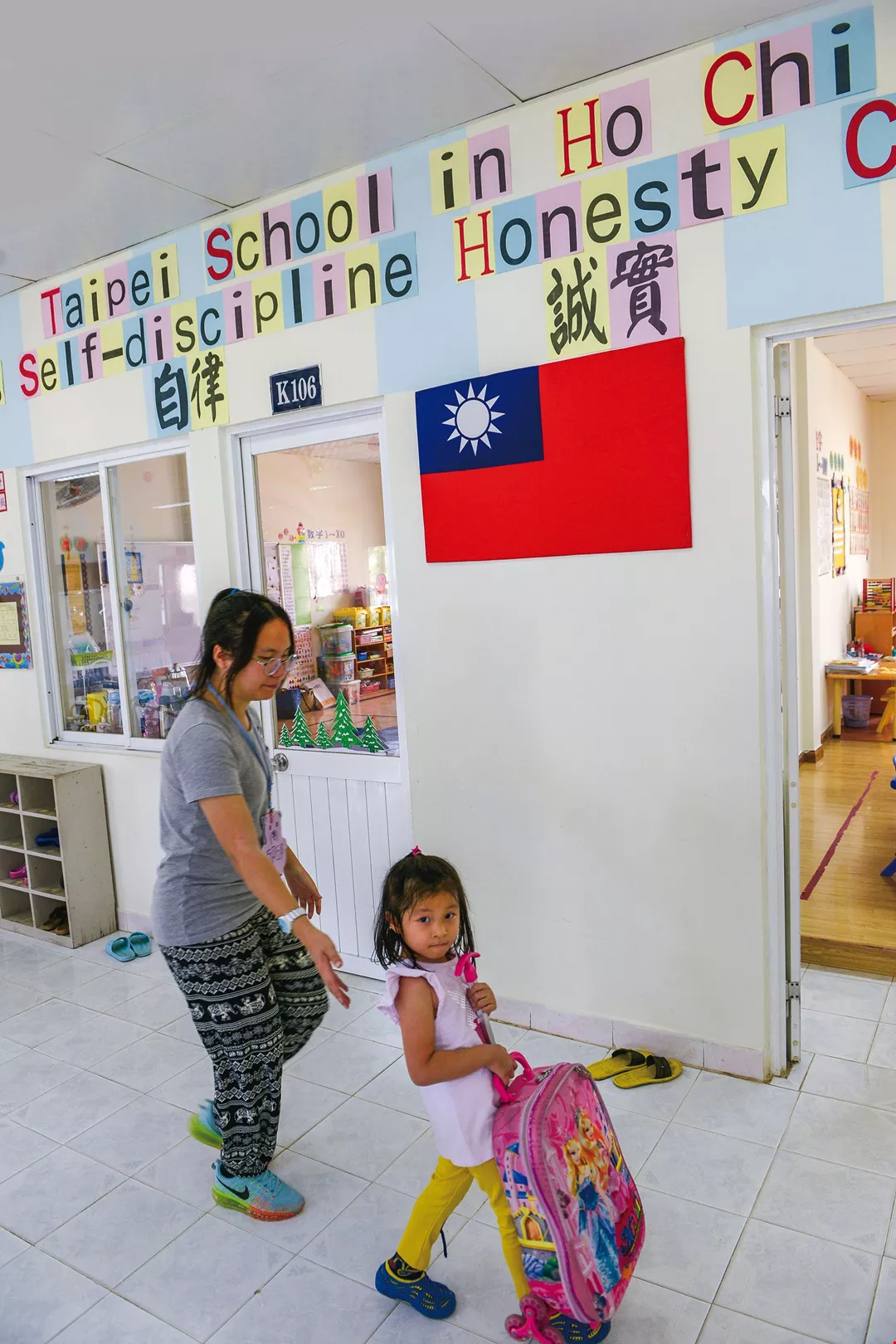
A mini United Nations
Located in the Phu My Hung Urban Area in the city’s District 7, the HCMC Taipei School sits in the middle of a veritable academic United Nations, surrounded by the International School, the Japanese School, the Korean International School, and the Canadian International School.
In fact, the school itself is a mini UN, with its diverse kindergarten a particular case in point.
Chen Xiuling, the kindergarten’s principal, says that it currently has 132 students in five classes. It uses the Hsin-Yi Foundation’s curriculum and employs credentialed teachers from Taiwan. Even the meals it provides its students are cooked in the Taiwanese style.
With the kindergarten’s student body coming from nine different nations, the faculty must not only speak Mandarin, but know a bit of Korean, Japanese, and Vietnamese as well. And that’s not just for the benefit of the non-Taiwanese; the majority of “Taiwanese” students don’t speak Mandarin either. Chen says that only three or four kids in a typical 22-child class can speak Mandarin. The rest speak Vietnamese. “The reason is that 61.8% of the kids have Vietnamese mothers.” She says that the school copes by pairing two teachers with every class: a homeroom teacher from Taiwan and a bilingual local teacher with a degree in Chinese.
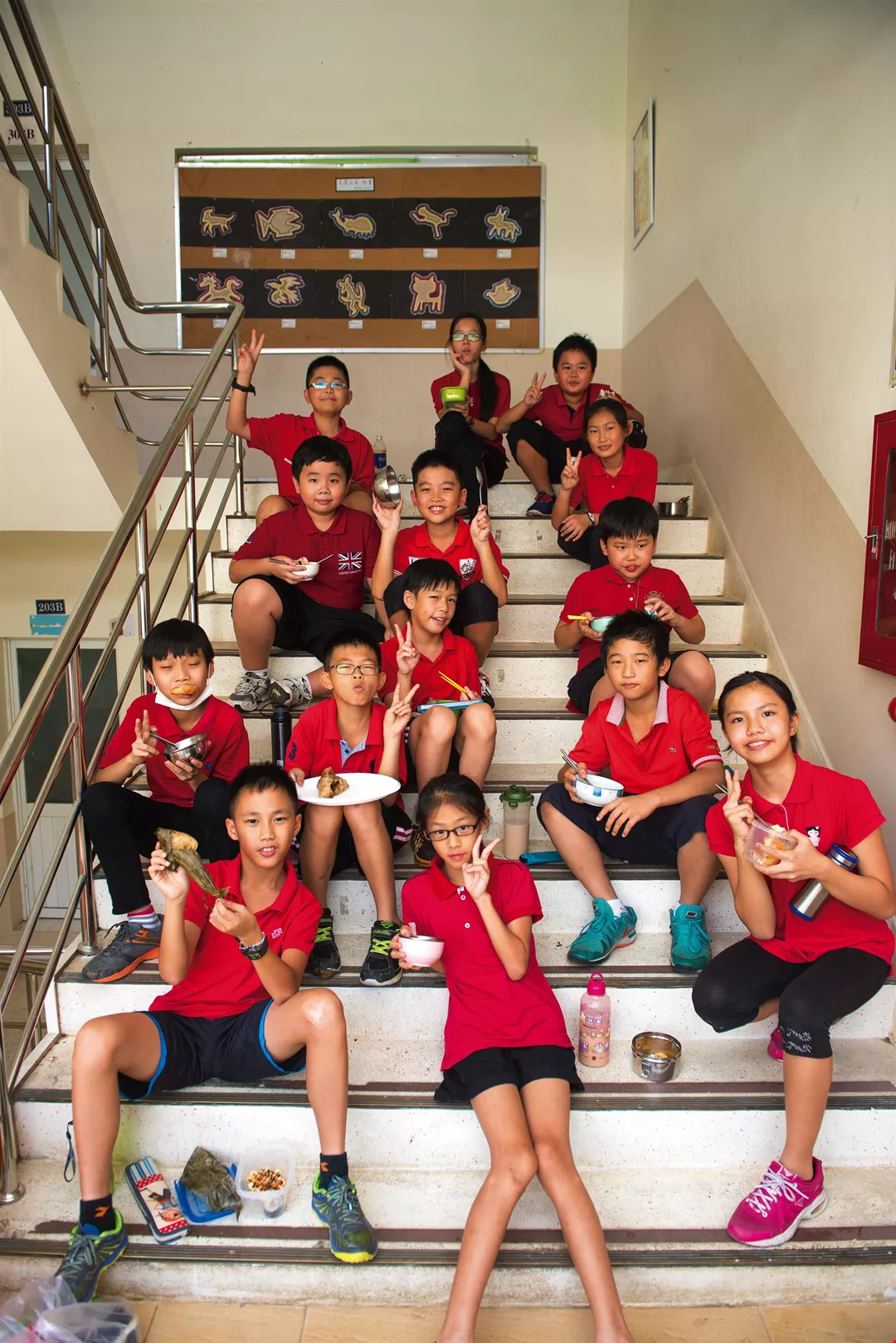
Even though they live abroad, these children are receiving a Taiwanese-style education.
On different tracks
The Taiwan School’s students live all over the area, which makes for serpentine school bus routes.
The buses range far afield and can take as long as two hours to deliver kids to their destinations. To help students who live far away get home at a reasonable hour, the school no longer schedules a full lunch break. Instead, it rushes students through a quick 15-minute meal before they zip off to their next class.
Chen says that the Taiwanese kids travel great distances to attend the Taipei School so they can be prepared to continue their educations in Taiwan.
Avon Wang, head of the Taipei School Parents’ Association, came to Vietnam eight years ago and has a son in the fifth grade. She explains that she chose to enroll him at the Taipei School to better prepare him for Taiwan’s university entrance exam.
Pan Tao-jen says that 90% of those who graduate from the school’s high-school division choose to go to university in Taiwan to take advantage of preferential admissions criteria and scholarships offered to overseas Chinese and children of Taiwanese diplomatic personnel. Many then return to Vietnam to take over family businesses. Given that most of its students hope to study in Taiwan, one of the school’s most important missions is to provide them with high-quality Mandarin instruction.
The Taipei School also runs Mandarin classes every Saturday for locals and students of other schools. Chan Shao-wei, director of academic affairs, says that the Mandarin classes are now in their 14th year. They include children’s Chinese, advanced Chinese, Chinese for international children, and Chinese for international adults, and attract nearly 500 students per year, more than similar classes at any of the other Taipei Schools.
Looking ahead
Changes in the times and the environment have confronted the HCMC Taipei School with many difficulties it has yet to overcome.
For example, teachers have a hard time continuing their professional development and receive few perks, leading to a high rate of faculty turnover. The school’s rented campus is also subsiding at a rate of three centimeters per year, which results in annual repairs to all the buildings. And the school’s severe lack of dormitory space makes it difficult for it to meet the needs of students whose homes are far from the campus.
The school has also had difficulty obtaining study materials and additional reading materials. In the most recent semester, the ongoing dispute in the South China Sea actually left some students without a world history textbook after the book failed to pass muster with Vietnamese authorities.
But necessity is the mother of invention. The students without texts managed to have a great time in their world history class anyway. On the day we visited, the fifth graders were in the hallway holding a “foreign foods carnival,” for which their mothers had prepared a variety of dishes, as a class activity. The Taipei School in Ho Chi Minh City isn’t just building bridges; it is also creating a model for cultural integration.


@List.jpg?w=522&h=410&mode=crop&format=webp&quality=80)


