A Discordant Enlightenment--Reevaluating the May Fourth Movement
Sam Ju / photos Into Contemporary China, by Eugene W. Chiu and Chang Yun-tsung Wu Nan Cultural Enterprise / tr. by Scott Williams
May 2009


The May Fourth Movement of 1919 has been referred to as mainland China's cultural awakening and its political salvation. The intellectuals at the heart of the movement introduced scientific and democratic thought to post-revolution China. These individuals, who held that study should not preclude devoting oneself to the service of the nation, set alight the fires of nationalism and anti-imperialism. They also midwifed the birth of Chinese communism. This year marks the 90th anniversary of the May Fourth Movement. What lessons can modern-day Taiwanese intellectuals learn from the impassioned, eager, duty-bound and ultimately misguided figures at the head of the movement?
As a steam whistle shrieked over Shanghai Harbor on May 1, 1919, Hu Shih stood on the pier eagerly awaiting the arrival of a mail carrier from Japan. Hu had returned to China two years previously after earning a PhD in philosophy from Columbia University. Still just 28 years old, he was already a professor at Peking University.
Two other men in Western suits waited with him. One was the 33-year-old Chiang Monlin, who would go on to write Tides from the West: A Chinese Autobiography. The other was Tao Xingzhi, a professor of education at what was then the Nanjing Normal College (now National Central University). John Dewey, a key figure in the pragmatic school of philosophy, was aboard the ship and making his first visit to China. When he arrived, the three men, all of whom had studied with him at Columbia, welcomed him warmly.
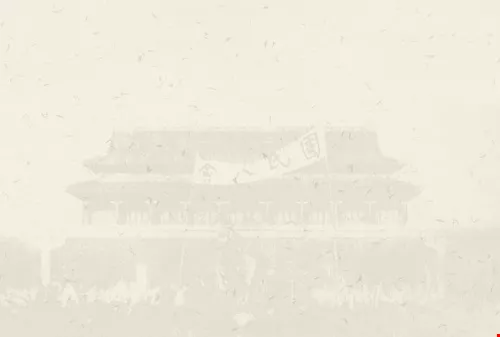
On May 4, these four individuals were strolling through downtown Shanghai and arranging for Chiang to accompany Dewey to Hangzhou the following day. They had no idea that as they talked some 3,000 students from 13 institutions of higher learning, including Peking University and Peking Normal College, were demonstrating in front of the red walls of Tian'anmen in Beijing. The students were calling for China to "struggle for sovereignty externally, and get rid of traitors at home" and protesting its humiliation at the Paris Peace Conference. At around 4 p.m., an angry crowd of students surged onto Wangfujing Street shouting "onward to Cao's house." Cao Rulin was the pro-Japanese head of the New Communication Clique. When the students arrived in front of his two-story Western-style home (known as the Zhaojialou) about half an hour later, they burned it to the ground.
One year later, Hu and Chiang jointly published a piece entitled, "Our Hopes for the Students." In it, they recalled their feelings on May 4 and wrote: "Our only thought was to keep Mr. Dewey in China to lecture and teach philosophy, to advocate the application of an experimental attitude and scientific spirit to thinking, and [to promote] the incorporation of new theories into education to spark Chinese enlightenment and [encourage] everyone to participate in fundamental educational reform."
The Communist Party of China (CPC) was founded in Shanghai three months after Hu and Chiang published their piece. Interestingly, Sun Yat-sen had admitted to the two that his Plans for National Reconstruction were "easier said than done" while they were visiting him in Shanghai with Dewey the week after May 4.
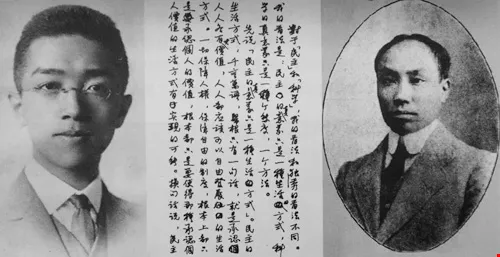
Hu Shih (left) and Chen Duxiu (right) were the standard bearers for the May Fourth cultural movement. Hu wrote that "democracy" was a way of life, and that "science" was a mode of thought and knowledge. He believed that Chen had turned to communism because he had insufficient understanding of them.
More than just a march
The national salvation movement that Beijing university students ignited on May 4, 1919 protested the fact that the Treaty of Versailles ignored China's place among World War One's victors and transferred Chinese land in Shandong from German control to Japanese.
The implications and effects of May 4 extended well beyond the student demonstrations. On the cultural front, it advocated replacing Confucianism, which had influenced Chinese intellectual life for thousands of years, with Western "democratic" and "scientific" modes of thinking. On the political front, it fostered the development of Marxism in China. May 4 was a defining moment, one in which the Chinese intellectuals who had been the progressive charge in China turned in very different directions. The separate paths followed by Chen Duxiu and Hu Shih are representative of the split.
How did the rise of these patriotic May Fourth intellectuals lead to a regressiveness and backwardness in Chinese politics and society that was to last 50 years, from the establishment of the CPC in 1920 to the Cultural Revolution, which began in 1966? The May Fourth Movement's advocacy of "democracy" and "science" are widely known, but there were other facets to the movement. Which of these still reward investigation, review, and reflection 90 years after the fact?
Many years later in oral recollections (compiled by Tang Degang as Oral Autobiography of Hu Shih), Hu characterized the May Fourth Movement as "an unfortunate political disturbance." Hu said, "At that time, it was probably a kind of foolish sincerity that led us to think we could keep it purely a cultural movement and literary-reform movement. But ultimately and unfortunately it was hindered then ended by politics." The "political hindrances" Hu refers to in this rough summation of his later thoughts about May Fourth were Marxism and the rise of the CPC.
Yu Ying-shih, an academician with the Academia Sinica and 2006 recipient of the John W. Kluge Prize for lifetime achievement in the study of the humanities, has stated that Marxism's introduction into Chinese intellectual circles caused "the left to begin to actively participate in ever larger organized mobilizations of the masses, turning May Fourth into a political movement. The liberals, on the other hand, continued to work towards the goals of the original plan in the cultural and intellectual fields-a renaissance in culture and the arts."
Yu believes the May Fourth intellectuals had only a limited understanding of the Western concepts of liberty, democracy, and human rights, and also lacked firsthand knowledge of working-class society. Fervently desiring reform, they were ultimately drawn to Marxism. Lin Yu-sheng, also an Academia Sinica academician, quotes Yin Haiguang, who taught liberal thought, saying of the May Fourth intellectuals: "Many could shout; few could think." Their political views were likewise always "twisted and confused, reflecting their own intellectual crisis rather than a genuine intellectual awakening."
The history of the movement's transition from culture to politics laid the course for China's recent history, and reflects on the intellectual preparedness, judgment, and responsibility of the May Fourth intellectuals. New Youth magazine, already popular among Chinese intellectuals at the time the students marched, offers a window onto how May Fourth thought evolved.
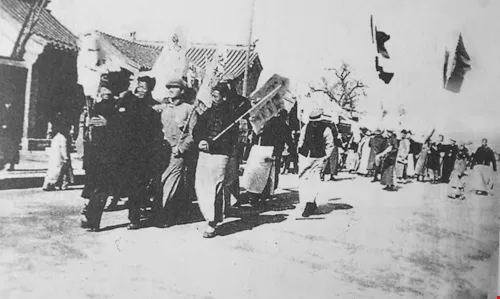
The May Fourth student demonstrators poured out onto Wangfujing Street heading towards the home of Cao Rulin, the pro-Japanese head of the New Communication Clique.
Destroying the "old"
Running a publication and commenting on public affairs and the arts had been a tradition among intellectuals since the late Qing Dynasty. (Liang Qichao's Qing Yi Bao and New Citizen are prominent examples from that era.) Chen Duxiu was the driving force behind New Youth, and published its first issue in 1916. Chen, who went on to found the CPC, established the magazine as the reincarnation of an earlier publication, Youth Magazine, which he had founded in Shanghai in 1915.
Chen described the ethos of Youth Magazine in a piece entitled "A Warning to Young People" published in its inaugural issue. Drawing on the Western thought he had absorbed while studying in Japan, Chen made six demands of young people in the piece:
To be independent instead of servile
To be progressive instead of conservative
To be aggressive instead of retrogressive
To be cosmopolitan instead of isolationist
To be utilitarian instead of impractical
To be scientific instead of visionary
The first and last of these six points specifically advocate for science and democracy, positions Chen was to carry over into New Youth. Chen Pingyuan, a professor in the Chinese Department of Peking University, has argued that with the exception of science and democracy, "New Youth's staff never found a common cause." In addition to Chen himself, that staff included such renowned figures as Hu Shih, the Zhou brothers (Lu Xun and Zhou Zouren), Wu Chih-hui, Tsai Yuan-pei, and Li Dazhao. Aiming to strengthen science and democracy in China, the magazine enthusiastically advocated literary and cultural reforms.
Hu's "A Tentative Proposal for Literary Reform" is a case in point. Written in 1916 while Hu was still at Columbia and published the following year in New Youth, the piece got China's intellectuals buzzing about its eight recommendations: write with substance; do not imitate the ancients; respect grammar; reject melancholy; eliminate tired cliches; avoid allusions; avoid couplets and parallelism; and do not avoid common characters or colloquialisms.
Chen Duxiu-Chen Pingyuan calls him a master of the talking point-echoed Hu in a piece entitled "A Treatise on the Literary Revolution" in which he proclaimed the "three principles" of the new literature. These were: rejecting the ornamental, fawning aristocratic literature in favor of developing a literature of the people that expresses feelings directly; rejecting the hackneyed and extravagant classical literature in favor of developing a fresh and sincere realist literature; and rejecting the obscure and abstruse "recluse literature" in favor of developing a popular, easily understood social literature.
The writers at New Youth didn't only attack Confucianism, they were also critical of China's other ritual and educational traditions. When Hu and his student Luo Jialun translated Henrik Ibsen's A Doll's House for New Youth, arguments on the prospect of women leaving their homes and abandoning their children to seek independence immediately flared up in intellectual circles. China's new women found a rallying cry in Nora's line: "You are not the man to educate me into being a proper wife." Chen Pingyuan says that the problems of the day became New Youth's editorial compass; its "entry point was literature, but its objective was the wholesale revolution of thought and culture."
When Tsai Yuan-pei became president of Peking University in 1917, he hired Chen Duxiu to head the school's College of Liberal Arts. As a result, Peking University's students and faculty ended up producing most of the articles that ran in New Youth until 1920. Chen also gave up his exclusive control over editorial duties while at the university, allowing the editor-in-chief position to rotate among six other faculty members, including Hu and Li Dazhao.
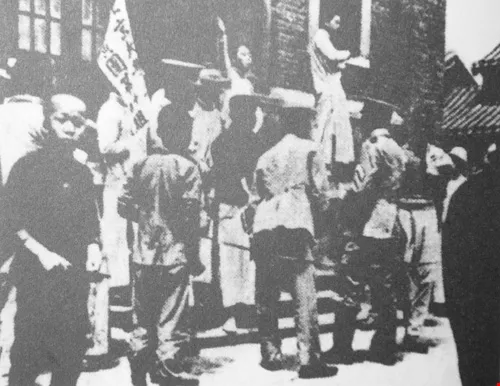
The May Fourth Movement swept into every corner of China as university students lectured in the streets calling for cultural reform and new ways of thinking. Seemingly overnight, terms like "inspiration" and "Nora" (a reference to the independent-minded female protagonist of Ibsen's A Doll's House) were being bandied about everywhere.
Shared culture, disparate politics
Conflicts emerged about the direction of New Youth sometime around 1919, with Anhui natives Hu and Chen Duxiu representing the two factions in the debate. These days, most believe that Russia's 1917 October Revolution was a major factor in the split.
In December 1919, New Youth published an editorial entitled "This Magazine's Manifesto." The first half of the piece explained why one might sever ties with political parties. The second took the opposing view, affirming political parties as a necessary means of exercising political power and stating that one should only eschew "parties that fail to consider the good of society as a whole."
According to Chen Pingyuan, the manifesto was the product of the battle among the factions. The writers' original intent was to establish a consensus opinion to paper over their differences, but in fact they simply brought the contradictions to the surface. Chen Duxiu felt that New Youth should be concerned with political realities, whereas Hu argued that it should keep its distance from politics. The split was made public when Chen moved to Shanghai in 1920 and pulled New Youth away from Peking University. From that point on, Chen's interest in Marxism grew ever stronger. He profiled Lenin and the post-revolution Soviet government in the magazine in July of that year, and helped bring about the founding of the CPC in Shanghai in August.
How could these May Fourth intellectuals, all motivated by their love of country, end up taking such different paths?
"All were anti-imperialist nationalists, but they dedicated themselves to their country in different ways," says Jessie G. Lutz, a Rutgers University professor emeritus. "Some hoped that educational and cultural events would lay the foundations for a new political system. Others saw politics and the nation as the instruments of revolution." Hu was among the former, Chen one of the latter.
Why didn't the May Fourth intellectuals make their judgments rationally? It wasn't that simple. Yu Ying-shih says that the complementary relationship between nationalism and the intellectuals enabled the rise of the CPC: "Nationalist sentiments were shared by all, but it was the intellectuals, who functioned as society's conscience, that really took nationalism to heart."
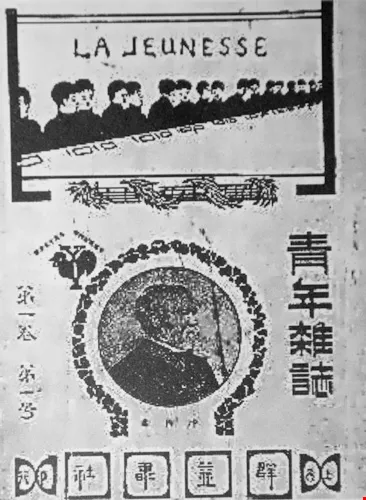
Chen Duxiu's Youth Magazine, founded in 1915 and renamed New Youth the next year, had an enormous impact on May Fourth thought. The magazines also carried the French title La Jeunesse as a means of proclaiming their loyalty to the new, Western way of thinking.
Hurried choices in chaotic times
According to Chang Hao, an Academia Sinica academician, there were two currents in May Fourth thought. One promoted rationality, but had an undercurrent of romanticism. The other advocated taking on real issues, but was anxious to embrace all kinds of "isms." As a result, he says, "Utopian thinking was pervasive in the May Fourth Movement."
Academician David Wang has written: "The 'public clamor' represented May Fourth's greatest awakening." To Wang, the spirit of that "clamor" expressed itself in doubts about authority. He says, "Taking Lu Xun as representative of May Fourth, his greatest gift was giving us the courage to engage in dialogue, the courage to question tradition, authority, and iconic figures."
But the May Fourth era was an impatient one. Intellectuals had almost no time in which to mull or question the new ways of thinking before the urgency of the mission to "save the nation" compelled them to make decisions. Or, as Yu put it: "Not enough thought went into May Fourth thought."
Academician Wang Fan-shen cites Fu Ssu-nien as a case in point. Fu was a leader of the May Fourth Movement, served as president of National Taiwan University, and even composed an ode to the Russian revolution. Wang also mentions Luo Jialun, who wrote in the "Manifesto of All the Students of Beijing" that the nation was dead and urged his compatriots to arise. Luo was also among the Marxist Li Dazhao's favorite students at Peking University. "To the May Fourth intellectuals, who were new to Western thought, democracy in the US and the UK and revolution in Russia alike represented 'freedom and democracy,' explains Wang. "The historical background to the May Fourth era made the thinking of the intellectuals not nearly so black and white as those of us who came later might imagine."
"Though the May Fourth intellectuals attacked tradition, they themselves never escaped the traditional monistic mode of thought," says Lin. "They believed they'd win the war just by taking pen in hand and writing up a few scrolls." So was the May Fourth "clamor" a matter of substance or just of form? That's still open to debate.
As Yu wrote in "Intellectuals and Bachelors," the great confusion of the intellectuals enabled the rise of the CPC. May Fourth was impassioned, but that fervor turned towards inchoate notions of national salvation and awakening, setting China on the course it was to follow for the next 100 years. Reflecting on these events, one can't help but sigh with regret.
Contemporary Taiwan is far more diverse than May Fourth China, with an abundance of media outlets, competing views, and schools of thought. But the question we face is, are today's intellectuals more confident in their thinking, or even more perplexed? Are they becoming more fervent in their concern for our nation and society, or more indifferent?

@List.jpg?w=522&h=410&mode=crop&format=webp&quality=80)


