

There are only two troupes in the entire province, one in Hsinying and one in Matou. The average age in the Hsinying company is 65 years old. The Grand Aunt Chen is one of the most rapidly disappearing art forms in Taiwan.
In Taiwan folk customs, each time the birthday of a deity comes around,the faithful hold a festive parade around the temple area, with colorfully made-up folk artists and kaleidoscopic performance troupes, to express gratitude for divine beneficence.
These artists and performers are known collectively as yi-chen, which simply means "arts and troupes. " Traditional yi-chen have deep religious significance, as well as admirable artistic skills. Modern troupes are mainly in it for the fun or interest, and reflect a slice of contemporary life.With traditional and modern yi-chen constantly evolving, Sinorama has undertaken a continuing series on Taiwan's arts and performance companies to leave a permanent record of where they are today.
When you get to the Chiang Kai-shek Memorial in Taipei, you see a gaggle of men dressed up as "old grandmas. " Their faces are painted with rouge, and they wear skirts splashed with red and green. They carry fans in their left hands and parasols in their right. The gaudy makeup attracts a great number of curious people who want to have commemorative photos taken.
The performance time has arrived, and they line up in a row, taking mincing little steps. They move their oil paper parasols up and down in time with the music. Then they set off in a circular route, walking double file for about fifteen minutes, until the surrounding audience can't help but ask: "What is this? What are they doing just walking back and forth not performing?"

Under the mask, these old grannies are actually men!
Thirty-six aunties:
To be sure, the religiously based "Twelve Great Aunts chen"is one of the weakest of the arts troupes in terms of performance. The parade is intended to have the function of expelling evil on behalf of children who have been disturbed or who are ill. Thus, in the early days, the coming out of the Great Aunt troupe was most welcome among mothers and children. It was very common for a grandmother or mother to bring their child to ask a Great Aunt to touch the child. Why would they do this? This is all tied in with the role of the Great Aunts.
The Great Aunts stand at the side of the "Water Madame" Chen Ching-ku and are worshipped with her. Because Chen Ching-ku, without regard to the fact that she was pregnant, devoted herself to praying for rain on behalf of the common people, her divine powers greatly deteriorated, and a demon took advantage of this to entrap her and cause her to have a miscarriage and die. As death neared, her parting words were "after death I will become a goddess to aid those having difficulties in giving birth." So among the people she is considered the protective goddess of maternity, seeing those sons are given, protecting the womb, and saving those endangered in the course of giving birth. She is thus also called " Mother Nurse."
The Twelve Great Aunts are also known as the Twelve Great Ancestors, reduced from the Thirty Six Palace Great Aunts. It is said that they are female demons accepted by Chen Ching-ku after she returned from the mountains where she studied Taoism. Or it is said they are palace ladies swallowed by a white snake who became acolytes of Chen after she rescued them, helping to raise and look after small children. In the Lungshan Temple in the Wanhua District of Taipei, in the Pao An Temple of Talungtung, and in Hsia Hai Cheng Huang Temple in Tataocheng, the Twelve Great Aunts stand next to Chen Ching-ku. In the Hsinying troupe, each member of the company has the name of a Great Aunt embroidered onto the costume. "The Water Madame Temple in Tainan has all the names, that's where we get them from," states troupe elder Chen Chiang-chih.
In fact, at the Water Madame Temple dedicated to Chen Ching-ku in Tainan, all 36 of the Palace Great Aunts are there. Some help kids wash up, some teach them how to walk; some lovingly nurse children, others severely scold unruly ones; some are responsible for bringing fortune and well-being to the toddlers.

The Twelve Great Aunts are deities worshipped alongside Chen Ching-ku, protective goddess of maternity; Taiwanese believe that they are invisible nursemaids to every child.
A youthful 65:
The Great Aunt Chen, or performance troupe, has its origins in the Twelve Great Aunt deities. In addition, there are two additional characters in the drama, one old and one young--the Grandmother and the Son. The artists explain: The Son is the child of the Fourth Miss of the Third Palace. Because the Fourth Miss remarried and left home, the child went out in search of his mother. His Grandmother was deeply worried and thus followed the child to look after him. During the performance, the Son weaves in and out of the Great Aunts, and will from time to time have a peek inside their upper garments and pretend to be suckling for milk, while the Great Aunt whacks his head with a fan and says, "I am not your mother! " This amusing pattern adds some life and comic relief to the otherwise rather dry procession. As for the Grandmother, she is at the rear of the Chen, limping along, tottering and tumbling left and right. Because this role is exhausting, it is ironically played by the youngest and most vigorous member of the troupe.
The two existing Great Aunt chen are limited to the Tainan area. Add to this that the Great Aunts are not especially renowned or awesome deities, and as a result they are not very well known, and there are consequently few opportunities to perform. At present the Hsinying Great Aunt chen has only about two events per month, and the company members are almost all retired seniors with grown children and grandchildren.
On the morning of a procession, by eight o'clock some of the more restless types are already at the home of the troupe leader. They bring out a few stools and sit under the trees chatting in knots of two or three. By ten there are more people still, and a table is scrounged up for a little round of gambling. After a short while, troupe director Shen Ming-chu returns from working in the fields, and only then do you discover that the chen is not scheduled to set off until 12:00 noon.
"These older folks are about 65 years old on average. I'm 72, and even then I'm considered a youngster. Uncle Niu, the oldest, is 79!" laughs Shen Chin-chu.

There are only two Great Aunt troupes in the whole province. The Matou group has a shorter history, but the costumes are more colorful and they have long had women performers as well. (photo by Pu Hua-chih)
As permitted by the gods:
Each year, in the days before and after the birthday of the goddess Matsu on the 23rd day of the third month of the lunar calender, the Hsinying company will select one day to go and worship at the Feng Tien Temple in Hsinkang. This is a "business trip " for which they do not get paid. If they perform in response to a request, their fee is NT$15,000 per day for places outside their immediate area, NT$9,000 for the locals. Since there are 12 Great Aunts, the Son and Grandma, plus the musicians and the director, after paying for the transportation, there's less than NT$500 per person to go around. Despite the fact that the members are mostly seniors who do not need the money and participate in the chen mostly for the fun and companionship, the small amounts involved make one worried about the possibility of maintaining this small group.
"Early on we organized a Matsu association, and invited the Matsu statue from the temple at Hsinkang. Each year everyone would cast fortune-telling crescent-shaped wooden blocks to see who would be the censer master. The person selected would have to invite everyone to a banquet and bring the golden Matsu statue and the incense burner back home. With the help of Matsu, the troupe has really stayed unified; otherwise we would have faded away long ago," explains Tsai Wan-fu, who has been in the chen for half a century.
Because they are all members of the Matsu association, in the past there was even less of a "professional" feeling about the troupe, with the sense of community and voluntary cooperation correspondingly richer. "In the past there was no pay for a procession, and the money the troupe earned was placed with me for safekeeping, and anybody who was in trouble could take out a loan," says Tsai, waving his account book in illustration. Butsince there's not much money to begin with, it's more practical for the members to take "petty cash," and that's the way it's done today.
Like other chen, besides the birthdays of deities, the Great Aunt troupe has also worked up a "Seven Sisters" chen for inclusion in funeral processions. "There's no tradition behind the Seven Sisters, it's just to make some noise," states Tsai Wan-fu. The only difference is that when they perform they change into black costumes with red floral designs, and wear black shoes.
On the procession to Hsinkang this year, the Hsinying troupe was clearly short of manpower. One of the musicians was missing, as were two flagbearers; even the guy who played the part of the "Son" was nowhere to be seen.

Though the procession won't head out until 12:00 noon, already some senior members have gathered at the home of the troupe director by 8:00 or 9:00 to chat, and perhaps gamble a bit.
See you next year?
These days it's no surprise to have a shortage of performers. But that has brought an intriguing development in this case. There are women performing in this religious chen. In the past people believed that a woman's menstruation cycle was unclean, and thus in popular belief women were not allowed to undertake sacred tasks like holding statues of the gods or playing the role of deities. Women could not even play the goddesses. "There was nothing else to do, we didn't have enough people to fill all the roles. So we cast the crescent blocks and asked Heaven what we should do. We only made the change when the gods gave permission," points out Shen Ming-chu.
The first time a woman appeared in the troupe it happened to be a local performance, and the older folks on the street had plenty of objections when they saw what was going on. But it couldn't be helped.
"Chen like this one, with a relatively weak artistic component and little variety or interest in the techniques, will inevitably be washed out by the times, " argues Ho Pei-fu, an associate professor of history at National Chengkung University. But he adds that there's no need to specially keep it around, because new times will bring forth new culture to replace it.
After coming back from worship, the current holder of the censer tells everybody not to forget to be at his house that night at 6:00 PM for dinner. Four round tables have already been arranged in front of the palanquin for the deity, and the caterers are too busy to chat. Things only really get rolling after dinner, when it's time to select a new censer master, after which the old is succeeded by the new.
After the new is duly congratulated, the elders enthusiastically tell outsiders to "come back again next year." But beyond the warm feelings one leaves with, there is also a nagging thought: The peach flowers will be as always, but will the faces of the people be the same?
[Picture Caption]
p.96
Under the mask, these old grannies are actually men!
p.97
The Twelve Great Aunts are deities worshipped alongside Chen Ching-ku, protective goddess of maternity; Taiwanese believe that they are invisible nursemaids to every child.
p.98
There are only two Great Aunt troupes in the whole province. The Matou group has a shorter history, but the costumes are more colorful and they have long had women performers as well. (photo by Pu Hua-chih)
p.99
Though the procession won't head out until 12:00 noon, already some senior members have gathered at the home of the troupe director by 8:00 or 9:00 to chat, and perhaps gamble a bit.
p.99
In early days the players received no money, and income was placed in a common pot that could be borrowed from in emergencies. Today, people prefer cash.
p.100
The annual worship procession in Hsinkang is over. Looking back over the road they've travelled, will the same faces still be around next year?
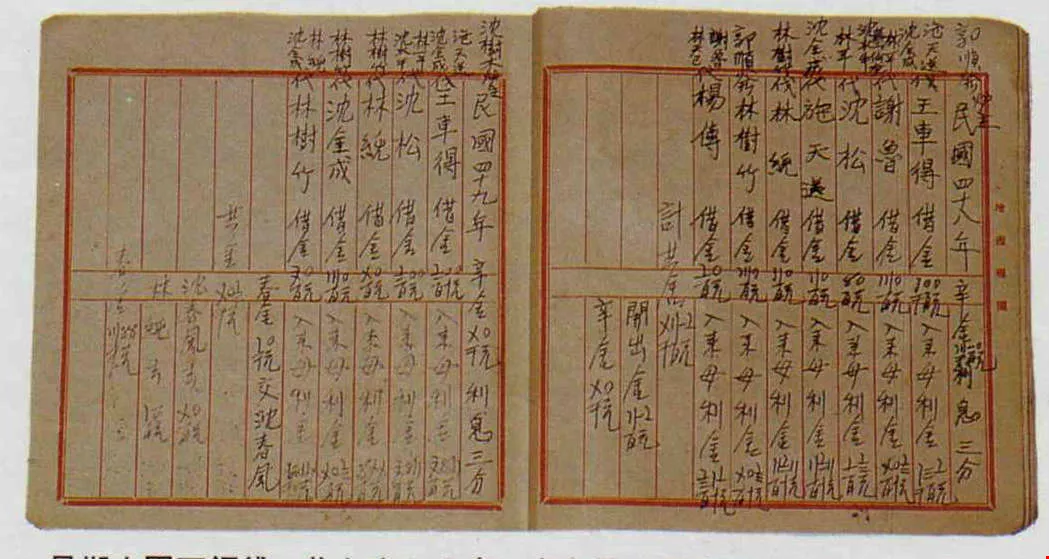
In early days the players received no money, and income was placed in a common pot that could be borrowed from in emergencies. Today, people prefer cash.


